On 9/11, it would also be good to remember what the catastrophe brought on.
Share it.
Lethal trivia: One week after, we were treated to anthraxer Bruce Ivins from the heart of the US biodefense industry. That’s him in the video and the white label pressing of his home-made country 45.
Just think about that for a minute. Bruce Ivins, a man at the very center of one of the more famous defense science installations, used 9/11 as cover to kill, sicken and spread fear in more Americans.
Fort Detrick, the place where Ivins made the anthrax, has never apologized.
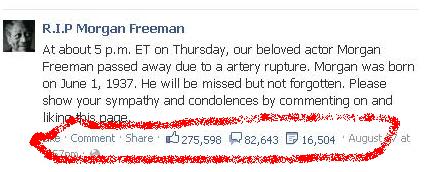
One of the great advantages of Facebook’s automatic hiding of comment threads: Celebrity death hoaxes flourish.
Think of it this way. You’re a bona fide prick and determined to show something no one else has, ever — that it’s easy to trick people on the web! And what better way to do it than to launch a hoax: Beloved actor Morgan Freeman has passed away!
Make a short obit that only sorta looks like it came from someplace concerned and authoritative, like a newspaper, with picture, and share on Facebook!
Watch an army of idiots spread it.
Don’t worry about those who show up to post coments like, “Look people, Morgan Freeman is not dead!” Facebook will quickly hide them and the only thing most will see in their newsfeeds is the announcement that the poor man croaked suddenly, along with a huge number of likes, share and comments.
And there will be lots of comments, by people vainly posting that Morgan’s not dead. Heck, Mr. Freeman could show up himself! All of it to be ignored, hidden away, because that’s how Facebook works.
The large numbers displayed will convince people there’s been an outpour of regret because ‘Mericans stupid people believe such figures on social networks mean important news and shit is brewing. It’s the wisdom of crowd-sourcing, boiled down to one or two simple and infallible metrics.
So quick, go and post your thing about Morgan Freeman, or anyone else — as long as they’re famous, dying.
Or post an obit of someone who died seven years ago, like Bob Denver, and watch the users rush to share it while Facebook hides all the attempts at rectification: “Hey people, I liked Gilligan, too, and was sad when he passed but that was …”
Or post spam, with a picture, of some poor animal that was tortured to death or mistreated somewhere in Jugoslavia or Trans Dniester …
The quote most deserving of today’s horselaugh (believe me, there’s always a lot to choose from):
“Some of today’s national cyber actors don’t seem to be bound by any sense of restraint” — Debora Plunkett, head of the NSA’s Information Assurance Directorate
[Plunkett] told a university audience that “we’re starting to see nation-state resources and expertise employed in what we would characterize as reckless and disruptive, destructive behaviors.”
Sort of like being scolded to stop smoking by someone with a lit cigarette in the mouth who’s absent-mindedly reaching for still another pack.
“U.S. standing to complain about other nations’ cyber attacks has been undermined, however, by disclosures that Washington, along with Israel, launched sophisticated offensive cyber operations of its own against Iran …” reads the piece.
ENTERTAINMENT WEEKLY: Did you watch Star Trek growing up?
RYAN GERMICK: I did, yes. I’m early 30s and I grew up watching the original series with my dad, and I kind of realized, the guys on the Enterprise were like family friends to me …
If he’s actually in his early thirties:
(31,32 or 33) – 46 = negative number in teens
I watched the original series, not reruns. I was ten when it started.
Google did not invent the world, or the vaccines for smallpox or polio, but we’re stuck with how they order it for the time being.
There is a thing Google android Ryan Germick got right, and it’s the most obvious:
[It] was a vision for the future. I think it was also that it was multicultural, pro-science, and full of curiosity and passion. I think like a lot of good science-fiction, it sort of says a lot about its present era. We can really appreciate what Star Trek did in its time. As an adult, you can appreciate how progressive it was. You learned to be compassionate towards all kinds of people — even alien creatures …
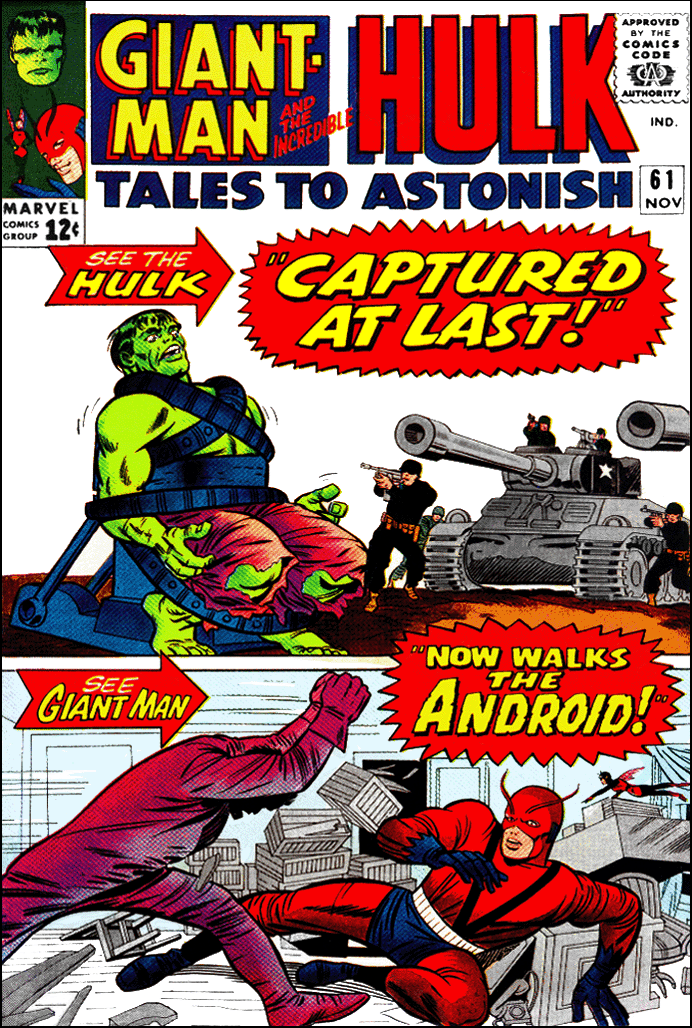
Originally, androids were instruments of villains, primarily the Leader, in Marvel Comics.
Not something made by Google, which allowed me to find this copy of the cover.
This particular Marvel Comic was published in 1964, two years before the debut of the original Star Trek.
I had a copy. Today it’s worth 59 bucks on eBay. My mom threw it out along with all my Marvels, one day when I was away in college.
Eventually, she threw out everything. She had issues.
Above photo, nabbed from standard rot on “DARPA” wanting to make cyberwar and planning for it “routine” with “X” at Wired. (No link.)
The pic, unintentionally hilarious as an inside joke, shows NSA director, Keith Alexander, in Afghanistan. Where everyone knows the Taliban is just loaded with cyberwarriors. Why, the Iranians and al Qaeda in Pakistan are probably attacking, too.
American special operations forces have suspended the training of new recruits to an Afghan village militia until the entire 16,000-member force can be rescreened for possible links to the insurgency, U.S. officials said Sunday.
The move is the latest repercussion from a series of “insider” shootings carried out by members of the Afghan police and army against Western troops. Forty-five NATO service members have been killed in such attacks this year, and the U.S. toll in August alone was 12 dead.
“[Plan X] means building tools to help warplanners assemble and launch online strikes in a hurry,” informs Wired’s DangerRoom.
“Google, and YouTube, and their competitors have made the place — a web where winner-takes-all. And there isn’t anyone else. It’s the top or nothing. Root hog or die.”
Once you establish a regular pattern of uploading videos to YouTube, the Google property attracts you with blandishments to “monetize” and “make an ad campaign for your video.” This is all said to be good for growing your audience.
I’ve dealt with monetization on Google properties previously. For the majority it’s a waste of time. You might get enough clicks to justify Google sending a check in five to ten years of activity, if you haven’t changed your address by then.
Barring old traditional media exposure, like on TV — or in a big magazine or newspaper — Google AdSense/AdWords campaigns are for Internet bottom feeders with more significant amounts of money to spend but not quite enough to get advertising into big old traditional media.
YouTube recommended I advertise “Rich Man’s Burden.”
So I set up an ad campaign of “impressions,” for it to be served as a “featured” piece advertised as a satirical funny song about the wealthy in related works, for seven days.
After two days Google/YouTube had served the impression approximately 2500 times. Over the course of the seven day campaign it was on a schedule for about 8750 impressions.
The click through to actual view of “Rich Man’s Burden” was about 2.5 percent, of which only 16 percent of hits (or about 0.3 percent of the total ad impressions served) watched it three quarters of the way through. About fifty percent of the viewers, out of a total of a little over sixty Google/YouTube alleged clicks on it, did not watch at all. That is they did not even register in the breakdown Google presents to you on the percentages which watched 25, 50, 75 or 100 percent of
the video.
This is a stat I took to mean that many people who click on impressions immediately leave before any content can be streamed, before a second or even a fraction of one elapses. (Remember, these are not even the in-line streamed ads YouTube compels you to watch before other content.)
Which tells me that the observation that, for many, clicking on Internet ads is done as a meaningless and random behavior is probably fairly accurate.
For “Rich Man’s Burden,” here, the Google/YouTube ad campaign cost 11 cents a view and was not cost effective in any way.
For very modestly boosting video views to an audience that might never be exposed to it, a presumably legitimate purpose, it was relatively expensive per hit even though such campaigns and ads are very cheap to implement. And it was a complete statistical wash for getting people to click through to the YouTube channel.
I tried to find an ad impression for “Rich Man’s Burden” while it was running using a variety of keyword searches similar to what the video ad contained and could not.
YouTube does not furnish obvious tools for this so honing an ad campaign is a matter of trial, error and effort requiring what probably amounts to a substantial waste of money and time for the average person with an account.
At two days I canceled the campaign scheduled for seven. After an initial 24 hours “views” dropped off noticeably telling me that YouTube had hit the audience it was serving — whatever it was, one could define that it be in the United States or other locales, or restricted to certain ages. Subsequently, it was just repeating with the same pool. And that at all times it was impossible to know what the demographic was, only that the ad wasn’t particularly effective. I get better numbers just putting it in a blog post here every other day of the week.
YouTube took four days to examine the ad, approve it and get things running.
As a come-on, Google/YouTube furnishes a calculator which purports to estimate how many views you will get for a certain ad buy. Mine was 750, unambitious, and certainly a very small potential target number in the YouTube/Google scheme of things. And it would have comprised a 10 to 11 percent return on the buy. It was a total fabrication.
One understands how and why Google properties can give away $75 or $100 certificates for promoting ad campaigns. These “free” sums would not be expected to return any interesting results. They are bait.
You’ll use that “free” money, get nothing or next to nothing for it, and think you did it wrong. Or that it just needs to run a second time — with a few tweaks. Or that two or three times the spend will do it. And that’s when they have you.
On Facebook ad impressions look almost the same as those on YouTube and other Google properties. I would expect them to be similar wastes of time and money for the great mean of people who buy them.
Alway remember the solid web phenomenon of people who click on ad impressions but don’t actually look at them for even a fraction of a second. While you are charged for them, it is just money blowing away in the air.
It would come as no surprise that some, or an increasing number in corporate America, view such advertising as virtually worthless. That being the case, and since they are always under peer pressure to be seen as being active and liked on the web, there is substantial incentive to cheat the system. (Which I’ll get to.)
The above, on how to buy significant views for a worthless and purposely unwatchable video, combined with this post, leads one to a conclusion about web ranking and value as based on number of views.
If you don’t read it, the subject is that two reporters bought 60,000 views on YouTube for a video of paint drying, paying about 100 dollars to black hat services that deliver numbers. YouTube’s algorithms, allegedly tuned to freeze out cheating, did not detect it.
That comes to a tenth of a penny per view for 60,000 as opposed to what I paid through a legitimate YouTube campaign before canceling it as futile, 11 cents per view, according to Google, for an insignificant number (22 cents per, if you get technical, factoring in that about 50 percent of the clicks, by the search giant’s own measurements, didn’t watch at all) — 60 or so — and virtually zero clicks on my channel.
View counts are all important on YouTube, as with “likes” and “shares” on Facebook, and — in a less direct manner through linking, in Google search. High numbers dictate opportunity with YouTube algorithms favorably positioning your video in recommended lists to others and in search returns. Low numbers mean you are regarded as disease. The few people who do see your video on search will never click on it because American web users believe only high view counts, likes, shares, Twitter followers and reviews on Amazon are indicators of quality.
The conclusion one arrives at is that you are a chump if you choose to play within the system rather than cheat and just buy clicks, back links, likes or numbers from black hat sites experienced at rigging. If you worry about people seeing where your views are coming from — all from Mongolia because that’s where a taken over network is operating — you just hide your statistics on geo-location from the public leaving only the raw view number. As many do.
Consider, Google advises webmasters and random users not to do such things, not to just sell links without ‘no follow’ attributes to other websites, because their programmers and algorithms may discover you trying to manipulate their search and swat ranking.
But you already have the equivalent of zero ranking. You cannot be punished by having your content downgraded any further than it already is. It is out of sight of the top and, therefore, out of mind.
Google, and YouTube, and their competitors have made the place — a web where winner-takes-all. And there isn’t anyone else. It’s the top or nothing. Root hog or die.
There are always those, every week, who get lucky. They may be discovered by a high traffic site that decides to send them viewers or clicks. And an audience is established, value built, in such a manner.
However, for the great majority, this is not something that can be planned for or worked toward because it is reliant on whimsy, fortune, things which cannot be programmed.
If you are not in the first page of results, or the couple of handfuls of those with the highest likes, or whatever social metric of the day is being discussed as very special, you will not exist. Search is of no economic value to you. It is of value only to the very topmost.
For example, big official corporate cheating is fairly obvious on Google. If you use Google to search for news items, Arriana Huffington’s Huffington Post is always in the top few returns. For everything.
And when you go to some Huffington Post link you find, almost without relief, that it is not the generator of the original information but the equivalent of some vapid placeholder posted by a nobody, which contains a link to and some copy from the original source, the latter always ranked below it. Even though it may be more respected. And this is well known but nothing can be done about it.
Huffington Post (like Wikipedia) is the perfect example of orderly Internet rigging.
The former has paid for that advantage through the work of programmers and web designers rather than heavy intrusive advertising or any intrinsic but hard to measure qualities obvious to human beings.
Nobody with sense could possibly believe that the Huffington Post is an oracle on all things. But it bested Google.
There are other examples. Pick them from your experience.
And so Google and its properties, and the social networks, have made a world where there is only incentive to cheat and to do so big. In fact, there is little apparent downside as the environment mostly selects against those who do not.
Now don’t you sell links to worthless places, or buy views, or employ a service with phony accounts on Facebook or Twitter to like and follow you! You’ll anger the powers that be and they’ll turn you into a toad.
Oh wait, you’re already a toad at the bottom of the virtual pit they made for you.
Nevermind, go right ahead. Do the bad stuff.
“[Buying views from black hats] comes to a tenth of a penny per view for 60,000 as opposed to what I paid through a legitimate YouTube campaign before canceling it as futile, 11 cents per view, according to Google, for an insignificant number (22 cents per, if you get technical, factoring in that about 50 percent of the clicks, by the search giant’s own measurements, didn’t watch at all) — 60 or so … “
Too rich to pass up, the press release passed off as a story, from Google News, written by “a former corporate director of public affairs for General Dynamics Corp.”
Anyway, the headline reads:
‘Revolution,’ new TV show, focuses on absence of electricity; could it be from electromagnetic pulse attack … Scenario not unimaginable if terrorists can get hands on nuclear weapons
We haven’t heard much lately about the potential effects of an electromagnetic pulse attack on our country but we’re going to hear about it soon. “Revolution,” a TV show premiering next month, will explore the question: What would happen to our society if we lost all of our electricity?
Imagine an environment in which nothing electrical works … That’s the premise of “Revolution.” Think that’s far-fetched? Think again. It is possible and we’re not prepared to deal with such an environment.
Revolution is said to be the work of Eric Kripke. He’s famous for Supernatural. But now it would be good to beat him over the head with a plank.
Electromagnetic pulse destruction, right there with vampires and zombies in scarcity. Both of which were present, off and on, in Supernatural. EMP, it’s such an ambitious stretch.
Now, don’t you really want to hit him with something? I know you do. Admit it. That would be the right thing. And just.
“The National [sic] Heritage Foundation says an EMP attack constitutes one of the greatest threats to national security,” continues the spiel. “Unfortunately few Americans have ever heard of it.”
I guess they’ll let anyone in. So what’s with all the regular crap about big corporate America not being able to find employees with the right “skills” and “intelligence”?
If you’re an overseas reader and still haven’t seen it, watch American icon Clint Eastwood.
Grandpa, hair mussed and smelling a bit of drink, his voice trembling, hemming, hawing, cursing a chair.
After six years, Mitt Romney is finally the Republican presidential nominee, but the man everyone’s talking about is Clint Eastwood — who has apparently lost his mind. — the LA Times
The disappearance of midwage, midskill jobs is part of a longer-term trend that some refer to as a hollowing out of the work force, though it has probably been accelerated by government layoffs.
“The overarching message here is we don’t just have a jobs deficit; we have a ‘good jobs’ deficit,??? said Annette Bernhardt, the report’s author and a policy co-director at the National Employment Law Project, a liberal research and advocacy group …
The occupations with the fastest growth were retail sales (at a median wage of $10.97 an hour) and food preparation workers ($9.04 an hour). Each category has grown by more than 300,000 workers since June 2009.
Some of these new, lower-paying jobs are being taken by people just entering the labor force, like recent high school and college graduates. Many, though, are being filled by older workers who lost more lucrative jobs in the recession and were forced to take something to scrape by.
The mid level job losses documented were wiped out in the economic collapse. They have not and will not come back, one professor indicates.
Remember: Stop your drinking, moochers, and hope for a lowering of the minimum wage.
Facebook co-founder Dustin Moskovitz is shedding another 450,000 company shares for a take of about $8.7 million.
Moskovitz has been selling 150,000 shares a day and disclosing the sales every three days. Including the most recent sale, he still holds more than 130 million shares.
The latest filing, made late Wednesday, covered sales from Monday to Wednesday. He sold shares at prices ranging from $19 to $19.49.
Shares of Facebook Inc., based in Menlo Park, Calif., have been in steep decline since debuting at $38 each in May …
Best unintentionally fatuous quote ever, a couple months ago, from somebody named Alexander Heffner at the blog formerly known as the Christian Science Monitor newspaper:
Mark Zuckerberg has the potential to rekindle confidence in the markets and to engage everyday Americans in the kind of economic growth that has been limited to only a handful of individuals in recent years.
Americans don’t merely admire the rich, especially the working rich; we vote for them all the time. Heck, we’d like to be them.
But Romney is a rich man whose policies often seem — to many voters, anyway — aimed at helping job creators more than job holders …
Perhaps we vote for them all the time because only the rich have the resources to run.
Yes, received wisdom about wishing to someday join the country club, too. Great stuff, something we all learned in our youth — you might get lucky, so don’t be sore, America is a class-less society.
Pre-Civil War rubbish straight from Alexis de Tocqueville.