The [House] tweak to the [defense authorization] bill would essentially neutralize two previous acts—the Smith-Mundt Act of 1948 and Foreign Relations Authorization Act in 1987—that had been passed to protect U.S. audiences from our own government’s misinformation campaigns.
The bi-partisan amendment is sponsored by Rep. Mark Thornberry from Texas and Rep. Adam Smith from Washington State.
In a little noticed press release earlier in the week — buried beneath the other high-profile issues in the $642 billion defense bill, including indefinite detention and a prohibition on gay marriage at military installations …
The bill’s supporters say the informational material used overseas to influence foreign audiences is too good to not use at home …
Does it have any chance of passing” Maybe not.
But realistically, it’s hard to get very worked up over because we already have Fox News and the Citizen’s United case. Between those two, how could any US government of Pentagon misinformation campaign aimed at domestic targets do better?
Cynical? You bet.
On the other hand, over the last decade the US has been singularly bad at winning the hearts and minds of folks abroad. Truth or misinformation? It just hasn’t mattered.
And more recently, Secrecy blog released a DoD publication discussing the efforts to shape perceptions in Iraq and Afghanistan.
I’m rescuing this from the comments section of my last Facebook post. It’s worth wider dissemination and it’s from the Los Angeles Times’ morning edition on Friday, written the preceding evening before the start of the Facebook IPO.
The answer can be found partly in the experience of people such as DeAnna Stephens of Charlotte, N.C. The 36-year-old video producer quit using Facebook in December, deciding she was frittering away too much time reading about what her friends were eating for lunch. Then she realized that she had lost touch with 900 people.
“I couldn’t believe how out of the loop I was on things in life,??? Stephens said. Tired of being the last to hear about new jobs, new boyfriends and new babies, she signed up again …
I’m sorry, you can’t follow 900 friends in your Facebook feed. Whatever this woman may have believed when the reporter talked to her, it has no basis in reality.
In fact, I find the entire idea of 900 Facebook friends utterly stupefying. But I’ve also found those numbers, as on Twitter, not uncommon.
So rather than such things being a meaningful metric concerning the power of social networking, my hunch is they’re more a measure of the human capacity for self-delusion, of the desire in people to believe stuff that’s imaginary in terms of worth because lots of others believe the same thing. In other words, the Cardiff giant thing, the worth of a delusion being determined by how big a majority cleaves to it.
At this time I’m also a bit tickled that, other than the people who vested because they held large amounts of Facebook stock prior to the IPO, most didn’t make any gain on investment yesterday despite the volume of trading.
Inescapable in our American landscape are those motivated by fear. The blog covers a lot of them and it’s depressing. One can laugh dryly at how crazy it reads — those prepper survivalists and electromagnetic pulse crazies, ha-ha — but it’s one reason, among a good number, the country has slipped into paralysis.An entire political party thinks only in terms of what it fears. And its actions are then to attack those fears, or more accurately, those who they deem behind them.
The end result has been poisonous in the extreme. The Republican Party fears and hates science. It fears and despises people not exactly like its members, so much so it appears bizarre and mentally to those not part of it. Worse, as quickly as possible it drafts law and policy to attack those believed to be enemies.
Last week, the worst example was in Kansas. I’d skipped it for days but it essentially boiled down to the state legislature crafting a law targeted at Muslims, specifically through the cracked idea that sharia law is infiltrating the US legal system. (Realistically, every week brings news like this. So you may see things equally astonishing and nasty but attacking slightly different classes of people, places and things n your news consumption.)
Previously, the blog has written on this craziness here. Readers will note the constancy of it.
A bill that would outlaw the use of foreign legal codes in Kansas courts — broadly written but particularly aimed at Islamic sharia law — is on its way to the governor.
The final Senate vote, a lopsided 33-3, came after a lengthy and at times emotional debate Friday on the last scheduled day of the session. Lawmakers said they plan to come back next week; unresolved issues include the budget, tax cuts and redistricting …
But in an impassioned speech, Sen. Chris Steineger, R-Kansas City, said the bill was obviously directed at Muslims.
He said he was originally approached about the bill in January. The original pitch wasn’t about protecting the Constitution, but that Muslims were trying to use sharia law to take over the United States and had to be stopped.
“I thought that was quite ludicrous at the time and I still do,??? he said. “This (bill) doesn’t say sharia law, but that’s how it was marketed back in January and all session long, and I have all the e-mails to prove it.???
It’s difficult to find any admiration for Republican Chris Steineger’s admission of regret. There’s a certain contingent within the GOP that knows the party has turned venomous and predatory. But they lack the spine to do anything about it because they are fearful of being purged.
To me, this is a women’s rights issue,” said Sen. Susan Wagle, R-Wichita. “They stone women to death in countries that have sharia law. They have no rights in court. Female children are treated brutally.???
Sen. Jean Schodorf, R-Wichita, said she had confirmed that criminal actions, such as stoning, are prosecuted in Kansas regardless of the offender’s religion, even without the bill.
Sen. John Vratil, R-Leawood, said he quizzed the bill’s supporters on when a Kansas court had ever based a decision on sharia law and had yet to be provided with an example.
The prime instigators who have built up an imaginary sharia law infiltration in US courts are Frank Gaffney, not coincidentally a birther and one of the chiefs of the Cult of Electromagnetic Pulse Crazy, and the people who put out the Iranium movie last year. Which, of course, made the case that Iran was a threat to the United States on par with the old Soviet Union and that it ought to be bombed immediately before US civilization was ended by its mullahs.
[The Republican Party has] “become an insurgent outlier — ideologically extreme; contemptuous of the inherited social and economic policy regime; scornful of compromise; unpersuaded by conventional understanding of facts, evidence and science; and dismissive of the legitimacy of its political opposition.???
One cannot fix a problem one will not face. And the new cultishness of the Republican Party is certainly a problem … — opinion piece, the Miami Herald
I coined the name Cult of Electromagnetic Pulse Crazy to describe these same manipulative paranoid nutcases years ago. While they do not have their fingers directly on the buttons of power in DC because of the presidency of Obama, they assiduously work the sidelines in other related areas — like attempting to institute Islam-o-phobe laws against an imagined sharia menace in the heartland.
And they have been successful.
“A bill that would ban Sharia law in Kansas has passed both houses of the legislature and awaits the signature of the governor,” reads a news report from yesterday.
“While the rest of us are busy worrying about the economy, partisan gridlock in Washington or maybe even the Facebook IPO, the Kansas legislature has been busy fighting off a perceived ‘threat’ from shariah law,” said Simon Brown of Americans United for Separation of Church and State. “[Governor Sam Brownback] hasn’t said what he will do with the anti-shariah bill, but stoning it would seem an appropriate response.”
An anti-sharia law from the heartland listing — from Google.
Following bad advice and the crowd I created an account on Facebook.
I’m not a good match for it and when the company began rolling out its new TimeLine format I thought a bit and decided not to cooperate.
TimeLine is built on the idea that you actually want to have one — a serial accounting of your posts, who you ‘friended,” and everything else you chose to “share.” And it wants it all in a gated community, immune to search, the exact opposite of this domain and everything I’ve put into cyberspace for the last twenty years.
So to make TimeLine useless, as far as my account and anyone viewing it is concerned, new material is deleted every couple days, sometimes sooner.
This had made a profile in which there are serial posts up until TimeLine was announced. And then an increasing gap, punctuated by a couple music videos I want to remain on one page of scroll, and whatever I have posted to Facebook in the last couple days.
By doing this your Facebook existence is mapped only in the present, or whatever slice of it you wish to present. All status changes and activities are immediately hidden. And if you wanted to see something posted last week, if it wasn’t one of my YouTube things, you can’t. You have to come here. Period. And if you don’t know how to do that because your primary cyberspace experience is Facebook, you won’t be able to do it. Which is fine with me.
There are some advantages to this, foremost — if you pursue it — being that you don’t have to worry about something from your past annoying someone you’d rather not stir up. Once in the habit, it automatically cleans up embarrassments or those things that don’t age well.
And face it, much of anyone’s day to day life is ephemeral. It doesn’t need preserving for the benefit of Facebook’s corporate clients.
The very idea of any value existing in a years long TimeLines of hundreds of thousands of Facebook captioned picture spammers masquerading as human beings should be enough to reduce you to tetany.
Mark Zuckerberg’s motto is to help make the world more connected and open. For 99.8 percent of all people that’s rubbish. They don’t need to become more open or connected. The human condition is not elevated by Facebook. There is no magical transmutation from lead into gold. There is no benefit to ‘liking” American businesses so Facebook can show you and those in your friends list what crap you buy and what movies you may have seen. You will not be handed career opportunities because you had a Facebook wall on which you came off as “passionate” in your interests. Corporate America is not combing Facebook to find new talent to hire, new opportunities to extend. And it’s not taking note of your ardent brown-nosing when you comment on a business’s or magazine’s wall posts.
On the other hand a nice Facebook page can ruin your life quite easily.
Take ex-Marine Gary Stein, who got the equivalent of a bad conduct discharge for a common sin — being a churl in public about the President. Unless he has a million dollar book deal in the offing, his Facebook page in trade now probably seems like a very bad deal. (Paradoxically, using my approach to Facebook, Gary Stein might have disappeared the content that got him booted before superiors saw it. But then all those anonymous armed forces Tea Party ninnies who flocked to his page to egg him on might not have thought it so great.)
General Motors figured all this out, or at least some of it. The company came to the conclusion there was no benefit to Facebook advertising.
My take has always been that, primarily, only morons click on Google AdSense links, and by extension, Facebook advertising. Those who do click may be doing so only out of curiosity, often to see just how awful whatever’s being shilled actually is.
And what benefit could any of that be to a big company like GM which puts things on network television everyday?
Once the dust has cleared on the IPO. Facebook’s market value will, absurdly, probably be higher than GM’s. GM employs hundreds of thousands of people worldwide. Facebook employs something over three thousand.
If you had any self-respect and intelligence and you were a manager at General Motors, you wouldn’t want to have anything to do with the cult of Facebook.
Yesterday, while house-sitting for a friend, I read the LA Times’ frontpage piece on lavish spending in the Bay Area as run up to Facebook’s IPO.
There’s Uber, which provides young tech titans with on-demand limousine service at the touch of a smartphone app. Exec provides freelance go-fers to fetch dry cleaning and run other errands.
Then there’s Lux Delux, a start-up run by Andy Hsieh, brother of Tony Hsieh, founder of online shoe retailer Zappos. The invitation-only travel service books getaways to Las Vegas, providing VIP perks such as tables at the hottest restaurants, rock-star access at shows and penthouse suites at hip hotels.
Snooki and the Situation would do well to watch their well-tanned backs. “Silicon Valley,” a new reality show planned for the Bravo network, is gunning for “Jersey Shore.” Its executive producer is Randi Zuckerberg, Mark Zuckerberg’s sister.
“We’re the best thing happening in America,” said one tech entrepreneur, who asked to remain anonymous so he could speak candidly. Celebrities “might be more famous, but this is where the true value is being created.”
Today’s most hilarious line comes courtesy of some nerd named Alexander Heffner t the Christian Science Monitor blog, the publication that used to actually be a real newspaper (no link):
Mark Zuckerberg has the potential to rekindle confidence in the markets and to engage everyday Americans in the kind of economic growth that has been limited to only a handful of individuals in recent years.
Kinda like the confidence inspiring Facebook co-founder who renounced his citizenship to get out from under US taxation.
Heffner apparently also believes Facebook has freed Syria and that it’s solved the problem of scarcity in organ donation, all in a couple weeks.
What’s next for Zuckerberg? Perhaps he’ll make the lame see, the blind talk.
An old Pennsy Dutch folk song would seem apt here.
One of my friends is always sending me links for lectures posted at TED. I always delete them and send a retort meant to discourage the sending of more in the future. It bums him out that I’m this way.
The reason TED stuff is virtually worthless: It’s for semi-bright nerds and other simple-minded and easily led folk who actually believe its a web engine for the portrayal of genius and innovation. If you subscribe to Wired, you probably think it’s neat.
TED is for tech industry groupies, part of the culture of lickspittle. And today it’s in the news in a small way for spiking a talk on the US economy, one in which a TED lecturer — a venture capitalist you’ve never heard of named Nick Hanauer — argued that the wealthy aren’t job creators.
Paul Krugman has made the same point, much more successfully and to a much wider audience on the pages of the New York Times for the past few years. And I don’t believe he’s ever needed TED to get the word out.
It’s not a hard point to make because all the data is in.
So the only bit one needs to see is a slide, its information now published in many different ways by different people around the web, on the tax rates for the wealthy versus employment in this country.
It destroys any argument that cutting taxes on the wealthy leads to more jobs for everyone else. In fact, just the opposite. There’s no more trickle-down than there is a tooth fairy. (But at least your parents put some coin under the pillow.)
Radically cutting taxes on the top over the long-term destroyed much of the economy for the middle class. Unemployment surged. It’s ugly.
Since these facts are anathema to all arguments about the economy put forward by the Republican Party, such information is often thought political.
So if you always thought TED was high-button excrement but couldn’t quite put your finger on what was shite about it, today’s news is an example. TED can’t deal with facts that might annoy its audience of libertarian tech shoeshine boys and girls.
See, when you make money on the clicks and data-mining of US Facebook users who do pay taxes, you take that swag to Singapore, the famous wart-on-the-tip-of-Malaya that masquerades as an important country, to cheat Uncle Sam. From the wires, the likely story, filed under ‘P’ for ‘Parasites:’
Eduardo Saverin, the Facebook co-founder who gave up his U.S. citizenship, has nothing against the U.S., just its complicated rules on U.S. citizens holding money overseas, a spokesman said.
Mr. Saverin, who now lives in Singapore, decided last year to renounce his U.S. citizenship, a decision that was made public a few days ago. The move sparked an outcry among some tax experts who suspect he’s aiming to save on taxes. Although Mr. Saverin will have to pay a hefty exit tax for renouncing his citizenship, based on some calculation of his assets, Singapore is a relatively low-tax jurisdiction, particularly for foreign investors, and does not levy capital gains tax.
Sing along: ‘Gonna go to Grand Cayman, if he don’t get it back …’ And that’s famous Jamie Dimon, Aemrica’s most well-known financial crook, at 42 seconds in.
None of the little legal money-laundering countries have militaries worth shit. US Special Operations and an airborne brigade could knock them over in an afternoon.
Since their business is increasingly to deprive the US government of legitimate revenue, money which could be employed to repair US infrastructure, retain jobs at the local level, and — in general — provide the necessary services of good civilization to Americans, they can be viewed as threats to security.
Wouldn’t it be nice to see a clever short story about a US military assault on the banking districts of Luxembourg, Singapore or Grand Cayman?
It used to be the other way around. Movie scripts could be written about a small nothing country, like the Duchy of Grand Fenwick, declaring war on the US so as to lose and get American reconstruction dollars.
“There isn’t a more profitable undertaking of any country than to declare war on the United States and to be defeated … No sooner is the aggressor defeated than the Americans pour in food, machinery, technical aid and lots and lots of money …” — trailer from The Mouse That Roared
Time for a rewrite of that script.
Now wars are the revenue stream of American arms manufacturing and national security businesses.
So it’s just plain easier to offer personal services which enable wealthy Americans and businesses to be tax cheats for a percentage of the action.
Wouldn’t you like to see a movie of Singapore or Luxembourg banks and financial server farms knocked over by American troopers? Hilarious.
Imagine living on a serene, man-made floating city where you can live and work with other like-minded individuals from all over the globe, without direct influence from any government entity. If Paypal co-founder Peter Thiel has his way, that wild idea may be just a few years away. The wealthy venture capitalist is putting his money behind Blueseed, a company that promises to create an offshore luxury barge where young entrepreneurs can work, live, and socialize, all without the constraints of a modern city — or pesky immigration laws.
This perhaps because the starship needed to leave the planet seems just a bit out of reach. Even claiming an asteroid or a piece of the moon seems logistically impossible.
In the culture of lickspittle people with super-rmoney always attract sappy cult folllowings. Money can’t buy you love but it goes pretty far with whores and boot-licks.
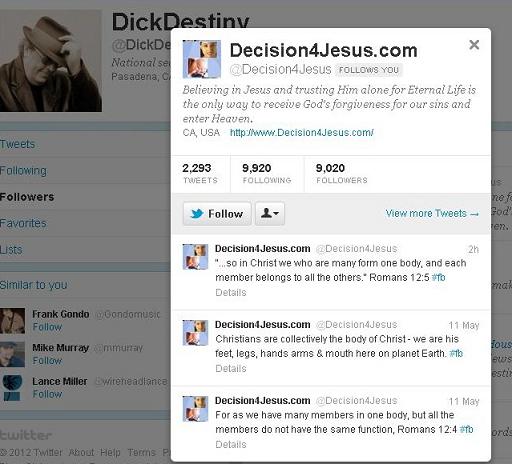
Someone who scans only for keywords and proper names on Twitter, now following me because they mistakenly believe I’m on the same page, spiritually. Not the first time, either, just one of the more unintentionally funny.
Which makes me also ask the question, “How do you follow 9k twits?”
Social media big numbers, all about pecker-length measuring metrics, useful to celebrities who don’t need it and use Twitter as a micro-mailing list for those who believe anything in excess of 140 characters is “TL — DNR.”
See Nick Kristof. Still trying to get the whores and pimps off the Village Voice’s BackPage property after a social media petition site (an American fad some like to pretend has more power than the NYT or Jamie Oliver’s TV job on pink slime) wasn’t quite enough. 1.2 mil followers! He could win any social media talent contest he entered on the net and not even have to hum one tune for an MP3.
Anyway, back to my follower, the emitter of the sayings of Jesus.
Even the joke book cover was “TL — DNR,” apparently.
“Shun the word ‘gay’ for it despoils the Sacraments of Holy Matrimony and is a mortal sin.” — Page 9.
When also can’t rule out the person thought it was actually real and approved, only showing, again, you just can never accurately underestimate the minds of people you don’t know.
Keywords: Jesus of America, American Jesus, social media buffoons
Dave Hurban, a tattoo artist from Newfield, N.J., surgically implanted four magnets into his wrist. Why? Basically, it’s a cool (or at least unique) way to hold his iPod Nano in place without a pesky wristband.
You can check out the video of the process below. But be warned—there will be blood.
I passed. But the meat blob Cult of iJunk didn’t.
Visually, still not as striking as sticking iKit in your mouth.
The ‘Evil Genius’ behind Al Qaeda’s underwear bombs
“With the death of Osama bin Laden, Asiri is a key reason that US officials consider Yemen’s Al Qaeda in the Arabian Peninsula, to be one of the most significant threats to the American homeland,” reads the piece. “He is highly determined and fully committed to attack America,” it continues.
“They have a team of engineers, scientists and doctors. It’s a little spooky,” said Rep. Mike McCaul, R-Texas, a member of the Homeland Security Committee who was briefed this week on the intelligence operation that U.S. officials say thwarted an AQAP plot to bomb a U.S.-bound airliner. “In my view, it’s very likely they have produced more of these.”
One hint at the expansion of AQAP’s bomb-making capabilities can be found in passages in an article entitled “Wining on the Ground,” found on the 57th page of the latest 59-page edition of Inspire, released by AQAP last weekend.
In 2009, AQAP had only a “very modest and small laboratory in a rural area” to make bombs, the author of the article –identified as Yahya Ibrahim — wrote.
But now, after obtaining “a large deal of chemicals from military laboratories” in a key city in southern Yemen — “the modest lab has transformed into a modern one,” the Inspire article stated.
It’s almost beautiful how the story is twisted from one of failure into pieces which try to cast the impression al Qaeda men are cranking out underwear bombs at some modern facility in Yemen.
From two failed attempts, a failed printer cartridge bomb plot, and infiltration by a spy who turns over the latest goods to the US, to an “Evil Genius,” a bomb factory of perhaps great capacity, and a most dire threat to the US “homeland.” The refashioning of the story is eye-watering in audacity.
By this time next week it will be in the rear view mirror as an al Qaeda victory.
In fact, at the time, I felt the Newsweek journalists knew they were twisting the story. They did so because the truth didn’t fit the official narrative of the war on terror as published in this country.
Jamie Dimon, the chief executive of JPMorgan, blamed “errors, sloppiness and bad judgment” for the loss, which stemmed from a hedging strategy that backfired.
The trading in that hedge roiled markets a month ago, when rumors started circulating of a JPMorgan trader in London whose bets were so big that he was nicknamed “the London Whale” and “Voldemort,” after the Harry Potter villain.
“Voldemort” or the “Evil Genius” of underwear bombs — who’s the threat?
Some national security leaders argue, in turn, that there have been times in U.S. history when the country has to make security investments whether they make business sense or not. The need to prepare for a massive cyberattack, they say, is such an occasion.
Larry Clinton’s response: Then the government should pick up the check.
“If the government was interested in paying the private sector to do all these things, probably we would go a long way toward doing it,” he says. “But the government so far, [with] the Lieberman-Collins bill, wants it all done for free. They want the businesses to simply plow that into their profit and loss statement, and the numbers are staggering. You simply can’t do it.”
First, it’s necessary to understand Larry Clinton is a spokesman for a trade group of big weapons manufacturers and Pentagon contracting businesses (Boeing, Lockheed Martin, Raytheon, Science Applications International Corporation) with cyber-defense arms called the Internet Security Alliance.
The Internet Security Alliance knows that if American corporate business which holds the telecommunications, energy, banking and transportation infrastructure is asked to pay for strengthening cyber-defenses they’ll simply decline to spend at the level US arms manufacturers would like to see. If they spend any more than usual, at all.
Therefore, the ISA is very interested in having the government pay for everything, as it more strongly guarantees revenue streams.
Think of it like the business model adopted by the banksters. Risk is shoved off. The government picks up the entire tab and the defense industry profits.
It’s very easy to be supercilious with the Internet Security Alliance.
ISA advocates a modernized social contract between industry and government …
Developing a 21 century policy platform for government to work productively with industry through a “Social Contract …
To understand what the ISA means, substitute the phrase “rent-seeking” for “Social Contract,” which the business group misuses horribly.
Generally, the “social contract” has been used to mean humans ought to live in a civil society, one in which government imposed order and protected the weak and the average from the predatory, who if allowed to prevail would, as Thomas Hobbes described famously, make life “solitary, poor, nasty, brutish, and short.”
The “social contract” doesn’t say anything about the government guaranteeing the business of corporate computer security and arms manufacturers because without them, our life might be “solitary, poor, nasty, brutish and short” because of cyberwar.
What the Internet Security Alliance wants, like much of what big corporate America advocates for, is “rent.”
The expenditure of resources in order to bring about an uncompensated transfer of goods or services from another person or persons to one’s self as the result of a “favorable??? decision on some public policy. The term seems to have been coined (or at least popularized in contemporary political economy) by the economist Gordon Tullock. Examples of rent-seeking behavior would include all of the various ways by which individuals or groups lobby government for taxing, spending and regulatory policies that confer financial benefits or other special advantages upon them at the expense of the taxpayers or of consumers or of other groups or individuals with which the beneficiaries may be in economic competition.
That the ISA would actually pay corporate mouthpieces to write such self-serving shite about a so-called non-existent “Social Contact” tells you everything you need to know about the group.