Woe, the rich man’s burden to pay too much tax. Gonna leave to Grand Cayman unless he gets it back. Woe, the rich man’s burden to carry all the poor. An endless trail of sorrow he cannot tread no more.
The poor don’t pay enuff. They spend it all on liquor! If we stopped it all right now we’d get rich a whole lot quicker.
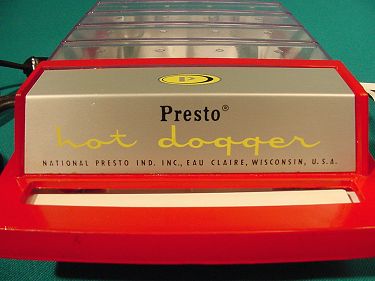
The last post on ‘Old pink meat product‘ produced a comments section identifying the electrocuting hot dog cooker as the Presto Hot Dogger. YouTube had a few home videos devoted to the Presto as retro cooking equipment. Unbreakable and manufactured, originally, as early as the Fifties in Eau Claire, WI, here’s one amusing video.
With a touch of extra amusement provided by the Carolina Chocolate Drops singing “Short Life of Trouble.”
I used the Hot Dogger in the late Eighties and early Nineties. It was a thing that, fundamentally, always worked. Unlike the current service-centered economy, as you know if you have standard Internet connectivity through AT&T, or have recently dumped cable because having no tv other than DVD replay is actually better.
Presto made home appliances. And you know what happened. It was all moved to China.
Here’s a piece from the BBC on US manufacturing, from 2002:
Maryjo Cohen is shutting two factories.
Cheap, high quality goods from China have eaten away profit margins at National Presto industries, a Wisconsin-based firm which makes pressure cookers and electric frying pans.
“That’s going on all over the US, our entire industry has moved to China,” says Ms Cohen, National Presto’s president.
She is reluctant to say how many jobs will go at National Presto’s plants in New Mexico and Mississippi but it will be a “substantial number for a company our size” – at least half the workforce.
National Presto has an agent in Hong Kong who subcontracts work to plants in China’s neighbouring Guangdong province.
How did National Presto diversify and expand after outsourcing its small cooking appliance manufacturing? You read this blog, you already have a hunch.
Once again, a perfect example of national decline.
National Presto went into arms manufacturing, the only protected business and preserved-at-all-costs labor in the United States.
The company makes over 600 million a year in ammo and ordnance production through a subsidiary.
National Presto Industries Inc. said Monday its ammunition products unit has received an $81 million defense contract option from the U.S. Army.
The Eau Claire-based company said AMTEC Corp., a wholly owned subsidiary, received the option award under AMTEC’s five-year contract to produce 40 mm systems for the Army. It is the first award AMTEC has received during the government’s 2012 fiscal year, which ends in September, and additional awards are anticipated, the company said.
The option award brings the cumulative amount awarded under an ongoing 40 mm contract to $364.7 million, the company said.
A business profile at Seeking Alpha comments, “National Presto Industries (NPK) is an oddly diversified producer of military arms, adult diapers, and small cooking appliances with a market capitalization of well under $1 billion.”
Up until a few years ago the received wisdom, also delivered by economists, was that it was fine to deindustrialize and ship most domestic non-military manufacturing to China and other periperal nations with cheap labor markets.
You didn’t have to make things in America anymore. You could be good at other stuff — like financial products and software programming.
Add arms manufacturing.
Life ain’t fair. But even the bromide, the preservation of arms manufacturing and the consequent decade of continuous war has been profoundly unfair to the 99 percent in this country.
If arms manufacturing had been exposed to the same pressure as all other forms of domestic manufacturing, we wouldn’t have war.
A black comedy could be written around a script in which a national leader decides to enact policies that would mandate absolute lowest bid contracts on arms manufacturing to a global marketplace. Yes, I know it could never happen.
But a story revolving around the fear, loathing and comeuppance in the military defense industry complex upon dislocation into the Chinese manufacturing sector is enjoyable to consider. I’d buy that novel. I’d anticipate it being optioned to Hollywood. I’d be first in line for the the movie adaptation, too.
I’d love the parts where the dispirited newly fired workers of Northrop Grumman and Lockheed Martin were taught how to apply for food stamps at severance meetings. And, how, with a lot of extra free time on their hands they fruitlessly strived to make a go of things by fashioning their own personal brands, uploading homemade white rap and comedy videos to YouTube. Or making small business website pages advertising new artisan coffee or dog walking businesses. Logging on to Zaarly everyday to find new opportunities as personal assistants or gofers for the more fortunate, locally.
Going back to school to learn how to be a chef at the Cordon Bleu school; taking two or three janitorial positions, any job that couldn’t be sent to hired hands overseas. Wait staff, not so favorable an outlook, because of something else, made by another in the army of pitiless trivial douchebags from the creative economic destruction industry, coincidentally called the Presto.
There would be growth in the cyberdefense subsidiary businesses of the big arms companies because, paradoxically, while all the manufacturing had been shipped to China, Chinese state-supported hackers were still penetrating US networks. However, growth would slow as even the Chinese began to realize there was little left to steal in the way of so-called intellectual property. And getting into the power grid just wasn’t important when you had that country’s
production completely by the balls.
Yes, there should be equalization and fair dinkum payback! And no, it won’t happen but that doesn’t mean you can’t savor the idea. China is getting into the aircraft carrier business, I hear. And certainly it has a military space program.
Think of all the money that could be saved on ammo and bombs.
If the Chinese can make electric guitars for Fender and Gibson, and all the digital underpinnings that go into the modern consumer electronics music industry, surely it can produce Joint Direct Attack Munitions and Predator drones through licensing agreements.
Shock! Horror!
It’s nice to dream about it all being gone. Like the Presto Hot Dogger.
My lunch, revolting to some. Two hot dogs — actually cheaper turkey franks — and one for late in the afternoon. Since I’ve been doing the slime thing I wanted to let readers know: Of course I’m a hypocrite on meat. You have to be in this country.
I’m 90 percent sure turkey franks are made in a way similar to pink slime, from the worst cuts of the bird, stuff that used to be thrown away. Then sanitized, perhaps with ammonia, to kill all the salmonella and listeria.
And while I’ve been known to eat a raw hot dog in a pinch, mostly I boil them thoroughly. Once I even had something called a “Hot Dogger” that cooked by electrocution, making the hot dog part of a completed circuit you ran off the wall. (Did you ever have something like it? I would like to know.)
However, I’m also completely encouraged by the idea that one day, maybe soon, someone like Jamie Oliver will do a number on this, too, just the way pink slime was treated.
It will be a good thing because it’s the television coverage, complete with producer’s eye for unforced footage of mothers and kids going “Yuck!” and shrinking back in revulsion that galvanized consumer choice.
And if something is tossed off the market and more people keep thinking about the US agri-meat system, one in which toxic microbial growth is guaranteed, that’s very good.
As posted yesterday, the meat industry produces incomprehensible amounts of manure. The shit not only contaminates the cows on the outside when they stand in it, but also on the inside, when they are fed from grains cultivated in fields fertilized or tainted by runoff from it.
While bad practice, maybe — and it’s a small maybe — this wouldn’t have mattered so much but for one thing, toxic E. coli. It was not native to the cow intestine but now finds a home there and the way the meat industry does things is responsible. That’s the science of it.
It came about because the mass of excrement in proximity to the animal and meat processing makes for an excellent mixing process. And it cannot be ameliorated, therefore Rube Goldberg sanitation processing of the meat has become a feasible profit source.
So the technologies invented to cope with it are all band-aids, lousy inventions and jerry-bilt methods to diminish the numbers of dangerous microbes in the product — after the fact.
That’s the long and short of it.
From a security standpoint a bioterrorist can’t do as effective job as centrally placed business malfeasance in the food industry. It’s a topic the blog has discussed in the past when mentioning mass food poisonings caused by widespread bacterial contaminations in the last ten years.
Invariably, we have made and allowed an infrastructure in food processing which allows for casualties, presently factored out as an acceptable minor cost of doing business if the human losses are not too bad. If the profit margin is great enough a certain level of collateral damage in the way of foodborne illness and resulting fines are acceptable.
De facto, that makes the businessmen and companies fingered in food poisoning outbreaks better incidental bioterrorists than anyone purposeful.
For instance, in a multi-mail from the DailyKos last week:
Here’s the story. The United States Department of Agriculture (USDA) currently inspects all chicken and turkey carcasses for things like bruises, bile and feces before they are sent to further processing. However, the UDSA [sic] is now considering a pilot program that would eliminate that inspection and allow poultry processing plants to do whatever they want.
From now until April 26, the USDA is holding a public comment period on whether to go forward with this pilot program. During this comment period, we plan to submit tens of thousands of comments in opposition. Already, over 40,000 members of the Daily Kos community have signed our petition to the USDA …
I’m not a big believer in on-line petitions.
It wasn’t social networking that knee-capped the makers of pink slime. It was television, specifically Jamie Oliver and 60 Minutes, and well-placed articles in the New York Times.
It wasn’t enough for Steve Jobs to creatively destroy the major label recording industry with iKit and funnel a portion of all the profits in pop music through Apple.
He imposed the same model on book publishing and, yesterday, the news of the US government pushing back at Apple for it was everywhere.
Completely blown off the wrestling mat in operating system software and networking by Bill Gates, Steve was saved, now to the regret of many. It was his special genius to create coveted consumer goods that made Apple the collecting funnel for big money from artistic and literary talent.
Even though it invests in no infrastructure — like artists & repertoire, agents or development for acquiring, growing and nurturing the talent its shiny hardware and software baubles guarantees it gets pie from.
Eventually even the Beatles were compelled to tithe to Apple and Steve.
The Justice Department’s complaint quoted Steve Jobs telling publishing executives how Apple’s iPad strategy would work.
“We’ll go to [an] agency model, where you set the price, and we get our 30 percent, and yes, the customer pays a little more, but that’s what you want anyway,” Jobs said, according to the complaint.
A group of chief executive officers of the publishers mapped out their collective actions during quarterly meetings “in private dining rooms of upscale Manhattan restaurants,” including at The Chef’s Wine Cellar at Picholine, according to the complaint, which also cites phone calls and e-mails.
[Apple] struck a “most-favored-nation??? deal with the publishers that effectively prevented them from selling their product for less through other retails outlets like Amazon and Barnes & Noble. Newly emboldened by the launch of the iPad, the publishers gave Amazon a stark choice: adopt the agency model, with higher prices, or lose the ability to sell new e-book bestsellers. Amazon initially balked, but quickly capitulated, publicly announcing that it had no choice but to accept the agency model.
Apple will fight. Maybe the company will even win.
And you may not like this song but the shoe fits. Apple technology is all about instant self-gratification for assholes at the expense of those who provide the broadcast material for its iKit.
Pop music has always been dispensable. Increasingly, books are, too. There’s paradoxical irony in the iKit of Steve becoming the only part in the pipe to the consumer that inspires customer loyalty.
Everyone knows that frequently the press is your enemy.
In the desperate quest for eyeballs on the web its writers develop idiotic essays, wrap them up in pseudo-authority, and publish because they know it will get under a lot of skin.
So it was a recent blog entry at the WaPost’s WonkBlog, where Barry Plumer, an expert on zip, mused that divestiture of pink slime comes at a cost.
Of course, Plumer had no way of knowing such things or even making an educated guess.
[A] ban on pink slime could, potentially, require the slaughter of another 1.5 million cows to maintain current levels of beef consumption. And, because cows are a major source of heat-trapping methane (all that burping), that could have a serious climate impact.
How much impact? We can do a rough calculation. The average cow emits the equivalent of about four tons of carbon dioxide per year. To put that in perspective, the average automobile emits about five tons per year. So, in the worst case, a total ban on pink slime would be like adding 1.2 million cars to the road, from a global-warming perspective.
The fact of the matter is Plumer can’t do a rough calculation of such a complex affair as the beef industry, absolute contribution to global warming, methane produced by cows, energy expended in all facets of meat agribusiness, and on and on. And certainly not in two paragraphs.
However, the object of the exercise was to get a lot of readers and, in this, it was successful. The Google News tab had it as a most-cited selection.
Worse, Brad Plumer — the Post journalist turned pseudo-scientist for ten minutes, inspires Kevin Drum, blogger at Mother Jones to out pseudo the pseudo-scientist for another five minute calculation:
Brad Plumer brings us news that maybe it was all a big mistake. After all, the pink slime processors recover an extra ten pounds of edible beef from each cow, which means we need fewer cows to feed us all. And fewer cows means less global warming …
I am now going to embarrass myself by playing amateur economist. What follows might be totally off base, so real economists are welcome to scoff and tell me what I’ve done wrong.
Here goes: According to [a] paper, the price elasticity of beef is -0.61. So a 1% increase in the price of beef produces a .61% decrease in the demand for beef.
According to this report, pink slime reduces the price of ground beef by about 3 cents per pound. Roughly speaking, that’s a decrease of 1%.
An average cow produces about 500 pounds of edible meat.
Harvesting pink slime increases that by about 10-12 pounds or so. Let’s call it 11 pounds.
Total beef consumption in the U.S. amounts to about 34 million cows per year, or 17 billion pounds of beef.
So here’s what we get:
Banning pink slime raises the price of beef 1% and therefore reduces demand by .61%.
In my experience, a lot of scientists would no more bother to explain to journalists why they’re wrong than they would spend time talking to a plate of singing maggots. Sometimes the world is worse off for it.
But, in this case, it’s unproductive to explain to the fool why he hasn’t come up with a great equation of truth in a couple minutes.
How much greenhouse gas emission is curtailed if all the plants that produce pink slime 24 hours a day go off-line permanently?
I have no idea. However, they produced a lot of material and Beef Products has already been forced to stop production at a number of them.
“Canadians needn’t worry – nothing has slimed its way across the border, nor will it, because Health Canada bans the importation and sale of meat products treated with ammonia,” reads an editorial from a big Canadian newspaper
If one uses the elementary reasoning of the tallywhackers, one might have to entertain the idea that Canada is contributing more to global warming than it ought because it doesn”t maximize use of the cow through pink slime processing. Why not get more for less? What’s wrong with them?
How much global warming would be added or subtracted if the US didn’t have a mass animal meat food processing system producing such mountains of excrement that potential disease mitigation through unusually tortured band-aid technology like pink slime production becomes a profit-source?
The next day Plumer acknowledged his reasoning had inspired some
disagreeable mail. (I sent him a comment.)
“Spraying beef trimmings with ammonia gas was an ingenious way to suppress [the] E. coli outburst,” he writes, oddly. Outburst is not really a word one might use to describe the amount of microbial life that generally comes in excrement. Animals needs their intestinal flora.
But toxic E. coli in cows is now perpetuated because of the use of manure on feedstocks consumed by the animals. As life does, it has found a niche even as a stranger in the environment.
Not ingenious is coming up the equivalent of stop-gap security patches for the problem, like pink slime, an E. coli vaccine for cows, or different antibiotics to stuff into the animals.
Plumer doesn’t really show that he understood much, if any, of this while concocting his columns.
“But phasing out pink slime won’t get rid of the underlying bacterial factories,” he continues. Finally, some truth.
Here’s an earlier post on whether a ban on “lean, finely textured beef??? would be bad for greenhouse-gas emissions — if it meant that more cows would need to be raised and slaughtered as a result. A lot of readers took that post as a defense of pink slime, though it was more a way of illustrating how meat-consumption habits contribute to climate change …
But there are many ways to do that, none involving making up stories about how pink slime production maybe reduced greenhouse gas. However, such stories wouldn’t have stuck out so well in the crowd.
Everyday, someone somewhere spreads rubbish in an effort to get you to think the reality in the robot novels and short stories of Isaac Asimov are just years away.
Often they come from the military. Along with the military robot research stories come emphases that projects are all for good Samaritan work — like wanting fire-fighters, this rather odd at a time when state governments have fired workers that do these essential jobs. Due to economic collapse.
From MSNBC:
Uncle Sam wants you to make a military robot capable of walking on two legs, handling power tools and even driving vehicles. Luckily, the U.S. military’s new robotics challenge aims to save lives rather than hunt down human warriors …
[Yeah, luckily.]
The $2 million challenge by the U.S. Defense Advanced Research Projects Agency appeared in an official online solicitation Tuesday. DARPA wants a humanoid robot to replace humans doing dangerous work in the aftermath of terrorist attacks, industrial accidents or natural disasters … the U.S. Navy already has plans to build its own robotic firefighter capable of doing humanoid tasks such as climbing ladders and throwing extinguisher grenades.
The Government anticipated receiving approximately $11.5M of FY04-07 funds for this program. The Government expected TO 1 costs would not exceed $500K, TO 2 costs would not exceed $3M, and TO 3 would not exceed $8M. It was anticipated that an IDIQ contract would be awarded with a maximum ceiling of $20M since it was impossible to accurately estimate all requirements during the five year period of performance. This funding profile was an estimate only and is not a promise of funding, as all funding is subject to changes/availability and Government discretion. It was desired that contract expenditures be managed and billed so as to maximize FY05 expenditure of FY04 and FY05 funding.
It weighs as much as the bell in Big Ben; it’s capable of plunging through 60 feet of reinforced concrete and has the most ridiculously sexual name imaginable for a deadly weapon – but the Massive Ordnance Penetrator is THE bomb, says the Pentagon.
Talk of beefing the bomb up with a hardened case and further advancements has been ongoing since the Air Force took delivery of it in September 2011. But Bloomberg reported that, in response to “an urgent request??? from the Pentagon, immediate approval was given to shift $81.6 million to the so-called MOP program.
The urgency is not explained – but it can be speculated that the Pentagon does not want to mop up a potential mess if (or when) it goes to war with Iran. So they’re putting a rush on something that can easily destroy things like underground labs, or secret nuclear facilities.
Two million puts life-saving clean-up after terrorist attack robots as posh hobby/corporate welfare money for relatively small business and/or vanity projects.
Catering to the American love of technology expressed as mountains of computer servers, wires and really big numbers, this CNN story on how Watson — the IBM supercomputer celebrity — could be a game-changer in cancer diagnosis.
In the case of my deceased friend, no number of suggested diagnoses, arranged in a prioritized list, would have made a difference. And so that would be with many, many cancers, often discovered too late to cure. Unfortunately, that’s frequently the nature of it.
The partnership here is between Sloan-Kettering cancer hospital in New York and IBM. The hospital will turn over all its cancer case histories to Watson’s brain.
One of those will be my father’s. He was diagnosed early. It didn’t save him although he lasted five years through a succession of agonizingly difficult treatments. He did not actually die at Sloan-Kettering.
His last trip involved a suggestion that he undergo a round of chemotherapy but that the prospects were not good. He left the hospital for a quack cure in the Bahamas and died a few weeks later.
Today I wonder what’s in his file at Sloan-Kettering and how that kind of thing makes much of a difference lost in the ocean of Watson’s data storage media.
Here we are, a year after General Electric made big news on avoidance of corporate income tax — even getting a bribe from Uncle Sam — and nothing has changed.
Last year, Citizens for Tax Justice found that 30 major corporations had made billions of dollars in profits while paying no federal income tax between 2008 and 2010. Today, CTJ updated that report to reflect the 2011 tax bill of those 30 companies, and 26 of them have still managed to pay absolutely nothing over that four year period …
“26 of the 30 companies continued to enjoy negative federal income tax rates. That means they still made more money after tax than before tax over the four years!”
Amongst the 30 are corporate titans such as General Electric, Boeing, Verizon, and Mattel …
Which makes this piece in Salon, with a picture of GE’s Jeff Immelt at the top of the page, claiming greed is a force for good, a real howler.
Capitalism can transform from a model of greed is good to greed for good. Incentives and purpose matter, and enlightened corporations that take a long-term view will find taking on some of the world’s difficult global problems can be profitable. That does not mean that the role for government or the individual is diminished. Companies can’t solve all of society’s problems. But increasingly, enlightened firms will realize that by investing for the long term they can find profitable ways of meeting society’s greatest challenges. This change in mindset is best captured by GE’s current chairman, Jeff Immelt, who sums things up this way: “The era of free capitalism without consequences is over.??? Gordon Gekko never saw that coming.
The one year old tune about GE, Jeff and corporate tax avoidance is still here.
You don’t see the nauseating boot-scooting GE workers and merry elephant on tv for GE anymore — maybe I had a little to do with that — but the message is still true.
Today, however, some snapshots from Sunday. I did not honor Easter but it didn’t stop a friend and I from having a nice afternoon in a green Pasadena backyard.
Here’s a picture of Lily, the household’s top cat. Unlike some, she is
unequivocally a fan of my guitar playing.
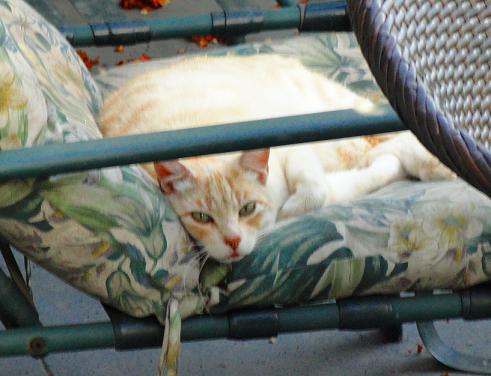
This is Tigey, now a bit football shaped, five years after being a rescued kitten. He’s a timid fellow and bolts at a glance. If he thinks you’re not looking, though, he’ll rub against you.
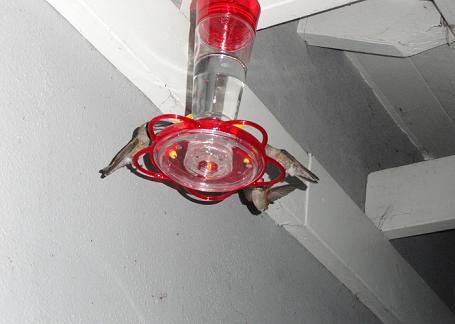
The house’s garden is also a hummingbird restaurant. These, all taken just before dusk, show the birds at their most active. There were four of them, tweeting and bumping each other over what was more than enough for all just before disappearing into the trees for the night.