11.19.11
Vote for the favorite scumbag
Capital idea. H/t to Pine View Farm.
Permalink Comments off
Ask George Smith e-mail: webmaster at dick destiny
E-mail reaction, a couple days ago, to “In This Brokedown Country:”
nice. fun. but alas, I don’t post anything smacking of this or that side — now, for me, I am not one percent but half the country seems to identify with them — the conservatives
and when some time ago I posted [a] gallery of Occupy Wall St I got heaps of email lambasting me and telling me I was hardly non-partisan. So: though I enjoyed it I won’t post. Simply want to sail on my non-partisan way.
Inconveniently, civil unrest delivers a point of view that offends many people.
Anyone reading this knows I find keeping the peace for the sake of popularity an utterly baffling position. Particularly so for the last, say, five years, at least.
Permalink Comments off

With Globalsecurity.Org hat on, a couple weeks ago I posted on the potential use of non-lethal weapons on OWS protests.
Today, TPM discusses the appearance of portable LRADs in New York City.
The LRAD, or long range acoustic device, is a sonic cannon. I posted on it here and here in the last year.
From one of the posts, on a police-vehicle mounted version:
[A] motorized crowd control system, it generates loud screeching noise with the idea that ear pain makes people run away, was deployed in Pittsburgh where it has been mostly just a nuisance.
It came out of the idea that sound could be used to shatter the ear drums of “terrorists” on airplanes, without killing passengers.
If common sense is telling you that such a thing is fairly dubious, you’re not alone. However, that has never impeded the development of such things.
At TPM, the company defends them as communication devices.
But anything that comes from the non-lethal industry has always been dubious, from machinery to claims about said technology. Exotic non-lethal weaponry has been pushed for military and police use for almost twenty years, getting an extra shove during the war on terror. And it is no surprise that LRADs would have been sold into the NYPD in the last decade.
The LRAD company’s rationalization that the things are for communicating does not stand close scrutiny when considering the nature of the OWS protests.
It is not readily apparent that a beamed highly directional sound cannon, particularly the size shown in TPM photos, would be any good in shouting directions to a large moving crowd determined to go somewhere, a mass not particularly interested in police instructions or warnings. Which would be expected, anyway.
On the other hand, if you want to spray a crowd with random bursts of irritating noise that hits individuals, perhaps with the aim of instilling some manner of trepidation in them — well, that’s just what a beam-projecting weapon would be able to do.
The LRAD manufacturer concedes to TPM that it only sells to military and police force clients. So much for the handful of feeble humanitarian uses described for them. And it’s worth adding that LRADs and similar devices have been shown on American television on shows expressly interested in making entertainments out showing applications in weapons technology. For the US Navy, in addition to the non-lethal role (which is nil), they have also been sold as devices to be used in hailing, which is significantly different than use against a crowd in close quarters.
TPM reprints a bit from the LRAD website:
LRAD can broadcast in any language with authoritative and highly intelligible communication. LRAD provides military personnel with a powerful, penetrating warning tone that can be followed by clear voice broadcasts in host nation languages to warn and shape the behavior of potential threats.
If you read the details, there’s indication that up close — at distances of one meter — the portable LRAD can be damaging.
It also indirectly speaks to the relative ineffectiveness of the devices, other than as purposeful irritants to a few.
The broadcast, even designed to be directional, dissipates in power geometrically at distance. And it can be fought with barriers and ear plugs.
What needs to be understood is the long-term nature of the non-lethal industry in the US.
The purpose of it was to sell to the military and militarized police forces technology for use on unarmed crowds. And the major sales argument for all of it is that it puts into the hands of its users technology that allows them to do something without hurting the subjects being targeted. In other words, it’s always been sold by exploiting military and police force susceptibility to magical thinking.
Right now the LRAD is, at worst, a nuisance. At best, it’s a complete waste of money delivered with the delicious irony that if you were a taxpayer any time in the last decade (before losing your job and going to protest), in a general sense you helped pay for it.
However, a civil unrest propagates and grows in the United States, the potential exists for other more threatening “non-lethal” devices to appear in the hands of those the empire dispatches to quash it.
From the standpoint of the private sector businesses that make these things, it’s a sell-sell-sell time.
Permalink Comments off
About a year ago a couple scientists began having trivial successes at essentially duplicating mirage effects.
From a Yahoo news blog called The Lookout:
A University of Texas Dallas scientist is working on developing a technology that would delight Harry Potter fans everywhere–an invisibility cloak.
Ali Aliev uses carbon nanotubes–which look like pieces of thread–and then heats them up rapidly until the objects beneath them effectively disappear …
Aliev only has the capacity to make tiny sheets from a few threads … Luckily, many other scientists around the world are also working hard on this technology.
It’s brainless drivel. Luckily, “other scientists” are working on this. If we get any luckier there will be 30 percent real unemployment and a war with Iran in two years.
Remember my inner bias. After twenty years of this repetetive gee-whiz-miracles-galore puffing and blowing I despise Alvin Tofflerian military gadget freak stuff and the groupie journalism industry that caters to it.
And who and where are the invisibility scientists we’re lucky to have boffining away at this? In England, trying to make a tank harder to see at night. Like, in case, there’s a war against someone else with big tanks in the distant future, or something.
Permalink Comments off
“U.S. national security endangered by China’s army of hackers,” reads the subhed in an opinion piece a couple days ago at the WaTimes.
From old man author William Triplett III:
In November 1997, Deputy Defense Secretary John Hamre testified before the Senate Subcommittee on Terrorism that “we’re facing the possibility of an electronic Pearl Harbor. … There is going to be an electronic attack on this country some time in the future.??? Two years later, he told a secret session of the House Armed Services Committee, “We are at war – right now. We are in cyberwar.??? Fast-forward more than a decade, to 2011. President Obama’s choice for secretary of defense, Leon Panetta, tells the Senate Armed Services Committee at his confirmation hearing that the United States faces a possible “electronic Pearl Harbor.??? Mr. Panetta had been the CIA director for the previous two years – so he would have known.
Two extreme, nearly identical warnings 12 years apart should have brought home the magnitude of the electronic threat facing the country.
From way back in November 1999, William Triplett III, pimping a book on the Red Chinese menace, in the pages of the Washington Times, taken from the old Crypt Newsletter archive on “electronic Pearl Harbor:”
The Washington Times is what Congressmen, particularly Republicans, read regularly before work. As such, material in it is influential in decision-making.
This particular piece continues the current Zeitgeist thread in which mainland China is painted as a threat.
“It is essential to have an all-conquering offensive technology and to develop software and technology for Net offensives so as to be able to launch attacks and countermeasures on the Net, including information-paralyzing software, information-blocking software, and information-deception software,” Gertz quoted a Chinese military publication as stating. He neglects to mention that US Department of Defense print similar tripe fairly regularly — and have done so for most of the decade.
Pentagon “anonymoids” show up on schedule: “A senior Pentagon official said he was notified about the article, which has raised concerns among defense officials who see China’s information warfare capabilities as a potential threat to U.S. civilian infrastructures . . .”
An “expert,” “William Triplett, co-author of a new book on the PLA,” said: “All of this offensive-warfare talk, when China is not threatened by anyone, shows that the dragon is at the point where it doesn’t have to hide its claws.”
Then the scary hypothetical scenario of catastrophe is produced.
According to Triplett, by way of the Washington Times, “China could launch a devastating computer-run sabotage operation by attacking U.S. oil refineries, many of which are grouped closely together in areas of Texas, New Jersey and California.”
“A [Chinese] computer attacker could penetrate the electronic ‘gate’ that controls refinery operations and cause fires or toxic chemical spills . . . “
China has what appears to be a vigorous offensive/defensive hacking operation for the purposes of intelligence gathering. So does the United States.
What makes the “electronic Pearl Harbor” meme different now — although still risible — is its use in justifying defense-spending for those parts of the plutocracy many of us find most detestable.
Wall Street, high finance and, as targets mentioned by the WaTimes opinion piece: “DuPont, Johnson & Johnson, General Electric, RSA, Epsilon, NASDAQ and at least a dozen other firms.”
“Alan Paller, a security expert at the SAND [sic] Institute, observed, ‘The depth of the penetration is more than anybody is admitting,” it reads.
Actually, it’s the SANS Institute. Although SAND as in “to sandbag” is accidentally danger close.
File under durable meme, used solely for enrichment of a section from the 1 percent.
Ted Rall published a column at CommonDreams accurately describing the place:
Governments are supposed to fulfill the basic needs of their citizens. Ours doesn’t pretend to try.
Sick? Too bad.
Can’t find a job? Tough.
Broke? Can’t afford rent? We don’t give a crap.
Forget “e pluribus unum.??? We need a more accurate motto.
We live under a f— you system.
Which is why we are finally, at long last, starting to say “f— you??? to them.
A good statement of rebellion, it again goes into the use of alleged concerns in various American bunds over mess and disease as rationalizations for cracking down on civil unrests. On the other hand, mess and disease among the poor, as long as they’re quiet and on Skid Row or on corners begging, that’s OK.
Permalink Comments off
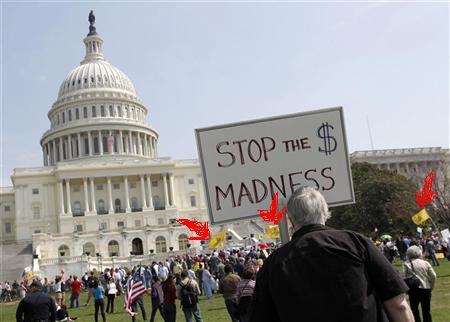
The Civil War 2 gang gets out its colors.
The above is from a Reuters poll allegedly showing more Americans than not want health care repealed than not. The photo, on the other hand, is very obviously a Tea Party rally. And the Tea Party is far from “most Americans.”
The marker — the presence of nausea-provoking multiple Gadsden flags.
Down with tyranny! Down with the Kenyan Muslim! Don’t tread on me! Don’t tread on me! Gahhhh, don’t tread on meeee-meeeee-meeeeee! See my fierce rattlesnake, baby! Do the rattlesnake shake!
As the U.S. Supreme Court prepares to review President Barack Obama’s healthcare reforms, more Americans want to it repealed than want to keep it, a poll released on Wednesday shows.
A Gallup survey of more than 1,000 U.S. adults found that 47 percent favor the repeal of healthcare reform, versus 42 percent who want the law kept in place. Eleven percent had no opinion.
But the survey also showed that 50 percent of Americans believe the federal government has a responsibility to make sure everyone has health coverage, compared with 46 percent who do not.
The results, which have a 4 percentage point margin of error, suggest a sharply divided U.S. public …
When one entire political party, one whole tv network, and almost all broadcast talk radio is devoted to calling for the destruction of health care reform daily, such polling is unremarkable.
No mystery here that Americans have a bad relationship with science. And the dislike of it has a lot to do with why the country has been so poorly run.
In the recent issue of Rolling Stone the magazine conducts a short interview with the author of Fool Me Twice: Fighting the Assault on Science in America, Shawn Lawrence Otto.
A couple questions and responses stick out:
The (unhelpful) role of the news media
Something has happened with the last generation of journalists, who have been taught the postmodern idea that there is no such thing as objective reality. But there is such a thing as objective reality – and we can measure it, and by measuring it we’ve doubled our lifespan, multiplied the productivity of our farms by 35 times, and totally changed the world. By not acknowledging that, reporters end up creating something called, “false balance,” essentially reporting on two sides of a story and letting the audience decide what they think is the objective truth or who is right. That’s really shirking their responsibility to dig and inform people what’s really going on.
How to mend America’s fractured relationship with science
First of all, scientists really need to reengage in our public conversation. Most Americans, when polled, don’t even know a living scientist. That’s got to change. Scientists need to get back out there and talk to their neighbors, speak in churches and talk to people where they go. People need to hear that voice in our political discussion again. The voice of values and religion – those are an important part of our conversation; but we need a plurality of voices and we also need the voice of facts, and reason, and knowledge.
From my personal experience, standard journalism has made it almost impossible to get across anything reliant upon science for understanding.
This has been very true in understanding terror potentials in chemical and biological weaponry. Journalists, like all the people caught with castor seeds, don’t understand what ricin is any more than those backwoodsmen trying to make a weapon out of it.
And it was only by a bit of luck that I was able to spend an hour discussing the matter with Atlanta Journal news reporters last week.
Still, this crept into the news:
“Ricin is a protein … the more you purify it, the harder it is to keep it around. People don’t understand that,??? Smith said, explaining that proteins are easily broken down by heat, ultraviolet light, acids or elements such as lye.
As noted previously, lye was common in US households and high school chem labs when I was a kid. And every college prep student had to take the class. Lye is not an element, it is a compound.
The author is also correct in that scientists have for too long not taken part in public conversation.
And much of the fault of this lies squarely with them. While at Lehigh University and the Penn State School of Medicine, NONE of the scientists I worked with had even the slightest interest in explaining to the public what they did or using their knowledge to help shape understanding of anything in the public sphere.
Add to this the hard fact that many scientists, primary investigators and research directors, are just terrible writers. Being the only person who could write in the labs in which I worked simply resulted in my employment dry-cleaning and working over the research papers and presentations by others.
Writing and good communication were seen as conveniences, tools to be used only for publishing in peer-reviewed journals.
This endemic disinterest has had spectacularly bad results for the country.
At Lehigh University, it resulted in the chemistry and biology departments getting black eyes and besmirched reputations in the residence of Michael Behe, the creationist who packaged his belief in that as the pseudo-science called intelligent design.
Behe could write.
And Lehigh’s hard science departments paid no attention to well after
he’d published Darwin’s Black Box: The Biochemical Challenge to Evolution , a book that became a bestseller, one that was subsequently used by Christian theocrats to inflict lasting damage on high school biology education throughout the country.
By then it was way too late and now the biology department is stuck with having to put a disclaimer concerning Behe’s beliefs and the actual science at the school, on its website.
And that is only one example of what can happen when a profession doesn’t pay attention, when it, or many people in it, believe that the development of a public voice is of no importance.
The New York Times is running several pieces on the police coup de main Mayor Bloomberg achieved at Zucotti Park last night.
OWS was evicted, the mainstream media suppressed and a court order ignored.
In the long run it could get ugly as the only response when peaceful protests are illegally quashed is escalation.
Naturally, you can always find locals to side with the forces for cleanliness and order. Protests and gatherings are too messy.
The clearing of Zuccotti Park struck a deep blow to the Occupy Wall Street movement, which had used the site as its physical and spiritual heart. But as the newly ousted protesters gathered in Foley Square to decide what to do next, many residents, workers and business owners near the park felt deep relief. ” Super ecstatic,” said a young office worker. “Definitely relieved,” said a young woman working behind the counter at Panini & Co., a cafe overlooking the park.
Paul Bruno, 54, who lives in the Bronx but has serviced elevators in Lower Manhattan for 30 years, had lunched daily in the park. He agreed with the protesters’ message, he said, but not their means. “The movement is the right movement,” he said, “but the movement got lost.”
Another man, who worked nearby and said he could not give his name because it was against his company’s rules, said it was time for the park to be cleared.
“It started out as a cool grassroots movement, he said, ” and then it turned into a big homeless camp.”
Still residents described a frightening scene last night, with police rushing into the park, bright lights glaring and helicopters whirring above. Mark Scherzer, a lawyer who lives half a block from the park, said he found the clearing deeply upsetting.
“I think the protesters were doing a valuable service,” he said, “And I think it was lawful for them to be there.”
Permalink Comments off
Readers know I like Gibson guitars. They may have read when I tried to do the company a favor by successfully pressing the Washington Post and others to drop website ads selling Chinese counterfeits of the iconic brand.
But it’s been increasingly hard to not be turned off by Gibson. And this is all due to its CEO, Henry Juszkiewicz.
With his company raided twice by government agents — the first time for buying blackmarket protected wood from Madagascar, the second time for impropriety with Indian imports — Juszkiewicz decided to go extreme right wing and cry about the alleged tyranny of the US government.
At one point, the Wall Street Journal tries to imply the real reason the US government may be after Gibson is because Juszkiewicz is a conservative businessman. This is done with the full knowledge that the investigation which led to the first raid was started during the Bush administration.
In the interview, Juszkiewicz is the very epitome of the bigshot from corporate America, the kind a great deal of the country is coming to visibly detest in street protests.
Juszkiewicz apparently believes in favors for corporate America. So what did he do, according to the WSJ?
Try to get President Obama to let him off the hook. And the Prez ignored him. The nerve of the man. Even his daughters have Gibson guitars, he said.
“[I] will say this: I wrote a letter to President Obama. I spelled out what happened. I said: You know, we got raided and here are the facts, I think it’s unfair. What do you think we should do? No response.”
Maybe the president is not a music lover? “He knows who we are,” Mr. Juszkiewicz says. “His daughters have a couple of Gibsons. [Mrs. Obama] gave a guitar to [the French president’s singer-songwriter wife] Mrs. Sarkozy. And we called up to make sure that he saw the letter, and he did. No response.”
You read this blog or just about anything else these days and you know this attitude. Laws are for little people, not for the wealthy, those who think of themselves as the drivers of job creation in China and capitalism.
At one point Juszkiewicz inexplicably goes into a riff where he tries to explain that guitars are too hard to play for average people while implying the company will expand into consumer electronic products for those who don’t.
Juszkiewicz presides over a company where all the everyman instruments are now made in China. This leaves the domestic end of the market priced so high in relation to, say, the wages of music store workers, that his instruments are now mostly only for the wealthy hobbyist or musician who can put it on the record label advance.
From the WSJ:
“Consumer electronics is a big target of ours because it’s a much bigger market than the M. I. [musical instrument] industry. . . . Right now we have a brand that people recognize and value. But only 5% of those people can buy something with the Gibson brand. . . In order to buy a guitar you actually have to play guitar. . . . You may say, ‘Wow that’s pretty cool to do,’ but . . . it’s like learning Greek. It’s not intuitive to sit down and start playing rock and roll. So guitar players reflect one in 20 consumers. But high-fi speakers [can be used by] 20 out of 20, so it’s a much larger market.”
So what does Juszkiewicz think is the next hot product? Expensive speakers. I can hear the air going out of the balloon six months to a year from now.
For the Journal, Juszkiewicz emits even more dipshit quote.
Gibson guitars do well during hard times, he says, neglecting to mention that if his high end guitars are indeed selling now it’s precisely BECAUSE the wealthy who buy them haven’t seen hard times at all.
“We did really well in the Great Depression,” the Gibson CEO tells the Journal. The company and its instruments were then nothing like now.
“Because everybody wanted to be like Woody Guthrie?” asks the paper, generating unintentional hilarity.
Guthrie, was known, among many other things, for the slogan, “This Machine Kills Fascists,” on his instrument. And it almost goes without saying that Guthrie spent his life in protest against the wealth barons of the country and, for that along with the writing of a column called Woody Sez, was called a commie.
In answering the newspaper reporter’s question about sales during the Great Depression being good, maybe because everybody wanted to be like Woody Guthrie, Juszkiewicz seems to realize he’s dangerously close to stepping in excrement:
“No, I would guess not,” comes the reply. “He did play our guitar, though.”
Reading an interview like the one in the Journal can cause you to lose all faith in a brand. One can imagine the company would only improve if a criminal charge caused Henry Juszkiewicz to step down.
The CEO also plugs his newest offering, the Firebird X, a robot-tuned guitar equipped with, no joke, Bluetooth, priced for the princes at $5,500.
Woody Guthrie, of course, wouldn’t have been able to afford it. (He did say he was for “singing for the plain folks and getting tough with the rich folks.”)

Made long before Henry Juszkiewicz showed up.
« Previous Page — « Previous entries « Previous Page · Next Page » Next entries » — Next Page »