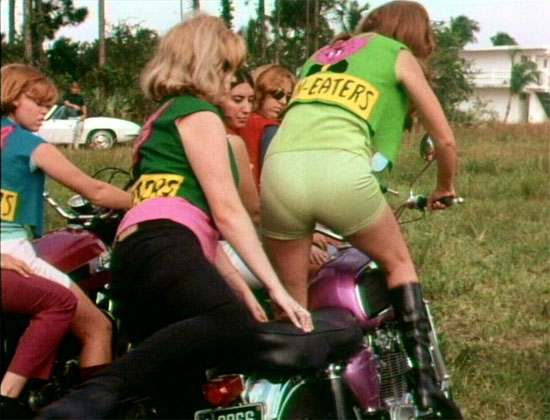
Always been a fan of crap outlaw biker movies. Therefore it seemed right to pick the opening bit of the trailer from “She Devils on Wheels” by Herschel Gordon Lewis as beginning and end for “Letter to the Taxman.”
Lewis’ She-Devils on Wheels (1968) was an attempt to cash in on that era’s biker-pic craze, with the gimmick that the eponymous motorcycle gang, a club called the Man-Eaters, was composed entirely of women who used men as sex objects. It has everything you look for in a drive-in movie: cheap production values, rotten acting, stupid writing, inept direction–the works. Think sub-Faster Pussycat! Kill! Kill! In fact, take practically any biker flick you have ever seen and turn it up a notch on the Dumb-O-Meter. This film defines the word “nadir.” And yet, somehow, abstract concepts appear much more clearly when glimpsed from the rock-bottom of human experience. Filmed in “Blinding Color” in South Florida with a cast of actual female bikers, She-Devils wastes quite a bit of time with long-held shots of bikes going down two-lane roads, but when the action heats up sufficiently it’s a model of compressed violence and paranoia.
Led by Queen (Betty Connell) astride her full-dress hog, the gals hold drag races on an abandoned airport runway, with the winners getting first pick of the “studs”–a group of nonbiker guys who seemingly exist to service the Man-Eaters–back at the clubhouse. (Enthuses one of the girls: “You treat men like slabs of meat!”) Two of the club members in particular draw Queen’s attention: the petite, scatterbrained club mascot, Honey-Pot (Nancy Lee Noble), who rides a pathetic little Honda scooter; and Karen (Christie Wagner, along with Noble the only professional actor in the bunch), who is under suspicion for the crime of becoming emotionally attached to stud Bill (David Harris). Both these plotlets resolve themselves in true biker-pic style, à la H.G. Lewis: Honey-Pot gets stripped, smeared with paint and motor oil, forced to pull train for the studs, and ends up battered to death, while Karen is compelled to drag her innamorato Bill to a pulp behind her bike. After which she finds another boyfriend.
Brutal as all this sounds, it should be pointed out that Lewis’ brand of splatter–outrageous in the ’60s–is pretty tame by today’s standards. That’s probably why it’s so much fun. Victims generally get daubed with stage blood; special effects are as primitive as the dialogue; and no one, even in the clubhouse orgy scene, so much as loses her bra.
“Angry feminists–not to mention fans of gigantic, dominant women–will no doubt thrill to scenes of the Man-Eaters hassling cops (“Dirty muther-fuzz!”), duking it out with a macho group of guys called the Joe Boys (the girls win, natch), and gaining climactic revenge on the leader of that club, Joe Boy himself (John Weymer), by stringing a wire across a road between two telephone poles, then taunting Joe Boy into chasing them on a bike,” adds the movie critic.
Of course, there is a theme song, “Get Off the Road.”
“This picture is not for children, this picture is not for the squeamish, this picture is not for those who think women sit by the fireplace knitting socks,” goes the voice-over.
My since long exited drummer was a gold bug. That is, he was a Fed hater, a true believer in the idea that the US should return to the gold standard and that “fiat money” was a fraud. Perhaps not that strongly, but enough to think the escape from gold and the Fed were the cause of lots of economic problems.
If you’re still checking, Mark, I still love you. That’s the arrangement of “Letter to the Taxman” we played.
Coincidental with the crash in gold is one for Bitcoins.
“Sounds like a Ponzi scheme,” said my departed old friend Don, about two years ago. More recently, one of the Internet mags, Slate or Salon, said the same.
Bitcoin enthusiasts have the same underlying mania as old-time goldbugs, an intense dislike of government, a toxically libertarian ethos. Like traditional goldbugs, they’re also hoarders.
Krugman has ragged on the virtual currency a few times over the years.
What is bitcoin? It’s sometimes described as a way to make transactions online — but that in itself would be nothing new in a world of online credit-card and PayPal transactions. In fact, the Commerce Department estimates that by 2010 about 16 percent of total sales in America already took the form of e-commerce.
So how is bitcoin different? Unlike credit card transactions, which leave a digital trail, bitcoin transactions are designed to be anonymous and untraceable. When you transfer bitcoins to someone else, it’s as if you handed over a paper bag filled with $100 bills in a dark alley. And sure enough, as best as anyone can tell the main use of bitcoin so far, other than as a target for speculation, has been for online versions of those dark-alley exchanges, with bitcoins traded for narcotics and other illegal items.
But bitcoin evangelists insist that it’s about much more than greasing the path for illicit transactions. …
The similarity to goldbug rhetoric isn’t a coincidence, since goldbugs and bitcoin enthusiasts — bitbugs? — tend to share both libertarian politics and the belief that governments are vastly abusing their power to print money. At the same time, it’s very peculiar, since bitcoins are in a sense the ultimate fiat currency, with a value conjured out of thin air.
Since Bitcoin has been in the news during the past week, I’ve often thought of what would happen if I interviewed my fellow shoppers at Baja Ranch in Pasadena about it.
The Winklevosses are famous for being in a pistachio commercial, that as a consequence of their legal brouhaha with Mark Zuckerberg over who originated the idea for Facebook.
Starting at about 2:40, Sherlock Holmes’ arch enemy, Jim Moriarty, blows a hole in the cyberwar meme:
You don’t really think a few lines of computer code are going to crash the world down around are ears, do you? I’m disappointed, I’m disappointed in you, Sherlock …
I knew you’d fall for it. That’s your weakness. You always want things
to be clever.
From the second season ending episode, The Reichenbach Fall, which I heartily recommend.
U.S. Web users are searching for information about North Korea with astounding, unprecedented frequency. Google searches for “North Korea,??? currently seven times the previous peak during the country’s 2006 nuclear test, are dramatically outpacing those for Beyonce or even President Obama.
Last week, North Korea was the third most-popular term on Twitter, following only Easter and Good Friday. And these Web trends appear to reflect broader American views: Pew estimates that 36 percent of Americans are following the news “very closely??? – that’s unusually high for an international news story – with 56 percent saying the U.S. should take the threats “very seriously.???
Oddly, that skyrocketing interest does not appear to have translated into a better understanding of the North Korean threat …
The same Pew poll found that 47 percent of Americans think that North Korea is capable of launching a nuclear missile that can hit the United States, which is false …
It’s not clear why Americans who pay more attention to news reports about North Korea are so ill-informed about its military capability …
Beware the revenging pummeling labonza-belting fists of the enraged New Serbians.
Browsing through Congressional Rsearch Reports today at Steve’s Secrecy blog I came across FutureGen: A Brief History And Issues for Congress.
The cryptic name drew a blank until I suddenly remembered it was clean coal project once supported by Barack Obama.
If you download the CRS .pdf, here, you’ll quickly come to the conclusion that “clean coal” technology is finished in the United States.
Which is a good thing.
It’s all over. The only thing left to do is to admit it.
And that’s shown in the report on FutureGen. It is a mere fifteen pages long, the first five devoted to mostly white space, title and a table of contents.
To put it in a nutshell, FutureGen, a clean coal demonstrator factory and business, formed as a collaboration between the private sector and the government in 2003 during the Bush administration, has gone nowhere in a decade.
The plan to make a coal plant and sequester the produced carbon dioxide as a liquid squirted into underground rock formations has failed. Indeed, it never even really got started.
Technical problems associated with the process kept revising the price to the government upward. And with no milestones met or set, FutureGen has just served as sink for escalating cost estimates, from 1 billion, to 1.4 to 1.6.
In the intervening time period the US government failed (or didn’t even try) to assign a tax to carbon emission which would have provided American industry some incentive to get behind things like FutureGen.
And fracking, the controversial method of extracting natural gas from underground reservoir rock formations, took off.
It is easier and more lucrative to pollute water and mine natural gas, which releases less carbon dioxide than the burning of coal, then to pursue the technical fantasy of “clean coal.” There is nothing to be done with carbon dioxide from fossil fuel combustion except work to generate less of it. Or to at least mine sources that produce more energy for every metric ton of it generated.
The report on FutureGen and its clean coal carbon sequestration effort, or more accurately, the analysis of its slowly cooling body, is here.
A fan tribute video which, it’s probably safe to say, is not exactly what Brad Paisley was aiming for.
Having pilloried Brad Paisley before, I’m delighted to find he’s embarrassed himself nationally with the lead single, “Accidental Racist,” off his new Wheelhouse record.
With “Southern Comfort Zone,” another single from the same record, Paisley has had a nervous breakdown over his southern identity. In response, he’s tried to make music that explains to the rest of us why the south isn’t so bad and that it’s hard being a white guy from there.
Like everyone from WhiteManistan Paisley doesn’t quite get why this is so.
Anyway, Brad Paisley has always thought of himself as quite the lyricist. In a guitar magazine he once laughably compared himself to Mark Twain. But he has neither the nerve nor incision of Sam Clemens and way too much stupid on hand.
So you get what Brad Paisley delivers, apparently serious songs that are very public embarrassments, which — nonetheless — are received well by his country audience.
If you look on chat board or comments sections, I would suspect his grass roots love his “Accidental Racist” and “Southern Comfort Zone” songs and are astonished, even enraged, that others would laugh at him.
Which fits one of the definitions of WhiteManistan. You can condemn the bozos all you want but they view condemnation as affirmation. They expect it. It defines who and what they are. It is a very real measure of the polarization over race and antique traditions in society and that there will be no reconciliation or reconstruction. This war is truly forever.
There is nothing complicated in the ideology of the current white right/south. It’s one of hate, very real confederacy against outsiders, paranoia, and white supremacy.
And Brad Paisley, because of his great commercial success, seems to have foolishly picked himself as someone who can be an explainer and a middleman, a moderate, for it to the rest of us.
He’s failed grandly although sales might not reflect it and Barack Obama might still invite him to play the White House on July 4 because Paisley is a safe southern man, not someone overcome with spittle-flecked rage who elects heirs to the spirit of John Wilkes Booth to the US House of Representatives.
“Accidental Racist??? appears on Paisley’s ninth studio album Wheelhouse, which debuts today,” reports the TIME magazine website. “[However], the video appears to have been pulled from the Internet.”
One might say Brad Paisley has accidentally reverse-Dixie-Chicked himself.
Geez, it’s tough being a southern white guy.
Dude from WhiteManistan describes the “Accidental Racist” conspiracy.
.png)

