02.22.13
The Weekly Intelligence Report
A brilliant idea, Susie! It’s time has come.
Hat tip to Pine View Farm.
Permalink Comments off
Ask George Smith e-mail: webmaster at dick destiny
A brilliant idea, Susie! It’s time has come.
Hat tip to Pine View Farm.
Permalink Comments off

Early in the week I received an e-mail query about the old Mujahideen Poisons Handbook. Many readers will remember it as a .pdf pamphlet that figured prominently the US government’s and media’s received wisdoms passed out on al Qaeda and its capabilities with regards to weapons of mass destruction.
A historian was asking where to find a clean copy because she was writing a book about “popular manuals and their challenges to free speech. She explained this went back into the 19th century.
Loompanics, an American publisher based in Port Townsend, Washington, specialized in fringe books on mayhem and other unsavory topics. It was part of this literature in the United States, although its heyday ran only from the mid-Seventies to the early Nineties.
When the digital networks began to arrive in the early Nineties bits of the detritus from Loompanics and other fringe US publishers were copied into cyberspace, usually by young men, and distributed out of their bedroom-based bulletin board systems.
This copied samizdat electronic literature went around the world.
Paradoxically, this phenomenon and the rise of the web put Loompanics out of business. Which wasn’t a bad thing considering the collateral cost in ruined lives possession of the works of Loompanics and other similar publishers has caused as a result of the war on terror.
Free speech guarantees the right to publish odious materials of little social value. But there can be severe random and unintended costs associated with it.
The war on terror produced such things and continues to do so.
Specifically, with regards to Loompanics, the brief e-mail discussion
dealt with the Mujahideen Poisons Handbook.
I refuted it often around the middle of the decade, most famously when it showed up in a Sunday feature at the Washington Post on “e-Qaeda” and how the terror organization was using the web to train its minions.
The graphic above is the Post’s. It was utter trash on the making of “betaluminium poison,” presented as a real potential menace, evidence of a real capability where none existed.
‘”[Contrary] to the Post story line, the cited library materials suggest a startling lack of technical competence,” wrote Steve Aftergood in his Secrecy News Bulletin. “Unfortunately, the Post did not critically examine the materials that it presented.”
Specifically, the bit on “betaluminium” was a garbled excerpt on botulism from a Loompanics book, Maxwell Hutchkinson’s (a pseudonym) The Poisoner’s Handbook. (On which I’ve regrettably written quite a bit.)
Most of the information in both the Mujahideen Poisons Handbook and Hutchkinson’s Poisoner’s Handbook is laughable in terms of accurate chemistry and biology. However, over the decade, many counter-terror and police forces never got that.
And you couldn’t tell them.
Perhaps it was too inconvenient to the time and their purposes to admit to such things. Or maybe their analyses were just always done by “experts” who were really incompetent.
Both pamphlets were apparently written/composed/put together by people who seemed to have very little idea about chemical or biological terrorism, or poisoning, but wished to create appearances that they did. They wrote as if they had performed procedures that simply do not adhere to reality.
Nevertheless, these writings became documents that put you away, ruining a life and reputation once news is published and convictions handed down.
In England they became seditious materials, a crime to possess because they fell into the category of things deemed likely to be of material use to terrorists.
In the United States, possession of recipes or related materials copied from them and other similar publications are always presented as evidence of intent to commit acts of terrorism in domestic trials.
I’ve been consulted in three such trials on these publications and recipes, two in England years ago. And more recently, one which is set to run soon in Georgia.
The Washington Post’s story, published in 2005 and written by Steve Coll and Susan B. Glasser, was not the only mainstream news organization that disseminated ridiculous claims on the nature of these types of documents and what they allegedly showed al Qaeda could do. Many did it, far too many.
But the Post’s article, by dint of the importance of the newspaper, puts it in the forefront in terms of the damage it did to public information and perception on these things.
During the war on terror, al Qaeda never possessed the capability to make weapons of mass destruction. The best it could manage was apparently videotaping, very early on, the cruel killing of a puppy with cyanide in a room used as a gas chamber.
However, the government and very-important-person thinking on the matter was just the opposite.
They were very wrong. And if they continue to think such things, they still are. The Post’s reporters and editors, and too many others to count in the mainstream media, got it all wrong.
In 2005, Steve Coll won the Pulitzer for his book, Ghost Wars: The Secret History of the CIA, Afghanistan, and Bin Laden, from the Soviet Invasion to September 10, 2001. Today he is the president of the New America Foundation, “a nonprofit, nonpartisan public policy institute that invests in new thinkers and new ideas to address the next generation of challenges facing the United States.”
The belief that weapons of mass destruction can be simply made from recipes included in the publications of the American fringe, migrated to the desperate places of the world, is now irreversibly embedded in our culture.
I see it almost every week, from ex-anti-virus king John McAfee’s ridiculous stories about Hezbollah using Belize and Nicaragua to ship massive amounts of ricin powder into the United States to a new television movie in England called Complicit, a drama dealing with a “jihadist plot to smuggle ricin … from Egypt to the UK with a view to killing thousands …”
Permalink Comments off

Death toll from 9/11: 2,753.
Killed by drones, the US count, today: 4,700
Bombing the destitute in the desperate places of the world, assorted “bad guys” and whoever happens to be in the wrong place at the wrong time, ad libitum forever, is one great global strategy.
Permalink Comments off
You know the GOP and Tea Party brands are well and truly shot when professional wrestling takes their WhiteManistan ideology for a character heel.
Zeb Colter, formerly known as the entertaining pro wrestler, Dutch Mantell.
Permalink Comments off
The cyberwar shoeshine crowd takes holidays. But when not on holiday it fabricates and dissembles almost non-stop, often in the most absurd ways.
From the well-known publication, on every newsstand you know, Infosecurity magazine:
A national survey of Americans shows that a majority fear that cyber warfare is imminent and that the country will attack or be attacked in the next decade. In addition, Americans believe both the government and private sector networks are ill-prepared for a surge in cyber conflict.
A poll by Tenable Network Security, which works with the US Department of Defense and military and government clients globally, found that the increasingly strong rhetoric about a “cyber Pearl Harbor??? and cyber attacks being the modern-day equivalent of nuclear weapons is apparently having an effect on the nation’s psyche.
Modern day equivalent of nuclear weapons.
Now you know why I find a lot of people who work in the national computer security machine contemptible.
Anyway, a poll conducted by a cyberwar defense firm, Tenable, whose business is contracts on the taxpayer dime, just happens to find that a majority of Americans believe cyberwar is imminent. I bet you’d have a hard time making that one stick in a random sampling at any burger joint in Pasadena.
This is how it works. Guys who worked at the National Security Agency, whose leader is famous for claims that cyberwar is causing the greatest transfer of wealth in history, disappearing the future of all Americans, leave and go into business selling the same warped story.
All in the effort to grease expanding budgets on cyberwar defense from which they will personally profit.
The shoeshine boys of cyberwar have done this kind of thing for a decade and a half, at least. I just didn’t have an insulting enough name for them previously.
[iDefense went bankrupt and ceased operation a few years ago. Its CEO’s bizarre proclamations, however, deserve preservation.]
James Adams was highly quotable on what would happen in cyberwar. No one in the mainstream press cast even the slightest fishy eye at his claims, most of which were laughably absurd.
Here then, is a small sampling of James Adams …
Pentagon hackers employed in Eligible Receiver “did more than the massed might of Saddam Hussein’s armies, than the Nazis in the Second World War.” From Techweek, 1999.
“iDefense is way ahead of the competition.” From Washington Technology, “the business newspaper for government systems integrators,” November 1999.
“Which brings us to the final rung on the escalatory ladder: the virtual equivalent of nuclear deployment. I offer as illustration Eligible Receiver.” From a speech, “The Future of War, Wright-Patterson Air Force Base, June 2000.
‘Nuff said.
The shoeshine boys of cyberwar — from the archives.
Permalink Comments off
As mentioned yesterday, the state of the debate on drone use is zero. There is no debate, none is allowed. While you don’t have to go three yards in the grass roots web media to hear one, all the very important people and the US government cannot be influenced by it.
Excerpts from a Daily Beat piece tell you all you need to know:
Yet despite the testy exchanges and the theatrical protests [by Code Pink ladies who were ejected], it’s worth noting that not a single senator said he or she opposed targeted killings. It was perhaps a recognition that drones are here to stay—a permanent part of America’s hi-tech 21st-century arsenal. Indeed, instead of a dramatic moral showdown, the hearing showcased evidence that Congress and the Obama administration could be moving toward pragmatic compromises …
Consider the lethal targeting of Anwar al Awlaki, the American citizen and al Qaeda member who was killed in a CIA drone strike in Yemen in September 2011. Awlaki was actually placed on the kill list before the Justice Department had finished its opinion, though Obama’s lawyers had already weighed in orally. As for due process, it was far more informal than anything Feinstein envisions. One example: before State Department legal adviser Harold Koh was willing to give his blessing to the deliberate killing of an American, even one who had joined an enemy force, he wanted to scrutinize the intelligence himself. So in March 2010, he holed up in a secure room in the State Department and pored over hundreds of pages of classified reports detailing Awlaki’s alleged involvement in terror plots. Koh had set his own standard to justify the targeted killing of a U.S. citizen: he felt that Awlaki would have to be shown to be “evil,??? with iron-clad intelligence to prove it. After absorbing the chilling intel, which included multiple bombing plots and elaborate plans to attack Americans with ricin and cyanide, Koh concluded that Awlaki was not just evil; he was “satanic.???
In one paragraph, the meretricious rationalization cited yesterday, the line of allegation always used to steamroll thoughtful discussion:
Technology has advanced so far, the little tribes of really poor people, even single individuals, can develop weapons of mass destruction.
In this case, the old boogieman, Anwar al-Alaki — now dead, elevated to “satanic power,” out in the desert wastes of Yemen, virtually dead broke and without any infrastructure, allegedly capable of making a ricin WMD.
Castor seeds, which are where one gets ricin, cannot make a weapon of mass destruction. Indeed, no one has ever made a WMD from ricin, or even made a convincing stab at one.
Yet these are the types of horrendous distortions, now used as received wisdom, for the virtual justification of pre-emptive attacks in the desperate and destitute places of the world.
There is no way to see an end to it.
Permalink Comments off
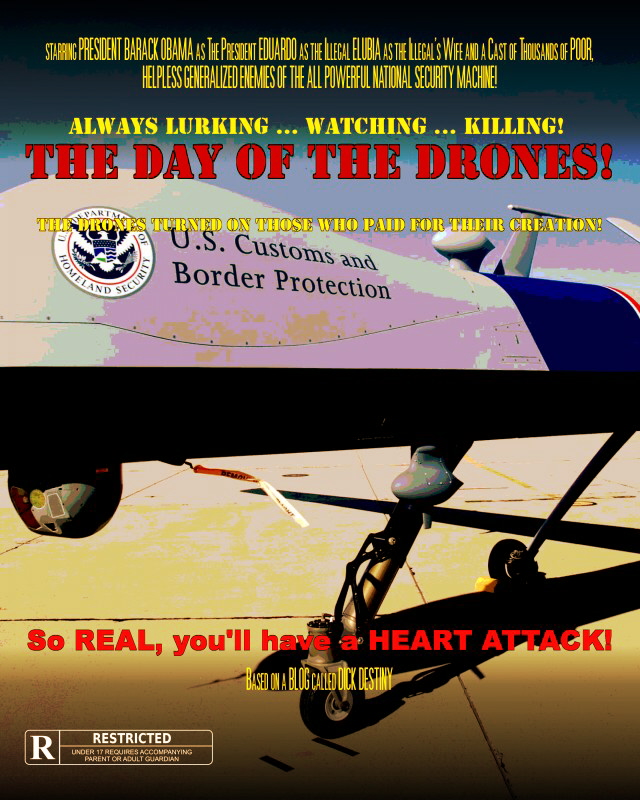
Homeland Security magazine, edited by Dan Verton, had an interesting piece on the issue of domestic drones the other day. It mentioned that lower level grass roots opposition had canceled a police drone program in Seattle.
Seattle Mayor Mike McGinn on Feb. 6, announced the cancellation of the Seattle Police Department’s controversial surveillance drone program after citizens and civil liberties groups voiced concerns about privacy.
McGinn joins a growing list of state and local officials who are buckling under extreme pressure from their constituents and privacy advocates who argue that police departments are moving too far, too fast, on drone deployments without concrete policies and procedures to safeguard the privacy of law-abiding citizens.
State legislatures around the country are also stepping up activities designed to limit or ban the use of domestic surveillance drones. To date, Florida, Maine, Montana, Missouri, Nebraska, North Dakota, Oklahoma, Oregon, Texas and Virginia have introduced anti-drone bills.
Domestic drones are financed by block grants from the Department of Homeland Security. They are part of a much larger phenomenon, one which has seen national taxpayer dollars pay for the military weaponization of small local police forces.
Locally, a good example was the acquisition of an armored car last year by the South Pasadena police force.
Called a Peacekeeper, I wrote about it here.
All the hardware, drones now included, becomes appealing to police forces because it appears free. That is, the cost is distributed over the entire population. Like food stamps, only the dollars spent on drones aren’t funneled back into the community as food buys at the local markets.
It’s a racket.
Homeland Security interviewed longtime colleague Steven Aftergood, author and keeper of the Secrecy blog, had this to say to the magazine:
“It’s a dynamic situation that is subject to change,” said Aftergood. “Industry clearly had a head start, with strong support in Congress and a rosy view of the future full of potential applications for unmanned aerial systems. But privacy values are deeply rooted in society and will have to be addressed by all parties. The debate cannot be avoided indefinitely. It needs to be engaged directly.”
Aftergood is correct. There does need to be a debate and there is already a groundswell of noise on the matter.
However, it comes from all the sources the US government ignores. And nothing good will happen until major news sources start covering drones without just going to the usual experts, chosen from defense think tanks, whose job it is to be fuglemen — wingmen — for whatever the national security machine is pushing.
The argument presented by the side of evil, the forces recommending more and more drones, is one in which they are presented as great and inexorable technological advances, things which make war less bloody.
The technology is not spectacular. And the argument obfuscates by not framing it within an expanded context of American and global reality.
This expanded view recognizes that that the US government/military has moved to take on the role of prosecuting special operations against whomever it thinks necessary in all the desperate and poor corners of the world. War on terror is the rationalization.
This has nothing to do with technology. It is to keep the industries of war moving. It is also is linked to a meme which has become pernicious received wisdom: Technology has advanced so far, the little tribes of really poor people, even single individuals, can develop weapons of mass destruction.
I’ve spent close to a decade as something called a Senior Fellow for GlobalSecurity.Org arguing that’s not true, that it’s a construct that has been passed off because it’s a semantic weapon for the national security industry, one used to steamroll thoughtful discussion.
Drones don’t operate in an environment where the purported adversary has any equivalent technology, or usually, even much of an infrastructure. They are used against populations that cannot mount a conventional defense because they are destitute. Or, as in Pakistan where an air defense could perhaps, theoretically, be mounted, allowed by bribing the government into non-interference over the regions of the poorest with weapon sales and cash assistance.
There is a moral issue in that and the United States is not on the right side of it.
However, the formal “debate,” what little there is of it, is dominated by the hand puppets of the American government and national security apparatus.
This week, Matt Taibbi’s blog at Rolling Stone points out an instance, one in which a “scholar” you’ve never heard of at one of America’s old but now given-over-to-flacking think-tanks, rationalizing drones using a most tortured comparison:
Read an absolutely amazing article today. Entitled “Droning on about Drones,” it was published in the online version of Dawn, Pakistan’s oldest and most widely read English-language newspaper, and written by one Michael Kugelman, identified as the Senior Program Associate for South Asia at the Woodrow Wilson International Center for Scholars in Washington, D.C.
In this piece, the author’s thesis is that all this fuss about America’s drone policy is overdone and perhaps a little hysterical. Yes, he admits, there are some figures that suggest that as many as 900 civilians have been killed in drone strikes between 2004 and 2013. But, he notes, that only averages out to about 100 civilians a year. Apparently, we need to put that number in perspective:
“Now let’s consider some very different types of statistics.”In 2012, measles killed 210 children in Sindh. Karachiites staged numerous anti-drones protests last year, but I don’t recall them holding any rallies to highlight a scourge that was twice as deadly for their province’s kids than drone strikes were for Pakistani civilians.”Nor do I recall any mass action centered around unsafe water. More people in Karachi die each month from contaminated water than have been killed by India’s army since 1947 . . . 630 Pakistani children die from water-borne illness every day (that’s more than three times the total number of Pakistani children the BIJ believes have died from drone strikes since 2004).”
Adds Taibbi: “So there it is, folks. Welcome to the honor of American citizenship. Should we replace E Pluribus Unum with We Don’t Kill as Many Children as Measles? Of course people aren’t mad about bombs being dropped on them from space without reason; they’re mad because anti-Americanism is alluring!”
There’s nothing to add.
Well, there is actually. You can expand the argument to justify drone use just about everywhere in the impoverished world.
Malaria kills [five figures] each year [some country in Africa. Drones, by contrast, have only killed 140.
Roll your own, arguing drone fatalities as something less horrid than many of the world’s most famous diseases. And therefore OK.
Permalink Comments off
The President can’t even get the minimum wage up to what it should be if it had been adjusted for inflation. But this is what our cyberwar shoeshine boys were saying today:
One threat is that another nation could perpetrate a Stuxnet-style attack on the US. Stuxnet, the powerful cyberweapon unleashed on Iran’s nuclear fuel centrifuge facility at Natanz, is reported to have destroyed at least 1,000 of the machines and set the program back as many as two years. Such weapons, targeted at civilian systems, could likely wreak havoc on the US power grid. — the website that used to the newspaper called the Christian Science Monitor
The [executive order] won’t scare potential cyber enemies, says Alan Paller, director of research at the SANS institute, a cybersecurity educational organization.
“I expect all of those attack communities that might have been worried [about the order] are breathing a sigh of relief and shaking their heads in wonder that the United States government leaders could be so completely in the thrall of corporate interests that they would leave their military and financial future in harm’s way,??? he says.
“We are in a cyber war. Most Americans don’t know it … and at this point, we’re losing,” said House Rep.[ Mike Rogers, R-Mich., on the Intelligence Committee.]
The United States military/intelligence structure attacked the Iranian nuclear program with malicious software, most notably the Stuxnet virus.
The argument made by the cyberwar shoeshine corps has morphed that reality into a threat against the United States power grid.
What if a Stuxnet was loosed on us?
It takes a lot of hypocrisy and mental gymnastics to be so self-serving.
Officials within the US government and an assortment of cyberwar flacks have since gone public with their belief that Iran is behind the cyberattacks that made some big banking websites run unevenly, sometimes. But probably not when you were there.
Permalink Comments off
The President took a few moments in last night’s State of the Union to address infrastructure and cybersecurity. It was the usual shoeshine, assertions that something terrible will happen if steps aren’t taken, allegations of a looming menace that means nothing when stacked up against major economic issues.
The mythology of cyberattacks turning off the power, poisoning the water, and — most laughably — attacking the financial system (ie, Wall Street) have been piled so deeply over such a long time, a substantial number of people now believe them.
However, there’s reality-based analysis. And so there is this from Homeland Security Today:
President Barack Obama on Tuesday signed the long-awaited executive order designed to enhance the security posture of the nation’s critical cyber infrastructure. Obama made the announcement during the State of the Union address.
“America must also face the rapidly growing threat from cyber-attacks,” Obama stated. “We know hackers steal people’s identities and infiltrate private email. We know foreign countries and companies swipe our corporate secrets. Now our enemies are also seeking the ability to sabotage our power grid, our financial institutions, and our air traffic control systems. We cannot look back years from now and wonder why we did nothing in the face of real threats to our security and our economy.”
The new executive order, however, does not have the force of law. And some analysts see it simply as the latest attempt by the administration to increase pressure on Congress to pass meaningful cybersecurity legislation.
“The administration has been building up to issuing an executive order on this for months,” said George Smith, a senior fellow at Globalsecurity.org. “And, no, it won’t have any impact on infrastructure cybersecurity. None of the Obama administration’s executive orders, in anything for that matter, have any teeth or any practical consequence. They’re essentially blandishments and suggestions that are ignored or meant for window dressing. It’s an attempt to shape the debate and push legislation.”
And that’s exactly how Obama left the issue in his State of the Union speech.
Pabulum.
The country would be better served by the President helping to reduce the power of the minority culture of gun nuts with real steps in new law and control. At the end, that was easily the most powerful part of his speech.
On Ted Nugent at SOTU, from Slate:
Nugent was shepherded over to a standing MSNBC camera. Two police officers looked on, confused by the mobile media herd.
“Who’s that???? asked one cop.
“It’s Ted Nugent,??? said the other cop. “He’s a rock star, he talks about guns.???
“Really? Never heard of him.???
[The] cable news networks have, so far, maintained a near-blockade on Nugent clips, and according to Bill Press, wasn’t featured in any of the crowd shots from the speech. The only exceptions, so far, have been CNN and MSNBC, who each aired Nugent snippets during the 5 am hour Wednesday morning, one of which, naturally, contained the word “fecal.???
It wasn’t as if Nugent didn’t make himself available, either. Politico (Oh no! They couldn’t resist either!!) reported that Nugent held court with reporters, telling them that Rep. Jim Langevin (D-RI), who was paralyzed in a shooting accident, had “Shit for brains??? because he was critical of Nugent’s attendance at the address. He also denied threatening President Obama.
NBC News’ Luke Russert later asked Nugent if he thought that was “an appropriate thing to say about a sitting member of Congress who’s in a wheelchair????
Permalink Comments off
Yesterday I went to the DMV in Pasadena. If you’ve ever been to a DMV office in southern California without an appointment, you know there’s a lot of waiting.
Like many businesses, the DMV has put up flat tv screens to divert you. One runs the “DMV TV Network,” which made me laugh. It features little informational notes on good driving and traffic law interspersed with little quizzes like:
“Which of the following will wake you up best?”
A. energy drink
B. coffee
C. apple
The correct answer is … apple! DMV tv helpfully explains its natural sugars help the regulation of your energy level, which is fairly accurate.
Also, apples do not contain unnatural “chemicials [sic].”
Well, their hearts are in the right place.
Also displayed, weekend box office results.
Zero Dark Thirty, the movie about the hunt for bin Laden, has made $4 million, only twice as much as the already failed Sylvester Stallone gobbler, Bullet to the Head.
I’ve infrequently said Americans have no taste for movies from the endless war, no matter the hype associated with them.
Really, they no more want to see Zero Dark Thirty than Berliners wanted to see a movie called Stukas in 1942.
That’s justice, particularly in light of the news that bin Laden’s “Shooter” has been treated so poorly.
Believe it or not…

Permalink Comments off
« Previous Page — « Previous entries « Previous Page · Next Page » Next entries » — Next Page »