Of course, no one bats an eye at the spectacle. In the US, it’s a plus to be a great-looking obvious dumbshit. (For her trick, visiting Hawaii, “When we attacked the Japanese battleships at Pearl Harbor we showed we were ready to fight against tyranny and for freedom…”)
Bear in mind that the unemployed aren’t jobless because they don’t want to work, or because they lack the necessary skills. There’s nothing wrong with our workers …
“US has less extreme version of same. UK’s econ emerg: flatlining living standards, unskilled men.???
“Instead of a determination to do something about the ongoing suffering and economic waste, one sees a proliferation of excuses for inaction, garbed in the language of wisdom and responsibility.” writes Krugman, indirectly explaining the thinking of the very special good boy, David Leonhardt.
Every Memorial Day features sales. Locally, this weekend Guitar Center ran television ads for theirs, all the bargains made in China.
Get your rock on, they beckoned. Courtesy of all the offshored rock and roll gear manufacturing in the last decade.
Ultra low low prices to compensate for the beggaring of the US middle class, the abandonment of domestic non-military manufacturing except for arms and that thing called private sector debt overhang.
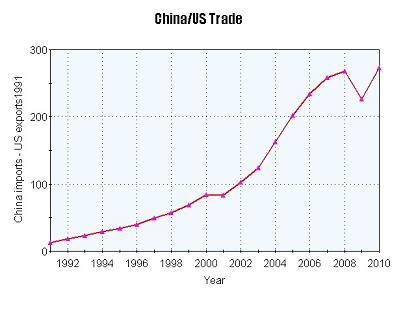
So for the sake of Guitar Center’s Memorial Day Sale, the graph that shows the increasing slope of trade imbalance, a picture of US offshoring during the decade when permanent war arrived.
And a measure of the social cost in the state of war which, on Memorial Day, is unstoppable:
Buried in the numbers in the area under the curves, all the rock and roll equipment production, stuff once invented and made here, sacrificed to China.
[The American people] accept it. Since 9/11, war has become normalcy. Peace has become an entirely theoretical construct. A report of G.I.s getting shot at, maimed, or killed is no longer something the average American gets exercised about.
He continues on a theme I’ve had for awhile. It doesn’t matter what anyone says because nothing can be done about the state of affairs.
Not to put to fine a point on it, the national security apparatus successfully removed the democracy organ.
The tragedy of WikiLeaks is obvious in the continuing news mined from CableGate.
One might now consider the agency as a big powerful animal driven by the cult of personality that’s Julian Assange.
But fame, that trouble with women and monetization through contemptuous big media killed it.
However, the carcass — due to the sheer volume of Cablegate — still has bubbles of gas in it. And the gas escapes from time to time, making a stink like a dead skunk in the middle of the road during high summer.
And such is the case with the news mined by the McClatchy chain from Cablegate, showing Saudi oil ministers informing the US government in 2008 that speculators were causing an oil bubble.
When oil prices surged to a ridiculous $147 a barrel in the summer of 2008, conventional wisdom held that normal supply and demand issues were the cause. Both the Bush administration (in the form of the Commodity Futures Trading Commission) and most of Wall Street (through both media figures and market analysts) blamed such factors as increases in oil demand from the Chinese industrial machine, and the failure of Americans to conserve, for the surge in crude prices …
Well, thanks to Wikileaks, we now know that when the Bush administration reached out to the Saudis in the summer of ’08 to ask them to increase oil production to lower prices, the Saudis responded by saying they were having a hard time finding buyers for their oil as it was, and instead asked the Bush administration to rein in Wall Street speculators.
According to the McClatchy report, the Wiki cables show that Saudi ministers repeatedly told Bush administration officials that increasing production might be counterproductive.
The cables show that at the height of the bubble, in May 2008, U.S. officials met in Riyadh with the Saudi assistant petroleum minister, Prince Abdulazziz bin Salman bin Abdulaziz al Saud, who told the U.S. he was “extremely worried” that high prices would destroy the demand for crude.
“Aramco is trying to sell more, but frankly there are no buyers,” he reportedly said, referring to the Saudi state oil company. “We are discounting buyers.”
“The cables also show that the Saudis urged the Americans to enact reforms to rein in Wall Street, calling for speculative limits and other changes,” Taibbi adds.
The tragedy, again, is that this is emission from the dead dog.
Bank of America and its ecology of corruption was supposed to be next. That’s gone well.
Someone else was going to step in and replace WikiLeaks.
Public announcements and great enthusiasm followed.
Now the parade is over and all the bunting has come down.
A pathetic story on job creation plans for the dead but still flopping fish middle class economy reveals the Obama plan is lame, and the GOP plan is what you already know — give more money to rich people.
Both the Obama administration and congressional Republicans released plans yesterday that they say will create jobs. The administration said it would scrap or scale back hundreds of unnecessary and burdensome regulations affecting everything from the environment to worker safety. White House officials claimed that this measure would save businesses hundreds of billions of dollars, making it easier for them to hire workers.
For instance, under the new guidelines, the Environmental Protection Agency will no longer require states to install systems to protect against fuel emissions at gas stations–a problem that has mostly been fixed by improvements in vehicle technology.
I think we can all agree stimulating gas station/convenience store hiring through deregulation must be part of quite an amazingly ambitious plan.
For one thing, there are specific forces holding back growth. Oil prices, though down in the last few weeks, are still 40 percent higher than a year ago and continue to siphon money away from the American economy to overseas economies. When I filled my gas tank last weekend, it cost $74, more than I think I have ever paid.
Gas is costing him more than ever says the sport with the six figure salary.
“State and local governments continue to cut jobs,” he continues.
“These specific problems worsen the broader insecurity of both households and business executives — insecurity that is typical in the wake of a financial crisis.”
Boy howdy! Remarkable!
David Leonhardt, we note, has 5,627 followers on Twitter, all through the magic of US innovation, the kind that has globally networked and lubricated the sucking up to your celebrity betters, in any field of endeavor.
A sampling of tweets:
“US has less extreme version of same. UK’s econ emerg: flatlining living standards, unskilled men.”
Sayeth the Yale man.
“Top colleges too focused on affluent, not meritocratic enough.”
From Foreign Policy, where the important writers can always be depended upon to direct you to the back of your hand (or how to grab you ass, if you prefer:)
The federal government is spending and borrowing so much that the United States will soon go broke. Washington’s spending binge has put our nation in debt, eroded economic confidence and caused massive uncertainty for private sector jobs creators (except in arms manufacturing).
So kill Medicare.
Death rays, yes. Old folks, no. We’re never broke when it comes to the former and its less grandiose brethren.
While you don’t get fired at the nation’s war-pushing think tanks when you screw up royally, the real estate you’re invited to scribble on goes from high rent to slum.
Today, O’hanlon’s on the opinion page of the Washington Times, the newspaper for DC’s extreme right, sharing space with the usual tumbleweeds blowing through that neighborhood — Medicare must be destroyed, Newt Gingrich is a genius, Obama is the greatest enemy Americans have ever known, etc.
Consider a few examples from Iraq. The task force helped Iraqi banks set up electronic funds transfer capabilities at 233 private banks. About 100,000 jobs were restored in Iraq after the invasion as the direct result of task force interventions. At least $2 billion in investment licenses were issued for new business development by an Iraqi government agency that the [Pentagon’s jobs program task force] helped set up. Dozens of international companies, including Boeing, GE, Case New Holland, Google and Microsoft, have begun work in Iraq as a result.
“Do we really want to concede the foreign role in developing mineral interests in Afghanistan, estimated at more than $1 trillion in value, to Chinese companies because American firms don’t have access to compete themselves?” write O’Hanlon at the WaTimes.
Our leaders, notably Congress and the administration, are increasingly desperate to rationalize reasons for little recovery in the middle class and high unemployment. So they look to Wall Street, which is doing fine, and economists to tell them it’s all the little people’s fault.
Structural unemployment is what it’s called. It’s an argument that makes the case that rotten is the new good, that nothing can be done because the country has moved on and the unemployed are so because they lack what the country needs for the future. So corporate America has decided to discard them.
They lack the necessary skills.
Except the American middle is not lacking in skills. Working for the census last year made this abundantly clear. The census’ labor, taking a great deal from those knocked into unemployment by the Great Recession, had all kinds of skills and varied training. And they were largely educated. You could not characterize them narrowly — as flawed in their education and training — which is what structural unemployment arguments always try to do.
Today’s news — from this article — delivers all the rancid goods needed to justify walking away from the national mess in the three minutes time it takes to read it.
For example: “Swonk believes that one of the lasting outcomes of the recession will be a skills shortage driven by educational inequality.”
Which, from experience, is rubbish.
The very next graf has one source disputing it, a position also taken by Paul Krugman:
Bart Hobijn, an economist at the San Francisco Federal Reserve, argues against the skills mismatch theory for driving up natural unemployment. Hobijn recently studied the unemployment rate among recent college graduates — who are theoretically resistant to the effects of a skills shortage — and found that they were faring just as poorly in the labor market as others, implying that skills mismatch isn’t having much of an effect on the natural unemployment rate.
Then the man finds a different reason to explain recalcitrant hiring. It’s the extended unemployment benefits, he reasons. The implication that it made people to lazy too find minimum wage work compounded by the fact that employers don’t like hiring low wage workers because, wait for it … they are lazy crap. Although the words “lazy” and “crap” don’t enter the discussion.
The US is great at making weapons and parasite economy stuff — financial services and monetized networked circle jerks (Facebook, Twitter, etc) — and virtually nothing else. And these industries don’t broadly spread their riches to the overall populace. The good fortune comes only to those directly connected to them — a feature of countries which are either saddled with or adopt rising levels of inequality.
One can marvel at the stubborn optimism of the 24-year old, of the ability to get a book contract, and the revelation of information that it’s important to hold onto your laptop. Or you’ll really be in a world of hurt.
Read it. It’s one example of a nation that’s given up on its people.
On the other hand, if you’re in arms manufacturing, things are jolly good.
Weeks ago I predicted Raytheon and others would get great numbers from our Bombing Moe adventure, even once we abandoned the job. Others, like Little Tommy Atkins, for instance, would shoot off all their nice American-made smart bombs and missiles. But Mo would still stubbornly refuse to die or run away, presenting them with the need to order even more from America’s armorers.
And such has been the case. Business at Raytheon has been wunderbar.
From a press release:
Raytheon Company (NYSE:RTN – News) announced today that its Board of Directors has declared a quarterly cash dividend of $0.43 cents per outstanding share of common stock. The cash dividend is payable on August 11, 2011 to shareholders of record as of the close of business on July 6, 2011.
Raytheon Company, with 2010 sales of $25 billion, is a technology and innovation leader specializing in defense, homeland security and other
government markets throughout the world. With a history of innovation spanning 89 years, Raytheon provides state-of-the-art [missiles] and [war] support services. With headquarters in Waltham, Mass., Raytheon employs 72,000 people worldwide.
In at number 2 on a list of 25 compiled by US News and the Glassdoor website, MITRE Corporation, which one can think of as a private sector arm of the government’s national security and intelligence apparatus.
The MITRE Corporation, which is based in Bedford, Mass., and McLean, Va., employs about 7,000 scientists, engineers, and support specialists, according to the company’s website. “Employees can adjust their hours around their children’s schedules,” an employee wrote on Glassdoor. “I don’t miss a thing with my kids’ lives, and I wouldn’t trade that for anything.”
In any case, two of the top five companies to work for, MITRE and United Space Alliance, wouldn’t exist without government contracts and the taxpayer.
So much for corporate America’s best and the love of the free market over guaranteed defense subsidy and jobs programs.
Facebook is number 7.
And none of the company’s in the top 25 make any durable goods.
Three of the top twenty five make nothing at all, being devoted only to
the parasite economy — business consulting, stock trades and financial instruments. Slalom (6), Scottrade (20) and FactSet (4), respectively.
Sheetz, a convenience store/gas station chain that provides minimum wage living jobs, is inexplicably rated #13 in the country for work life balance.
One assumes this is because working a lot for very little is the new standard of excellence.