The former [Richard Feynman] student who stands out to me the most was a friend of mine and fellow homesteader in the jungle here in Belize who, sadly, died of cancer about two years ago at age 51. Mark Ludwig had a doctorate in particle physics. For his PhD thesis, he had worked out by a different means one of the classic math derivations of modern physics. I marveled that it had not been worked out as he did it long before, but it was not a simple feat.
True? Probably.
It has the ring of it. Unlike John McAfee, Mark Ludwig was rock solid truth. However, there was always an element of mystery to him and it got stronger when he left the country for Belize and other parts in Central America many years ago. It lives on in his old books, by far the strangest and most idiosyncratic things on my bookshelf.
I knew Ludwig was a student of Richard Feynman’s at CalTech and the reference contains additional information congruent with what he’d told me over a few years back in the Nineties.
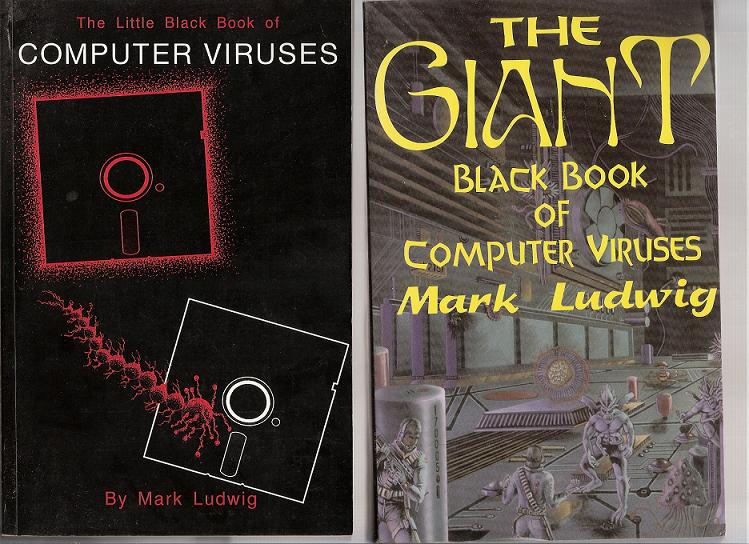
I first came to know the man in 1992, around the time of John McAfee’s hyping of the Michelangelo virus. I was interested in these contagious programs and found there was little information on their innards, their exact programming. Ludwig had written The Little Black Book of Computer Viruses, pictured, and it came with compilable source codes for a few simple viruses. (Two were basic DOS viruses. Two others, more accurately, worked at the level of the BIOS — since they operated from the boot sector of hard disks and floppies. This was the most effective method of virus spreading prior to common use global networked communication. There was a slang term to describe it — via sneaker net — or the running of disks and diskettes between machines.)
Ludwig sent me a copy of the book. This was forbidden stuff in 1992, you didn’t get malware every other day as an attachment in your spam folder, and it set me on a path into the virus underground, the results of which were published in my old virus-code Crypt Newsletter and, later, The Virus Creation Labs, which Ludwig published.
Although I have no figures, the original The Little Black Book (first edition is pictures, later editions revised the cover art) sold enough to launch Ludwig’s publishing company and make him infamous. For a time, he was successful at riling the anti-virus industry whose members were often compelled to purchase his CD-ROM virus collections so their programs didn’t miss anything.
The computer viruses in The Little Black Book were fairly simple by today’s standard. All written in assembly language, two file infectors didn’t do much of anything except slowly infect other small programs. One simple boot sector infector, called Kilroy, never spread. It had a habit of landing in a place on the hard disk the PC used as book-keeping for your files. And that immediately killed everything, requiring a clean-up.
However, the last virus in the book traveled around the world on floppy disks and diskettes. Dubbed Stealth.Boot.C, it was successful in the wild. A couple years after The Little Black Book was published I found from a colleague that it had infected quite a few PCs at the Washington Post. The friend remarked it was discovered because it often corrupted diskettes which were full of data.
The virus hid itself by copying part of its code to the data sectors on these diskettes. And if the diskette was full or near full when the virus tried to infect it, data was overwritten and lost.
From 1990 to 2002 Ludwig wrote virus black books, including even a dense, tangled volume on them as artificial life interleaved with a discussion on intelligent design/creationism. (It was uncharacteristically unpopular with the usual hacker crowd that bought his paperbacks.)
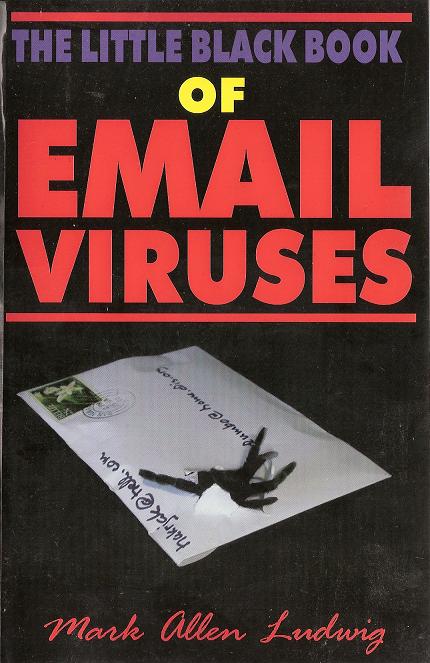
The last Ludwig volume was The Black Book of E-mail Viruses (also pictured).
By the time it was printed Ludwig had moved to Belize. Prior to 2000, he told me he thought the US was either going to fall or descend into total chaos and tyranny during a Millenium Bug crisis and occasional self-published pamphlets reflected this belief. Whatever the case, he wanted out of the country.
And so Ludwig left with his family to make a home in Belize where he pursued a hard fundamentalist Christianity, a life of faith (writing a couple more extreme books on this subject) and the building of geodesic domes.
Ludwig’s American Eagle, which an interesting publisher, was not the best place for my kind of book. The audience was all wrong, terribly so, now a matter of bemusement more than regret. You need a sense of humor to get what I did. Publishing black books on computer viruses was mostly for a totally humorless audience.
Indeed, a few years after the publication of VCL the company’s bestseller was a deplorable thing called Civil War II, a “think piece” on an alleged coming race war in America brought on by Hispanic gang revolt in southern California.
It was big with neo-Nazis.
I have a complete set of the black books of computer viruses and they indeed remain unique things. (Interested? They’re all mint to new. Plus you get an official GS “I was there” provenance. I might let go of them for a handsome figure.)
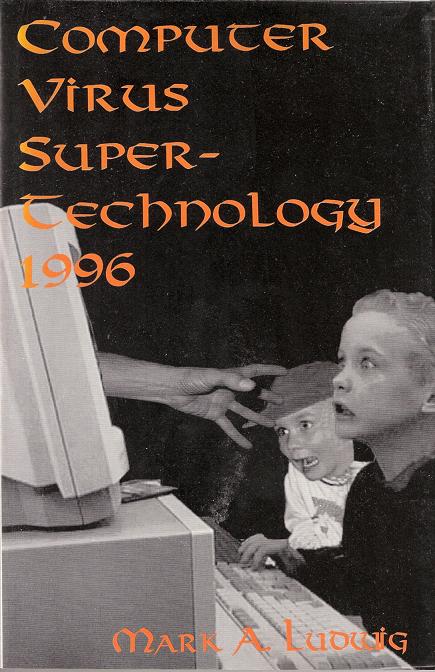
A new copy of Computer Virus Super Technology — 1996 reads “It is being published in a strictly limited edition of 500 copies and sold by invitation only to qualified people.” My copy is marked “review” in Ludwig’s handwriting. A collectible edition is billed as selling for 780-some bucks on Amazon.
Computer Virus Super Technology sold for $395 (see the back cover snap) which came to about two dollars/page although it was advertised, pre-publication, at a discounted $99.
In The Little Black Book of E-Mail Viruses, Ludwig’s last in 2002 — published from Panama, the author writes about progress and his philosophy:
[The Internet] has greatly increased the speed at which information flows and is generated. So one the one hand, a fairly simple virus can infect a million computers in a week, whereas that might have taken a year in the past. On the other hand, if a virus exploits a certain security weakness today, that weakness can be patched up by a software vendor this week and made widely available by automatic internet update next week …
These facts demand a different approach to learning about viruses. Frankly, I could write a book that contained examples of viruses that could be typed into your computer and let loose which would be fully capable of destroying the data on 100 million computers in one week. The problem is, first, that I don’t want to be responsible for doing that, and I know some idiot out there somewhere would actually sit down and type in anything I printed and send it on its merry way without having a clue to what he was doing. So it would be irresponsible to print such code. But secondly, this book would become obsolete after the idiot did that because it would force vendors to change programs so these viruses no longer worked.
So Ludwig asked readers to think of viruses more “conceptually,” to do a little of the mental work themselves. For this purpose, he included exercises.
“Get on the Internet and sleuth around with a search engine to see if you can locate a copy of the source code for the first generation file infecting virus called Jerusalem-B,” Ludwig wrote, for the first such exercise.
Now it’s an elementary task.
Time blows away everything. The physical reality of these books and what they contained are difficult to describe to people who are now growing up on smartphones and iJunk. Will apps for doing stupid, non-essential and unproductive things outnumber trivial PC viruses? Yep, and soon.
John McAfee’s goose is now well and truly cooked with the media. Few trust what he writes or says and the consensus opinion, although not always flatly stated, is he’s a drug addict despite regular denials. The media in the US realizes the truth is impossible to get from him since so much of his life has been devoted to unusual media deceptions.
In this, McAfee resembles one part of very old hacker culture typified by those who got some of their kicks through a kind of malicious and reflexive horse-shitting and ranking on acquaintances.
Eventually, it always backfired. And so it has for the ex-anti-virus tycoon.
Before he went underground, Mr. McAfee led a noisy, opulent and increasingly stressful life here [in Belize]. He was known for the retinue of prostitutes who he says moved in and out of his house …
Some McAfee watchers have a different theory — namely, that he grew paranoid and perhaps psychotic after months of experimenting with and consuming MDPV, a psychoactive drug. These experiments were described in detail by Mr. McAfee himself, under the pseudonym “Stuffmonger??? in a forum on Bluelight, a Web site popular with drug hobbyists.
So, here’s one hypothesis: Rich man doses himself to madness while seeking sexual bliss through pharmacology. Then shoots neighbor in a rage. Case closed, right? Ah, but those Bluelight posts were a ruse, Mr. McAfee would later blog …
Throughout his varied, occasionally confounding and hoax-filled career, the one constant has been a genius for self-promotion.
Mr. McAfee bought this [Belize] property four years ago and, like much else about him, the reasons for his relocation, and what he was doing here, are a bit murky.
What is certain is that he bought a water taxi service and started a couple of small local businesses. The most ambitious was QuorumEx, a biotech start-up that aspired to develop natural antibiotics with plants in the Belizean rain forest …
The idea for the company made a certain sense: a guy who had spent years fighting computer viruses turns his attention and talents to combating bacteria. [Actually, it makes no sense. The two have nothing in common. I learned bacteriology as an avocation, about computer viruses as coincidental accident. And there’s no connection in which knowledge about one leads to knowledge about the other.]
Whether these Bluelight posts [by the anti-virus tycoon on ‘bath salts’ use] were just a charade, as Mr. McAfee contends, is impossible to say. But Dr. Paul Earley, an addiction specialist in Atlanta, said that MDPV users commonly rhapsodize about their early experiences, claiming the drug makes them alert, activated and in some cases fantastically randy.
“That’s part of the danger,??? Dr. Earley said. “The absence of any apparent side effects lures users into heavier and heavier doses and at some point, for reasons we don’t fully understand, MDPV becomes extremely toxic. Users become psychotic and paranoid. They hallucinate monsters. Often they think the police are after them. That is the classic MDPV profile.???
In 1992, the same year [McAfee Associates] had gone public, he began hyping the threat of a virus called Michelangelo, contending in television and newspaper interviews that it would waylay millions of computers.
The scare came and went with little notable impact, other than the one it had on the balance sheet of the company (very positive) and the reputation of Mr. McAfee (very negative).
Read all of it. If there’s a way to write something more damning and which, essentially, has the ring of truth, I don’t know it. By the end of the piece it’s clear David Segal, the Times reporter, has had all he can stand of the legend.
Again, McAfee is tied to drug runners, addiction, seedy bribery and a taste for young prostitutes. His blog, although occasionally amusing, instead of revealing any compelling counter-story has been a public relations disaster.
There may be a book in the shabby crack-up of John McAfee’s life but it won’t be successfully done by an amateur and peddled as an R. Crumb-like graphic novel. There’s no new Hemingway or Hunter Thompson in the pipeline, no Fear and Loathing in Ambergris Caye.
McAfee explained that infectious bacteria become dangerous only when they multiply to a certain concentration, at which point, thanks to a process called “quorum sensing,” they collectively shift to a pathogenic mode. The signal that modulates this response is a certain chemical pheromone — if a drug can block its action, the bacteria will never become dangerous. And because no bacteria are killed, the accelerated evolution that results in antibiotic resistance never occurs.
Yes, all bacteria are good little pups until they agree, in a big group, not to be. Quite.
While the reporter isn’t quite up enough on science to immediately call bullshit, he does get at it another way in looking at the man’s history and ways prior to his arrival in Belize.
Back at the end of 2010 I enumerated a year end list — the biggest threats to the nation’s security. They were all internal and that old list is here.
All the threats still exist. But number 4 on the list — the Republican Party — has climbed to the top. And that is because since December 2010, the stakes have become higher, the disasters greater. Even less has been done.
At the time:
The Republican Party is a threat to security. And not solely because of its descent into right-wing extremism …
As the party that denies science, one that will put people in committee chairmanships overseeing science and technology issues in the House who are basically opposed to science whenever it contradicts their political views, the GOP poses a threat to America’s future.
You can’t have a forward-looking and capable nation with people in power who truly believe global warming and evolution are hoaxes.
During the past election, global warming was a third rail issue. The President would not speak of it.
In fact, about the only thing he would talk about with any connection to it was how avid a developer of fossil fuels he would be. And Mitt Romney made a joke of global warming it at the Republican National Convention.
And then came Sandy, a storm so violent it delivered notice that in the future there would be more of the same.
The nation’s lifelines — its roads, airports, railways and transit systems — are getting hammered by extreme weather beyond what their builders imagined, leaving states and cities searching for ways to brace for more catastrophes like Superstorm Sandy.
Even as they prepare for a new normal of intense rain, historic floods and record heat waves, some transportation planners find it too politically sensitive to say aloud the source of their weather worries: climate change.
Political differences are on the minds of the American Association of State Highway and Transportation Officials, whose advice on the design and maintenance of roads and bridges is closely followed by states. The association recently changed the name of its Climate Change Steering Committee to the less controversial Sustainable Transportation, Energy Infrastructure and Climate Solutions Steering Committee.
Still, there is a recognition that the association’s guidance will need to be updated to reflect the new realities of global warming.
In the immediate future, global warming is going to cost life. It means the continuing destruction of infrastructure on a national scale. We can only cope with it.
But at this time the gift of the Republican Party has made movement on the issue, except in sneaking inches by government agency, impossible. The GOP has successfully convinced almost half the nation to share in its dangerous know-nothing-ism, aided and abetted by reactionary mega-corporate interests, plutocrat money and the fossil fuel industries which choose to maintain a status quo at the expense of everyone else.
“[Several] climate scientists say sea level along New York and much of the Northeast is about a foot higher than a century ago, mostly because of man-made global warming, and that added significantly to the damage when Sandy hit,” wrote the AP.
Yet, “In conservative states, the term ‘climate change’ is often associated with left-leaning politics … Planning for weather extremes is hampered by reluctance among many officials to discuss anything labeled ‘climate change’ … The Obama administration has also shied away from talking publicly about adaptation to climate change. Transportation Secretary Ray LaHood’s office refused to allow any department officials to be interviewed by The Associated Press …”
It is not a bipartisan issue. The Republican Party and its bankrollers are entirely responsible for paralyzing a national response to global warming and accurate assessment and preparation for catastrophic weather. Democratic politicians won’t address it because to speak of it immediately mobilizes millions of dollars against them in re-election campaigns, all furnished by the radical right.
If it were Switzerland, Luxembourg or Andorra perhaps this would not matter. But we are not those countries and it very obviously does matter.
And it should come as a source of great outrage to the American people that the Republican Party would appoint a science-denier, Lamar Smith of Texas, to chair that body’s science panel. One can look at it as purely a political step taken to help guarantee paralysis as a national response.
The paralysis also infiltrates security and mainstream pundits.
“The U.S. must meet challenges such as climate change … says Patrick Doherty,” reads the caption under a photo of wreckage.
“Climate change is already with us,” Doherty writes. “Superstorm Sandy, the Derecho, Arctic melting, and droughts in the Midwest, India, China, and Russia this past year confirm the scientifically proven trend.”
Nowhere in the piece does Doherty acknowledge the political obstacle, the Republican Party, which has made dealing with it, even in some small ways, virtually impossible.
In fact, Doherty points to a column from Lloyd Blankfein, the CEO of Goldman Sachs, as something which may carry good advice on meeting American challenges. His use is to imply how the US could mobilize business capital by, for example, giving a corporate tax break to America’s big multi-nationals. But the Blankfein column is more interesting for how anti-solving problems it is.
For the first time in several generations, it has become clear that abundant domestic energy resources are within our reach, and that we have the technology to responsibly and safely extract it. The government needs to work with the private sector to implement effective and far-reaching policies to develop these resources.
That’s what you call a gold-plated recommendation for expanded use and mining of fossil fuels. Call it the accelerate-and-exacerbate-global warming answer to the problem of climate change. Blankfein, of course, does not have to worry about this. When climate change turns the Manhattan neighborhood of Goldman Sachs into a skyscraper version of Stiltsville in the Biscayne Bay, he will be gone.
You also might not have noticed that we’re barreling toward a “world of unprecedented heat waves, severe drought, and major floods in many regions.” Here in Washington, we’re too busy to pay attention to such trifles …
Meanwhile, evidence mounts that the legacy we pass along to future generations will be a parboiled planet.
But even Robinson can’t bring himself to write that it’s the GOP that has derailed the matter in the US.
To his credit he recommends the President do something:
And this is why President Obama should devote his next State of the Union address to climate change. He understands the science and knows the threat is real. Convincing the American people of this truth would be a great accomplishment …
The President has won re-election. There is no further political cost the GOP can extract from him. Telling the people about global warming in no uncertain terms is something he can do. Barack Obama can spell out who has blocked action, the very anti-science beliefs of the Republican Party, who supports them, and what the consequences have been at the federal and local level.
What was the Obama administration’s effort to battle climate change, or at least increase informed recognition of it, in the last year?
“Fueled by global warming, polar ice sheets in Greenland and Antarctica are now melting three times faster than they did in the 1990s, a new scientific study says,” reads a story, today, from the AP.
“Greenland is really taking off,??? National Snow and Ice Data Center scientist Ted Scambos told the news agency. Scambos is a a co-author of the paper referenced by the AP and published in the peer-reviewed journal, Science.
So if many in our country think that putting a modern Republican in power is a way to move the place forward, to help it deal with the very complex global problems with which it is currently faced, they’re one with entropy, which is the falling apart of everything, from order to disorder, until there is nothing left. That’s a tragedy and we should not delude ourselves that such actions, behaviors or opinions defend anything worthwhile.
Mr McAfee is on the run, fearful for his life and without a doubt in his mind Belize authorities are determined to kill him …
Belize police confirmed that authorities were searching for Mr McAfee but clarified that he was not a suspect at this time. On Wednesday police told the FT they had detained six people as part of the investigation including William Mulligan, 29, who is Mr McAfee’s bodyguard. He was arrested along with his wife, Stefanie, 22, and both have been charged with possession of arms and ammunition without a licence …
“Only last week, [McAfee] bought 40 stun guns and flashlights for the local police and yet he lives in fear of a police vendetta,??? [a local real estate agent told the FT]. “He is an extremely intense man – a tortured genius.???
From WhoisMcAfee, events continue:
Today [November 29], at 10:45 A.M, the GSU and the Coast Guard raided my property in San Pedro. They confiscated approximately $400,000 worth of property – cameras, computers, police gear purchased for donations (Note: I had donated tasers, pepper spray, to the SP Police department 4 weeks ago) and other items. They spent 3 hours ransacking every one of my buildings. This is the 8th search of my property since my disappearance. It is certain, in my mind that something or other was planted during this search. What it may be, I have no clue. This is the first time that they have openly taken items from me since the first raid in April of this year …
My a friends in the Police department have told me a wild tale. Barely believable, but it’s from multiple sources so I have to give it some credence.
Four weeks ago I donated about $100,000 worth of equipment to the San Pedro Police department.
Among the items donated were 40 or so brand new stun guns still in the box. Someone, at some point opened one of the boxes and inserted a bag of cocaine, and then resealed the box. Four weeks later, the box is opened and discovered. Among the items taken from my residence were close to 200 additional stun guns, still in the box, vallued at close to $80,000.
One of two things: the drugs were planted in order to give an excuse to confiscate more of my property (they have never returned any of my property confiscated during the April raid), or they intend to charge me with cocaine trafficking.
One may meditate on the revelation that John McAfee possessed 240 new stun guns, $80,000 worth, at a resort home. But this is a minor quibble.
Having issued a denial of a raid on McAfee’s property, the ex-anti-virus king has begun to post YouTube recording — audio only — of eye witness accounts of the raid, starting with the testimony of his girlfriend’s father.
“You are, by and large a kind and supportive group of readers,” McAfee writes. “From your comments, many of you are brilliant and talented. Many of you occupy positions of importance. All of you have hearts, and your loves and hopes, your dreams and ambitions, fears and attachments are the same as every occupant of this country who suffers under burdensome oppression [sic]. We are all of us, throughout the world, one people.”
My satellite snap from Google maps probably properly identified his Ambergris Caye villa in Belize.
It also discusses property in Molokai — which he is said to have never moved into — and a palace built in New Mexico. (Readers will remember his fabricated Molokai Island Times press pass.)
“[It is] in Belize that he or may not have lost his mind, killed his dogs, his neighbor, then gone on the lam … McAfee’s epic rise to fame and fortune is officially in free fall,” reads the piece.
Ex-anti-virus king John McAfee is now making the rounds of internet radio, presumably to tell his lengthy story.
And who has he chosen?
The leader of the tin foil hat demographic, Alex Jones. And some guy who was a color commentator for Ultimate Fighting, from the looks of it, a steroidal goon slightly notorious for “choking out” people in video on YouTube.
No links.
With regards to being taken seriously, these were unhelpful choices. That’s my free advice for the day.
Some hackers, a special few — not all, are determined to push the outermost boundaries of innovation. So they busied themselves with the task of breaking into hotel rooms.
Now, at last, having definitively proven they can defeat the locks on posh hotel room doors, who knows what technological mileposts will be passed next? Whooosh! Feel the relentless wind of progress blowing dust and dog dirt in your face!
September brought a series of mysterious break-ins to the Hyatt House Galleria in Houston, Texas. In the latest, a 66-year-old woman’s laptop was stolen from her room, and the lock’s records showed that no key, be it the woman’s, the maid’s, or a duplicate, had been used.
Police told NBC News that they arrested Matthew Allen Cook on Oct. 31, after the stolen laptop showed up at a pawn shop …
The lock in question is from Onity, a major supplier of electronic and keycard locks for hotels like the Hyatt. Cody Brocious, a software engineer at Mozilla and hobbyist hacker, demonstrated a vulnerability in many of their locks in July, afterwards showing a refined technique onstage at the Black Hat hacker conference.
Brocious, news articles say, sold his digital hotel room door opening method to a locksmith training business for $20,000.
From the recent academic policy report, “US Economic Growth Over? Faltering Innovation Confronts the Six Headwinds”, page 8:
Attention in the past decade has focused not on labor-saving innovation, but rather on a succession of entertainment and communication devices that do the same things we could do before, but now in smaller and more convenient packages … These innovations were rapidly adopted, but they provided [only] new opportunities for consumption on the job and in leisure hours …
Lads, you can do this at home! Take a Google satellite-view beach tour stroll along the northern part of Ambergris Caye in Belize and see if you can spy John McAfee’s center of adventure and intrigue.
The above snapshot may not be McAfee’s home north of San Pedro. But judging by a photo posted on his blog here, it is something of a match.
If you care to waste the time, try it yourself and see if you agree or find a better candidate. At max magnification, it take some time to scan the coast north of San Pedro for about six miles to approximately where John McAfee’s neighbor is said to have been murdered in news reports.
“Sam and I began our ungerground oddessey [sic], not on the day after Mr. Faul’s death, but on Monday, the 15th of October, early in the morning,” reads a recent entry.
As far as being on the lam and intriguing goes, it’s not a bad place to be.
The McAfee blog has been hit or miss. It could use some better copy-editing and style. And McAfee has informed readers all the stuff about drugs posted on another Internet site was a practical joke, so descriptions of what’s real and what’s not are of an undetermined elasticity. For example, McAfee exhibits his enthusiasm for forged press identifications in a photograph. His display of, one presumes, a forged laminate attributed to “The Molokai Island Times” of Hawaii, an inactive newspaper which apparently exists only as a Facebook website with 189 “likes” is here.
Readers will note the curious nature of a Colorado address on the “Hawaiian” document.
More recently McAfee has announced the arrival of a Financial Times of London reporter who will, presumably, investigate and report the truth of the events now surrounding the life of the ex-anti-virus king in Belize.
Over the objections of its authors, the Department of Homeland Security classified a 2007 report from the National Academy of Sciences on the potential vulnerability of the U.S. electric power system until most of it was finally released yesterday.
The report generally concluded, as other reports have, that the electric grid is lacking in resilience and is susceptible to disruption not only from natural disasters but also from deliberate attack.
But even though the report was written for public release, the entire document was classified by DHS and could not be made available for public deliberation. Amazingly, it took five years for the classification decision to be reviewed and reversed …
The report contains no restricted information.
In the aftermath of the Sandy natural disaster, it has again been made obvious to some that the electrical grid can be damaged. And that electrical power, if it is disrupted for a long enough period of time, can result in death or the serious damage to the health of citizens in our modern world, particularly if they are old, sick and dependent on technological services.
For example, from the opening pages of the report:
“If such large [theoretically terrorism-caused] outages were to occur during times of extreme weather, they could also result in hundreds or even thousands of deaths due to heat stress or extended exposure to extreme cold.”
One of the recurring memes of the Cult of Cyberwar is the insistence that the electrical grid can be disrupted with little effort by cyberattack on the infrastructure.
This pernicious meme has created the impression that catastrophically turning off the electricity in parts or all of the United States can be done by many, simply by pushing software buttons from the internet.
The NAS report has this to say on “cyber vulnerability:”
If they could gain access, hackers could manipulate SCADA systems to disrupt the flow of electricity, transmit erroneous signals to operators, block the flow of vital information, or disable protective systems. Cyber attacks are unlikely to cause extended outages, but if well coordinated they could magnify the damage of a physical attack. For example, a cascading outage would be aggravated if operators did not get the information to learn that it had started, or if protective devices were disabled.
That’s about it, essentially.
The report describes the biggest hazard to the electrical grid as physical, not digital.
Physical attacks by terrorists, which are deemed not likely but possible, could — for example — destroy critical high voltage transformers. (The physical failure of such a transformer serving New York City, by Sandy and rising water levels, was recently and repeatedly on television and preserved on YouTube.)
“Although major terrorist organizations have not attacked the US power system, such terrorist attacks have occurred elsewhere in the world,” reads the report. “Simply turning off the power typically does not terrorize people. However, the United States should not ignore that possibility of an attack that turns off the power before staging a large conventional terrorist event, thus amplifying the latter’s consequences.”
The report lists many instances of cascading power failures worldwide.
Interestingly, it mentions the western United States, from 1998 to 2001, was afflicted by “rotating blackouts because of summer prices.”
Two days of rolling blackouts in June 2000 that marked the beginning of California’s energy crisis were directly caused by manipulative energy trading, according to a dozen former traders for Enron and its rivals.
The blackouts left more than 100,000 businesses and residential customers in the dark for parts of two days, trapped people in elevators and shut down some offices of high-tech companies such as Cisco Systems and Apple Computer, as well as chipmaking plants, costing millions of dollars in lost revenue.
The traders said that Enron’s former president, Jeff Skilling, pushed them to “trade aggressively” in California and to do whatever was necessary to take advantage of the state’s wholesale market to boost the price of Enron’s stock .
The NAS report also discusses the risk posed by such insider attacks and malfeasance. It characterizes these attackers as “Participants in power markets seeking a predatory competitive economic advantage by disrupting the operation of other market players …”
I met Timesha 2 years ago while writing a story about the Mennonites of Belize. The Mennonites are austere and hard working, yet each Friday, many of the men allegedly went to a local bar in Orange Walk, drank, paid women for sex, and partied. I found it hard to believe, so I arranged to take photos at the bar on Friday mornings to help with my story. I showed up for five weeks straight before I finally got the photo I wanted …
Timesha works as a “bar girl??? in lover’s bar. She is not a prostitute. She is young and pretty and men may sit with her providing they simply buy her a beer. When the beer is finished, they must buy another or leave the table.
Emphatically proving that America’s rich white guys who flee to Belize aren’t like you and me. They really, really go for the impoverished girls, among other things, apparently.
To Have and Have Not is a movie with Humphrey Bogart and a very young Lauren Bacall, a very very loose adaptation of Ernest Hemingway’s book of the same title, spottily rewritten for the screen by William Faulkner.
Briefly, it’s a poor man’s repeat of Casablanca, only Bogart gets the girl after being chased by the authorities in Vichy-controlled Martinique.
Bacall was 19 at the time. Bogart was 45 and the film capitalized on their romance in real life.
But The Hinterland isn’t quite the same thing. No Walter Brennan as the drunk buddy, for one thing.