02.10.10
Posted in Rock 'n' Roll, Sludge in the Seventies at 11:24 am by George Smith
Well before Bill Cosby’s enshrinement as a TV star in the Huxtable family, DD thought he was hilarious.
If you were a smartypants kid living in Pennsylvania within easy travel of Philadelphia in the mid-Sixties, Cosby was the homegrown comic for you.
The most played Cosby vinyl in the Smith household, between my brother and I, was “Bill Cosby Is A Very Funny Fellow Right!” — a live recording of him doing his thing at the Bitter End in NYC.
But there was one Bill Cosby record that was off style.
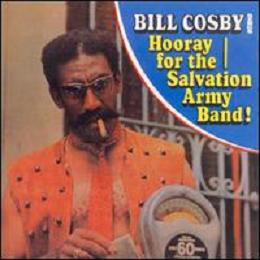
“Bill Cosby Sings Hooray for the Salvation Army Band!” was an album of Cosby singing — or yelling and chanting if you prefer — old favorites, many with his own lyrics tacked on, while backed by a funk band.
Viewed with a fishy eye by some regular fans, it was at first perceived to be a joke album by a jokester putting one over on the same fans.
It wasn’t.
DD was introduced to it by fellow Pine Grove Area School District student Dave Berger. Berger showed up in class one day reciting the lyrics to the title track. Even without music, they were a laugh riot if you were in our state of mind.
As we were easily entertained, Berger’s description of Bill Cosby singing about “stealing tires” and getting ready to “have a little sin” set to an unusual interpretation of the Jimi Hendrix Experience’s “Purple Haze” sounded top shelf — not a piece of eye-rolling junk to try your patience.
After that, it was about a week before I had convinced my grandfather to drive me to Pomeroy’s in Pottsville to secure a copy.
In the Eighties in Bethlehem I always wanted to perform “Hooray for the Salvation Army Band” but the Highway Kings would have never went for it.
The song was recorded using Roger Linn’s Adrenalinn III magic box. The Adrenalinn III is a guitar amp emulator and drummer coupled to beat-synchronized multi-effects. What that means is you can play a guitar through its digital selection of vintage pieces of equipment, like amplifiers chosen for their rock and roll history and tone. Through the software and processing power in the Adrenalinn III’s chips, your playing is lashed to the beat of any song you would like to record or perform.
The Adrenalinn has been around for years, upgraded intermittently but very effectively by its designers. It is the embodiment of sophisticated music machine fun and it’s hard to imagine making a recording or writing a new tune without employing it.
So the Adrenalinn III was the perfect tool for “Hooray for the Salvation Army Band” as it provides settings and sound ideal for something loosely based on “Purple Haze” — the original’s basic drum track, plus the old Marshall amplifier and octave fuzztone used by Jimi Hendrix.
Everything on the track (with the exception of the “Bringing In the Sheaves” punchline) was sent through the Adrenalinn III.
If you have Cosby’s original album — it is back in print — you know the tune was interpreted as garage-style funk rock. DD has altered it slightly, toward a more psychedelic hard rock flavor.
Hooray for the Salvation Army Band MP3.
A variety of endorsements of the Adrenalinn III — including mine.
No, you’re not seeing double. This is an old post migrated from DD’s old Blogger-administered site. In advance of Blogger’s shutdown of FTP publishing.
Permalink
02.09.10
Posted in Crazy Weapons, Extremism at 8:09 pm by George Smith
Occasionally one comes across an editorial in a US newspaper that almost knocks you out of your chair.
Not often does one see an editorial-like thing condemning the usual imprecations to bomb Iran because that country will eventually launch an electromagnetic pulse attack against the United States.
How did the sane person get a permissions slip to opine?
Barry Kissin of the Frederick News Post writes:
I just read “How to Save the Obama Presidency: Bomb Iran” by Daniel Pipes, visiting fellow at the prestigious Hoover Institution of Stanford University. When I first read the title, I was certain this had to be satirical. It’s not! His first point: “[Obama’s]counterterrorism record barely passes the laugh test.
It continues:
Pipes then points out that the way for Obama to consolidate popular support is to act tough, you know, start another war. Pipes follows with the polls (Zogby, Pew, Los Angeles Times, Fox News) that all show that a definite majority of Americans favor “using the [U.S.] military to attack and destroy the facilities in Iran which are necessary to produce a nuclear weapon.”
How about this from Pipes: “Eventually, [Iran] could launch an electromagnetic pulse attack on the United States, utterly devastating the country.” And: “Taking out Iran’s nuclear facilities … would require few ‘boots on the ground’ and entail relatively few casualties, making an attack more politically palatable.” And: “Just as 9/11 caused voters to forget George W. Bush’s meandering early months, a strike on Iranian facilities would dispatch Obama’s feckless first year … ” And the clincher: “[T]he chance to do good and do well is fleeting. As the Iranians improve their defenses and approach weaponization, the window of opportunity is closing. The time to act is now … “
However, Kissin’s final line is most surprising. It is something most editors simply would not allow into a newspaper in 2010.
This is subhuman idiocy. It is also part of a long-standing pattern of criminal manipulation of the frightened and very misinformed.
Subhuman idiocy. That’s unequivocal.
The entire piece is here.
By contrast, Pipes’ material immediately gets wide duplication around the country, also immediately flying into the Jerusalem Post.
“I do not customarily offer advice to a president whose election I opposed, whose goals I fear and whose policies I work against,” he writes. “But here is a way for Barack Obama to salvage his tottering administration by taking a step that protects the US and its allies.”
When the electromagnetic pulse crazy/bomb Iran lobby launches a sally — which is does once every few months, the last one petering out in September at the Values Voter summit — it always does so with perniciously admirable efficiency.
Everyone gets on the same page and makes a push into the opinion sections of US and foreign newspapers. And it always works.
In addition, the Cult of EMP Crazy lobby always comes up with a new catastrophic meme to sell the story of Iranian-launched electromagnetic pulse doom.
Usually, it has been the story that the US will be hurled back to the time of horse and buggy transportation, water drawn from the creek and shitting in out houses or trenches filled with lime.
Now, however, there’s a new flavor of Gotterdammerung.
“EMP attack, our version of Haiti quake,” trumpeted Clifford May for the Scripps Howard News Service very recently.
He writes, and this isn’t satire:
President Obama has pledged $100 million to help Haiti recover from its recent earthquake. By coincidence, that’s precisely the amount that the [mumble] recommends be spent on measures it estimates would limit the damage resulting from an EMP event by 60 to 70 percent.
This is delivered in an essay which, as must be the case, brings up the Bomb Iran lobby’s favorite story:
Think of a blackout, but one of indefinite duration — because we have no plan for recovery and could expect little or no help from abroad.
The EMP commission also reported that Iran — which is feverishly working to acquire nuclear weapons — has conducted tests in which it launched missiles and exploded warheads at high altitudes. And the CIA has translated Iranian military journals in which EMP attacks against the U.S. are explicitly discussed.
Might Iran’s rulers orchestrate such an attack if and when they acquire a nuclear capability?
That is a heated debate among defense experts.
That opinion piece is here.
For regular readers of DD blog and longtime observers of the the Washington DC Doom Club, May was warning about anthrax just in November.
“A scenario perhaps even more frightening: terrorists using biological weapons, setting off epidemics of smallpox, Ebola virus or other hemorrhagic fevers; a crop duster spreading 10 pounds of anthrax causing more deaths than in World War II.”
That ran in the National Review on-line, under the heading — Apocalypse When?
Alert readers will notice May always resorts to writing that potential enemy strikes will cause more casualties than America suffered in World War II.
On electromagnetic pulse attack by Iran, our equivalent of the Haiti quake , May writes:
When you consider that such an event — whether naturally occurring or a “man-caused disaster??? — could cause trillions of dollars in damage and claim more lives than were lost in World War II …
Readers will have also noted that it’s not really a coincidence that Dan Pipes’ Bomb Iran/EMP doom essay also ran in the National Review.
It’s what’s called a rigging. And one can’t help but applaud the EMP Crazy lobby’s talent for it. They’re really good.
Cult of EMP Crazy — from the archives.
Permalink
Posted in Rock 'n' Roll, Sludge in the Seventies at 5:25 pm by George Smith

Dick Destiny plays Needle and Spoon
Here!
“Needle and Spoon” first appeared on Savoy Brown’s Raw Sienna album from 1970. Penned by Chris Youlden, the band’s gruff but soulful blues shouter, it has always been one of my favorite blues rock tunes.
I’ve kept the fast shuffling beat, added a bit more thumping acoustic guitar, plus a short fuzz solo tossed in behind a vocal imprecation. For just that old-timey feel.
No one in this edition of Savoy Brown was a heroin user so rack it up to bumping into other rock ‘n’ rollers in 1970 Blighty who were. There was no shortage.
For extra fun, consider the single to have a virtual B-side, “Internal Revenue Boogie,” here.
Jolly good!
Gear: Roger Linn Design Adrenalinn III, lotsa guitars — at least three.
Permalink
Posted in War On Terror at 12:01 pm by George Smith
Bed-wetters and office clowns not sought.
The next story took over a year to develop and carry out. I was writing for a newspaper’s features section but didn’t tell anyone about it until the work was finished.
It remains a great read, one I’m still very proud of. And it’s relevant to our current national security problems over a decade after publication.
“Name five CIA experts on anything. I can’t do it,” said a former CIA analyst to the New York Times [on one Sunday] (“Langley, We Have a Problem,” Tim Weiner).
I write on substantive national security issues for the think-tank GlobalSecurity.Org and get quoted on them. While I’m not secret and classified, I did and do what CIA-men are supposed to do well but often don’t seem to.
On the old blog, this story steadily gained in readership over the past couple years.
And so I’ve elected to reprint it on the new blog, migrating it here for the eventual day I abandon Blogger.
Today, it’s one of the more frequently read pieces by people who apparently are searching for information on how to get hired by the CIA.
Good luck with it. I’ve no idea if the procedures described here are still in place. More’s the pity if even a few are.
Anyway, can you imagine DD ever working for the CIA? [Insert crazy horselaugh.]
(1992, Allentown) So you want to be a spy? And you’re sure the place to go is the CIA!
The CIA is interested in hearing from you. It interviews thousands of Americans for jobs as spies, intelligence analysts and technical specialists every year. But because of its classified mission, hiring methods are unusual and Kafka-esque, taking at least a year to complete and bound in smothering bureaucratic process, comic ineptitude and secrecy.
Although the number of people employed by the CIA is classified, it regularly recruits on college campuses and through the job listings in major metropolitan newspapers. A recent series of advertisements aimed at minorities in magazines like Ebony drew spectacular media attention, but the typical CIA ad is bland and unassuming, easily blending in with countless other corporate calls for highly-trained, college- educated Americans.
A year ago, one such ad ran in The Philadelphia Inquirer. Candidates were encouraged to send resumes for consideration to a post office box drop in Pittsburgh, one of the agency’s regional personnel clearinghouses. Candidates would be required to undergo a rigorous physical examination and polygraph test, the ad warned ominously.
I forwarded my resume to the CIA mail drop, listing my qualifications as a scientist and journalist with the reasoning that these talents would be useful in analysis.
Apparently, the CIA’s personnel staff agreed. They got back to me in about a month and in so doing, began a unique series of communications.
Candidates, you see, are not contacted directly by the CIA. Instead they are delivered mail that requests them to contact an agency worker by telephone within a certain time frame. The contacts are often anonymous. For example, prospects whose last names began with “S” were asked to phone “Bobbi – Program Officer” at the CIA’s Stafford Building in Tyson’s Corner Center, VA.
The initial interview with the CIA usually involves a type of cattle call. About a year ago, 30 of us met in a room at The Valley Forge Convention Center. There we underwent preliminary screening from a CIA team led by Pittsburgh-based representative. The team included workers from the agency’s directorates of intelligence, operations and science and technology, including one agency employee who looked over my resume, saw that I worked at a newspaper and added that he had come to the agency as a newsman, too.
It was the job of this spy and his colleagues to weed out potential crazies and issue to the remainder the agency’s personnel Holy Grail, the 30-page Personal History Statement (PHS).
The PHS is an inventory that scrutinizes all aspects of the job candidate’s professional and private life. It becomes the basic curriculum vitae used during hiring and the template for the CIA’s security team during its investigation of potential agents.
“Don’t leave anything blank,” warned one of the spies balefully at the convention center. “I didn’t think anyone would really sit down and go over the whole thing when I started, but believe me, they do.”
The PHS requires the spy-in-waiting to designate references in a number of categories, including family members, professional acquaintances and personal (not family) acquaintances who have lived in close proximity to the candidate for a year or two.
“This is so the agency can call up your neighbors and ask them if there’s loud music and blue smoke coming out of your front door on the weekends,” one of the CIA handlers cracked.

The candidate is asked to document any record of criminal activity including theft, traffic violations, sexual deviance and perversion, unlawful drug use or undue publicity surrounding a divorce or civil suit. There is a battery of medical inquiries probing the candidate’s injuries and hospital visits, mental stability, prescription and non-prescription drug use, gastro- intestinal health and nocturnal micturition frequency. (The last seemed aimed at uncovering whether the candidate had an enlarged prostate or was a chronic bedwetter.)
The candidate is warned that the veracity of his statement is liable to be tested by polygraph.
Accompanying submission of this dossier to the CIA are any collegiate transcripts and a long writing sample dealing with any topic of interest to intelligence workers. For example, writing about home grown pilot plants designed for the production of biological warfare agents in Third World countries is appropriate if you’re applying for a job as an analyst.
All candidates were warned not to inform anyone except close family members of their CIA screening. The CIA encouraged the use of a cover like “the government” or “Department of Defense” when notifying those who needed to be designated as references.
A few months after submission of the personal statement and transcripts, the candidate is likely to get a phone call from CIA security who identifies himself only as a member of “the Agency.”
His job is to verify and embellish some of the information included in the PHS, specifically those sections dealing with criminal activity and homosexuality.
In my case, the agent was particularly interested in a reference to recreational marijuana use in college.
“How many cigarettes would you say you smoked?” he asked. He was also interested in whether or not I had sex with men.
Satisfied, the agent continued by inquiring about drinking.
“The Agency’s position in these matters is one of abstention enforced by testing,” he said. [Sure, bro’. ] That concluded the interrogation.
“You have a nice day,” said the spy before hanging up.
Most of this preliminary screening is in response to much publicized problems the CIA has had in the past with the penetration by the criminal or mentally ill. James Jesus Angleton, the feared head of the CIA’s counterintelligence wing and one of the most powerful men in the agency during the height of The Cold War, left his office in disgrace, having acquired a reputation, documented by journalists Thomas Mangold and Seymour Hersh, as a paranoid alcoholic and pathological liar.
If the prospective employee’s personal statement and transcripts survive the initial evaluation, he or she is given a series of aptitude and psychological tests.
Those in eastern Pennsylvania were again contacted and issued a ticket/summons for the tests, which were administered one summer Saturday morning in the physics building at the University of Pennsylvania in Philadelphia.
The testing at Penn, an all-day affair, included a series of vocabulary, simple math, reading comprehension and abstract thought multiple-choice quizzes, similar to a college aptitude test.
Also included was the California Psychological Inventory, devised by Dr. Harrison Gough, psychologist. Our copy, which had a copyright date of 1956, asked for true/false responses to a number of statements, including:
“I have wound up in trouble because of my involvement in unseemly sexual activities.”
“In high school I was often sent to the principal’s office for ‘cutting up.'”
“I sweat in even the coolest weather.”
“I believe it is every citizen’s duty, as part of the community, to keep his sidewalk and lawn neat and clean.”
“I must admit, I think people are fools who don’t think the American way is the best there is.”
“I often think people are watching me.”
“I like tall women.”
“I must admit, I don’t mind being the ‘cut-up’ at the office party.”
One can only wonder what the two women who took the psychological inventory that Saturday answered to the question about liking tall women.
It seemed curious that the agency was using a test from 1956 — when presumably very few women applied for jobs in intelligence and when being a “cut-up” in high school was one of the worst things you could be accused of – to screen young professionals in 1991.
Two other tests included a work environment survey and a current world events test, both tailored for the CIA.
For example, the work environment survey asked whether the candidates would accept a job in a foreign culture or where conditions of extreme physical hazard (presumably a war zone), unpalatable food, no sanitation or debilitating disease prevail. It also focused on whether candidates would be willing to work anonymously and without recognition for long periods of time for people they find personally repugnant.
The hardest test was the current world events quiz. It presumed a comprehensive knowledge of world politics and personalities that might only be gained from religious study of The Washington Post or a background in international relations. Actually, I thought I did rather well on it.
After the testing, a couple more months passed.
Candidates were then informed by mail whether they had been bound over for interview at CIA headquarters in McLean, VA.
During this 9-month long period, no one from the agency had spoken to me for more than five minutes.
Finally, another letter arrived. It included an appointment date with “Agency Officials” interested in discussing possible employment.
The interview was set for the week after Thanksgiving in the Directorate of Intelligence’s Office of East Asian Analysis. “Ellie” was my contact. A room was reserved for the night before at The Days Inn in Vienna, VA.
It was a 15-minute drive to the CIA the next morning. The unmarked compound is not far from Langley High School. You can tell you are there by the barricades of concrete and obstacle-wire surrounding the wooded campus.
The entrance block-house guard was supposed to check my photo driver’s license, but he handed it back and waved me through without taking a look.
The Directorate of Intelligence is a modern looking edifice of cement and green glass. At the entrance were a score of smokers bearing the same furtive, hounded look seen at other corporations where smoking within the building has been banned.
Just inside was a marble hallway containing a likeness of William Casey.
Getting to the Office of East Asian Analysis entails a check-in at reception, where I presented my papers. After a few minutes, “Ellie,” a middle-aged woman showed up to escort me.
I was issued a green piece of paper and a pass card used to get through an electronic Pinkerton security turnstile. A security man gave my briefcase the once-over. Overhead was a sign stating that passage beyond the portal conferred agreement to a search of your person, your belongings and your car at any time.
The agency has been sensitive to accusations that it’s possible to walk out of the building with highly classified materials ever since 1978, when William Kampiles walked off CIA grounds with technical manuals for the super-secret National Reconnaissance Office’s KH-11 spy satellite. Kampiles, a junior clerk, was sentenced to 40 years in jail for selling the manual to the Soviets. During the same period, 16 other KH-11 manuals disappeared and were never traced.
While I was coming in, many were coming out. No bags were checked. Later, when I left, no one asked about my briefcase.
Upstairs in the Office of East Asian Analysis, National Geographic-like photos of China adorned the walls. Documents marked “SECRET” littered the desks.
Maddie, a personnel administrator, was holding court.
In her office, I asked her if the recession had affected hiring. It had, she said. “I don’t like the word ‘down-sizing’,” she said with a glassy smile. “We call it ‘right-sizing.'”
Maddie said she couldn’t say whether the agency’s “right- sizing” involves cuts in 60 percent of prospective hires, as had been recently reported in national newspapers. But then she changed her mind and commented, “That’s a little high.”
This has created problems for the agency, she said. Since attrition isn’t removing veterans at the expected rate, it’s been difficult to bring in new people she added. Complicating matters is the polygraph and security check. “Eighty to 90 percent of the people to which the agency makes an offer fail it.”
As for where I fit into things, interest was from the China Division: Industry & Technology branch of the office.
“The section head’s not here today,” said Maddie. “But Stan will speak with you.”
Stan turned out to be an airy, blond-haired analyst with a master’s degree in international relations from American University. (Today, Stan works at a company that specializes in business intelligence. When its partners aren’t out on the golf links they will — essentially — spy on your corporate competitors and provide research assessments or teach your firm how to do corporate counterintelligence.)
“What did you say your name was?” he asked as we walked down the hall to his boss’s empty office.
Stan didn’t have my resume, my PHS or any information on my scientific background, the reason I was being interviewed, so he didn’t ask any questions, preferring instead to talk about himself.
How many scientists are currently working in the office, I finally asked.
“None,” said Stan. “That’s why we’re trying to look at some.”
The agency, Stan said, made up for this lack by sending analysts to seminars on topics the various departments may have to deal with, such as ballistic missile technology. Stan said he was glad he had finally learned what an accelerometer was and how integral design is to ballistic missile development.
I asked Stan about the polygraph screening and nature of the psychological testing.
He laughed nervously but said, “Everybody has to go through it and it’s not any fun. But security believes very strongly in it and the agency works hard to get candidates through the lie-detector. We allow them to take it three times.”
At the end of the interview, Maddie asked me to take some “stuff” over to the Stafford Building for her when I went there to collect travel expenses. A moment later she thought better of it, but supplied me with directions anyway.
Outside the Stafford Building later in the day were more harried smokers. Inside I asked for gas money ($20) and mileage. A CIA worker insisted that this be compared against the price of the lowest airline ticket from Philadelphia. I argued that this was ridiculous, to no avail.
As predicted, a telephone call to a CIA airline-ticket specialist came up with a figure far in excess of the gas money. The agent then gave me a little more than $200 of the taxpayer’s money, a generous per diem, and mileage allowance. The hotel room had been paid in advance.
A call to Maddie’s office a few days later elicited the information that there were no job openings and no hiring plans.
When I asked why, in that case, the testing and interviewing, no one had an answer except to say “the agency has to plan for every contingency.”
Permalink
02.08.10
Posted in Crazy Weapons, Extremism at 6:29 pm by George Smith
In today’s Washington Times, Arnaud de Borchgrave, often called ‘the Short Count’ behind closed doors, if he is called at all, writes about how a neocon thinks the Obama administration can save and revitalize the country.
Bomb Iran!
The Short Count writes:
Mr. Obama is floundering as he tries to reset his presidency on economics. Defense is sacrosanct. Either taxes go up, or entitlements go down, or both. On Capitol Hill, it’s still burned toast for the president.
For centuries, leaders faced with insuperable domestic problems found escape in foreign distractions. In some cases, the distractions occurred suddenly and fortuitously, such as World War II, which started in Europe and pulled America out of the Great Depression.
President Obama isn’t looking for such a distraction, but others have no pangs illuminating what they think is the way out of the “clueless in Washington” dilemma. Right-wing scholar-activist Daniel Pipes, a neocon icon, could not be more blunt: President Obama can “save” his presidency by bombing Iran. The fact that this also could cost him the presidency is not deemed worthy of discussion.
Continuing:
“Obama can give orders for the U.S. military to destroy Iran’s nuclear weapons capacity. It would have the advantage of sidelining health care, push Republicans to work with Democrats, make Tea Party-ers jump for joy, conservatives and neoconservatives would swoon ecstatically.”
In 2003, President George H.W. Bush appointed Mr. Pipes to the board of the U.S. Institute of Peace.
And what better way to promote peace than to advocate bombing. Even the President can get behind that in America.
So what else is there? Electromagnetic pulse crazy, that’s what!
To reinforce the war party’s arguments, Mr. Pipes also says that “the apocalyptic-minded leaders in Tehran” could eventually “launch an electromagnetic pulse (EMP) attack on the U.S., utterly devastating the country.” His detractors dismiss EMP alarmism as flimflam. But they are wrong. EMP is a very real concern of those who ponder future asymmetrical threats.
Those durned accusers of flimflam’d be us (as in here and here and other places) and Armchair Generalist.
To summarize: One would be hard-pressed to imagine a bigger instance in which a group of people offer themselves up for deserved ridicule.
If a thing is backed up by hard science [like global warming or evolution], the Republican party denies its existence. If, however … something [is] rather abstract to almost all Americans, rests almost entirely on theoretical prediction, is … not likely to ever occur at all, and then only in the context of what would promise to be an all out nuclear war, [like electromagnetic pulse doom], the GOP extreme right believes in it very strongly.
And so The Short Count writes, repeating the electromagnetic pulse crazy/bomb Iran lobby’s favorite script of doom:
One Scud-type nuclear missile, fired from the cargo hold of a freighter off the East Coast, set to explode 75 miles up, could fry everything electrical in one-third of the United States, from every cell phone and computer to aircraft, trains, vehicles, elevators, and the entire government, including the Pentagon.
This comes to de Borchgrave through a Pipes article in National Review.
In it, Pipes writes:
Not only does a strong majority — 57, 52, 58, 61, and 61 percent in these five polls — already favor using force, but after a strike Americans will presumably rally around the flag, sending that number much higher.
Fourth, if the U.S.limited its strike to taking out Iran’s nuclear facilities and did not attempt any regime change, it would require few “boots on the ground??? and entail relatively few casualties, making an attack more politically palatable.
DD had missed this but it’s ably pointed out by Don Emmerich here.
Cult of EMP Crazies — from the archives.
Permalink
Posted in Predator State, Satan's Bank at 3:00 pm by George Smith
“During a recent protest outside his Walnut Street bank headquarters, OneWest CEO Terry Laughlin came down with the bank’s head of mortgage services for a little face time with borrowers,” reported the Pasadena Star-News recently.
“The idea was to ‘reach out’ Laughlin said, and see what he could do or say to help them with their home loans – which they angrily – and frequently – complain have yet to be modified.”
And for the newspaper, Laughlin’s interview was an attempt to ‘reach out,’ to counter the boatload of really bad press OneWest, or as it is called here — Satan’s Favorite Bank in Pasadena — has accumulated over the past few months,
Message to CEO: It’s not gonna help.
Banksters are less popular than soiled toilet paper on the bottom of one’s shoe now. And rightly so. Nothing can change that. And this is a good thing, not a bad thing.
Nevertheless, OneWest’s CEO told the newspaper that the giant vulture capitalism bank was now a community-oriented southern California bank interested in depositors and making affordable loans. And the newspaper could but go along because to get interviews like this one, the interviewee has to know that the interviewer won’t be anything but a lickspittle. That’s how America works.
The newspaper explained:
As of December, the bank, which entered the Obama administration’s Making Loan’s Affordable Program in August, had permanently modified 1,226 loans under the program, with 23,012 in the pipeline as trial modifications. If you count the loans modified under the FDIC’s control of IndyMac before the purchase, total permanent modifications come to 15,000 …
But readers know OneWest has been mostly publicized for foreclosing on people around the country rather than modify home mortgages.
This was explained in our Satan’s Bank post thusly:
[OneWest] uses government guarantees for distressed assets in its rescue to ensure a profit on forclosures. In essence, the US government uses taxpayer money indemnifying OneWest against loss on a distressed property it owns, indeed guaranteeing a certain good amount of profit on it. It is the very essence of vulture crony capitalism and its main purpose, socially, is profit for OneWest through capitalization of the very badness of its former self through the working over of subprime mortgage holders.
“The realities of the economy – unemployment, lack of income – are at odds with a key term of the government’s loan-modification program: Borrowers who want better terms must be able to prove that their current monthly mortgage payment is more than 31 percent of their gross monthly income,” OneWest’s CEO told the Pasadena Star-News.
Dig the foreclosure news
DD dug into Google to find OenWest foreclosures nationwide during December and January.
It was at this time that negative publicity on OneWest reached something of a peak, forcing the company into a cosmetic measure. It said it would halt foreclosures during the holiday season.
If it did, it was hard to notice.
DD found OneWest foreclosures from Hawaii to Topeka to New Orleans and all the way to Vero Beach, Florida.
A Hawaii newspaper, for instance, noted OneWest owned at least 26 homes in that state. Meaning it had foreclosed on all of them.
DD found two OneWest foreclosures in Topeka — one in mid-January, one about a week ago. And one in Boulder, Colorado, last mid-month.
On December 18, national publicity over a foreclosure in San Diego forced the company into p.r. defense.
“Just in time for Christmas, Brian Wofford has learned that his large family won’t be evicted from the house he mortgaged to the hilt after it was renovated for free five years ago on the ABC show ‘Extreme Makeover: Home Edition,’ reported the San Diego Union on December 18.
“Wofford, a widowed father of eight, is in default on his Encinitas house. He owes $770,000 after he refinanced several times and took out home-equity loans to get cash.
“He has been seeking a loan modification since 2007 and stopped making payments this year. The house was scheduled to be auctioned Dec. 14, but the Woffords received a last-minute reprieve from OneWest Bank after nationwide media coverage.”
A week earlier, the New York Post ran a story on the opposite side of the country entitled: LI MOM: Bank Strung Us Out.
“A Long Island family battling runaway medical bills for their two special-needs pre-schoolers are, days before Christmas, in danger of losing their house to foreclosure after their bank offered – and then retracted – three mortgage-modification plans, the frantic mother claims,” reported the newspaper.
The story continued:
Caryn Fleming, of Miller Place, said she and her police officer husband were at first overjoyed at the lower monthly payments under the modification offers – but were then shocked back into a real estate hell when their bank, OneWest, said they didn’t qualify for any modification because they made too much money.
“They knew exactly how much we made from the beginning of the process because they gave us our mortgage five years ago,” Fleming said.
OneWest, which last month made the news after a Suffolk judge ripped up a bank mortgage because of its deceptive, underhanded ways, was dealing with 111,674 mortgages that were 60 or more days delinquent as of Nov. 30, according to the Obama administration’s Making Home Affordable program.
The bank has extended 35,315 trial modification plans but has concluded zero permanent modifications, the Treasury Department reported this week.
Because the Flemings made reduced payments for 18 months – as instructed by the bank – they have accrued $40,000-plus in arrears and are facing eviction. Fleming said she recently offered to start making full mortgage payments and to pay off the arrears next October – when her husband retires from the NYPD. OneWest rejected the couple’s offer, she said.
The Post also ran a story in late November on a judge’s reprimand of OneWest:
A Long Island couple is home free after an outraged judge gave them an amazing Thanksgiving present — canceling their debt to ruthless bankers trying to toss them out on the street.
Suffolk Judge Jeffrey Spinner wiped out $525,000 in mortgage payments demanded by a California bank, blasting its “harsh, repugnant, shocking and repulsive” acts.
The bombshell decision leaves Diane Yano-Horoski and her husband, Greg Horoski, owing absolutely no money on their ranch house in East Patchogue.
Spinner pulled no punches as he smacked down the bankers at OneWest — who took an $814.2 million federal bailout but have a record of coldbloodedly foreclosing on any homeowner owing money.
OneWest’s conduct was “inequitable, unconscionable, vexatious and opprobrious,” Spinner wrote.
He canceled the debt because the bank “must be appropriately sanctioned so as to deter it from imposing further mortifying abuse against [the couple].”
The bank is involved in a similar case in California, where it’s trying to foreclose on an 89-year-old woman, despite two court orders telling it to stop.
Stung by the whip of bad reviews, OneWest announced it was turning to charitable giving at the beginning of the new year.
“With a seed of $10 million, OneWest Bank announced this week that it has created a nonprofit foundation to help develop the communities it serves,” reported Monterey County Herald on January 2.
“The Pasadena-based bank, which took over failed IndyMac in March, established the foundation ‘to actively invest’ in priorities such as affordable housing, health care, education, financial literacy and rehabilitating underserved communities, foundation bank officials said.
” ‘We are very committed to supporting the community in meaningful ways through our charitable efforts, including significant contributions from our employees in community service activities,’ ” foundation Chairman Steven Mnuchin said in a statement.”
Community service. Affordable housing. Fine words.
“The bank has 72 retail branches in Southern California and total assets of $24 billion,” one news story on OneWest informs.
Let’s see.
10 million / 24 billion = 0.000416666667
In other words, another ‘achievement in giving’ worth the stink eye. The amount is OneWest/Satan’s Bank equivalent of pocket lint. Maybe less.
Alms, alms for the poor!
And it is much like Goldman Sachs announcing it was getting into philanthropy after its banksters started to become afraid of potential fallout due to widespread public perception that they are evil.
Everyday DD walks past OneWest, either on the way to Ralphs or down to Colorado for a bit of a stretch.
Now OneWest has some rubbish in its windows about being a ‘neighborhood bank’.
Satan’s Favorite Bank in Pasadena — from the archives.
Permalink
Posted in Stumble and Fail at 9:18 am by George Smith
Today’s post comes courtesy of the parasite industry devoted to selling articles and services on how you can get a job in the dreadful economy.
DD cadged it off Yahoo a few weeks ago for it’s especially ludicrous nature: How to know when to quit your job because the business you work for is dreadful. Well, that would be more than half of the jobs in the United States, at least, DD reckons.
So I’ve chosen to steal it and rebrand the thing as a test on how to know when to quit your dreadful, or dysfunctional, country.
10 Signs Your Country is Dysfunctional
Does the United States drive you crazy? Do you sometimes wonder if you are the only sane person living in it? Is America dysfunctional, or is it you? Here’s how to find out!
Sign No. 1: Do large numbers of people in your country spout conspicuous value statements filled with vague but important-sounding words like “freedom” and so on.
Examples:
“America has the best healthcare in the world!” — see here.
“They hate us for our freedom.” — see here.
“We’ve found each other and we’ve found our voice and we are determined to fight for our freedoms,” says [a man who’s last name is Scott], wearing a white ‘Freedom Czar’ baseball cap at the convention.” — see here.
These slogans are never based in reality. They’re just rubbish statements used to end reasonable arguments or cheer-leading pap.
Sign No. 2: Bringing up a problem is considered more as evidence of a personality defect rather than as an actual observation of reality.
Example: “Those who oppose waterboarding are moral fools.” — see here.
In a dysfunctional country, if you don’t adhere to a belief held by many, you are the problem. Anything horrendous, illegal or plainly evil is justified on the basis that it’s a necessity for national security.
Sign No. 3: If by chance there are problems, the usual solution is a motivational pep rally.
From the Associated Press:
First, the independent Ross Perot contingent. Then, the liberal ”netroots” mobilization. Now, the conservative ”tea party” coalition.
No doubt this is democracy at work, a quintessential part of America.
Will the latest political phenomenon become a society-changing movement influencing elections and beyond?
”We are people who understand something wrong is going on in this country, and we want to change it,” says Dan Garner, a married 40-year-old sales representative from nearby Carthage who is new to politics. Like so many others, he’s had enough. ”The core thing is a loss of individual liberty.”
Here.
Attitude is everything. In dysfunctional America, there’s always a mob on the loose — a self-abusive confused mob more interested in tearing things down, setting fire to the place and obeying the interests of wealthier and more powerful people outside the mob aimed at destroying the lives of the people who comprise the mob.
To appear sane you must pretend that the mob is a symbol of democracy, not just a nuts crowd. Dysfunctional America is full of crazy mobs but if you have a good attitude, you won’t mention it. Or you’ll glorify them as part of the way the country solves its problems.
From AP:
”America is ready for another revolution, and you are a part of this,” Sarah Palin, the 2008 GOP vice presidential nominee, told convention attendees Saturday.
Sign No. 4: Double messages are delivered with a straight face. Too many to list.
America is always ending war and bringing freedom by starting up more war or escalating whatever wars it is in.
From Krugman:
Today, by contrast, the Republican leaders refuse to offer any specific proposals. They inveigh against the deficit — and last month their senators voted in lockstep against any increase in the federal debt limit, a move that would have precipitated another government shutdown if Democrats hadn’t had 60 votes. But they also denounce anything that might actually reduce the deficit, including, ironically, any effort to spend Medicare funds more wisely.
Sign No. 5: History is regularly edited to make executive decisions more correct.
Huge bankster salaries and bonuses for people who wrecked the economy require justification.
“Bonuses must be paid to retain top talent.”
Sign No. 6: Directives are threatening.
“Your seatbelt fine is $720.”
“The fine for that red-light infraction is $500.”
“[With] the national G.O.P. having abdicated any responsibility for making things work, it’s only natural that individual senators should feel free to take the nation hostage until they get their pet projects funded.”
Sign No. 7: Democracy means giving someone the power to do something and then watching them not do it.
Example: Obvious when you think of it, really.
Sign No. 8: Resources are tightly controlled.
The big pieces of the national swag pie go to the military/national security and Wall Street while little or nothing is diverted for the social good or advancement of the country.
Whatever is proposed with regards to advancement and social good, the first and loudest response is that it will saddle the country with ruinous debt.
Sign No. 9: You are expected to feel lucky to live here because America is always the greatest country in the world. And if you don’t like it you should get out, preferably to some other country regularly mocked even though that country has a higher standard of living.

Sign No. 10: Rules and success are enforced based on who you are.
In a dysfunctional country, there are clearly insiders and outsiders and everyone knows who belongs in each group. If you’re wealthy, powerful and/or a celebrity, you’re always an insider and it is everyone else’s job to be a lickspittle to you and to reward you who have so much with even more. Most of the outsiders know this and like it. Only a few don’t and they’re all losers with bad attitudes. Class war is forbidden unless you want to wage it on others in your own class or those in one beneath yours.
Permalink
02.07.10
Posted in Predator State, Stumble and Fail at 1:32 pm by George Smith

Fine for unbuckled seat belt, January 2009.
A sign of the country’s dysfunction failure is the escalation of fines as a way to squeeze money out of the populace.
A selection from today’s news tab:
A bill before state lawmakers would increase fines and add driver’s license sanctions for red light violations. — DesMoines Register
Large increase in penalties for anti-social behaviour in Lincoln … PNDs are fines issued by police to people over the age of 16 who commit low-level anti-social behaviour, such as harassment, being drunk and disorderly in … — The Linc
State and local budget crises are causing more municipalities to increase fines for driving and parking infractions as a way to boost revenue … — Los Angeles Times
During its Tuesday night meeting, the Selectboard had a first reading of a change to the town’s traffic ordinance that would increase fines … — Brattleboro Reformer
Report: LA County red-light camera fines soar … the fine has jumped from $271 to $446 and increased at about three times the regional rate of inflation. … — San Jose Mercury News
State and local budget crises are causing more municipalities to increase fines for driving and parking infractions as a way to boost revenue … — Los Angeles Times
Total fines bring in close to $600000 a year. With fines of $5 for the first two tickets in a year, $10 for the third through sixth tickets and $25 for each … — Appleton Post Crescent
The city of Madison plans to increase fines next month for most of the 11 dozen ways motorists can receive a parking ticket … — Wisconsin State Journal
Bayless says last December, city council agreed to increase civil infraction fines as a way to offset a bottoming-out budget — WILX
In California, the government in Sacramento is paralyzed by the same circumstance now halting all things in the nation’s capital. The minority party can, through legislative rules which require an unreasonable majority, destroy the government’s ability to raise money sensibly.
Unable to raise taxes or doing anything to combat fiscal crises, very mediocre local politicians immediately turn to increasing fines for all traffic violations, whether serious or trivial.
The citation stub at the top article comes from DD’s unbuckled seat belt at a stop sign infraction from last year.
That original post is here.
At the time, I wrote:
As if to emphasize the broken and irrational nature of US life in 2009, note this month’s exhibit, DD’s $720.00 ticket for having an unbuckled seatbelt in Pasadena.
Punish the bad scofflaw!
Here’s the story: Around Thanksgiving, your host was stopped at a stop sign. A police cruiser was turning into the street and the officer looked into my car as he went by. And my seat belt was not buckled. He turned the cruiser around, flagged me and wrote out a citation.
Now, there was no amount for the fine on the citation. And in the past, when I once received a speeding ticket, a citation was sent in the mail around a month later with an envelope and bill.
This time, no citation arrived until the yellow piece of paper with the $720.00 fine.
The local government does not have to send out a bill informing the guilty of the amount of the fine and an envelope to pay it. That is merely a courtesy, one that is not always extended. If one does not get the bill, it is your duty to report to court by the date on the back of the original citation.
What is the original fine for an unbuckled seatbelt in Pasadena? A bit over ninety dollars, DD is informed.
Does no one think it is unreasonable to slap an extra six hundred dollars to this fine?
Silence … DD is informed of a deal, which is also on the back of the original $720 ticket. If you pay right now (or seven days from the notice), California will take off three hundred dollars. If you don’t, the Department of Motor Vehicles will revoke your license and it will go to collections.
DD assumes this will play out all over California and in other states in 2010.
Since sending out ticket notices costs extra money, count on not receiving any until your fine is jacked up for missing the due deadline, at which point you will be threatened with further sanction or offered only a slightly less impoverishing deal.
On its editorial page yesterday, the Los Angeles Times seemed to notice that something is wrong with a system that escalates fines for infractions everyone winds up guilty of at one time or another, for the purpose of squeezing out money for failed governmnent.
But the newspaper doesn’t complain very loudly. Just don’t break the law if you don’t want to suffer, it implies. Obeying traffic law is a must.
“Traffic fines as cash cow…” it begins.
“Raising traffic fines has become attractive to politicians because, unlike hiking taxes, it seldom attracts much opposition. That’s OK with us but it’s possible to raise fines to the point that they’re grossly disproportionate to the infraction. We’re getting perilously close to that in LA and in some cases have probably exceeded it.”
Yes, DD would say $720 for an unbuckled seatbelt, no matter how many days after issuance of the ticket, was and is ‘grossly disproportionate’. It is extortionate policy and it spawns contempt for government by existing only to criminalize lots of people who aren’t criminals.
“As a matter of principle, it’s usually smart to tax socially destructive behavior such as bad driving … But if the punishment doesn’t fit the crime, it encourages public cynicism and lawless behavior,” the newspaper continues.
Here’s how that works.
Over seven hundred dollars for a seatbelt infraction, or the reduced ‘bargain’ of $420, on someone who is just hanging on by their fingernails, or who has just lost a job, carries a substantial risk of inability to pay. At which point the person’s license is revoked.
Do they stop driving?
No, they don’t. And with no license, they now stand a good chance of being jailed if they’re pulled over because they still have to … like … drive, either to work or to try and find a job.
“For a low-income driver, a $500 traffic fine — the cost of running a red light in LA when traffic school is factored in — is a devastating expense,” the newspaper concedes.
Extortion of funding through traffic ticketing was discussed here by columnists at the San Francisco Chronicle last year.
Blog readers should be sure to read the comments. The outpour of the pure milk of human kindness raging satisfaction, even glee, over the meting out of such fines is eye-opening.
Eye-opening but not necessarily surprising. When Americans talk about being revolutionaries and fighting the government, they have an unusual view of what this means.
As said last week: After a year of Glenn Beck, everyone’s ready to … hand out punishment for our awful state of affairs.
Filled with populist vigor and the burning desire to set things right, we’ll riot and make sure that tax cuts are made and the government paralyzed so local offices are closed …
Then when state and local government sneak in stealth taxes by unreasonably raising fines and the numbers of things for which one can be fined, it becomes time to scream when the revolutionary gets his. At which point calumny and ridicule are heaped upon him by his formerly comradely revolutionaries, still carrying the fire to burn down government and all social services in our big banana republic.
Until they get their tickets, too.
Permalink
02.05.10
Posted in Cyberterrorism at 2:39 pm by George Smith

The font from which all small brooks flow.
This week:
The NSA’s experience protecting government agencies give it the expertise to help companies as large as Google fend off sophisticated computer attacks, said Alan Paller, director of research at Bethesda, Maryland-based Sans Institute, which provides computer security training … — Businessweek
Alan Paller, director of research at the SANS Institute, told Information Week the privacy fears are overblown — San Francisco Chronicle
Fears that the Google will hand its servers over to the NSA are “completely unrealistic,” stresses Alan Paller, director of research at the SANS Institute … — Information Week
Alan Paller, director of research at the SANS Institute in Bethesda, Md. said the [cybersecurity research] bill is “absolutely vital” and needs to be passed … — Computerworld
There are several reasons why [buying the Air Force/IBM secure cloud computing is] a great project, said Alan Paller, director of research with the SANS Institute, a computer and network security — GCN.com
Alan Paller, director of research at the SANS Institute computer security training organization, said the [cybersecurity research] bill is vital to improving the country’s … — CNET
“These were regular old businesses being attacked,??? said Alan Paller, director of research at the SANS Institute, which provides cybersecurity training programs. “This means that regular old federal agencies are being attacked the same way, and they are, but their managers don’t know it.??? — Federal Computer Week
What’s worse, agencies have been required to take an approach to cybersecurity that makes it extremely difficult to protect themselves from these kinds of assaults, Paller and other security experts say.
Alan Paller of the SANS Institute, a US security firm, told the Los Angeles Times: “The odds of the 25 biggest companies in California not being fully [etc] … — Sydney Morning Herald, “Cyber attacks take aim at heart of the American empire”
Rolodex journalism, narrow sourcing and the all-seeing Paller-scope —
from the archives.
Permalink
02.03.10
Posted in Predator State, Stumble and Fail at 5:36 pm by George Smith

President In Perpetuity of the Fools’ Hall of Fame. Hint: It’s not the person on the right. She has nothing to do with this.
Today’s Los Angeles Times had a full page ad for a shindig at the Honda Center in Anaheim.
Are you a loser who believes if you sit in a vast hall and listen to a disgraced person give you a pep talk while pretending he’s a great leader, some of the greatness will rub off? And you’ll rush back into the world a new man ready to ascend the ladder of success, earn a couple million bucks and exit the dreary mess that’s your life?!
The Colin Powell, the lead speaker, is for you.
Along with Zig Ziglar, old man Lou Holtz, and Michael Phelps who’s probably using it to make up for ad revenue lost when he copped to smoking dope.
Fifty percent career motivational speakers and 50 percent famous wash-ups from the American parasite class, Colin Powell sits in the top of the latter demographic.
Really, this is so choice, it writes itself as a beautiful sneer. One could go on for ten thousand words of continuous slur, maybe even more.
The man who went before the UN Security Council and delivered a speech to the world, a speech in which everything was proven emphatically wrong. More power to him. In the days that followed, everyone in authority in the US jumped on the Powell bandwagon.
“How to Get Everyone on the Same Page” — once — is one of the tips the great Powell will dispense at this thing. (I added the ‘once’ part.)
Powell will teach you “Take Charge Leadership”!
Leadership to take the charge right over the cliff, the captain and leader of the mass of lemmings.
Only $4.95 for a ticket, with the coupon, it says.
Here’s a speech I’d pay twice that — ten bucks — to hear Powell deliver:
“How I got into the business of getting a big check every week to spout before thousands of iron-clad ninnies like you after I wrecked my career and reputation.”
“There’s no more faith in thee than a stewed prune,” someone once wrote. Perhaps he operates under the rule that it’s morally wrong to NOT take money off really stupid people.
Permalink
« Previous Page — « Previous entries « Previous Page · Next Page » Next entries » — Next Page »