02.02.12
Posted in Bioterrorism, Ricin Kooks at 2:44 pm by George Smith
Soligenix, a small company from the old Alliance for Biosecurity, recently acquired about six hundred thousand dollars from a New Jersey government state tax division function. Essentially, it looks like an accounting trick installed by the state to keep poorly-performing companies alive for a little while.
In the last ten years Soligenix hasn’t brought anything to market. And its main claim to funding has been for development of a ricin vaccine, called RiVax.
There is no demand or need for a ricin vaccine except perhaps among other researchers who work with pure ricin.
More recently it has also hitched its dray to anthrax vaccine manufacturing — another area of endeavor where the taxpayer is a guaranteed buyer.
From a press release:
Soligenix has received $574,000 in funding in a non-dilutive financing through the State of New Jersey’s technology business tax certificate transfer program, the company said Thursday …
The funds boost the company’s cash position to $6.2 million, or $0.028 per share, with no debt or preferred stock outstanding.
Soligenix expects the cash to last until the third-quarter of 2013, it said …
The technology business tax certificate transfer program allows approved and unprofitable biotech companies to sell their unused net operating loss carryovers (NOLs) in addition to unused research and development tax credits for at least 80 percent of the value of the tax benefits to “unaffiliated” profitable corporate taxpayers in the State of New Jersey … This allows biotech businesses to turn their tax losses and credits into cash proceeds to fund additional research and development, buy equipment or facilities, or cover other allowable expenses …
In September the company’s stock went virtually to zero (from a high that wasn’t so great) when one of its other products called orBec, failed in clinical trials.
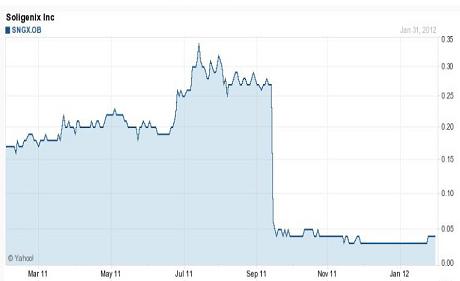
Trading below a nickel, right axis.
More recently the company performed what appears to be another accounting trick in order to boost stock price.
From the Times of Trenton newspaper:
Local pharmaceutical developer Soligenix sought yesterday to shore up its stock price by doing a 1 for 20 reverse split, effectively converting 20 shares into 1, ending at yesterday’s market close with a price of less than a dollar.
The company’s shares have been in a long, slow decline.
This is not precisely true. Soligenix’s stock price went from being worth very little to worth almost nothing overnight, according to the graph.
Soligenix was formerly known as DOR Biopharma. The name change never helped.
Permalink
Posted in Culture of Lickspittle, Cyberterrorism at 8:36 am by George Smith
“Israel, Finland and Sweden are more prepared than larger nations to fight a conflict in cyberspace, according to a McAfee-backed cyber-defence study,” reports the Register. (No link.)
Next:
The study, Cyber-security: The Vexed Question of Global Rules, is based on interviews with experts in the nascent field by by McAfee and Security & Defence Agenda, a defence think-tank. No metrics are involved in the study, which even McAfee admits is largely subjective. Brussels-based SDA based its conclusions on “in-depth interviews with some 80 world-leading policy-makers and cyber-security experts” …
Yes, the vexed question of global rules. Indeed it is proof they have scoured the corporate IT landscape for the talent to write a title only those paid to do so would read. And found it in Wallonia.

Plaster Casters alert for the Reg content.
Permalink
02.01.12
Posted in Bioterrorism, Ricin Kooks at 1:38 pm by George Smith
Today I point you to an article in the Western Farm Press on the attempted revival of the castor industry in the US. Castor oil has value in industry but in the Seventies it died here for reasons having to do with price. It was produced much more cheaply overseas and today India owns most of the business.
Castor mills existed in the US and the plant was cultivated in Texas and other places. No significant hazard was associated with its growth and use.
Since castor was cultivated and milled, trucks carrying castor seed and the mash of them traveled the roads of the land.
From this blog, in 2008:
[Castor seed oilcake] and seeds containing ricin would have had to travel the roads of the country. If one searches further, reference to it can be found in municipal codes for the transporting of “hazardous materials” via trucking. Castor seed oilcake [was] a material that [did] not require a 24-hour emergency phone hotline listed on the shipping manifest. In the Texas city of Laredo’s municipal code, the materials, referred to as “castor bean,” “castor meal,” “castor flake,” and “castor pomace” are things deemed of the same hazard, or lack of it, as “dry ice,” “fish meal,” “fish scrap,” “battery powered equipment,” “battery powered vehicle,” “electric wheelchair” and “refrigerating machine.”
The war on terror changed everything. Good science, common sense and a regard for the value in history were tossed out for the equivalent of old wive’s tales, a belief in rubbish minted by the US extremist right in the Eighties, and very bad counter-terror forecasting.
Castor seeds, because they contain about five percent protein — most of which is assumed to be ricin — were deemed easy to make into a weapon of mass destruction. Nothing could have been further from the truth.
However, it became the received wisdom. It hasn’t mattered that no terrorists have ever successfully used ricin. And it has not mattered that there has only been one instance, ever, (one I’m not going to mention because it’s cited ad nauseam, anyway) of the use of ricin in a state-instigated assassination.
So any attempt to revive castor cultivation in the US immediately runs up against belief from the war on terror and the homeland security apparatus.
An article published today, by BusinessWeek, entitled “Biological Attack Threat Cited as Pentagon Bolsters Defenses,” illustrates the problem.
First, the article is based on no actual evidence other than the now bog standard claims about what is easy for terrorists and supposition.
And it furnishes another piece of received wisdom, repeated thousands of times since 9/11, even though it’s not actually true:
“I would put ricin at the top of the list??? of threats, Kelsey Gregg of the [Federation of American Scientists] said. “You can get a deadly amount of it pretty easily.???
What you can get is an amount of castor powder, or the grind of castor seeds. And it contains some ricin but not quite enough to make a weapon of mass destruction although it has occasionally been used in domestic poisoning attempts — one, I believe — in the last decade. It’s put into food in such instances and, even then, often the victim stubbornly refuses to die.
And any larger purchases or attempts to get bagloads of castor seeds in the US are now monitored to a certain extent.
In any case, no terrorists have ever produced purified ricin. None. It hasn’t been done.
And that’s because it isn’t the elementary procedure lay people, and this includes most counter-terror experts in the employ of the US government, believe it to be.
The idea that ricin was easy to make comes solely from the extremist survivalist right in the United States. This group had authors with names like Kurt Saxon and Maxwell Hutchkinson, individuals who put their notional ricin recipes, sloppy inexact procedures for simply grinding and degreasing castor seeds, into pamphlets and books published by the fringe press in this country.
But after 9/11, the US national security apparatus, along with the mainstream media, worked the angle that al Qaeda could whip up anything dangerous with very little effort.
And one component of the hysteria always contained assertions that chemical and biological weapons were easy to make from recipes available from the Internet in seconds.
These recipes were all descendants of the trash printed by the US neo-Nazi/survivalist right. However, that material had gone around the world and been translated in documents subsequently found in hideouts in Kabul and Kandahar after the US overthrow of the Taliban.
But I’ve wandered far from my promise to point to the article on tentative steps toward a renewal of castor agriculture in the US, published in the Western Farm Press.
A few excerpts from it should serve to illustrate the problems:
In a time when bio-security and foreign oil dependency share the spotlight as major issues facing the nation, it comes as no surprise that the idea of growing castor on U.S. soil and extracting castor oil for biofuels and industrial use is a growing controversy with supporters on both sides of the question: Would the benefits outweigh the risks?
On one hand there is little or no commercial castor production in the U.S. Nearly all castor oil used in the U.S. is imported from India, China and Brazil. But because of its high seed oil content, castor has tremendous potential as an oilseed crop in North America, especially in parts of the Southwest. The increasing demand and potential use of castor oil in the production of specialty chemicals, biodiesel, and RFS2 renewable fuel has generated considerable interest by several companies in developing commercial castor oil production in this country. Since castor grows well on marginal land, it represents an alternative crop suitable for production in select areas of Texas.
On the other hand, castor production comes with a reputation, largely related to the fear of growing a potentially toxic crop. Ricin, a protein toxin found only in the endosperm of castor seed, can represent up to 5 percent of the meal weight remaining after oil extraction. It could pose a threat if not carefully isolated and controlled as there is a concern the meal could be refined and used as a bioterrorism agent.
“With castor seed producing as much as 50 percent oil and its ability to grow productively on marginal land, it represents a crop that could address a growing demand for castor oil. India virtually controls the global market now, and there is potential for domestic production,??? reports Dr. Calvin Trostle, associate professor and research scientist at Texas A&M AgriLife in Lubbock.
“Castor production will play a major role for many years to come,??? agrees Dr. Dick Auld, oilseed crop specialist and research scientist at Texas Tech University. “At one time some 70,000 acres in Texas were dedicated to castor farming. But when prices fell in the 1970s interest faded, and concerns over ricin and the potential for contamination of food crops overshadowed interest for its return.???
Castor/ricin contamination of food crops is not something that seems to concern that part of the world that still uses it for bulk oil and fertilizer production. India, China and Brazil simply do not care what beliefs the United States has twisted itself into accepting because of the war on terror.
Yet, the agricultural scientists working on the worthy idea to bring this industry back must act like ricin toxicity is a substantial obstacle. For practical purposes it is but this is far more due to the nature of the time we live in than any real need to come up with new methods and plans for growing and milling castor plants.
It wasn’t this way in the past. It isn’t anywhere else, either. And in the city of Laredo they once did not worry much about a spilled truck load of castor mash or castor seeds.
Clean it up, sweep it to the side of the road, let the sun and weather take care of it, whatever. But it in no way merits fear like a potential weapon of mass destruction.
“[Calvin Trostle] adds that researchers are recommending stringent management and control measures, such as dedicating combines to castor-only applications, taking safeguard in transportation and storage of castor seed to eliminate contamination and restrictions on growing food crops on fields used for castor,” reads the Western Farm Press near the end.
“Extraction And Characterization Of Castor Seed Oil” is the title of a paper published by researchers at Rufus Giwa Polytechnic, a college in Nigeria.
In the United States this procedure, which here is presented for the isolation and analysis of the chemical properties of castor oil, would be considered a ricin recipe because it also yields de-greased castor mash.
Indeed, the crime one is convicted of when caught pounding castor seeds in the US is that of taking a significant step toward the making of a chemical or biological weapon. And everyone who has been brought up on such a charge, or a related one in the last decade, has been sent over.
“The castor meal or cake is mainly used as fertilizer, this is because it is unsuitable as an animal feed because of the presence of toxic protein called ricin and toxic allergen often referred to as CBA (castor bean allergen),” write the Rufus Giwa authors. “However, it is noteworthy that none of the toxic components is carried into the oil.”
Permalink