“Let’s Ride,” one of the lead singles from Kid Rock’s new album, Rebel Soul, due on Black Friday.
Essentially, it made me want to punch his teeth in. The lyrics stink, the riff/melody is good but not great, and the white guy rocker/country artist doing his knee-jerk tribute to guns, the military and the American flag provokes nausea. Much worse, hang around, Rock actually takes time to explain it at the end. It’s his effort to make a song for the troops when they’re riding out on search and destroy missions, which he calls “doing their job.”
Admitting you like it is just like saying you enjoyed Barry Sadler’s “The Ballad of the Green Beret” as a serious tune, not unintended awful camp.
It wraps up many things wrong in WhiteManistan, condensed into stale ol’ classic rock lassitude. There’s the reverence for endless war as long as they, or we, don’t have to fight it, working the guilt off in silly gifts, in this case a tune by a rock star, for soldiers dispensing with the enemy, always less expensively armed and of different color and religion, somewhere else, not here.
No rockers signed up to fight after 9/11. And none have since although there’s been a decade and ample opportunity to do so.
Yet these kinds of tunes have become routine for the audience in WhiteManistan. The celebrities in pop rock and country are very keen on saluting the soldiers in words and melodies. Keep fighting, we think of you, thanks for all that you do.
While Kid Rock no doubt means well (he really, really loves the city of Detroit, Seventies America and Bob Seger), it’s also reflexive pandering. These are the things the white audience wants to hear, not what it needs to. Wounded and just barely surviving modern America, they’re convinced the bottom has fallen out because it has. They need their cultural comfort food plus the symbolic assignment, in song, of three Hail Marys and an Act of Contrition in penance to get the blemishes off the souls before Communion, too.
It deserves ridicule. Reinstating the draft would fix this wagon, but good. And what’s at all like a “Rebel Soul” about it, anyway?
There was just something about the pose that called for pink.
The value in the Petraeus affair is that it has given everyone a legitimate excuse to have a look at the vanity of one its national security and military rock stars.
Paula Broadwell had a p.r. sheet distributed for her book, All In, the David Petraeus biography. That is here.
A couple bits from it deserve showcasing:
“One of Petraeus’ favorite quotes comes from Seneca, a first century Roman philosopher: ‘Luck is what happens when preparation meets opportunity.’ This has been true for Petraeus at many turns …”
The Forum is an annual summer gathering at our signature “Aspen Meadows” campus in Colorado of top-level present and former government officials from all relevant homeland security/counterterrorism agencies (the White House; Departments of Homeland Security, Defense, State, Justice, and Treasury; the intelligence community; and Congress); industry leaders (large and small homeland security/counterterrorism-related companies, as well as private equity investors, merchant and investment bankers, venture capitalists, and other financiers); leading thinkers (in other think tanks and academe); nationally noted print and broadcast journalists; and concerned citizens. During three days of in-depth conversation, participants explore various aspects of aviation security; maritime security; border security; mass transit security; critical infrastructure protection; “soft targets” security; cyber-security; intelligence; counterterrorism strategy; terrorism finance; and more.
Or, more succinctly, one of the high-button places where the upper class in the national security industry convene to network and advance their careers and standing in the business of endless war.
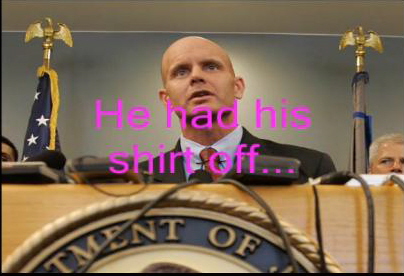
“[In] 2010, Humphries shot a ‘disturbed, knife-wielding man’ dead at the gates of MacDill Air Force Base in Tampa after being attacked,” reads the Hollywood Gossip.
Readers may agree with DD that during their lives, most will have been able to avoid shooting a mentally troubled disabled Vietnam vet who lived in a trailer at a military base, rented for $400/month.
Ronald Bullock made MacDill Air Force Base his home even though he was no longer in the military.
Decades had passed since a grenade blew up on him in Vietnam, rendering him disabled, his brother said. But as a veteran with a military ID, he could stay at the base’s campground for six months at a time.
Bullock, 61, didn’t have a family or a job. He told his uncle he suffered from post-traumatic stress disorder.
“He took a mess of pills to keep him going, to keep him cool,” said his uncle, Phil Sullivan, 80, of Tampa.
Ever since Vietnam, he struggled with drugs and alcohol, his brother said. In 1994, Bullock got four years of probation for aggravated assault on a public servant in Texas. Three years later, he was found guilty of possession of a controlled substance.
Still, his family never thought it would come to this.
Humphries, not named in the original news article, was apparently one of a number of security men involved in the shooting of the fellow:
Then, Wednesday evening, an altercation broke out at the camp. Bullock took off on a motorcycle with security officials in pursuit, according to Col. Larry Martin, the 6th Air Mobility Wing commander.
He became aggressive, and the pursuit continued, Martin said. When Bullock arrived at the gate on S Dale Mabry Highway, he got off the motorcycle and pulled a knife on the FBI agent.
The agent opened fire, hitting Bullock at least once, Martin said.
No one named in the scandal inspires confidence. It will make a cheap but entertainingly tawdry movie fit for cable.
“Having a bunch of medals and badges doesn’t necessarily mean you’ve accomplished anything, you’ve got to do something beyond yourself to make a difference in life. Seek to be consequential in whatever you do.” – Paula Broadwell
Always seek to be consequential. Sounds good. Like some hooey expressly for impressing the peons. Wish I’d seen it before I made the video for the tune.
As old CREEM magazine might have captioned: “Tee-Hee. Soon we’ll be consequential together.”
Over the last several years, Mr. McAfee began to put a large chunk of his [anti-virus] fortune into real estate, often in remote locations. He bought the house in New Mexico as a playground for himself and fellow aerotrekkers, people who fly unlicensed, open-cockpit planes. On a 157-acre spread, he built a general store, a 35-seat movie theater and a cafe, and he bought vintage cars for his visitors to use.
He continued to invest in financial markets, sometimes borrowing money to increase the potential returns. He typically chose his investments based on suggestions from his financial advisers. One of their recommendations was to put millions of dollars into bonds tied to Lehman Brothers.
For a while, Mr. McAfee’s good run, like that of many of the American wealthy, seemed to continue. In the wake of the dot-com crash, stocks started rising again, while house prices just continued to rise. Outside’s Go magazine and National Geographic Adventure ran articles on his New Mexico property, leading to him to believe that “this was the hottest property on the planet,??? he said.
But then things began to change.
In 2007, Mr. McAfee sold a 10,000-square-foot home in Colorado with a view of Pike’s Peak. He had spent $25 million to buy the property and build the house. He received $5.7 million for it. When Lehman collapsed last fall, its bonds became virtually worthless. Mr. McAfee’s stock investments cost him millions more.
One day, he realized, as he said, “Whoa, my cash is gone.???
His remaining net worth of about $4 million makes him vastly wealthier than most Americans, of course. But he has nonetheless found himself needing cash and desperately trying to reduce his monthly expenses.
From everywhere, allegedly John McAfee, on the drug called “bath salts”, sometime about a year ago on-line:
I think it’s the finest drug ever conceived, not just for the indescribable hypersexuality, but also for the smooth euphoria and mild comedown.
The story, in pictures, of a man in the vice of a raging sulphate addiction, apparently. Belize, where a number of white, wealthy American men go for native nubiles, do drugs, and die.
McAfee, being 67, is old and delusional enough to be influenced by both Ernest Hemingway and Hunter Thompson.
The rich aren’t like you and me. But the story of John McAfee certainly takes the cake.
You see, citizens, the cliff would dramatically cut the deficit, but it would do so by cutting Pentagon spending–
Which through the mysteries of Newly Frugalness, is huge government spending that is amazingly not socialistic!
We all know true deficit reduction can only come from cutting pinko social programs like schools, health and welfare!
The Fiscal Cliff also threatens to blow up the Bush tax cuts and devious Spendocrats want taxes for the rich to return to what they were during the dark days of Clinton, back when the economy was, was, well . . . never mind.
If you wrote about computer viruses and the anti-virus software industry in the late Eighties and early Nineties, you dealt with John McAfee, the founder of McAfee Associates.
To the many people who crossed his path on a tropical island in Belize, it was apparent John McAfee’s life had taken some bizarre turns in the last few years.
The anti-virus software guru, who started McAfee Associates in 1989, has been in hiding since police said they wanted to question him about the weekend murder of his neighbor, fellow American Gregory Faull, with whom McAfee had quarreled.
Despite his disappearance, McAfee, 67, has remained in contact with the media, providing a stream of colorful bulletins over his predicament, state of mind and his claim that Belize’s authorities want to kill him.
Residents of the Caribbean island of Ambergris Caye and others who know him paint the picture of an eccentric, impulsive man who gave up a career as a successful entrepreneur in the United States for a life of semi-seclusion in the former pirate haven of Belize, surrounded by bodyguards and young women.
The anti-virus industry was started by individuals you might gently call “idiosyncratic,” like McAfee.
The publisher of Virus Creation Labs, my book on that world, also fled to Belize over a decade ago.
Mitt Romney said Wednesday that his loss to President Obama was due in large part to his rival’s strategy of giving “gifts” during his first term to three groups that were pivotal in the results of last week’s election: African Americans, Latinos and young voters.
“The Obama campaign was following the old playbook of giving a lot of stuff to groups that they hoped they could get to vote for them and be motivated to go out to the polls, specifically the African American community, the Hispanic community and young people,” Romney told hundreds of donors during a telephone town hall Wednesday …
The Los Angeles Times listened in to the Wednesday call, but Romney did not appear to be aware of the presence of reporters.
Oops.
It was the gifts — free stuff they did not deserve — to those 47 percent in the national moochers club, apparently:
“With regards to African American voters, ‘Obamacare’ was a huge plus — and was highly motivational to African American voters. You can imagine for somebody making $25—, or $30—, or $35,000 a year, being told you’re now going to get free healthcare — particularly if you don’t have it, getting free healthcare worth, what, $10,000 a family, in perpetuity, I mean this is huge. Likewise with Hispanic voters, free healthcare was a big plus.”
A leading Republican governor sharply rebuked Mitt Romney for his view that President Obama owed his reelection to “gifts??? his administration gave to various demographic groups, saying the sentiment was not representative of what the Republican Party believes.
At a post-election gathering of the Republican Governors Assn., Louisiana Gov. Bobby Jindal said Romney’s comments just hours earlier in a conference call with top donors were “absolutely wrong.???
“We have got to stop dividing the American voters …”
Can’t we all get away from The Stench? Not so fast, it would seem.
Lee Atwater: You start out in 1954 by saying, “Nigger, nigger, nigger.??? By 1968 you can’t say “nigger???—that hurts you, backfires. So you say stuff like, uh, forced busing, states’ rights, and all that stuff, and you’re getting so abstract. Now, you’re talking about cutting taxes, and all these things you’re talking about are totally economic things and a byproduct of them is, blacks get hurt worse than whites.…
What Mitt Romney is now complaining about is the horrifying reality that many people who aren’t black see themselves as victims of those “economic things??? — and as a result anti-government rhetoric is turning into a way to lose elections rather than win them.
And I don’t think the Republican party as currently constituted can change this: after 45 years of the Southern strategy, this stuff is what defines the party’s soul.
A few years ago Atwater was the subject of a documentary called Boogie Man.
It was a comprehensive dissection, exposing the famous dead man’s tactics during the elder Bush’s first campaign.
Wholly bizarre and sickening, Lee Atwater was a bigot like Ted Nugent in that he and his pals insisted he wasn’t one while simultaneously exploiting race division.
He also played guitar and chummed around with old black blues artists who seemed to tolerate him even though they knew what he was about. Atwater apparently felt that such associations, like many so afflicted, proved he couldn’t possibly be a racist.
Then Atwater came down with an aggressive brain tumor. In a losing struggle for life portrayed in Boogie Man, he goes on a piteous self-examination trip, coming to the agonized conclusion that he was a horrible human being, one of the real bad men.
Atwater begs and talks as if he’s afraid of what’s in store. When I was watching it I was glad he perished. That seemed fair.
Atwater made a mockery of decency. From the venomous political propaganda that was his invention and the antic little white man clown guitar playing routines at GOP victory parties to the leeching on to famous blues musicians by offering them opportunity to rub elbows with famous politicians, Boogie Man continually makes you vaguely nauseous. It is the biography of slime. And the cruel animal atavism shown in it is the backbone of the crazy Republican Party.
“People work their asses off to get where they are, and they get punished,??? [a hedge fund manager] said. “I wanted to fly my friend to Davos this year, and people were like, you’re not going to fly the jet to Davos, are you? How will that look to the Occupy people? I’m like, what the fuck are you talking about? I worked hard for this!???
The supposed victimization of America’s financial elite in the last few years has been almost entirely self-imagined … —NY Mag
“We must contest every single inch of ground and delay the baby-murdering, tax-raising socialists at every opportunity,??? Peter Morrison, a Republican Party of Hardin County (Texas) treasurer, wrote. “But in due time, the maggots will have eaten every morsel of flesh off of the rotting corpse of the Republic, and therein lies our opportunity.??? –TPM
“Dear Lord:
“The American people have made their choice. They have decided that America must change its course, away from the principals [sic] of our Founders. And, away from the idea of individual freedom and individual responsibility. Away from capitalism, economic responsibility, and personal acceptance.
“We are a Country in favor of redistribution, national weakness and reduced standard of living and lower and lower levels of personal freedom.
“My regret, Lord, is that our young people, including those in my own family, never will know what America was like or might have been. They will pay the price in their reduced standard of living and, most especially, reduced freedom.
“The takers outvoted the producers. In response to this, I have turned to my Bible and in II Peter, Chapter 1, verses 4-9 it says, “To faith we are to add goodness; to goodness, knowledge; to knowledge, self control; to self control, perseverance; to perseverance, godliness; to godliness, kindness; to brotherly kindness, love.???
“Lord, please forgive me and anyone with me in Murray Energy Corp. for the decisions that we are now forced to make to preserve the very existence of any of the enterprises that you have helped us build. We ask for your guidance in this drastic time with the drastic decisions that will be made to have any hope of our survival as an American business enterprise.
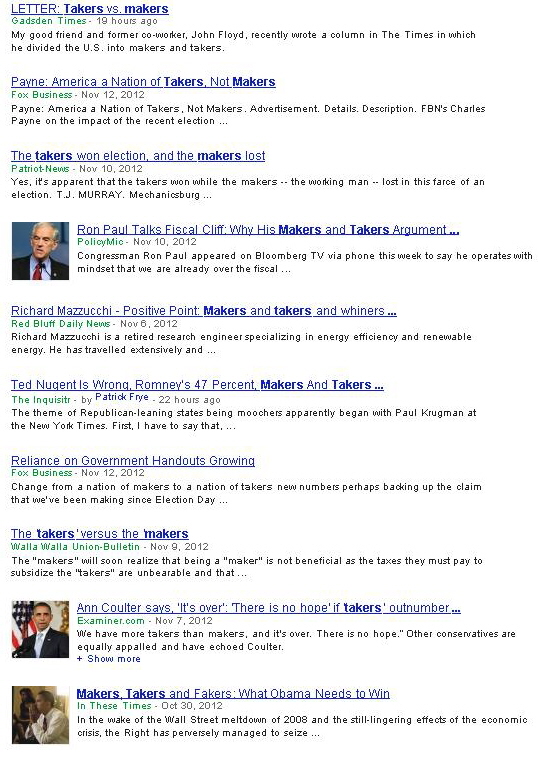
A snapshot, today, of a sampling of news stories and letters using the takers and makers shtick, most from the right:
A month or so ago I broke out an old copy of Ayn Rand’s Atlas Shrugged.
Struggling, I made it through to about 750 pages, around the time where Dagny Taggart is stranded in Galt’s Gulch and being shown the marvelous perpetual electricity machine that extracts power from thin air. She cannot get into the room housing it, John Galt tells her, because she is not yet ready. The machine’s room is guarded by a special, almost mystical lock, that will only open when the person trying to get in is of the right Objectivist mind and can utter the appropriate incantation. Any attempt by infidels to force entry will result in the destruction of the building.
Right then I quit.
For hundreds of pages, Rand’s characters do not converse. They exist as props to make the woman’s speeches and rants about the virtues of selfishness and the perfidy of government parasites sucking off the talents of a handful of gifted industrialists.
To be fair, the characters are not as cartoon awful as anyone now on public display in the Republican Party. Dagny Taggart and Hank Rearden are occasionally even likable. And there is no blowtorch hatred aimed at non-white people.
All the good characters are stern, tall, and strong Teutonic hero types. All the bad are ugly weasels. The portrayals often seem unintentionally laughable.
Atlas Shrugged is so screwed up, so turgid, it’s difficult to imagine many of the denizens of WhiteManistan getting through it. The Tea Partiers, for instance, have never struck me as readers with the necessary determination to crawl through interminable books not written by Stephen King or Tom Clancy.
I suspect Rand has been the beneficiary of a cultural abridgment in story-telling. That is, a condensed version of Atlas Shrugged has been communicated verbally to the many in WhiteManistan.
And in so doing it has become a corrupted lore, all twisted up into whatever they have wanted to make of it, a rationale for being a gold bug (gold only shows up a few times in the thousands of pages, once as a solid bar and as the only accepted currency in Galt’s Gulch), a resonance with the paranoid feeling that your precious cash money and economic purity of essence are being siphoned away by moocher-takers, and the childish belief that the world is so dependent on the genius of American business and industry that the withdrawal of 50 engineers, tycoons and some of their assistants will bring on world collapse.
Even a bum portrayed in Rand’s book becomes a convert to the cause.
The bum has lost his job because he joined a parasitic union, which caused the company he worked for to go under. And in his bumming around the country, he has come to see the error of his ways. When he finally meets Dagny Taggart on a train, the repentant bum recites a long denunciation of the bloodsucker class and his lapses in judgment. In reward, he is redeemed and Taggart makes him a conductor on her train.
Everything the followers of Galt produce is superior, even the cigarettes. Marked by a silver dollar sign, they are the most exquisite smokes in the world.
Anyway, if you hacked 750 or so pages out of Atlas Shrugged it could probably be made into a decent piece of accidental satire.
It is trash and it’s hard to imagine anyone not thinking so, even when it was published in 1957. Alan Greenspan was apparently one person who thought it was fabulous. Matt Taibbi, much more recently, called Greenspan “The Biggest Asshole in the Universe” in his book, Griftopia. So there’s that.
The ROTFLMAO nature of Atlas Shrugged is best represented by a short speech given by Ragnar Danneskjöld, a pirate who robs from the poor to give to the rich:
Ragnar Danneskjold: But I’ve chosen a special mission of my own. I’m after a man whom I want to destroy. He died many centuries ago, but until the last trace of him is wiped out of men’s minds, we will not have a decent world to live in.
Hank Rearden: What man?
Danneskjold: Robin Hood …. he is not remembered as a champion of property, but as a champion of need, not as a defender of the robbed, but as a provider of the poor. He is held to be the first man who assumed a halo of virtue by practicing charity with wealth which he did not own, by giving away goods which he had not produced, by making others pay for the luxury of his pity. He is the man who became a symbol of the idea that need, not achievement, is the source of rights, that we don’t have to produce, only to want, that the earned does not belong to us, but the unearned does. He became a justification for every mediocrity who, unable to make his own living, had demanded the power to dispose of the property of his betters, by proclaiming his willingness to devote his life to his inferiors at the price of robbing his superiors. It is this foulest of creatures – the double-parasite who lives on the sores of the poor and the blood of the rich – whom men have come to regard as the moral idea … Do you wonder why the world is collapsing around us? That is what I am fighting, Mr. Rearden. Until men learn that of all human symbols, Robin Hood is the most immoral and the most contemptible, there will be no justice on earth and no way for mankind to survive.
Danneskjold then gives Rearden, who is already fabulously wealthy, a gold bar.
“I have always lived by the philosophy I present in my books …” Rand writes in one of two end notes to the reader.
“If you are the kind of reader who knows that for 1084 pages he has lived in the atmosphere of John Galt’s world — if you now feel regret at the necessity of returning to the gray hopelessness of a culture that is truly bankrupt …” she continues in end note #2.
From the Washington Post, and others, news that many are as sick of Jeff Bezos and Amazon as this blog:
“Care of Wooden Floors,??? by Will Wiles, is the kind of novel you’d expect to see on a “staff picks??? shelf at an independent bookstore. A slim but sophisticated farce by a relatively unknown author, the book is full of witty asides and snappy comments about modern life; its wry, endearingly hapless narrator feels like he might have stepped out of a Nick Hornby story.
But many local stores, both independents and chains, are refusing to stock it. They don’t want to promote what they see as a predatory publisher. [Amazon].
Earlier this year the two companies signed a licensing agreement whereby Amazon Publishing acquires, edits, markets and publicizes books that are then distributed by Houghton Mifflin Harcourt’s sales force, according to Alexandra Woodworth, a publicist for Amazon/New Harvest. The partnership was an effort to woo bookstores into stocking Amazon-published books. But many booksellers are balking.
“We don’t want to do anything that will support their publishing venture,??? said Mark LaFramboise, chief buyer for Politics & Prose in Washington …
“[Amazon] pretty much want nothing more than our demise.??? LaFramboise told the Post.
The bookseller boycott of Amazon titles may be working.
The Post reported:
According to Nielsen BookScan, fewer than 1,000 copies of the [Willes] book had been sold as of last week. “My Mother Was Nuts,??? Penny Marshall’s memoir, which New Harvest [the Amazon imprint] published Sept. 18, sold just 7,000 copies in its first month, despite a reported $800,000 advance; Jessica Valenti’s “Why Have Kids?,??? released by New Harvest on Sept. 4, has sold 1,000.
Why you should have nothing to do with Jeff Bezos and Amazon — from the archives.
“You’re doing a performance for a website and you know they have almost no readership, but you do it anyway,” reads one line from Rolling Stone, in a piece on how to make money in the music industry. “You’re in somebody’s garage doing a taping and you know no one will see it …”
It focuses on a few semi-famous artists, people and groups who were able to sell records in the old industry, but can no longer because no one buys music.
The Rolling Stone article notes: “Record sales were never a major income generator for musicians, thanks to high recording and promotion costs that were charged against the artists’ accounts.”
Which is true. However, the old label structure did not shovel all the risk on the artist and saddle them with an enormous debt if it didn’t work out. It also worked to get the artist, at least initially, in front of a potential audience.
Now this is all gone, replaced by a winner-take-all model. In the winner-take-all system you’ll have noticed one of the major features is the astronomical success of a few artists. These acts wind up so ubiquitous, legions of people make videos, all the same, miming to their music. It’s wall to wall, impossible to escape.
“Digital streaming sites like Rhapsody and Spotify are not yet proving to be viable financial substitutes for CDs,” continues the Rolling Stone article. “[Typical] digital-streaming royalty checks are minimal: ‘You’ll get a check for $100 in six months.’ Managers are equally skeptical. ‘You have to sell a thousand copies to equal a few cents …'”
While the video makes a joke of it, it’s the model of accumulation by dispossession, in which Apple, Google and the web industry have effectively given a relative few haves all the tools to take everything off everyone else.
Apple is more important, more powerful and more controlling than any old music industry label. Yet it has nothing to do with artist development.
Apple was able to position itself as the maker of the best portable jukeboxes, its iJunk the portals everyone must pay for before getting their “free” music. Apple, and web companies in related business, have made their fortunes by transferring what people used to pay for music to themselves while putting little to nothing back in.
It’s a model that’s in place throughout the American tech infrastructure from the development of collective job bidding sites for squeezing the most service work for the least possible amount from desperate labor to automation software expressly to eliminate labor, never to be replaced while those workers remaining boost productivity figures by being stretched to do even more for less. And the profit taken by the dispossessions is split between the purchaser and the maker of the automation.
As far as innovation goes it means less for the good fortune of mankind than the discovery of penicillin.
(In a side note, the leadership, public and private sector, have dealt with the labor disenfranchisement horridly. They have fostered a collective belief that it’s possible to have a country of 312 million in which substantial parts are reduced to poverty and indigence, rationalized under the excuse that the economically displaced all lack the skills and education to be viable human beings in the 21st century.)
Putting the Apple-mediated modern music industry another way: It’s as if one company making a transistor radio had become all that people paid for their rock ‘n’ roll in the early Sixties. And how is that spectacular?
So are Apple and the web now gateways or parasites? It’s the latter.
None of this is quite so funny as the man posing as an MTV exec telling off a young woman in the comedy skit. Thank heaven for those clever enough to make such, not like this dumb sod, eh?