The Ricin Beans Gang discussing their (actually quite ludicrous) plan to use the poison:
Sam Jerry Crump: What I’d like to do is make about ten pounds of that … Give you 2, me 2, Ray (Adams) 2, Dan (Roberts) 2 and somebody else 2. Put it out in different cities at the same time: Washington DC, maybe Newark, Atlanta, Jacksonville, New Orleans. Dump that little (unintelligible) … that’s all you gotta do is lay it in the damn road, the cars are gonna spread it.
FBI Informant: Yeah, but what’s it take to make it? I haven’t got a clue.
Sam Jerry Crump: Just some seed. I got the, got -uh — one more ingredient, and I’ll get it today …
Other statement concerning ricin from Samuel Jerry Crump:
“Ya got, ya can’t let none of it get on your skin. Got to be a closed environment when it’s made. No wind. If it gets up your nose there’s no cure.”
[Ricin is not a contact poison.]
Samuel Jerry Crump also mentioned another toxic substance, probably botulinum toxin:
“That other kind, 1 pound can kill 30 million people … We need somebody to back us with money so we can make that other shit … This is worse than anthrax … That shit’s deadly! There ain’t no damn, there ain’t no cure for it. And it works, I think, in 2 hours.”
Finally, on prodding, Ray Adams names the more deadly toxin.
Crump: “Kills about 30 million people at one time, one pound of it. It’s caused from dead food.”
Ray Adams: “Oh, botulism.”
Crump goes onto to roughly describe the ricin recipe devised and distributed by Kurt Saxon in his pamphlet, The Weaponeer, back in 1984.
Further along, he goes into details on his plan to disburse it. First the castor powder should be mixed with charcoal to make it black. Presumably so it would be hard to see at night, one guesses.
Later, Sam Jerry Crump makes one astute observation:
“[But] if they find that shit on your computer you’re hung.”
Crump later mused on “going to Africa” to get “botulism”:
“Well, I thought you can’t make that botulism (unintelligible) … got some good backers … go to Africa, uh, and get some of that to make.
“We’d bring it back over here. Ya don’t make it over there. You just get the samples of the stuff out of the soil. It comes from dead animals, from rotten meat. That’s where botulism comes from. It’s more potent than the stuff (ricin) … I know somebody can make it.”
Ray Adams, another member of the Ricin Beans Gang, alleged to a lab technician at one time, discussed making ricin:
“Well, I’ve never done it (made ricin) but I have laboratory experience and once you extract that stuff enough just splashin’ it on your skin can kill ya. Once it dries, while it’s wet, any kind of solvent, like anything, it just takes water solution to soak through your skin. It’s highly permeable through the skin. There’s no antidote.
“I’ve handled all kinds of deadly stuff, pesticides and that kind of stuff, so … ”
[To emphasize the level of knowledge on display, it’s worth repeating that ricin is not a contact poison.]
Like many states and local governments struggling to cut costs, Michigan hopes to replace some government employees with contract workers who will do the same job for less.
Ginny Townsend, a nursing assistant under a state contract, attending to Harold Sundberg at a veterans facility in Michigan.
Ginny Townsend, 41, took a job in January as a nursing assistant in the state-run home for veterans here. Technically, she works for a private company that supplies some employees to the veterans home under a state contract. She makes $10 an hour, about half the wage of the public employees working at the facility.
With the national unemployment rate at roughly 9 percent, Ms. Townsend says she feels lucky just to have a job. But on her low wages, she is barely scraping by. She said she was raising four randchildren under 11 with her unemployed sister and could not support them without the $300 in food stamps she collects every month …
The lower wage, she says, has left her strained to cover $675 a month in rent, along with basics like food and child care. So Ms. Perttu collects $400 monthly in food stamps and child care assistance, programs administered by the state but largely financed by the federal government. She has not been able to buy winter coats for her children, she said, and often avoids calls from credit card bill collectors.
At the veteran’s home, “one check was enough to pay all the bills,??? she said. Drawing on public assistance, she added, “is not helping our economy.???
This is so immoral it is difficult to know where to begin.
First, it deprives people of what was formerly a middle-class living in the name of austerity, rationalized that corporate America can do it better and cheaper by paying labor much less for the same work. And at the same time getting the workers out from under the protections and contracts which they are afforded by working for the government, the last place where unions can still sort-of-reasonably survive.
Second, it shoves the cost of slashing wages to just eking by off on the government, and taxpayer, by necessitating hunger be kept from the door through food stamp subsidization.
Third — corporate America vulture contracting makes its profit on the money the federal government must then make up with increased food stamp enrollment.
There is nothing efficient or free market about this. It’s economic parasitism and the stealing of labor, pure and simple.
And it’s using a bad economy, one in which people are desperate, to make corporate profit by making things worse. When the state slashes its payroll, it also loses more tax revenue, increasing the potentially downward spiral.
It is indeed remarkable that more people aren’t in the street with OWS.
What governments save in salaries and benefits often “ends up on the government books through all sorts of programs,??? Paul C. Light, “a professor at the Wagner School of Public Service at New York University” told the newspaper. He meant “unemployment insurance, Medicaid and other public assistance for workers earning low incomes.”
“Outsourcing becomes more popular during tough economic times as states and municipalities transfer the operations of facilities like prisons, school cafeterias and sanitation departments to private contractors,” it continues.
None of this makes any sense. It is merely expedient, momentarily superficially convenient and predatory. Repugnant on so many levels, it merely shows how failed and unfair the United States is at every level one cares to examine.
The census report found that the poverty rate for all groups would have jumped to 18 percent — or 6 million more people — if it weren’t for the earned income tax credit, a safety net program which offers credits to low- and moderate-income families as an incentive to work and to help offset the burden of Social Security taxes. Temporary expansions to that program are slated to expire after next year.
Without food stamps, the poverty rate would have risen to 17.7 percent, which translates to about 5 million more people. That program was expanded in 2009 as part of the federal stimulus plan; the expansions are now phasing out gradually and will expire completely in 2014.
Because of the drive to private contract for workers in state health care facilities engendered a lawsuit stopping it in Michigan.
The Times interviewed the person who levied the suit who explained it in this way:
The lawsuit, filed by Anthony Spallone, a resident, says that fill-in contract workers have, among other things, repeatedly dropped residents and left them in urine-soaked beds, and once fed a resident solid food despite specific instructions not to.
Tim Frain, the chief executive of J2S [the company furnishing the reduced wage contract workers], declined to comment.
Mr. Spallone, a 64-year-old Vietnam veteran who said he had served “12 months, eight days, four hours and 22 minutes??? as an Army engineer, described the state’s caregivers as “like family.??? He suggested the government “drop one less bomb overseas and pay these guys’ salaries.???
“We’re just driving everybody down,” someone adds.
Into the intersection of these trends comes a fascinating, one-of-a-kind new instrument called the You Rock guitar ($200) from Inspired Instruments.
Its solid plastic body is small and not as heavy as wood, but much more substantial than the hollow plastic that most Guitar Hero heroes are used to.
You play real steel strings with your right hand. But they’re only six inches long; they don’t continue up the neck. Instead, your left fingers, on the neck, press what turn out to be only touch sensors.
Since the You Rock can get its power from four AA batteries, it’s an incredibly portable and private practice instrument. You can play when you’re in a rowboat, up in a tree, next to a sleeping partner — all places where ordinary electric guitars would fear to tread.
And you’re not just carrying around one guitar; you’re carrying 100. The You Rock is a full-blown synthesizer. It can sound like a gentle nylon-string acoustic, a rich 12-string folk guitar, a screaming heavy-metal ax — even an organ or a string section.
Electric guitars went portable on AA batteries a long time ago. I’ve attached a pic of a Korg Pandora — mine — a processor that runs on two AA batteries, one that pumps earbud and can make your electric sound like Keith Emerson with ELP at the Isle of Wight, or “a rich 12 string folk guitar. You get the idea. It’s around five years old.
Third, there’s You Rock mode. The guitar’s control panel (colorful square buttons on the top edge) contains 25 song loops — a professional backup band laying down grooves for you. It’s great fun, and great practice, to play along. There’s also an audio input so that you can play along with music from your iPod or another source.
Been done. Everyone has a pocket amp you can plug you iCrap into nowadays.
For example, the You Rock can connect to GarageBand for the iPad. Can you imagine? An entire multitrack recording studio now fits into a backpack.
Lots of multi-track recording studio kit already fits into a backpack.That doesn’t mean you’ll be able to do anything listenable with it. Often, quite the contrary. And there is something to be said for a real studio.
Now, I’m a musician, but not a guitarist.
One of my old Korg Pandoras. A rock band/rehearsal tool in a box.
A newer model, made to also be a sound card for any computer. One version of the Pandora was a 4-track studio that recorded to a small removable data chip.
The Pandoras come with bunches of preset tone applications, for making you sound like an arena-rocker.
It’s three years old. Be a nuisance and send this link to Mr. Pogue.
It’s worth noting there’s a certain physical pleasure that comes from playing an acoustic or electric guitar. It’s a nerves in the fingers, hands, touchy-feely, sensory satisfaction kind of thing. The device reviewed in the New York Times apparently goes to some length to defeat that.
It’s also worth mentioning that having your stuff profiled in the New York Times by some heevahava is better than being given a gold brick.
Nice job, get crap for free because of where you work and then make the company that gave it to ya really happy.
ATLANTA — Four men who were indicted in alleged terror attacks had the weapons they wanted and were one ingredient away from making deadly toxin ricin, according to a criminal indictment.
Two days before they were arrested defendants Ray Adams and Samuel Crump said they needed just one more ingredient to produce ricin, according to the indictment. Adams said he needed one pound of lye and was ready to begin the process of making the deadly toxin.
This means the ricin beans gang had a copy from Kurt Saxon’s Poor Man’s James Bond, or something similar descended from it.
Soak castor seeds in lye, Saxon advised as early as 1984 in The Weaponeer, one of his pamphlets later incorporated into the Poor Man’s James Bond volumes.
Ricin is a protein. Proteins are destroyed by strong base. Lye is a a strong base.
Saxon had no real idea what ricin was. The Poor Man’s James Bond contains a couple methods for working with it, some seemingly made up out of whole cloth. At one point there’s a procedure recommending using a strongly acid solution, which is also very harsh on proteins.
And article discusses using ricin on bullets, an absurd idea since the heat and explosion in the barrel of a gun would destroy all the poison. The idea here was that if you only winged somebody — a “degenerated person” — the poison would do them in later. Quaint.
However, another part of the news story shows the ricin beans gang repeating the treasured old and undying script of the far right extremist:
Thomas is quoted in the affidavit from a recorded conversation with the informant: “There is no way for us, as militiamen, to save the country, to save Georgia, without doing something that’s highly illegal. Murder. That’s (expletive) illegal, but it’s gotta be done. When it comes time to saving the Constitution, that means some people gotta die.”
Saving the country, saving Georgia, saving the Constitution — by, among other things, following almost thirty year-old poison recipes manufactured by the US backwoodsman neo-Nazi survivalist right.
A member of the Ricin Beans Gang, photo taken in 2001.
This was the question that someone asked me last week.
While I was in the cancer ward helping someone through a hard bout of chemotherapy.
We had been sitting there and if you know anything about people, you know you can help alleviate exhaustion or general feelings of great illness with mild conversation. It helps to have a friend there to take the mind off things, to feel the warmth of it.
And we had been discussing the week’s news in passing including the protests and the police firing of teargas rounds.
Another patient — chemotherapy is an automated group out-patient experience these days — overheard and asked me “But what do they want?”
It was a much older individual. And I just said OWS was protesting economic inequality, the economic collapse and Wall Street greed and massive unemployment.
Which brought the response that yes, greed was a problem in the US. But it was the greed on the part of people who all got home loans they did not deserve and could not afford. And that this, in turn, had caused the economic collapse. And, finally, it was Bill Clinton’s fault.
I said little. One doesn’t argue with cancer patients. It’s not graceful or human. It would have been excruciatingly bad to not be on their side right then.
There was a brief pause and then another person joined in. The mass joblessness was caused because people had no skills.
Eventually the talk petered out. Even in the cancer hospital, the walls are high and people can’t let the class differences and embedded animosity for the young or different appearing slide for a minute.
Anyone who has tracked this issue over time knows what I mean. Whenever growing income disparities threaten to come into focus, a reliable set of defenders tries to bring back the blur. Think tanks put out reports claiming that inequality isn’t really rising, or that it doesn’t matter. Pundits try to put a more benign face on the phenomenon, claiming that it’s not really the wealthy few versus the rest, it’s the educated versus the less educated …
The most popular argument right now seems, however, to be the claim that we may not be a middle-class society, but we’re still an upper-middle-class society, in which a broad class of highly educated workers, who have the skills to compete in the modern world, is doing very well.
It’s a nice story, and a lot less disturbing than the picture of a nation in which a much smaller group of rich people is becoming increasingly dominant. But it’s not true.
Workers with college degrees have indeed, on average, done better than workers without, and the gap has generally widened over time. But highly educated Americans have by no means been immune to income stagnation and growing economic insecurity …
That is, the protesters who portray themselves as representing the interests of the 99 percent have it basically right, and the pundits solemnly assuring them that it’s really about education, not the gains of a small elite, have it completely wrong …
His argument is that this disparity threatens the nature of our democracy, making it one “in name only.”
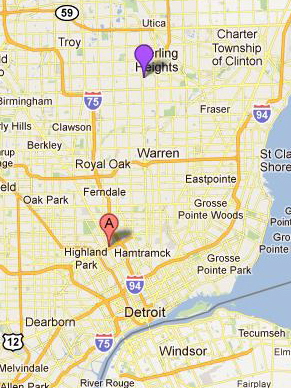
General Dynamics Land Systems, makers of the M1 Abrams tank, in purple.
Highland Park, where they’re being forced to hock street lights, in red.
Two big parts of the American economy flourished during the last decade: financialization on Wall Street. And national security/arms manufacturing.
General Dynamics Land Systems, corporate HQ in Sterling Heights, Michigan, was one of the manufacturing companies that suffered not at all during the economic collapse. Armored fighting vehicle sales went through the roof due to the war on terror and the desire of toady nations in the Middle East to own American-made weapons.
As for the rest of Michigan, things haven’t been so good. We do recall the automotive industry needed saving.
As the sun dips below the rooftops each evening, parts of this Detroit enclave turn to pitch black, the only illumination coming from a few streetlights at the end of the block or from glowing yellow yard globes.
It wasn’t always this way. But when the debt-ridden community could no longer afford its monthly electric bill, elected officials not only turned off 1,000 streetlights. They had them ripped out — bulbs, poles and all. Now nightfall cloaks most neighborhoods in inky darkness.
“How can you darken any city?” asked Victoria Dowdell, standing in the halo of a light in her front yard. “I think that was a disgrace. She said the decision endangers everyone, especially people who have to walk around at night or catch the bus …
Highland Park’s decision is one of the nation’s most extreme austerity measures, even among the scores of communities that can no longer afford to provide basic services.
Other towns have postponed roadwork, cut back on trash collection and closed libraries, for example. But to people left in the dark night after night, removing streetlights seems more drastic. And unlike many other cutbacks that can easily be reversed, this one appears to be permanent.
The decline, states the story, has been relentless, slow and long.
Once a hub of auto-manufacturing, the city took a severe hit when Chrysler moved its headquarters north to Oakland County in the Nineties.
After that, small businesses and the tax base began to collapse, a disaster that was never reversed.
One imagined way of dispatching your enemies with ricin — dreamt of by Old Weird America extremists in the Eighties and passed down through the years.
DD is intimately familiar with Old Weird America.
I grew up in part of it, Schuylkill County, PA. There, fear of fluoridation and the existence of the occasional barn burner, invariably an unsettled young man who set fire to the obvious target, marked it in my youth.
That signature demographic has many subcultures. My first publisher, American Eagle, belonged to one of them.
American Eagle was a book maker run out of a house in Tucson, AZ. It was the creation of a fellow with advanced degrees from CalTech and MIT. He was also a theocrat.
Most of American Eagle’s books were devoted to publishing computer virus code. My book, a look into the old computer virus underground, Virus Creation Labs, was part of this collection.
But American Eagle, like other small US publishers devoted to the Old Weird America demographic, published one book, its last, that pitched directly to the most dangerous part of it.
It was called Civil War II and swiftly became one of the publisher’s best-sellers, catering as it did to the far right extremist’s view that Mexico and US Latinos would reconquer the American southwest and that the middle class was being destroyed by affirmative action and the US government.
Sound familiar?
It was a terrible read. Nevertheless, it was popular in the reactionary and violent far right underground.
If you liked Civil War II you probably had it on the shelf next to a worn copy of The Turner Dairies, America’s premier piece of raging bigot race war fiction, a novel in which “freedom fighters” bomb the FBI and Pentagon, eventual inspirations for Timothy McVeigh.
Around 2000, seemingly convinced the US government would collapse due to the Millenium Bug and other catastrophes, American Eagle’s creator left the country for Belize.
Between the start of American Eagle and it’s eventual end the publisher would occasionally write pieces on what life in a theocracy might be like, how one might start one’s own micro-nation on an island, or the greatness of Spetznaz knives. In one pamphlet or book he mused about a computer virus that would substitute the word “Sodomite” for every instance of “homosexual” or “gay” found in text.
Can you guess my book didn’t do well in this milieu? Wrong venue.
The point of this introductory is that this part of Old Weird America is always with us.
It had its own publishing arm with imprint names like Paladin Press and Loompanics, makers and distributors of generally always disgraceful and sometimes horrifyingly repugnant books. (I have one or two on my shelves, part of the research library on ricin and American samizdat lit on weaponry. These include the infamous Poisoner’s Handbook and Silent Death by “Uncle Fester,” aka the ex-con methamphetamine chemist, Steve Preisler.)
They all fed and feed to a dark undercurrent, present at gun shows in the hinterland, sometimes off in the corner, on the necessity of preparation for war and preemptively attacking your enemies — always the government, its various agencies, or your neighbors if they got in the way or weren’t the right color. And to be prepared for war meant having a library stocked with pamphlets and books on how to make improvised weapons — bombs, incendiaries, jellied gasoline, fire bottles, homebrew toxins, zip guns, fortifications, camouflaged pits lined with excrement impregnated stakes, booby traps, landmines, whatever you needed.
Old Weird America lives in its own world and is always paranoid.
People in it can’t be approached with reason. In fact, it’s often counter-productive and hazardous to do so. Nothing disturbs their cracked doomsday-is-coming world view.
They may be a crew of white guys who think no laws apply to them because they’re “free men,” far right Christians waiting for the second coming in which all unbelievers are to be sent to eternal damnation, gold bugs, neo-Nazis, survivalists, pro-lifers, census-resisters, people who think the income tax is unconstitutional and therefore illegal, or any combination of these.
They all share an apocalyptic dark vision of the future. And, invariably, they always think a civil war, or some manner of armed heavy combat between the government and the citizenry is imminent. And this is a battle for which they either plan to be well-prepared or intend to strike first. And they have written plenty of non-fiction and romantic man’s fiction about it.
The geriatric ricin beans gang nabbed in Georgia early this week come right from Old Weird America central casting.
It was June 9, and Frederick Thomas believed he was meeting with a dealer in black market weapons at a Lavonia restaurant, according to FBI affidavits.
“I ain’t worried about dying,??? said the 73-year-old Thomas, the accused ringleader of a North Georgia militia group now at the center of domestic terrorism charges.
A story grew clearer Wednesday through federal affidavits, interviews and court statements accusing Thomas, Roberts and two other men — Ray H. Adams, 65, and Samuel J. Crump, 68 — of planning to unleash the toxic agent ricin across Atlanta and other major U.S. cities, bomb federal buildings and take innocent lives. Documents say the men intended to launch their plot within a year.
At that meeting in June, Thomas talked about buying explosives, silencers and mines, and killing officials with the Bureau of Alcohol, Tobacco, Firearms and Explosives and Drug Enforcement Administration. It was a plan based on a novel by Mike Vanderboegh, a former militia leader and blogger, that detailed killing Justice Department attorneys, Thomas said, according to the FBI affidavits.
“Now, of course, that’s just fiction, but that’s a damn good idea,??? Thomas, a retired aerospace engineer, once told the others in the so-called “covert group …???
Documents allege that Crump planned to disperse the ricin in various U.S. cities including Atlanta, Newark, N.J., and Washington. In Atlanta, the documents said, the plan was to unleash the powdery substance on I-285, I-75 and U.S. 41.
A member of the Georgia ricin beans gang, pic from 2001.
The back of one of the most widely sold books of Old Weird America, one containing advice on ricin, The Poor Man’s James Bond by Kurt Saxon, reads:
“It is bad to poison your fellow man, blow him up or even shoot him or otherwise disturb his tranquility. It is also uncouth to counterfeit your nation’s currency and it is tacky to destroy property as instructed in [the chapter] Arson and Electronics …
“But some people are just naturally crude … It is your responsibility, then, to be aware of the many ways bad people can be harmful …
“Also, in the event that our nation is invaded by Foreign Devils, it is up to you to destroy them with speed and vigor. Or — and perish the thought — if our Capitol should fall to the enemy within, I expect you to do your duty.
“It is right to share with your enemies, the knowledge in this wonderful book …”
Succinctly, it sums up one of the many bleak philosophies of Old Weird America. And while I don’t know if anyone in the Georgia ricin beans gang ever read it, they certainly appear steeped in it.
Full disclosure: Your host was a source on quote on ricin for the AJC piece:
But could the group have made ricin?
“No, what they would have wound up with is dried castor powder,??? said George Smith, a senior fellow for GlobalSecurity.org, a public information organization on terrorism and homeland security. “They would not be able to make that into a weapon of mass destruction, and it’s not something even a lab technician can really do.???
As mentioned, self-published man’s romance fiction as tutelage for and on the destruction of your enemies and the tyrannical government has always been popular in Old Weird America.
It’s all uniformly dreadful and it’s no different with alleged inspiration for the Georgia ricin beans gang.
The authors and bloggers from Old Weird America are always pretty much the same — crippled stereotypes of Kurt Saxon and William Pierce, only dumber, but utterly convinced of their righteousness.
On his website, militia leader-turned-blogger Mike Vanderboegh writes about fed-up Americans responding to government violence with guns and grenades. It’s an attempt to warn the government that people are armed and angry, he says, just like last year when he urged those upset with President Barack Obama’s health care plan to toss bricks at Democratic Party offices …
In the introduction to ‘Absolved,’ first posted in 2008, Vanderboegh writes: “If this book is to operate as a ‘useful dire warning,’ then both real sides in my imaginary civil war … must be able to recognize the real threat to avoid it.
“In this, I am frankly writing as much a cautionary tale for the out-of-control gun cops of the ATF as anyone. For that warning to be credible, I must also present what amounts to a combination field manual, technical manual and call to arms for my beloved gunnies of the armed citizenry. They need to know how powerful they could truly be if they were pushed into a corner.”
Last year, Vanderboegh was denounced for calling on citizens to throw bricks through the windows of local Democratic headquarters.
YouTube gee-whiz, complete with bad but wishful computer animation, for man groupies who get erections over technical applications
for making slipping it to others far poorer more tactically efficient.
Consider for a moment the wonderland on display here, completely isolated and out of touch with the rest of the country.
(“Nearly 15% of the U.S. population relied on food stamps in August, as the number of recipients hit 45.8 million,” read the WSJ on Tuesday. “Food stamp rolls have risen 8.1% in the past year, the Department of Agriculture reported, though the pace of growth has slowed from the depths of the recession.”)
You may have seen things tank in the last decade but the contractors and boffins in the business of research and development of flying war robots are in the same general vicinity as the 1 percent.
No better than Wall Street when you get right down to it.
An investigation by Channel 2’s Jim Strickland revealed fake chips have been discovered at a Georgia military base and at a Roswell military supplier.
Technicians repairing an F-15 flight computer at Robins Air Force Base in 2008 said they discovered that four replacement microchips were fake just in time.
“Our job is to ensure that those who want to counterfeit parts, that we don’t allow them into the supply chain. It’s a battle every day,” said base commander Maj. Gen. Robert McMahon.
McMahon is battling back-alley operations like ones in Shenzhen, China. Video of laborers there revealed an operation in which workers peel chips off old circuit boards, Strickland reported. Some are reconditioned and relabeled as military grade …
“Anyone who has legacy-type products is forced to go into the independent world of electronics distribution, and that world can be a scary place,” said Dan Ellsworth, CEO of World Micro in Roswell. His company is a global components dealer. Ellsworth infiltrated the Shenzhen facility himself.