01.08.14
Posted in Culture of Lickspittle at 1:24 pm by George Smith
In the e-mail, from Rock n Roll Fantasy Camp, the place for middle-aged white guys to reward themselves with a Dad Rock getaway:
ATTENTION!!! Rockers: If you were in a band in High School or College band during the years of 1985-1995, Rock ‘n’ Roll Fantasy Camp is looking for your bands’ [sic] photo to use in an upcoming HS/ College social media campaign. Please submit your photo to reunion@rockcamp.com. More details to follow.

Trouble is on the way.
Permalink
01.07.14
Posted in Culture of Lickspittle at 5:06 pm by George Smith
One of America’s pressing problems, TIME magazine and a doctor’s group at the Centers for Disease Control informs is, wait a beat, excessive drinking!
“Excessive drinking’s medical impact drains the country of $200 billion yearly, according to the CDC …” reads the magazine.
A CDC doctor behind a report on the drinking problem says his colleagues should now engage in “motivational interviewing” with their patients to curb the plague of excessive drinking.
No word on whether an alternative method, eliminating mass unemployment and underemployment, was considered to reduce American excessive drinking, or whether excessive drinking was used as a pain killer or, perhaps, an anti-depressant, cheap drink being easier to access than prescription medication and psychotherapy to cure the blues.

Internet advertising is the best advertising.
Permalink
01.06.14
Posted in Bombing Paupers, Culture of Lickspittle, Cyberterrorism at 1:55 pm by George Smith
The US has the biggest national security infrastructure in world history. It’s globe-spanning. And what’s its purpose? To hammer poor people, mostly.
Nothing advertised it more than, once again, 60 Minutes’ lame publicity work for the National Security Agency.
Let’s stop a moment and look again at what the NSA chose to show on television.
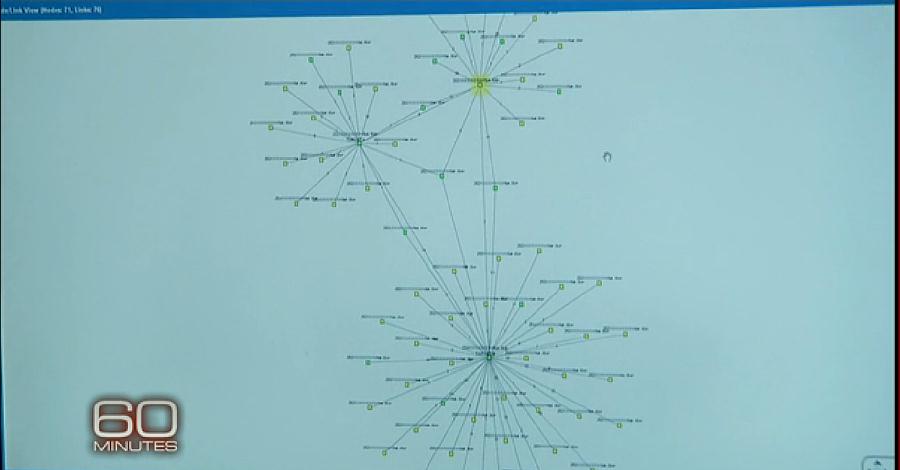
From the transcript at Cryptome:
Metadata has become one of the most important tools in the NSA’s arsenal. Metadata is the digital information on the number dialed, the time and date, and the frequency of the calls. We wanted to see how metadata was used at the NSA. Analyst Stephen Benitez showed us a technique known as “call chaining??? used to develop targets for electronic surveillance in a pirate network based in Somalia.
Stephen Benitez: As you see here, I’m only allowed to chain on anything that I’ve been trained on and that I have access to. Add our known pirate. And we chain him out.
John Miller: Chain him out, for the audience, means what?
Stephen Benitez: People he’s been in contact to for those 18 days.
Stephen Benitez: One that stands out to me first would be this one here. He’s communicated with our target 12 times.
Stephen Benitez: Now we’re looking at Target B’s contacts.
John Miller: So he’s talking to three or four known pirates?
Stephen Benitez: Correct. These three here. We have direct connection to both Target A and Target B. So we’ll look at him, too, we’ll chain him out. And you see, he’s in communication with lots of known pirates. He might be the missing link that tells us everything.
The disconnect from our world and theirs is total. They’re using all their massive computing, relationship-mapping software and data sucking power to spy on people who are among the poorest and most desperate in the world. They are “chaining” them out.
Look at the photos on Cryptome.
The NSA is showing the young people bent over their computers. They think they’re defending the country against foreign threats.
What they’re really doing is spying on the pathetic in the worst places of the world using virtually unlimited technological resources. They should be ashamed of themselves. And Edward Snowden has brought them a measure of it.
Somali pirates pose no real threat to Americans. More die, per year, from attacks by angry bees.
Take a look for yourself.
Such bad guys.
Yet this is the example of metadata sifting of the networks of global enemies the NSA chose as an example to show the American people on prime time television.
The NSA workers shown are just more cogs in the big machine, a machine that bears no resemblance to a military that once existed to destroy the Axis powers.
That is all gone.
In its place, a monstrous and growing device that’s been at it for well over a decade, grinding after the paupers and the piss ants even after an original threat has been annihilated, selling it forward by convincing only the gullible that the targets pose serious threats to the country.
Under this mechanism of distortion and unreality, one can justify anything.
The people who make untrustworthy networks:
Many of the cryptologists skipped grades in school, earned masters degrees and PhDs and look more like they belong on a college campus than at the NSA.
Actually, [solving] the Rubik’s cube took [one of them] one minute and 35 seconds.
Recent score card:
Afghanistan: Hammering poor people. Majority of Americans want to leave, feel it’s not worth it, are ignored. Malnutrition worsening.
Libya: Hammered poor people to depose one famous dictator. Created failed state.
Syria: Resisted hammering poor people for the sake of getting at one famous dictator.
Iraq: Hammered poor people for a decade, rendered country into ruins, then left. Country now in bloody civil war.
What Keith Alexander, director of the NSA says:
“Well, my concern on that is specially what’s going on in the Middle East, what you see going on in Syria, what we see going on– Egypt, Libya, Iraq, it’s much more unstable, the probability that a terrorist attack will occur is going up. And this is precisely the time that we should not step back from the tools that we’ve given our analysts to detect these types of attacks.”
Permalink
01.05.14
Posted in Culture of Lickspittle at 4:53 pm by George Smith
Associated Press has published a bit of inside-look news on the business of Internet rigging. None of this is new to readers. But some of it is worth underlining because it is the Google-rigged American internet, and our corporations, that are the reason for it.
The global network, developed here, is now a fertile ground for sweat-shop click factories and website riggers in the poorest parts of the world, employed by American business to inflate their net statistics and social networking numbers.
Anyone could have seen it coming:
[An] Associated Press examination has found a growing global marketplace for fake clicks, which tech companies struggle to police. Online records, industry studies and interviews show companies are capitalizing on the opportunity to make millions of dollars by duping social media …
Dhaka, Bangladesh, a city of 7 million in South Asia, is an international hub for click farms.
The CEO of Dhaka-based social media promotion firm Unique IT World said he has paid workers to manually click on clients’ social media pages, making it harder for Facebook, Google and others to catch them. “Those accounts are not fake, they were genuine,” Shaiful Islam said.
A recent check on Facebook showed Dhaka was the most popular city for many, including soccer star Leo Messi, who has 51 million likes; Facebook’s own security page, which has 7.7 million likes; and Google’s Facebook page, which has 15.2 million likes.
[Oops!]
In Indonesia, a social media-obsessed country with some of the largest number of Facebook pages and Twitter users, click farms are proliferating.
Ali Hanafiah, 40, offers 1,000 Twitter followers for $10 and 1 million for $600. He owns his own server, and pays $1 per month per Internet Protocol address, which he uses to generate thousands of social media accounts.
Those accounts, he said, “enable us to create many fake followers.”
The Associated Press story features boilerplate on how bad it is. It reports Google and others do not approve and strive to stop it. The Internet rigging industry has also spawned corporate counter operations in which specialty firms are hired to analyze counts and expose click fraud, allegedly to preserve the sanctity of true popularity and the internet experience.
But please. It’s dead. And it was Google and other internet giants who did the deed.
Yes, by all means, we should listen to this advice:
David Burch, at TubeMogul, a video marketing firm based in Emeryville, Calif., said that buying clicks to promote clients is a grave error. “It’s bad business,” he said, “and if an advertiser ever found out you did that, they’d never do business with you again.”
Yes, bad. But here’s the way the world Google, Facebook and Twitter works:
They’ve made this digital ecology where only the very top results in search, the biggest numbers on social media, matter. It’s their code that did it, their design. They own it and it’s a winner-take-all place. There isn’t anything for anyone else. Not even crumbs. It’s the top or nothing. Root hog or die.
Since that’s the case they bear the responsibility for making the incentive to cheat overriding.
Taking measures to stop cheats doesn’t fix this. These are just band-aids over a system of rot that is web search and its social approval and reward by numbers ecology.
And to a great extent, it’s to Google’s and Facebook’s and Twitter’s advantage.
For instance, it is only through being in the top of search, or at the top in numbers of “likes,??? that one is rewarded by linking and algorithms which present you to others, thereby giving one the opportunity for practical monetizations.
On the other hand, it also means Google and everyone else that made the environment have to pay much much less in their “revenue sharing??? schemes while passing out blandishments that everyone can be made “partners??? in monetization.
What it is, in the end, is that their monetization schemes are now like a chance at winning the lottery for almost everyone. Nonexistent.
Last, our human nature in dealing with the web has a hand in the mess.
People respond strongly to perception of popularity and that perception is gained by counts.
When everything is judged by numbers of clicks and likes and position in the top fold of the search return, everyone else not there might as well not exist.
To take advantage of cheating schemes, then, is not illogical.
I’ve said this cynically, but truthfully, once:
You’re already in a pit Google-world made for you. So if you take advantage of search gaming or buying astro-turf and likes from click farms, what’s the worse they can do?
Make you more invisible? Haw. [Bitter laughter.]
Let’s explain it again.
If you’re not in the top you are toast, thanks to American-made search and social-networking technology.
It’s a somewhat different matter for those already at the top who stupidly buy more rigging and get caught at it. Then they have a negative publicity effect to deal with.
But for those who have no publicity, they are not likely to get any on Facebook or wherever because here’s another open secret:
Even if you promote yourself honestly on Facebook or Twitter and pay scrupulous attention to your ‘friends’ and ‘followers, now the situation is such that no one pays attention because, once again, they look at your numbers (or Facebook algorithms look at your numbers), and you get nothing, or are hidden from the all important stream because, well, you’re a nobody.
In the Culture of Lickspittle, nobody does favors for anyone below them.
Since this is the way it is one cannot totally honestly argue that there is a practical serious downside to getting into rigging other than potentially losing an account that couldn’t be monetized into anything, anyway.
Gaming YouTube — from the archives.
Google’s revenue sharing and advertising scams.
Internet counts and popularity:
In the alternative world that began with the true rankings reversed [by count inflation], the least popular song did surprisingly well, and, in fact, held onto its artificially bestowed top ranking. The most popular song rose in the rankings, so fundamental quality did have some effect. But, overall – across all 48 songs – the final ranking from the experiment that began with the reversed popularity ordering bore absolutely no relationship to the final ranking from the experiment that began with the true ordering. This demonstrates that the belief that a song is popular has a profound effect on its popularity, even if it wasn’t truly popular to start with.
Hat tip to Pine View Farm where I more incoherently chalk-boarded it.
Permalink
Posted in Culture of Lickspittle at 3:19 pm by George Smith

Have a laugh at the title, a bleak joke.
Today, if you’re American and want to listen to the Green Bay Packers /49ers game streaming on Internet radio, a game that is sold out, you can’t.
Corporate America put a stranglehold on the net. Local radio stations cannot stream NFL games because of “NFL rules.” The National Football League is one of the biggest money-making operations in American history.
Three years ago you could catch NFL games on radio. And ESPN often streamed some of them, as well as most college football games on-line.
Not anymore. If you gave up American cable television because of its monopoly power and unfair pricing, corporate American struck back.
Today, ESPN allows no viewing of any of the big bowl games, or most college football games, without making you first log in on-line through a cable television provider.
But you do know who gets ripped off by the internet in 2014?
Everyone else non-corporate. They — more, accurately, WE — all get to enjoy the alleged promise of the Internet without the power to make deals designed to maximize ballooning profits.
So America and the civilized world can still have all that free music from middle-sized to little guys at the big web portals.
Famous old meretricious saying:
Information wants to be free!
That worked out well.
Permalink
01.01.14
Posted in Culture of Lickspittle at 10:39 am by George Smith
Pleez, Mr. Pope, don’t criticize capitalism for stomping the poor, it makes American plutocrats angry and then they’ll stop giving money to the church!
Really:
One of us might look at this and say, “so [Home Depot founder Ken Langone] doesn’t want Pope Francis to tell the truth about capitalism.??? Not only that, but how this comes across is as a sort of economic blackmail: you continue saying irresponsible things about the sincerity of rich people’s Christianity, then those rich people will show you exactly how they feel about turning the other cheek by withholding the funds to rebuild cathedrals. In other words, if you want our money, lie about capitalism, or, at the very least, stop telling the truth …
[For] some 2,000 years the biggest problem facing rich people has been how to “be??? Christians without BEING Christians, if you know what I mean. The Republican Party has solved this problem in the simplest possible way: by restructuring Jesus’ gospel and turning his teachings about rich and poor on their head. Now rather than blessing the poor, Jesus is a capitalist’s capitalist who blesses the rich. Naturally, many capitalists are less than enthusiastic about the emergence of a Pope who seems to actually know what Jesus’ original message was, and not only takes it seriously, but is busily repeating it to all and sundry.
Great essay.
Jesus of America: “Wealthiness leads to Godliness.”
You will also surely enjoy The Compleat Sayings of American Jesus.
And Happy New Year from Pasadena! The TV eyes of the country are upon us! And the WhiteManistan Blues Band will be praying, I mean, playing “Jesus of America” today.
Permalink
12.31.13
Posted in Culture of Lickspittle, Cyberterrorism, WhiteManistan at 10:47 am by George Smith
60 Minutes, infamously:
John Miller: Could a foreign country tomorrow topple our financial system?
Gen. Keith Alexander: I believe that a foreign nation could impact and destroy major portions of our financial system, yes.
John Miller: How much of it could we stop?
Gen. Keith Alexander: Well, right now it would be difficult to stop it because our ability to see it is limited.
One they did see coming was called the BIOS Plot. It could have been catastrophic for the United States. While the NSA would not name the country behind it, cyber security experts briefed on the operation told us it was China. Debora Plunkett directs cyber defense for the NSA and for the first time, discusses the agency’s role in discovering the plot.
Debora Plunkett: One of our analysts actually saw that the nation state had the intention to develop and to deliver, to actually use this capability– to destroy computers …
So the BIOS is a basic input, output system. It’s, like, the foundational component firmware of a computer. You start your computer up. The BIOS kicks in. It activates hardware. It activates the operating system. It turns on the computer.
This is the BIOS system which starts most computers. The attack would have been disguised as a request for a software update. If the user agreed, the virus would’ve infected the computer.
John Miller: So, this basically would have gone into the system that starts up the computer, runs the systems, tells it what to do.
Debora Plunkett: That’s right.
John Miller: –and basically turned it into a cinderblock.
Debora Plunkett: A brick.
John Miller: And after that, there wouldn’t be much you could do with that computer.
Debora Plunkett: That’s right. Think about the impact of that across the entire globe. It could literally take down the U.S. economy.
John Miller: I don’t mean to be flip about this. But it has a kind of a little Dr. Evil quality– to it that, “I’m going to develop a program that can destroy every computer in the world.” It sounds almost unbelievable.
Debora Plunkett: Don’t be fooled. There are absolutely nation states who have the capability and the intentions to do just that.
John Miller: And based on what you learned here at NSA. Would it have worked?
Debora Plunkett: We believe it would have. Yes.
From Sherlock, the BBC:
Jim Moriarty, in The Reichenbach Fall: “You don’t really think a few lines of computer code are going to crash the world down around our ears, do you? I’m disappointed, I’m disappointed in you, Sherlock …
“I knew you’d fall for it. That’s your weakness. You always want things
to be clever.”
There is old precedent for this. The NSA does have an obscure record of issuing broad claims on how easy it is to crash things in the US, although most would be hard-pressed to put their finger on it.
One example from the past revolved around an NSA-conducted war game, or mock-up penetration test, dubbed Eligible Receiver in 1997. Eligible Receiver was used, by the NSA working through the press, to get out the message that foreign cyberattack could easily be catastrophic for the United States.
It’s now sixteen years beyond Eligible Receiver. No such cyberattacks occurred. However, the old footprint of Eligible Receiver was quite large in the mainstream press.
It is not unfair to look at it as a propaganda campaign, backed up by only small nuggets of truth, the purpose of which was to boost cyberdefense spending. I covered it extensively on the old home page of the Crypt Newsletter.
Here is one of the old NSA claims from Eligible Receiver:
Bob Drogin of the Los Angeles Times invoked the Pentagon ghost story of Eligible Receiver — the secret wargame conducted two years ago [in 1997] which proponents of “electronic Pearl Harbor??? insist demonstrated the nation could be flattened by cyberattack.
Drogin wrote: “The [Eligible Receiver] hackers broke into networks that direct 911 emergency systems.???
It was a clear and rather extravagant error.
Appearing in June of 1998 to testify before Congress, Ellie Padgett, deputy chief of the National Security Agency’s office of defensive information warfare spoke of how Eligible Receiver addressed the alleged vulnerability of the 911 phone system.
In a simulated exercise, Padgett said, “we scripted (an) Internet message (that) would be sent out to everybody saying there was a problem with the 911 system, understanding that human nature would result in people calling the 911 system to see if there was a problem.???
The working idea in this part of Eligible Receiver revolved around the hypothesis that many people viewing the message on the Internet in a newsgroup might panic and phone their local 911 trunk, causing a jam-up on the line.
“It can probably be done, this sort of an attack, by a handful of folks working together . . .??? Padgett said.
This is an extremely far cry from Drogin’s assertion that the 911 system was broken into by alleged Eligible Receiver hackers. In fact, it has nothing at all to do with breaking into a 911 computer system, whatever that might be.
However, it is consistent, thematically, with the flavor of the mythology propagated on Eligible Receiver …
In fact, during an interview with Crypt Newsletter in the summer of 1998 concerning Eligible Receiver, a Pentagon spokeswoman for the affair asserted “no actual switching systems??? were broken into at any time during Eligible Receiver. She went on to say that Eligible Receiver had only simulated these attacks on NSA computer networks set up to emulate potential domestic national systems.
Nevertheless, Drogin also wrote in paragraph two of the Times piece: “In less than three months, the [NSA’s Eligible Receiver hackers] secretly penetrated computers that control electrical grids in Los Angeles, Washington, and other major cities.???
In 1997, this made the grand assumption that Americans were broadly plugged into the internet, read the Usenet and that the result of a toxic post, like old computer virus hoaxes, would cause people everywhere to overwhelm their local 911 trunks.
Seriously.
Trivia note: Edward Snowden was fourteen at the time of Eligible Receiver.
More as the day continues.
Number of people on food stamps in 2013: between 47 and 48 million.

Keith Alexander, directly from the NSA’s web page, as early as 2012:
The ongoing cyber-thefts [by China] from the networks of public and private organizations, including Fortune 500 companies, represent the greatest transfer of wealth in human history.
Why harp on this?
More than anything else it shows the total disconnection between those at the very top of the national security megaplex and everyone else.
Most of the country, at my level certainly, is still struggling with the economic deprivation and outright calamity of the Great Recession. Although corporate America has rebounded nicely, there has been no recovery for most.
And for Keith Alexander and the NSA, as well as the rest of the defense infrastructure, they saw only expansion. How unfortunate for them that Edward Snowden has spoiled it a bit.
Keith Alexander lives in the world of the plutocracy. Cash money for the day isn’t an issue. Bare bones survival isn’t on the menu. Instead, he and the structure have spent much of their time expanding operations and dreaming up threatening stories and messages to be delivered by the shoeshine men in the press, digging around in their big data suck for things which they, in encapsulated isolated delusion, believe threaten the existence of the country.
When one sees and hears the cant from on high about virus threats to the US financial system and the Chinese cyberwar operation being the greatest transfer of wealth in history and you’re left asking for help at Christmas time, believe you me, it really gets under the skin.
In fact, it’s personal. And it should be so for lots of other Americans, if they ever become more familiar with the subject.
Still more to come.
Liquidate your life in the sharing economy
In which the upper crust and their immediate servants not yet rendered obsolete show how bad they are by leveraging the desperate with smartphones swipe-your-finger apps:
Kim Sundy’s husband kept heckling her nonstop to get her Christmas list to him.
“When I hired the puppet, it got him off my back,” she said.
For $15, the Ann Arbor Mich.-based blogger outsourced the problem to a puppeteer on Fiverr.com who created a short video of a puppet rapping her Christmas list …
Then there is the unselfconscious oaf of wealth, “a chief technology officer,” passed off as someone who thinks of himself as a brilliant do-er in the new world.
The assistants, according to Fancy Hands, will do “anything that doesn’t require us to physically go somewhere for you. Anything a smart, patient, Internet-savvy person with a cellphone can conquer,” as long as it is legal. Plans run from $25 a month for five requests to $65 a month for 25 requests.
For Chicago’s Harper Reed, whose storied career has included chief technology officer gigs for Barack Obama’s presidential re-election campaign and Threadless.com, using services like Fancy Hands and TaskRabbit is just plain “economic.”
“I have a very small company. I don’t have enough money to pay a personal assistant,” he said.
The tasks he hands out aren’t exactly ordinary — things like, “Where can I buy a foghorn for my father for Christmas?” along with sourcing vegan Christmas dinners …
The article gets only one person on the other side, someone newly unemployed who has turned to free-lance micro-paying gigs serviced by bike delivery.
“[Kevin Wagner, a] 34-year-old Chicagoan was laid off from his sales job in August and learned on Lifehacker.com that regular people were making extra money by performing odd jobs with TaskRabbit,” reads the Tribune.
“The Loop resident with a bike has picked up several jobs delivering items, and he has acted as a handyman, including assembling a lot of Ikea furniture … Depending on the week and how much time he has, he’ll make $20 to $400 a week at TaskRabbit.”
One suspects the latter figure is an exaggeration, like most quotes from unemployed people reduced to taking gig work in the on-line bazaar. Few want to tell you what they really earn.
For me, Mechanical Turk has been worth, on average, six dollars a week, at best, an occasional nine, never really exceeding 45 cents an hour, which allows you to determine how much time you need to put in to satisfy the whims of the corporate or academic crowd-sourcing chiseler.
In southern California, acting as a delivery man for Task Rabbit would be suicidal. There simply weren’t enough gigs in Pasadena, when I looked at Task Rabbit, to make them in any way profitable. If you bicycled them in town, perhaps almost.
But an auto is necessary for most of southern California, even much of
Pasadena, and the cost of gas puttering here and there for micro-payments being a gofer to the upper class would annihilate most earnings. This, in the same way that Mechanical Turk’s miniscule payments are significantly eaten into by the cost in electricity just to run the computer you do them on.
It is ludicrous to expect anyone to entertain the idea that people can revitalize themselves economically using the petty networking schemes developed by the tech industry under the euphemism of the sharing economy.
It’s aptly described as gig slave and servant labor in which smartphone and network tech do away with the inconvenience of having to house and pay for the food of your servant, pitting the unemployed or poverty-wage underemployed in a struggling economy against each other for the most miserly sums.
If the economic picture were healthy for the average worker, far fewer would even remotely consider taking such work. The outsource-your-vanity-work bidding services exist precisely because we live in a vulture economy.
Liquidating your life through them is no future. None are increasing the size of the economic pie, revealing only the worst (not that you needed to be told) about the people who burble about how great they are in the mainstream press.
And finally, The Disenlightenment rolls on, provenance — WhiteManistan
The stupid become more concentrated.
Permalink
12.30.13
Posted in Culture of Lickspittle, Decline and Fall at 3:26 pm by George Smith
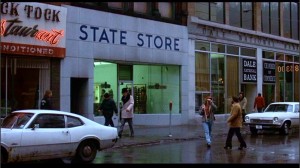
I’ve been storing up the energy to for a review of “Slap Shot,??? the Seventies movie with Paul Newman as the player coach of the Charlestown Chiefs (modeled on the Johnstown Jets) of western Pennsylvania. I have an old videotape and have had it on replay. “Slap Shot” can also be viewed through the lens of America’s forty year slump, a movie framed at the time big business resurrected a devotion to unrestricted preying on its human labor, and — as it turned out — hundreds of millions of future livelihoods.
The backdrop for “Slap Shot” is the perfect picture of it. The steel mill is set to close in “Charlestown,??? laying off thousands.
“Ten thousand people put on waivers,” says Ned Braden (Michael Ontkean), the Charlestown Chiefs’ leading scorer, to Paul Newman, as both stand outside the steel mill waiting for a ride from Lily (Lindsay Crouse), Braden’s wife.
“What’s going to happen to them?” Newman, as Reggie Dunlop, the Chiefs’ player/coach asks.
It’s every man for himself, replies Braden.
They realize it’s the end for the Chiefs. No money, no ticket sales. What there are of the fans won’t be spending what they have left at War Memorial ice hockey arena.
Strother Martin plays the general manager and is making phone calls trying to find a new job and people to buy the team’s old equipment.
Newman as Reggie Dunlop gets the idea to revitalize the team for the remainder of the season with a stunt, using three comical brothers to attack the opposition. The matches turn into brawls as the Chiefs snap a losing streak and stomp their flustered opponents.
Newman plants a ludicrous story in the local newspaper, one that intimates the Chiefs are being avidly sought by a buyer in Florida, one who wants to bring the team to a community of retirees who miss old time ice hockey.
The working stiffs of Charlestown come back to Chiefs games for the blood and circus, organizing a pep squad that even follows the squad around to its away matches. The fan hysteria reaches a climax when the Chiefs play in Hyannisport against “the Presidents.”
A Hyannisport lout throws a key ring at one of the Hansen brothers after a goal is scored and the trio assault the crowd, intimidating the locals. The police are summoned. It’s another publicity windfall for the Chiefs.
Paul Newman finally confronts the owner, a wealthy woman who admits the team is making money now that it’s winning but she’s going to kill it, anyway, because her accountant advises the tax write-off would be better for her bottom line.
“Well, we’re human beings, you know,” replies Newman.
He curses, calling her “garbage” for “letting us all go down the drain” when they’re doing better than ever.
She replies: “I don’t think you understand finance.???
I grew up through that systemic result in Pennsylvania.
From the mid-70’s to today, one unrelenting slump.
It never got better. More jobs were always lost. People made less and less money. There were no moments when anything turned around.
Occasionally, because of presidential propaganda, people felt better about it.
Largely, we bought the swill about “trickle down economics,” the need to squash labor unions, that firing thousands of people was “right-sizing” to get lean, mean and efficient, that life would be a different set of opportunities in which you’d go back to school or be trained four or five times, every ten to fifteen years, this so you would fit the workforce of the glorious future!
All convenient lies. And that’s only a fraction of it.
Manufacturing flushed down the toilet
When I was entering college, Alcoa aluminum closed the biggest extrusion plant in the world in Cressona, PA, where my father worked. He escaped lay-off and was transferred to a small soda bottle-cap manufacturing plant outside Lancaster, a three hour drive every day.
The metal-working plants closed. A recession was in full swing when I graduated from college in Reading, PA. There were no jobs so I enrolled in a Ph.D. program at Lehigh.
During the Reagan years, the nation’s economic policies destroyed Bethlehem Steel. The center of Allentown and the south side of Bethlehem turned into slums. I saw it happen. The people voted for the man who was killing their future. So did the rest of the country.
In November, I was invited to a friend’s house for Thanksgiving and during dinner I sat across the table from a man, my age, who declared Bethlehem Steel had gone out of business because it was “inefficient.” He told me he based this position on having been to one of its plants, one time.
I lived there. Yet that was the type of received wisdom you can routinely hear from Americans who know nothing of the subject except the trivial, making broad statements that it was bad business and everyone had it coming
When you rip the economic heart out of a community it takes a lot down with it.
I went to work for the Allentown Morning Call for a short period.
Advertising revenues, at its owner — Times Mirror, and readership were always in decline.
Losing Bethlehem Steel by no means explained total newspaper weakness but it surely did not help. As with the Chiefs, that so many people had so much less to spend and much less vital economic futures made a difference. A newspaper is a luxury one could forgo, even well prior to the internet, in bad times.
There was a rival to the Allentown Morning Call in Bethlehem. I subscribed to it. It died during the time of the steel collapse.
Newspapers have been going extinct ever since. Once I moved to California, layoffs always, like clockwork every two years, or even more frequently at the Los Angeles Times. An endless river of cutbacks.
However, no matter how people were squeezed or how many were disposed of, the publishers and owners always made more.
Always.
A proudly antagonizing pleasure over the annihilation of people was part of the spirit of it. You would have had to been blind not to have seen the corporate joy over the tearing down of so many working people, of the disposition of them into waste-bins with the added insinuation that it was because of the alleged manifold weaknesses in the American worker.
It is an excrescence in character that has come to be seen as both virtuous and normal.
Forty years of slump. Pitiless. Period.
Now it’s the beginning of the end. The cancer is developed, it’s “stage IV,” fully metastasized, everywhere, as a doctor might say. We never wanted to admit this was festering, growing more toxic. Instead, we have always been full of misplaced optimism, slogans, bromides and fix-it patent nostrums on reinvention and revival.
My parents were steeped in it, believing things were getting better all the time, that America was the best, even as bitter proof of the opposite stared them in the face.
How can you tell it’s really bad? It’s an insane question but I’ll humor you.
You can tell it’s almost terminal because the six and seven-figure explainers have taken it up in essays and television shows, even as they have absolutely no skin in the game.
A timely example is Robert Reich, who was part of the American ruling class work over as a piece of the Clinton administration. His movie, “Inequality for All,” got largely great reviews. And he is a fantastic celebrity explainer. But who is he explaining things to?
In the movie, it’s his class at Berkeley. Is that an audience with any exposure to the 40-year slump? Of course not! Americans can’t afford Berkeley in 2013. It’s a school for the offspring of the plutocracy and their immediate most well-paid servants, the latter who just haven’t yet been properly obsoleted.
You should be so lucky to have a camera crew following you around at Cal and for the well-off to laugh at your jokes, eager staff who’ll edit your shit, get financing and a KickStarter campaign going, put it on YouTube and pass it around everywhere because you’re, well, YOU.
Do you have that?
Great message! Wrong messenger. I don’t need to be told it. Neither do you. I already have a good friend who is unemployed, just like me. And others who have either greatly diminished prospects, been fired or who are regularly threatened with lay-offs by bosses who continue to rake more in.
You see, it’s just “[we] don’t understand [American] finance.”
But even the forces of systemic political evil had the last laugh with Reich’s movie. It’s publicity campaign was run over by the shutdown and blanket news coverage of the latter.
But back to “Slap Shot.”
At the end of it American optimism still rules. The Charlestown Chiefs win the championship but are shut down, anyway. Charlestown gives them a parade. For a day it’s all right.
Newman as Reggie Dunlop excitedly tells his ex-wife, a beautician who is leaving Charlestown because there’s no business, that he has a new job as coach of a team in Minnesota.
When he gets there, he’ll bring up “all his guys.” Clueless hope springs eternal.
However, it is still a great movie. View it again. It’s humorous, coarse in a good way, with wonderful ensemble acting. “Slap Shot” rewards repeated watching.
In America, though, for the majority, places like “Charlestown,” Johnstown — in real life, they never came back. The people just had to deal with ever diminishing expectations and opportunity, with slowly but inexorably more crabbed and desperate lives.
Any social contract that existed was shredded by corporatism.
Despising American labor and wishing for only ever larger immediate gain, US business de-industrialized the country, chasing slave labor, or whatever was closest to it, around the globe.
The belief that Americans were a great resource in human capital was made anathema. American labor was something to be crushed in an allied political and business vice.
To corporate America people are good for only two things: Buying stuff and working for as little as possible.
And when they can no longer buy there’s no use for them at all.
We may have believed this country still was showing signs of vitalism, progress and ways forward. But these were illusions, booms for the few, mostly at the top.
If you were in the national security megaplex, you did fine and will continue to do so. During the slump, beating up on piss ant little countries with the biggest military in world history was tremendous business opportunity.
Oil, financialization and Wall Street, even better.
And now, ad nauseam, the tech industry, heavily engaged in writing software, swipe-your-finger “apps,” to take what little everyone else has have left while telling us how inferior we are for not being able to deal creatively and imaginatively with “disruption.”
An old American story, just a different buzzword.
Some day soon, maybe you too will be able to go to work for nothing or next to it, disrupted and atomized by computer code, courtesy of the mechanized all-against-all economy and a civilization [cough] that’s socially bankrupt.
Or you could stay home and drink whatever cheap stuff you can find. Hell, I’ll drink with you.
“Yeah? Well, then normal is fucked.” –Lindsay Crouse as Lily Braden, Slap Shot
Lily Braden, played by Lindsay Crouse, pictured above coming out of the state store, Pennsylvania’s infamous government-run liquor control business, plays the movie as a drunk. She is enraged, trapped in Charlestown, a “goddamn dump,” while her husband Ned is always on the road with the Chiefs. To ease the pain, she gets shit-faced.
Newman/Dunlop concedes the same thing happened to his wife, she wound up drinking and driving.
“Why do you talk dirty?” Newman/Dunlop asks Lily, one furious night after a game in which her husband, Ned, has checked into a hotel to avoid being with her.
“My family has money,” she replies, in tears.
A minute later she pulls up in front of Newman/Dunlop’s place, realizing she’s been manipulated again: “Get out! Beat it!”
E-mail from a friend in the Lehigh Valley a couple days ago: “Did you know that downtown Allentown is changing? A hockey arena is being built, with buildings around it for offices and restaurants. Leases are being signed. I just can’t picture it, but who knows, it just might work.”
Errata and please pardon the faux pas: It is pointed out to me, quite correctly, that I misspelled “Reggie Dunlop” as “Dunlap” through the entire piece. Oof. Now, so corrected! Thanks, TP!
Permalink
12.29.13
Posted in Culture of Lickspittle at 12:26 pm by George Smith
How much have things changed since Barack Obama took office at the start of economic collapse? Not a whole lot.
The alleged jobs to have, those craved by employers, are the same then as now. Degrees in finance and computer programming, all for fueling the pace at which inequality is increasing, people adept at moving money around globally, and those who make the software that reduces everyone else to penury.
At Yahoo.
Oh yeah, plus one tacked on at the end that doesn’t nearly pay as well — a community college certificate in dental assisting. Scrape teeth for 13 dollars an hour or maybe less.
A future of bedpan technicians, 2011:
Financial examiner jobs require a college degree. Big deal. The present job market may desire financial examiners but the idea that an army of them will lead to future progress is deluded.
And filling the territory with platoons of dental hygienists and occupational therapy assistants isn’t an answer for anything except maintaining clean teeth in people with health plans and, as for the second, c’mon. We’re going to innovate our way back into the lead with people trained to rehabilitate those who’ve had strokes and fractured hips?
As mentioned last week, this country doesn’t lack for human capital. It lacks vision and the desire to do something with it because it’s far simpler to run an entrenched vulture economy.
Permalink
12.27.13
Posted in Culture of Lickspittle, Predator State, Rock 'n' Roll at 8:54 am by George Smith
Fiore.
‘Twas the day after Xmas through the Senate and House
Salvation was coming for every jobless louse…
See the poor have too much, the jobless are lazy
If we give them much less, they’ll get hired like crazy
But why stop with food stamps and checks, unemployment?
We’ll cut down the moochers for our own enjoyment…
And this is still the electric folk song of the year, from the heart of the great American mean, more on point every damn day.
Just not enough social love on Facebook, Reddit, Twitter and et cetera, alas…
I was readin’ Atlas Shrugged
How the rich all get mugged
Blessed are the job creators
They can always hire way more waiters
Permalink
« Previous Page — « Previous entries « Previous Page · Next Page » Next entries » — Next Page »
