03.11.15
Posted in Culture of Lickspittle, Rock 'n' Roll at 2:16 pm by George Smith
At RockNYC, on what to do with your millions when the pro football team is too boring. Buy up the guitars of rock icons, usually dead:
If only we could all be like rock n roll Jim Irsay. Your dad gives you a pro football team, the Colts. Plus a stadium and the family fortune. But the best professional exhibition of crazed greed is your collection of 90 or 175 famous guitars, depending on who is consulted, and the regular bootlicking that comes your way for it.
It is a great country, indeed. If 48 million people are on food stamps, it’s because they’ve made bad personal choices along the way.
But if you take personal responsibility in life, bulling through the drink driving fusses, there’s no telling how high you might climb, like Jim, who spent $275,000 for “Black Beauty,??? Les Paul’s most famous guitar, just a month ago.
Read the entire thing.
Funny! I guarantee it.
Permalink
02.11.15
Posted in Culture of Lickspittle, Made in China, Rock 'n' Roll at 2:59 pm by George Smith

They don’t make ’em like this anymore. That’s a Washburn A-20v BBR, for black-black-red, ca. 1984-85. I have one, made at the Matsumoko company in Japan (since out of business) for Washburn USA (which isn’t).
The shape and color scheme enjoyed a very brief moment in the sun, one coinciding with Quiet Riot’s Metal Health LP, the first heavy metal record to hit number one in the US charts in 1983, going on to sell 6 million copies.
Although I wasn’t much of a fan, Metal Health was a catchy record. Guitarist Carlos Cavazo and bassist Rudy Sarzo played Washburn A-20s, featured in videos on MTV and guitar magazine advertising.
That’s not why I bought mine. I’d wanted a Gibson Explorer but couldn’t afford it. And I’d played one of the BBRs at a Washburn stand at a guitar show. So I had one special ordered and still have it.
I play it regularly now. It’s a shape and color that went horribly out of style. And it fits me, also horribly out of style at almost 59, perfectly.
Even Carlos Cavazo won’t play his Washburn A-20s in public anymore. He joined Ratt and switched to Gibsons. His friends, he said, talked him out of playing those old things. It’s not hard to guess why.
Still, it sounds and plays great, a poor man’s Gibson with a great jet-black hard finish.
It has “Power Sustain” pick-ups, say the old brochures!
And that’s my intro to today’s post on the American guitar business. In the mid-Eighties, electric guitars were still solidly of the middle class business. Leo Fender made it that way.
It doesn’t take a lot of brains to figure out what happened.
The recession, the evisceration of buying power, and the great thinning of the middle class made the guitar-making industry polar.
One end is cheap guitars made in China or similar Asian labor markets. And the other end is expensive custom-shop artisan instruments for classic rock musicians who can still get paid, but mostly for the upper class and very top people who want them as nice things to have. Investments that impress stupid people.
And there’s little in the middle.
The stagnant economy isn’t the only reason guitars have had a hard time. Classic rock is music for an older generation. Like polka was for me in southeastern PA when I was in school.
It’s not entirely dead, of course. Taylor Swift, the biggest seller in pop rock, is firmly from classic rock roots. All her sidemen play vintage model guitars, the best. But young people, as they should, have different choices. They don’t need electric guitars in any big way.
And the industry bet wrong on that.
Before the collapse, the idea, and it was a clear one if you shopped at Guitar Center or BestBuy or Target, was that electric guitars could be put in every household, like microwave ovens. And so the production of 70 percent of all electric guitars was moved to China, the instruments made cheaply, and sold in cardboard boxes as start-up kits.
And then the bottom fell out of the economy and ruined it. Even $120 guitars-made-in-China weren’t quite cheap enough a lot of the time.
Plus a lot of young people would have rather spent up for a more universal symbol of cool, an iPod or iPhone.
However, you can’t have a guitar business like you did in the Seventies, Eighties and Nineties. Guitars are not thrown away. They don’t end up in landfills. You can find them everywhere in pawn shops and used sales. And the very wealthy, who buy the American-made custom shop hot rods? There just aren’t enough of them.
They lack the numbers and the same prole desires of the old middle class.
I see this on-line everyday. Facebook shoves posts from guitar publications and companies into my feed and they’re all about only two things.
First, pictures of expensive hot rod guitars, most of which the middle class, or even people who work in music stores, can’t really afford anymore. And the guitar accessory business, which exploded.
The accessory business, which means guitar effects and foot pedals, can just barely keep prices down on American-made stuff because there’s not much to it in the way of materials.
Fuzz-tones, of which there are at least eighty different brands/makes now, are priced only slightly higher than a rock bottom guitar made in China or Indonesia. And at that price point, a lot of poverty-stricken musicians, which is to say quite a few of them, can still afford the stuff.
And so the American makers of guitar pedals have gone through a boom. Culturally and socially they resemble the demographic of Silicon Valley programmer/brogrammer. Only not paid nearly as well.
They’re all tinkerers. With analog electronics rather than code. They play guitar, naturally, and they’re all white guys who pretty much look and sound the same.
It’s a busy industry that’s forced adaptations on the old industry. Big manufacturers, who have been around for decades, have seen the offerings and co-opted, leased or bought out some of the best of the little guys. Or the luckiest. It’s often hard to tell which.
Dunlop, for example, makes about a score of guitar fuzz/distortion effects under three different sub-company names, MXR, Way Huge and its own. They all feature some overlap, many in details that are of little or no distinction to the millions of people who still listen to classic rock recordings.
But it’s a fit for the hollowed out economy. Small stuff, made-in-America, that young men can still afford to buy a bit of. Gadgets easy to market and advertise, not requiring a lot of development time or much of an investment as the designs have already been made over and over and over again. And lots of choices, like hot sauces or ketchups and mustards at slightly snob up-market grocery stores.
This has established glut as what looks like a permanent feature of the market. There are more things to buy, and more coming all the time, than there is demand.
But despite the inexorably shrinking market for this, YouTube bristles with unpaid advertising for the new state-of-the-art electric guitar and accessory market.
New local bands nationwide can record and make as many videos of their music as they want, never make any headway, never get any numbers without a couple lucky breaks.
But un-boxing and demonstration videos of new fuzz-tones and guitar overdrives often guarantees some kind of audience.
Since American guitar manufacturers moved their production to China they surely cannot be surprised at some of the more interesting ramifications.
Three years ago I did a number of posts on Chinese-made counterfeit Gibson guitars after the Washington Post and other major newspapers actually began running on-line ads pointing to sites that sold them.
The ads were eventually taken down but the business became more vigorous. And why would it not?
Why pay for an expensive American-made Gibson guitar when you can’t afford it? But you can have a nice-looking forgery for hundreds of dollars, with a little luck when it comes to shipping.
There are many people who think this way. Can you blame them? They know that if they try to hock a forgery it will be discovered. They know that in many areas in won’t be up to the standard imposed at the Gibson factory.
But the Chinese are always getting better at the job and, in terms of for personal pleasure and looks, often the difference in quality matters less and less every day.
Why, just look at the video enthusiasms of young American men over “Chibsons,” the name for Chinese Gibson forgeries, on YouTube. It’s real.
How good is that Chibson? How do you tell if you’ve been sold a Chibson? Let me show you the unboxing of my new Chibson! How do you get a Chibson and what can you do to upgrade it?
Boy, that Chibson sure looks nice!
Even Earl Slick plays, markets and recommends Chinese-made guitars! Chibsons and Chenders!
Ask and I’ll tell which one looks good to me.
Two years ago Fender Musical Instruments tried to go public.
Initially, it seemed a natural, even proper, thing. The company of Leo Fender, although he’s long dead, is the tap root of the tree of American electric guitar. It’s a big part of the history of pop rock all around the world.
The attempt failed, done in by the opinions of America’s financial wizards who deemed it overvalued.
“Jeffrey Bronchick, the chief investment officer at investment advisory firm Cove Street Capital, says the stock was overvalued,” read a story from Fortune.
“It is a much more difficult business than what it was being sold as,??? says Bronchick (who also plays guitar, on a Fender),” told the magazine. “It was highly levered, there was a big question mark on growth and it was priced too high …???
For the New York Times, there was the same financial adviser, telling the newspaper he had four Fender guitars, but: “What possible niche is left unexploited by Fender?”
Fender’s margins were under pressure, said the newspaper. “Many of the guitars that are selling these days are cheap ones made in places like China — ones that cost a small fraction of, say, a $1,599 Fender Artist Eric Clapton Strat …”
And “Poof!” went the i.p.o.
Done in by the merciless judgments of those in the financial industry who make nothing but who buy tricked-out American custom-shop goods as investments and baubles. They weren’t believers in the company’s future. What they believed was how nice it is to show off a couple expensively furnished Eric Clapton Stratocasters to wealthy acquaintances at dinner parties, acquisition of luxury goods as a means of keeping score.
Today Fender is owner by a private equity firm. It’s interim CEO is known for being an executive at Under Armour and J. Crew, the latter an upscale women’s wear company.
In 2011, the Fender Museum closed due to lack of interest. A week or so ago there was a garage sale for what was left of its memorabilia.
And in a not very surprising development, Fender announced it would be selling direct from its website, royally pissing off its 70-year old network of bricks-and-mortar guitar store dealers.
Why not? Perhaps it would increase the profit margin, if only by increments. And to the new generation who use smartphone apps of convenience, shopping in a physical store lacks the zing of custom-picking the colors and hardware of a Stratocaster on-line.
Picking up a guitar in a store is old and fuddy-duddy, obsolete. You have to drive to it. You might have to plug it into an amp to see how it sounds and plays. With new computerized machinery to set-up a guitar before it leaves the factory and the service of UPS or FedEx, things are generally OK when they arrive at your doorstep.
And there is the upside: Direct sales taps Fender directly into the mania of unboxing video.
Playing the guitar is entirely secondary to the loving way in which the cardboard shipping box is displayed. Then the slow prying open and gentle removal of packing materials, all captured with full HD digital camera work.
Finally, the climax: The camera shows the un-boxer panning over and turning the as yet untarnished instrument itself. Exquisite!
Perhaps a second video can be made in which the unboxer briefly plays the instrument.
But, really, this is relatively unimportant in the grand scheme because there are always new instruments and accessories to be unboxed. It is the movie-like documentation of the acquisition that is the be all and the end all.
Besides, look at the videos of the Fender guitar un-boxers. They’re nerds with expensive hobbies.
There’s no more rock n roll in the lot of them than there are in boxes of mashed potato mix. But that’s where the money is and you cannot fault Fender for trying to shake hands with the future.
What about Washburn? It has its custom shop in America, for the high-priced models. For the rest of us, there are those made in Indonesia.
Permalink
01.28.15
Posted in Culture of Lickspittle, Rock 'n' Roll at 2:35 pm by George Smith

From the archives of the Philadelphia Inquirer, now on-line, a review of the first Dick Destiny album in 1986:
DICK DESTINY AND THE HIGHWAY KINGS Arrogance (Destination Records * * * ): It’s less arrogance than devotion that compels Dick Destiny to sing – his howl nearly drowns out the real reason to listen to this record, i.e., the guitar playing, which for all I know may be done by Dick Destiny (lack of credits on the album jacket there, Dick). Anyway, the lead guitarist knows his way around everything from blues to heavy metal and doesn’t condescend to either genre. If the lyrics have no purpose other than to hymn rock cliches – the road, love and rock-and-roll its own bad self – the music convinces me that someone in this band is in it for the passion, not the potential for stardom.
Rated by Inky pop music critic Ken Tucker over Alice Cooper’s Constrictor (“the songs are mostly dull, hostile twaddle”) and Stacy Q’s Better Than Heaven which generated the world-wide smash, “Two of Hearts,” and nothing else.
“Can the singer whose voice is strong enough to remind you of Madonna’s with voice lessons and the performer of one of the year’s catchiest No. 1 singles (“Two of Hearts”) – the song that brought disco back into pop consciousness – sustain such excellence for a whole album?” asks Tucker. “No.”
Oh, snap!
I got three stars doing it the home-made way. They got two.
What’s that you say? Buy Loud Fold Live?
Permalink
01.19.15
Posted in Culture of Lickspittle, Rock 'n' Roll at 12:56 pm by George Smith
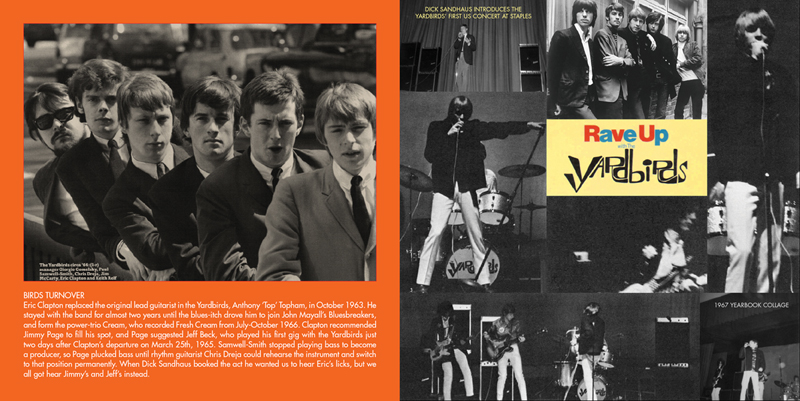 Bigger.
Dateline — Westport, October 1966 and the British invasion! The Yardbirds featuring the not yet super-famous rock guitar gun-slingers Jimmy Page and Jeff Beck had landed in Connecticut!
The Westport Staples High School auditorium was the famous rock group’s first appearance in the United States.
How did it happen?
It’s a remarkable story told in “The Real Rock n Roll High School: True Tales of Legendary Bands That Performed in Westport CT,” compiled by Staples grad Mark Smollin and the students who were there.
In 1966 Staples students Dick Sandhaus and Paul Giambacinni wanted to make their high school days special. And they had a subscription to Billboard magazine. So with the audacity of kids they pitched the idea of bringing the new cutting edge of pop music, rock bands in the charts, to Staples. And the principal bought it! As long as the two could keep the stars to an initial down payment of 750 bucks.
They did.
And so they booked the Beau Brummels, a California band then climbing
the US charts with a single entitled “Laugh Laugh.” The Staples auditorium was filled to capacity with screaming fans, kicking off what would be a long tradition of big name rock bands appearing there.
Tour promoters and record labels realized Westport’s high school was a great stage, one where the teen fans would show up and bands would get a warm reception.
So along came The Yardbirds, Cream, Sly & the Family Stone, The Doors, The Animals, Pete Seeger, Blues Image and many more.
The illustration in this post, excerpted from the book, is a collage of snapshots taken at the Yardbirds show.
In late summer I copy-edited The Real Rock and Roll High School. It is a good book, one of a kind describing a part of history from the beginnings of classic rock, something that happened nowhere else.
I thought of it as an oral history, a richly illustrated scrap book and fond high school memoir filled with pop art, concert posters, ticket stubs, local newspaper clippings, and many photos taken by students.
It was fun to do and obviously a labor of love.
In the process it also exposed the limitations of ebooks and publish-on-demand at Amazon CreateSpace.
If you read the standard news on do-it-yourself publishing, Amazon is the be-all and end-all, the perfect place for everything: Publishing platform, print-on-demand, ebook distribution and the website where you will build a career and following in front of the largest potential audience.
Not so fast.
Amazon CreateSpace can’t handle books like The Real Rock n Roll High School.
And the reasons are actually pretty simple. Amazon’s technology isn’t up to the challenge of sophisticated and complicated pages loaded with color photos, black and white imagery and text. It cannot make such a volume into an ebook for Kindle, either.
That’s not something you read in Amazon’s fine print. The author of The Real Rock n Roll High School had to find out the hard way that Amazon’s self-publishing couldn’t produce a good quality physical or electronic copy of a color dependent mixed-media volume on good paper, the likes of which you can still find by the hundreds and thousands in old brick-and-mortar stores across the country.
So how do you do it? Old school. The hard way, like book publishers have done for centuries. It turns out there are some things traditional book printing is still much better at.
Is there a digital copy of the book available? Yes, of course. As a .pdf, a form in which it looks very good.
But you don’t really need Amazon for that now, do you?
Here is the ordering page.
Permalink
01.17.15
Posted in Culture of Lickspittle, Rock 'n' Roll at 12:38 pm by George Smith
At RockNYC:
Never speak ill of the dead. And so it has been for Kim Fowley, Hollywood impresario, producer, self-promoter and talent scout for the crass just-for-the-sake-of-it, third or fourth-tier glam rock artist, all of it over the span of half a century. In the obituaries everyone’s come out with praise and fond memories of a life goodly lived.
As organizer/producer of the Runaways alone, that would have been enough. In the last dozen years Fowley was a major character in three movies, two on the Runaways (one, the big famous Hollywood production with Michael Shannon with the vulpine producer, the other the not-so-famous documentary, Edge Play) and one about Rodney Bingenheimer, “Mayor of the Sunset Strip,” If Bingenheimer was the mayor, Fowley, as it appeared, could have certainly been its animal control officer.
“[Fowley] sometimes claimed to have been born in the Philippines in 1942 (many accounts say he was actually born in Los Angeles), which would have placed him there during the vicious Japanese occupation in World War II,” Billboard wrote dryly in a recent obit. So what if it’s fiction?
It’s a good detail and who would care if all the plaster stuffing up the cracks between the facts of Fowley’s art and business is somewhat made up?
The consensus of the death notices is that Fowley relished being thought of as a bad man with a heart-of-gold, that, perhaps, he wished he’d been American tv famous. But you get the idea he kind of knew it would never happen with bands like Venus & the Razor Blades, The Orchids (the Runaways redone), the Quick, the Hollywood Stars and, yes, the Runaways. Not even with enough albums to asphyxiate an elephant, a number of them big sellers in name. Not in Seventies America.
At least that’s what it looked like back in the Rust Belt while paging through Creem, Circus and Rock Scene magazines. Fowley always got great publicity. Heck, it was still great entertainment!
And so you see the print, the concept, the photos, the minor desecrations of American middle class pieties for short, amusing and sometimes almost anthem-like tales of garbage spied in the streets were actually better than the reality.
“Punk-a-Rama” and “Dog Food” as in, they ate it in place of cake, by Fowley project Venus & the Razor Blades read and looked great. And then the record arrived. You kept it but after scoring five years later you’d only played it ten times.
Fowley had hits. “Alley Oop,” a novelty by the Hollywood Argyles. “Nutrocker” by B. Bumble & the Stingers. The latter probably earned him the most money when Emerson, Lake & Palmer covered it on a vilified but stentorian live tribute to Mussorgsky sold at a promotional bargain price, “Pictures at an Exhibition.”
Believe me, laugh now, but that moved units in 1971.
As for Fowley’s glam rock trip, “International Heroes,” from 1973, again — looked real good on paper and in early rushes. There he is in gender-bender lipstick and eye-shadow, the poor man’s Ziggy Stardust but perhaps with a disease.
“Kim Fowley’s new album … will place him in the ranks of David, Mott, Alice and Lou in the hearts and palms of the American teenager,” reads Capitol’s press. In the palms? All right!
But you’re going to have to listen to it in the clips before crossing that bridge.
And you can see ’em here, believe me, you’ll want to, they’re short, along with the rest.
Or go to YouTube and type Kim Fowley. There’s no shortage of material. The man was made to be the video platform’s Ed Wood.
Permalink
01.10.15
Posted in Culture of Lickspittle, Rock 'n' Roll, Shoeshine at 12:06 pm by George Smith
Nothing bad ever goes away for good here. Like turds, these things just float back up to the top of the great public punch bowl of life, again and again.
Mitt Romney wants to be President, again.
It’s hard!”
The guy, of which who said it, died.
Permalink
01.05.15
Posted in Culture of Lickspittle, Phlogiston, Rock 'n' Roll at 4:00 pm by George Smith

One of electric guitar effects maker Electro-Harmonix’s first consumer devices, this 1970 Black Finger, a “Distortion Free Guitar Sustainer,” has been with me for 45 years. The last thirteen of which had been spent in closets in a box because it didn’t work.
I made getting it going again a holiday project. A liberal application of De-Oxit and some fiddling with the tone potentiometer and power supply leads and it came back to life.
It’s a compressor and probably the first one ever made for electric guitarists. [1] The basic layout is the same as the company’s Big Muff Pi fuzz tone. From 1970, it shares an identical triangle knob layout, plus an on-off switch in addition to the usual stomp switch and a two-battery power harness, just as many of the 1970 Muffs.
In the early Seventies EH removed the on-off switch, put the knobs in a straight line and added an illustration of a, well, black finger.
The 1970 Black Finger contains a real pile of old transistors. In use, after twisting the knobs for the degree of compression wanted, I always left it on for the duration of a session.
It is not a light compression. You know it’s on and squeezing the signal from the guitar, from a lot to really a lot. At the lowest compression delivered, it makes country licks and jangle rock pop. On the extreme end the attack of the guitar virtually disappears.
Electro-Harmonix has a tube-driven Black Finger compressor in its stable but it’s not really anything close to the same pedal.
The 1970 Black Finger was not particularly common. I never met another person who used one. Today there are one or two videos of old models on YouTube. (I’m planning on putting up a demonstration of it when I have the time.)
Of course, it was made entirely in the US 45 years ago before the forty year slump and the installation of corporate dictatorship. And it turned out to be a bit more long-lasting than the American Middle Class.
I used it at swimming pool parties in Pine Grove in 1970 and dragged it almost everywhere through dive bars with the Highway Kings in the mid-Eighties.
The Black Finger had a disadvantage which made it unique, a noise factor, actually. It takes two 9-volt batteries and when they run low the unit begins to distort, hiss at you and pump audibly. That had its uses.
Here’s an old review I wrote of it thirteen years ago for a web music site.
I’m taking it back (edited):
I used [the Electro-Harmonix Black Finger] for thirty years with a Fender Vibrolux and a variety of Hiwatts. It worked well with both but was extremely useful with the Hiwatts when it was necessary to squeeze more sustain out of fairly clean but overdriven sound at a volume level somewhat less than what would kill everyone but the criminally rock and roll insane.
It helped produce an unmistakably brutish sound that used to be common in the Seventies but which is rarely heard today. Waxing heavy on the control knobs makes for a variety of really abusive tones.
The first time you stomp the Black Finger into “on” it hesitates before giving you anything. A nice feature! As if something were charging up or picking up a head of steam before getting rolling. After it’s been stomped “on” once in the session, the lag goes away.
Who knows why it’s that way?!
As for reliability? Utterly so.
If you had a metal box of circuitry that lasted thirty years, what would you think? You could throw it into a landfill and if it didn’t rust it would probably still work when you dug it up ten years later.
Of course, this may be just the case with mine. Not yours.
Seems to be made of old battleship steel. (Actually aluminum although it is a heavy pedal.)
Requires two nine-volt (that’s “two” as in an eye-popping T-W-O!) batteries and eats them at a moderate but not accelerated rate.
Opening the kit to replace them is reasonably but not overly trying.
The edges of the inside of the battleship steel case are sharp and I have occasionally non-fatally nicked a finger while replacing T-W-O, that’s “two,” nine volt batteries.
The Black Finger always did me good. And the name! Exquisite!
Colleagues marveled at the sheer stubborn durability of my Black Finger.
They even sometimes mocked and laughed in disrespect at the annoying glitchy tones coming from it when the batteries ran low and it started to eat itself. But they also admired the clear, thick sustain that educated use could wring from it.
Certainly, it is a tool of utility in making old school rock. While not indispensable, I have never heard anything quite like it since.
The Black Finger has mostly always sounded old although it sounded quite new in 1970 or so. Guaranteed to sound old now, always.
That’s good!
It’s a tough, brutish, potentially ugly-sounding compressor that works well with tough, brutish, potentially ugly-sounding big amplifiers and fuzz tones. (Really, you put a fuzz face circuit after it and the results are great.)
It is not for milchtoasts.
You should be an old, crabby guy with a beard and a large bald spot for best results with the Black Finger.
1. The only other electric guitar compressor on the market at around the same time was the Dan Armstrong Orange Squeezer.
The Orange Squeezer was a ca. mid-70’s very small box with a fixed setting. It was much less aggressive, smaller and simpler in design than the EH Black Finger.
It attained some popularity for its use by Steely Dan (obviously never credited on recordings), some country artists who loved what it did for their picking, and later, Mark Knopfler of Dire Straits.
Like the old Black Finger, who uses Orange Squeezers today?
Really, nobody. Maybe some older session aces who either have originals or who bought clone designs of the original, which exist, but which still aren’t popular in any real sense.
There’s not much to compare between the two designs although I’d argue that the Black Finger I have, when set right, works great for accentuating country licks, adding warmth (although the tone knob can make it really irritating, too) and with distortion (refer the fuzz face citation) furnishes the vintage A-to-Z with the twist of the guitar’s volume knob early-70’s hard rock sound.
The Orange Squeezer was deemed more successful. No one credits the Black Finger with anything. It was totally eclipsed, and then erased, by the rapid success and reputation of the Electro-Harmonix Big Muff Pi fuzz. (Dave Gilmour of Pink Floyd wanted the Muff fuzz after Dark Side of the Moon. What if he had heard a Black Finger in line before his Fuzz Face?)
The only other compressor I’ve used that’s equal or better (for my taste) is the one designed into the Scholz R&D Sustainor which came many years later. At a practical level, the Scholz R&D compression circuit of the mid-Eighties was/is somewhat easier to work with and a slight bit more naturally musical than the original 1970 Black Finger. Both supplied a lot of compression. There were no really mild settings to be had from either.
What’s the difference? The Black Finger was not set in its equalization. Maxing the compression only kills the attack from the guitar as it blooms the tail.
The compression in the Scholz circuit, along with the rest of the design never totally kills the attack but does add a lot of mid-range.
Permalink
12.12.14
Posted in Culture of Lickspittle, Rock 'n' Roll, The Corporate Bund at 4:02 pm by George Smith
How a New York Times Dealbook blog post might have read, but didn’t:
Speaking at the Dealbook conference in Manhattan, chief executive officer of Goldman Sachs Lloyd Blankfein said Wall Street had come to occupy an unwelcome position in Washington similar to where the military was during the Vietnam War protests. “I certainly don’t think it’s a virtue to declare a big segment of the economy off limits,” Mr. Blankfein said.”
““You’ve seen a little bit of a tension between capital and labor,??? he said. This response when asked about Uber and the billions being taken off workers by the Silicon Valley predatory system known as “the sharing economy.”
Mr. Blankfein also likes Hillary Clinton, just as she likes Wall Street and Goldman Sachs. He wouldn’t mind if she was Queen the next President.
“I’ve always been a big fan of Hillary Clinton,??? he said.
Mr. Blankfein also voiced dismay that Senator Elizabeth Warren’s vehement opposition to the nomination Wall Street plutocrat Antonio Weiss for Sec’y of Treasury was gumming up the works.
After all, what was wrong with Mr. Weiss getting a 20 million dollar pay-out for leaving the Street and joining government?
“Why does the country benefit from making something hard so much harder???? Mr. Blankfein said.
Times tells us that it stands still in the USA. So you will want to hear “Let’s Lynch Lloyd Blankfein” from the album Loud Folk Live which you should also buy before Christmas because it’s cheap — 5 dollars (!) — and you can hear your host make jokes.
The picture of Mr. Blankfein is really boss, too, perfect for the song. So click that SoundCloud link!
Permalink
12.04.14
Posted in Culture of Lickspittle, Rock 'n' Roll at 2:08 pm by George Smith
To support Loud Folk Live.
In a country as fucked up and dismaying as the United States in 2014, it is genuinely a record to notice, an antidote to the Culture of Lickspittle.
Now, an anti-thesis, a standard and soul-destroying thing packaged as fun, something to encourage people to do for the good of their employer:
Last week [Rock & Roll Fantasy Camp’s] award-winning TEAM ROCK STARS Team Building/Entertainment Program hosted a great group from ESPN/Disney at the House of Blues on the Sunset Strip.
The group arrived at 4 p.m. and following an all-star band performance of Queen’s “We will Rock You,” they were surprised to learn that they were going to be broken up into groups to rewrite the lyrics of the infamous song with their own lyrics about their company sales meeting. ESPN’s meeting planner’s commented, “In the past 9 years, this team building program was the most innovative, creative and entertaining. Rock Camp blew us away!??? And her division president was all smiles and agreed with her comments. — “The best team building program out there.” — PEOPLE Magazine
“Your dream lives.”
That’s $250 dollars/person for any corporation that wants to see some of its employees rewrite the lyrics to “We Will Rock You” as praise for the business. And then to compel them to sing it on the Sunset Strip at the House of Blues.
Such an exercise is designed to be dignity-destroying.
But this is not and is orders magnitude better! Loud Folk Live tunes — The National Anthem, Rich Man’s Burden, Puta and Jesus of America — at the links.
Five bucks for a digital copy sent to your e-mail — cheap, LOL satirical, catchy, toe-tapping, as well as lots of other wholesome things.
Permalink
11.21.14
Posted in Culture of Lickspittle, Rock 'n' Roll at 10:40 am by George Smith
We are now playing Alfred E. Neuman’s “It’s a Gas” in the Dick Destiny Band. It seemed appropriate.
The belches are actually hard to arrange on the fly unless you have an unusual talent for them.
And, yes, while it’s not on Loud Folk Live, you can instantly have a digital copy for a measly suggested list of 5 dollars — CHEAP! (Teaser tunes and blurbs at the link.)
And, urrrp, I’ll send you a download page.
Permalink
« Previous Page — « Previous entries « Previous Page · Next Page » Next entries » — Next Page »