04.11.12
Posted in Ricin Kooks, War On Terror at 10:22 am by George Smith
Once again the Internet recipe for ricin takes down some fools.
Today wire news informed two members of the George Ricin Beans Gang copped guilty pleas to the lesser charges of “conspiring to get explosives and silencers.”
From the Associated Press:
Two Georgia men pleaded guilty Tuesday to conspiring to get an unregistered explosive and an illegal gun silencer in what prosecutors describe as a plot to attack government targets.
The suspected ringleader of the group, Frederick Thomas, and Dan Roberts entered their pleas at a hearing in federal court in Gainesville, about 55 miles northeast of Atlanta.
Thomas, 73, and Roberts, 67, could face up to five years in prison …
Readers may recall the ricin beans gang comprised four old men, mostly talkers, who were angry with the government’s alleged desecration of the Constitution. To make things right, they mused at a Cracker Barrel restaurant and other places, people would have to be killed.
One of the ways this was to be done was an absurd plan to grind up castor seeds and dispense the powder from a car speeding along the highway. It would never have worked and the men had no capability. I and others were quoted as saying so in newspapers.
From the Atlanta Journal Constitution:
“There’s no way for us, as militiamen, to save this country, to save Georgia, without doing something that’s highly illegal: murder,??? Thomas said during a meeting in March, according to the affidavit. “When it comes to saving the constitution, that means some people gotta die,” he was quoted as saying.
Roberts’ attorney, Michael Trost, said after the hearing that the plea was the best “rough justice” he and his client could hope for. The plea is “close to what represents the facts,” he said, since it is not an admission of terrorism.
“We will resolutely deny that it is terrorism” during the sentencing hearing, he said …
“Prosecutors said those two men brought [two other defendants who have not issued pleas, Sam Crump and Ray Adams] into the mix after Roberts talked of obtaining a ‘silent killer’ — the toxin ricin, which can be lethal in small doses,” added AP. “Crump had memorized the recipe for making the poison from castor beans, prosecutors said, and Adams had the know-how to make it as a former government lab technician.”
Adams did not have the know-how, as a “lab technician,” to make ricin.
He was a pesticide mixer, at best. However, this is unlikely to matter in the final reckoning.
There is no defense lawyer who can mitigate charges when ricin is part of the courtroom discussion. Juries, judges and prosecutors simply won’t have it.
“This is about an old man talking big,” said one of the defendant’s lawyers. It was an accurate statement. But the justice system during the war on terror makes no allowance for such things.
On the Georgia Ricin Beans Gang — from the archives.
Permalink
03.27.12
Posted in Bioterrorism, Ricin Kooks, War On Terror at 8:50 am by George Smith
Soligenix, the old Alliance for Biosecurity firm that occasionally appears on the blog, published a statement on its activities in the year 2011 today.
A number of things stick out.
First, the company’s profit this year resulted all from a “non-refundable” cash payment, licensing purchase by a firm that must now consider itself extremely unlucky, Sigma-Tau Pharmaceuticals.
“The increase in revenues was a result of a $5.0 million non-refundable license fee from Sigma-Tau Pharmaceuticals, Inc. (Sigma-Tau) in connection with the expansion of Soligenix’s existing North American commercialization rights to orBec …” reads the Soligenix statement.
“Christopher J. Schaber, PhD, President and Chief Executive Officer of Soligenix stated, ‘In 2011 we saw the unfortunate stoppage of our Phase 3 trial of orBec …’ ” it reads further on.
Oof, Sigma-Tau Pharmaceuticals! They bought busted goods and there’s no warranty.
[We] have restructured the organization by decreasing headcount with a continued focus on cash management and research …” continues the Soligenix report.
The firm has also moved onward with research on development of anti-radiation sickness medicine.
Sadly, this is not good news for dogs.
“On February 21, 2012, the Company announced further promising results from its continuing preclinical study of SGX202 (oral BDP) in a canine gastrointestinal acute radiation syndrome (GI ARS) model,” states the Soligenix missive. “The new study results indicate that dogs treated with SGX202 starting 24 hours after exposure to lethal doses of total body irradiation (TBI -1.61%, news) demonstrated statistically significant (p=0.04) improvement in survival when compared to control dogs …”
Grim reading. Particularly when considering the firm’s track record of unparalleled and glorious success.
Soligenix, formerly DOR BioPharma, is a company that pretty much exists because of the war on terror. Post anthrax, funding for bioterror defense took off.
Soligenix acquired licensing for the development, testing and manufacture of a vaccine for ricin from a researcher who had come up with it as a result of her work looking at the poison from the standpoint of a potential use in cancer treatment.
However, while a totally go-go industry through the middle of the decade, some funding for bioterror defense has now fallen by the wayside, due to the the economic crash of 2008, resulting austerity, and disinterest. Most of the companies in the old Alliance for Biosecurity have languished, producing nothing.
A huge bioterror defense research and vaccine facility planned for the University of Pittsburgh Medical Center championed by Tara O’Toole, old leader of biodefense lobbying (now at DHS) wound up canceled. UPMC’s bioterror defense program seems to have other troubles, too.
The ricin vaccine, although still the subject of some press releases, is — for practical purposes — orphaned for now.
Work on anthrax remains protected. However, the dirty tricks competition between the companies fighting over the taxpayer’s money has virtually guaranteed it produces nothing, corporate welfare for one or two stagnant firms.
Earlier this year, DD blog posted on Soligenix’s efforts to prop up its stock price after news of cancellation of trials for one of its potential products rendered it virtually worthless.

Stock slump: Bioterror defense company Soligenix falls on hard times.
Permalink
03.20.12
Posted in Ricin Kooks at 1:19 pm by George Smith
From the global wire:
An Indonesian man accused of plotting to poison police officers by tainting bottles of mineral water with the deadly toxin ricin faces seven years in jail, Central Jakarta District Court prosecutors announced on Tuesday.
Ali Miftah, and six other suspects, allegedly planned to ship the poisoned water bottles to police headquarters in Jakarta, Central Java, East Java and Central Sulawesi. The water was reportedly laced with ricin, a fatal toxin produced by the castor oil plant, prosecutors said.
“He was involved in an evil conspiracy,” prosecutor Ricky Rommy said. “[He attempted] to help or commit a premeditated act of terrorism.”
Ali was also charged with attempting to hide alleged Bali bomber Umar Patek …
The man’s associates, alleged mastermind Santhanam, chemist Paimin, Jumarto and Martoyo, all face six years in prison. Two other men reportedly involved in the plot, Umar and Budi Supriadi each face five years.
The group was not connected with any of Indonesia’s known terrorist organizations, according to prior reports.
Permalink
03.03.12
Posted in Ricin Kooks at 10:37 am by George Smith
I’ve been avoiding this one all week it’s so dispiriting and ridiculous.
A obese diabetic car thief in Florida — once slightly famous as an Elvis impersonator in Maine — told police when they came for him he had ricin.
This caused the evacuation of the motel he was holed up in with his son.
His son cooked him a bowl of oatmeal, which stabilized the man’s blood sugar, calming him down. The police then arrested him without incident.
From the wires:
A former Elvis impersonator from Maine who reportedly drove a stolen car from Augusta to Florida is charged with threatening police there with a weapon of mass destruction.
Michael James Conley, 64, of Waterville told the Miami Herald he was suffering from diabetes Monday when he told police in Fort Pierce, Fla., that a small vial he was holding was loaded with the lethal toxin ricin.
Conley was charged with possession of a hoax weapon of mass destruction, resisting an officer without violence and conspiring to deal stolen property. He was subsequently charged with contempt of court. Conley was being held at the St. Lucie County jail in lieu of $115,000 bail.
Conley’s son, Michael Harootian-Hughes, 28, who was in the hotel room at the time of the standoff and reportedly made the oatmeal that helped his father, also was charged with possession of a hoax weapon of mass destruction. He was being held in the same jail in lieu of $20,000 cash bail.
Yes, possession of a hoax weapon of mass destruction is against the law. In Conley’s case, it was salt. The news story also discusses his more famous criminal record, one involving murder conviction, later overturned.
And in Florida it is a second class felony.
Quote:
During his interview at the jail, Michael Conley initially said he made up the word “Ricin.??? However, he finally said he heard the name during a television broadcast about terrorists in the Mideast.
Permalink
02.27.12
Posted in Bioterrorism, Ricin Kooks at 12:02 pm by George Smith
Today, from the newspaper of Denton, TX, a story mentioning how the ricin vaccine fell in and out of favor.
Readers of the blog know it as the always coming but never arriving product of Soligenix, a now near worthless company from the old Alliance for Biosecurity. DD blog last mentioned the firm here.
Before 9/11 there was virtually no interest in a ricin vaccine. The main reason for this is that no one actually needs such a thing except those who research ricin, or the few weird crazies every year who pound castor seeds.
However, after 9/11 and anthrax, funding for bioterror research and nostrums to be used against all the diseases and toxins said to be about to descend upon us exploded.
Over ten years on, with little to show for any of it, some of the research and firms involved have hit a brick wall. Some, although not all, are out of favor. Budgets are busted and the country often has other newer problems to spend money on.
The ricin vaccine came out of research into using the toxin in targeted chemotherapy against certain cancers. And the interesting part is excerpted:
Less than a half-hour drive down the freeway from Sellers’ oncology treatments, researchers at the Cancer Immunology Center in Dallas search for a cure for cancer. Despite the physical proximity, Sellers and other chemotherapy patients are more than a decade displaced from the work of researchers down the road.
As professor and researcher, Dr. Ellen Vitetta, the immunology center’s director, has worked to discover new treatments for an array of incurable diseases for more than three decades. In 2000, after more than a decade of research to genetically engineer and modify a toxin to target tumor cells, her team realized the cancer research had brought them to the doorstep of a vaccine for something else — ricin, an extremely toxic protein found in the castor bean.
While continuing the tumor-targeting research, Vitetta’s team hoped government interest in the vaccine would lead to an increase in grant money that could be applied toward the lab’s primary goal of cancer research. For a while, it did.
But after 12 years, numerous papers and two clinical trials, both the vaccine and the cancer treatments that inspired it sit on freezer shelves in the Dallas lab — a sort of purgatory for promising research that falls out of favor, Vitetta says.
“If I can’t get money for [the research] and I can’t get money for the trials, there’s no choice but to hang it up and let it sit until it comes back into vogue again,??? she says.
In the freezer room at Vitetta’s lab, half a dozen 6-foot-tall freezers sit side by side, housing decades of unfunded work at 80 degrees below zero, hoping at some point in the future to be resuscitated. Some drugs, like the poison vaccine, show promise in clinical trials but become victims of federal funding cuts that leave the center no choice but to consign them to the freezer …
Vitetta licensed production of ricin vaccine to DOR BioPharma, now Soligenix. Readers know that in over a decade Soligenix hasn’t brought a single thing to market. And now the company is virtually in the toilet.
Live by the fad funding and hype that runs the bioterror defense industry, die by it.
Permalink
02.10.12
Posted in Ricin Kooks at 1:19 pm by George Smith
UPDATED Fixation of earlier draft

Oklahoma is a place of idiotic whims. This week a Republican legislator moved to outlaw castor seed production. In talking to the local newspaper a bunch of stupid rationalizations bearing no relationship to truth were employed to explain legislation that would ban lowly castor plant agriculture.
The blog saw this one coming a couple months back and the original, “GOP selects for genetically stupid people,” is here.
From an Oklahoma newspaper, on the move to pass legislation in the state’s House making castor bean cultivation a misdemeanor punishable by a $500 fine:
Growing castor beans for commercial purposes would be illegal under a measure that won unanimous approval Wednesday by a House committee.
Castor beans, which are composed of 50 percent or more oil, are the among the most promising biofuel crops, but they also contain ricin, one of nature’s deadliest poisons, said House Floor Leader Dale DeWitt, author of the measure …
House Bill 2189 would make it unlawful to plant, nurture or otherwise commercially produce castor beans. Anyone violating the law could be found guilty of a misdemeanor and could face a fine of up to $500.
Nurseries still could raise the crop as an ornamental, flowering plant, DeWitt said.
“We have some folks that want to start production of the castor bean,??? he said. “The problem we have is they’re also very toxic.???
Wheat farmers who would plant castor beans would jeopardize future wheat crops, DeWitt said.
“Once you go out and harvest this, you can’t get a machine completely cleaned out, you can’t get trucks totally cleaned out,??? DeWitt said. “You do the best you can, but if you happen to get one of those beans in there, then you contaminate that load.???
The rest of the world still cultivates castor. India is the major exporter of castor oil.
India — the world’s second largest country, population-wise — also produces a great deal of wheat.
Is there an epidemic of ricin poisonings in India? (Sound of crickets.)
The rest of the world doesn’t care what politicians in Oklahoma believe.
However, at DD blog I believe it’s important to point out such things, along with explanations when such people are lying to newspaper reporters.
And the Oklahoma politician is certainly being deceptive when he goes on about castor plant production as a source of biofuel.
It’s not a productive avenue, unless — of course — it could be heavily subsidized by the government. Castor oil into biofuel production in the world is negligible to non-existent.
However, it does make sense to have a castor oil business.
“[This plant] is a very useful raw material in many industries like soap, surface coatings, cosmetics, pharmaceuticals, perfumes, greases and lubricants etc,” informs a page in the castor industry in India.
The page also shows the world’s biggest importers of India’s castor oil.
Europe is first. The United States is second.
I do not know why Oklahoma politicians compete with rocks for smarts.
It’s just the way things are.
However, it’s disappointing when the local newspaper lacks the editorial skill among its journalists to explain why they should be ignored and even disciplined when going on about castor plants.
In the past the United States did cultivate castor. Loads of castor seeds and castor mash were shipped on the roads of our land. And there were no incidences of contamination and sudden tragic death by accidental ricin consumption.
It is just not a problem. It only seems to be one when people get away with presenting nonsense passed off as fact.
Texas also once had a castor industry. Today, efforts continue to try and revive castor plant production there despite the US’s decade-long war against castor beans.
If the Okies outlaw castor plant agriculture, sharing a common border with a state that hasn’t — Texas, might be considered a provocation. In the future, what would happen if castor pomace or seeds from Texas found themselves being shipped into Oklahoma, or straying onto its highways?
Much amusement can be had thinking up scripts for a short comedic story, perhaps entitled “The Great Red River Castor Bean War.”
DD recently wrote a great deal more on this matter and it is mirrored here at GlobalSecurity.Org in “Uncle Sam versus castor oil.”
The National Institute of Health furnishes a report on a single case of poisoning by castor bean in Oman, where a patient used one to mistakenly treat a cough.
Apparently, some old methods of “traditional” medicine employ castor seeds. And the castor seed does not usually poison unless it is chewed, a factor pointed out by the journal article.
It reads:
In various countries castor beans are the base of many traditional remedies. Our patient believed that they could treat his cough. Ingested castor beans are generally toxic only if ricin is released through mastication or maceration …
And from the abstract, the outcome is summarized:
Increasing the awareness of the population to the dangers of ricin would be a way to avoid the utilisation of castor seeds in traditional therapies. Here we are reporting a case of mild poisoning after ingestion of a single castor bean. The patient, who presented at Nizwa Hospital, Oman, fortunately recovered completely as the ingested dose was quite small.
Permalink
02.02.12
Posted in Bioterrorism, Ricin Kooks at 2:44 pm by George Smith
Soligenix, a small company from the old Alliance for Biosecurity, recently acquired about six hundred thousand dollars from a New Jersey government state tax division function. Essentially, it looks like an accounting trick installed by the state to keep poorly-performing companies alive for a little while.
In the last ten years Soligenix hasn’t brought anything to market. And its main claim to funding has been for development of a ricin vaccine, called RiVax.
There is no demand or need for a ricin vaccine except perhaps among other researchers who work with pure ricin.
More recently it has also hitched its dray to anthrax vaccine manufacturing — another area of endeavor where the taxpayer is a guaranteed buyer.
From a press release:
Soligenix has received $574,000 in funding in a non-dilutive financing through the State of New Jersey’s technology business tax certificate transfer program, the company said Thursday …
The funds boost the company’s cash position to $6.2 million, or $0.028 per share, with no debt or preferred stock outstanding.
Soligenix expects the cash to last until the third-quarter of 2013, it said …
The technology business tax certificate transfer program allows approved and unprofitable biotech companies to sell their unused net operating loss carryovers (NOLs) in addition to unused research and development tax credits for at least 80 percent of the value of the tax benefits to “unaffiliated” profitable corporate taxpayers in the State of New Jersey … This allows biotech businesses to turn their tax losses and credits into cash proceeds to fund additional research and development, buy equipment or facilities, or cover other allowable expenses …
In September the company’s stock went virtually to zero (from a high that wasn’t so great) when one of its other products called orBec, failed in clinical trials.
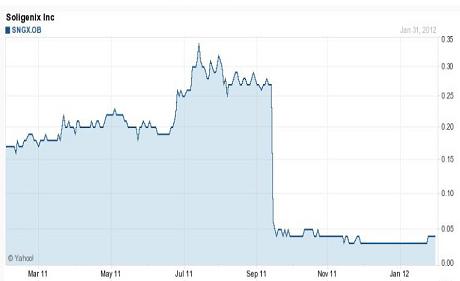
Trading below a nickel, right axis.
More recently the company performed what appears to be another accounting trick in order to boost stock price.
From the Times of Trenton newspaper:
Local pharmaceutical developer Soligenix sought yesterday to shore up its stock price by doing a 1 for 20 reverse split, effectively converting 20 shares into 1, ending at yesterday’s market close with a price of less than a dollar.
The company’s shares have been in a long, slow decline.
This is not precisely true. Soligenix’s stock price went from being worth very little to worth almost nothing overnight, according to the graph.
Soligenix was formerly known as DOR Biopharma. The name change never helped.
Permalink
02.01.12
Posted in Bioterrorism, Ricin Kooks at 1:38 pm by George Smith
Today I point you to an article in the Western Farm Press on the attempted revival of the castor industry in the US. Castor oil has value in industry but in the Seventies it died here for reasons having to do with price. It was produced much more cheaply overseas and today India owns most of the business.
Castor mills existed in the US and the plant was cultivated in Texas and other places. No significant hazard was associated with its growth and use.
Since castor was cultivated and milled, trucks carrying castor seed and the mash of them traveled the roads of the land.
From this blog, in 2008:
[Castor seed oilcake] and seeds containing ricin would have had to travel the roads of the country. If one searches further, reference to it can be found in municipal codes for the transporting of “hazardous materials” via trucking. Castor seed oilcake [was] a material that [did] not require a 24-hour emergency phone hotline listed on the shipping manifest. In the Texas city of Laredo’s municipal code, the materials, referred to as “castor bean,” “castor meal,” “castor flake,” and “castor pomace” are things deemed of the same hazard, or lack of it, as “dry ice,” “fish meal,” “fish scrap,” “battery powered equipment,” “battery powered vehicle,” “electric wheelchair” and “refrigerating machine.”
The war on terror changed everything. Good science, common sense and a regard for the value in history were tossed out for the equivalent of old wive’s tales, a belief in rubbish minted by the US extremist right in the Eighties, and very bad counter-terror forecasting.
Castor seeds, because they contain about five percent protein — most of which is assumed to be ricin — were deemed easy to make into a weapon of mass destruction. Nothing could have been further from the truth.
However, it became the received wisdom. It hasn’t mattered that no terrorists have ever successfully used ricin. And it has not mattered that there has only been one instance, ever, (one I’m not going to mention because it’s cited ad nauseam, anyway) of the use of ricin in a state-instigated assassination.
So any attempt to revive castor cultivation in the US immediately runs up against belief from the war on terror and the homeland security apparatus.
An article published today, by BusinessWeek, entitled “Biological Attack Threat Cited as Pentagon Bolsters Defenses,” illustrates the problem.
First, the article is based on no actual evidence other than the now bog standard claims about what is easy for terrorists and supposition.
And it furnishes another piece of received wisdom, repeated thousands of times since 9/11, even though it’s not actually true:
“I would put ricin at the top of the list??? of threats, Kelsey Gregg of the [Federation of American Scientists] said. “You can get a deadly amount of it pretty easily.???
What you can get is an amount of castor powder, or the grind of castor seeds. And it contains some ricin but not quite enough to make a weapon of mass destruction although it has occasionally been used in domestic poisoning attempts — one, I believe — in the last decade. It’s put into food in such instances and, even then, often the victim stubbornly refuses to die.
And any larger purchases or attempts to get bagloads of castor seeds in the US are now monitored to a certain extent.
In any case, no terrorists have ever produced purified ricin. None. It hasn’t been done.
And that’s because it isn’t the elementary procedure lay people, and this includes most counter-terror experts in the employ of the US government, believe it to be.
The idea that ricin was easy to make comes solely from the extremist survivalist right in the United States. This group had authors with names like Kurt Saxon and Maxwell Hutchkinson, individuals who put their notional ricin recipes, sloppy inexact procedures for simply grinding and degreasing castor seeds, into pamphlets and books published by the fringe press in this country.
But after 9/11, the US national security apparatus, along with the mainstream media, worked the angle that al Qaeda could whip up anything dangerous with very little effort.
And one component of the hysteria always contained assertions that chemical and biological weapons were easy to make from recipes available from the Internet in seconds.
These recipes were all descendants of the trash printed by the US neo-Nazi/survivalist right. However, that material had gone around the world and been translated in documents subsequently found in hideouts in Kabul and Kandahar after the US overthrow of the Taliban.
But I’ve wandered far from my promise to point to the article on tentative steps toward a renewal of castor agriculture in the US, published in the Western Farm Press.
A few excerpts from it should serve to illustrate the problems:
In a time when bio-security and foreign oil dependency share the spotlight as major issues facing the nation, it comes as no surprise that the idea of growing castor on U.S. soil and extracting castor oil for biofuels and industrial use is a growing controversy with supporters on both sides of the question: Would the benefits outweigh the risks?
On one hand there is little or no commercial castor production in the U.S. Nearly all castor oil used in the U.S. is imported from India, China and Brazil. But because of its high seed oil content, castor has tremendous potential as an oilseed crop in North America, especially in parts of the Southwest. The increasing demand and potential use of castor oil in the production of specialty chemicals, biodiesel, and RFS2 renewable fuel has generated considerable interest by several companies in developing commercial castor oil production in this country. Since castor grows well on marginal land, it represents an alternative crop suitable for production in select areas of Texas.
On the other hand, castor production comes with a reputation, largely related to the fear of growing a potentially toxic crop. Ricin, a protein toxin found only in the endosperm of castor seed, can represent up to 5 percent of the meal weight remaining after oil extraction. It could pose a threat if not carefully isolated and controlled as there is a concern the meal could be refined and used as a bioterrorism agent.
“With castor seed producing as much as 50 percent oil and its ability to grow productively on marginal land, it represents a crop that could address a growing demand for castor oil. India virtually controls the global market now, and there is potential for domestic production,??? reports Dr. Calvin Trostle, associate professor and research scientist at Texas A&M AgriLife in Lubbock.
“Castor production will play a major role for many years to come,??? agrees Dr. Dick Auld, oilseed crop specialist and research scientist at Texas Tech University. “At one time some 70,000 acres in Texas were dedicated to castor farming. But when prices fell in the 1970s interest faded, and concerns over ricin and the potential for contamination of food crops overshadowed interest for its return.???
Castor/ricin contamination of food crops is not something that seems to concern that part of the world that still uses it for bulk oil and fertilizer production. India, China and Brazil simply do not care what beliefs the United States has twisted itself into accepting because of the war on terror.
Yet, the agricultural scientists working on the worthy idea to bring this industry back must act like ricin toxicity is a substantial obstacle. For practical purposes it is but this is far more due to the nature of the time we live in than any real need to come up with new methods and plans for growing and milling castor plants.
It wasn’t this way in the past. It isn’t anywhere else, either. And in the city of Laredo they once did not worry much about a spilled truck load of castor mash or castor seeds.
Clean it up, sweep it to the side of the road, let the sun and weather take care of it, whatever. But it in no way merits fear like a potential weapon of mass destruction.
“[Calvin Trostle] adds that researchers are recommending stringent management and control measures, such as dedicating combines to castor-only applications, taking safeguard in transportation and storage of castor seed to eliminate contamination and restrictions on growing food crops on fields used for castor,” reads the Western Farm Press near the end.
“Extraction And Characterization Of Castor Seed Oil” is the title of a paper published by researchers at Rufus Giwa Polytechnic, a college in Nigeria.
In the United States this procedure, which here is presented for the isolation and analysis of the chemical properties of castor oil, would be considered a ricin recipe because it also yields de-greased castor mash.
Indeed, the crime one is convicted of when caught pounding castor seeds in the US is that of taking a significant step toward the making of a chemical or biological weapon. And everyone who has been brought up on such a charge, or a related one in the last decade, has been sent over.
“The castor meal or cake is mainly used as fertilizer, this is because it is unsuitable as an animal feed because of the presence of toxic protein called ricin and toxic allergen often referred to as CBA (castor bean allergen),” write the Rufus Giwa authors. “However, it is noteworthy that none of the toxic components is carried into the oil.”
Permalink
01.30.12
Posted in Ricin Kooks, War On Terror at 2:15 pm by George Smith
Sent over in the UK for going to Pakistan, waving a gun, having the wrong name and downloading ricin recipes that don’t work, from the Internet.
The Guardian:
A man who kept a recipe for a deadly poison and documents about how to make bombs has been jailed for two years and three months.
Asim Kausar, 25, from Bolton, Greater Manchester, kept the information on a computer memory stick that contained details about the toxin ricin, assassination and torture techniques and instructions for making improvised explosive devices …
The information came to light only after Kausar’s family suffered a burglary, when Kauser’s father handed the memory stick to police so officers could view CCTV images of the break-in recorded on the device.
Kauser told police he had downloaded the information out of “curiosity and a thirst for knowledge” …
The prosecution accepted the defendant had not disseminated the information and had not put it to any practical use. There was also no evidence to suggest Kausar had any links to terrorists.
Sentencing him, Judge Andrew Gilbart QC said: “I accept that all of this material is available on the internet and can be bought from retailers such as Amazon and I accept some of it is out of date.
“But that makes them no less dangerous or any less useful to a person committing an act of terrorism.”
Riel Karmy-Jones, prosecuting, said the defendant had “scoured the internet” between January 2009 and his arrest last year for information on the mujahideen. The information downloaded ran into thousands of pages …
Police also seized Kauser’s mobile phone, which contained a photograph of him posing with a rifle. The image was believed to have been taken in Pakistan.
Previously — These Documents Get You Jailed
Permalink
Posted in Bioterrorism, Ricin Kooks at 1:44 pm by George Smith
From the Los Angeles Times over the weekend, a laboratory designed to fight bioterror has no bioterror to fight.
Because the only bioterror was American bioterror defense industry bioterror. In the entire decade.
So there’s make work setting up test exercises for things which, in all likelihood will never happen. And moving into police work, which in the case mentioned by the newspaper, means helping to chase around those people selling and smoking the new kind of synthetic pot called bath salts.
Anyway you look at it, it’s trivial applications for trivial problems deceptively advertised as things bigger and more meaningful.
Please don’t take the bioterror funding away! See, it’s good for something! Like protecting the populace from synthetic Demi Moore dope and the odd intestinal illness that shows up every couple of years.
In the meantime, nationwide austerity forces the lay-offs of something one does need everyday — teachers.
From the Los Angeles Times:
When Jeffery H. Moran goes to work each day, he swipes his security badge, passes into an airtight chamber, opens a bombproof door and enters a lab full of deadly toxins.
As chief of the counter-terrorism laboratory at the Arkansas Department of Health — one of 62 such federally funded labs in the country — he heads two dozen chemists who are on constant alert for the release of pestilence or poisons in the United States.
Armed with $2 million worth of new equipment, Moran concocts gruesome tests to keep his team sharp. He has laced samples of baby formula with lethal ricin. Poured rat poison into water bottles. Tainted blood with cyanide gas …
Using a counter-terrorism lab to test for synthetic marijuana is the latest sign of how a multibillion-dollar national infrastructure built to detect or respond to chemical or biological attacks over the last decade has adapted to the lack of any actual attacks.
Stewart Baker, former head of policy at the Department of Homeland Security, said he wasn’t surprised that Little Rock’s high-tech lab is helping police ferret out potheads.
“Otherwise they would be like the Maytag repairman, just sitting there waiting for the phone to ring,” Baker said.
The only place ricin has ever been put in food, excluding one case in which a husband tried to kill his wife and failed, in the last decade is in government labs. And the only place pure ricin exists is also in government labs, or private sector research labs funded by the taxpayer.
No terrorist has ever produced pure ricin.
And no terrorists have successfully used cyanide gas bombs.
Edward Hammond is the only critic polled by the Times. For those of us who have followed the issues over a decade, Hammond was known for the Sunshine Project, a watchdog agency for bioterror research, one that worked quite well.
“Pork, pork, pork, pork, pork,” Hammond told the Los Angeles newspaper. “These state departments of health have become addicted to extra federal bioterrorism dollars.”
And Hammond is on the money.
About a week ago a newspaper in the Pacific northwest ran a news brief on a local laboratory that had taken bioterrorism funds to finance testing of oysters for marine vibrios.
Outside the Gulf coast states, the only marine vibrio that causes foodborne illness is known as Vibrio parahaemolyticus.
The Los Angeles Times newspaper mentions the lab in part of its piece:
In California, the Humboldt County Public Health laboratory spent federal bioterrorism funds to buy a DNA-sequencing machine. The lab began using the device this month to test for bacteria in oysters harvested off the state’s coastline.
“We don’t just purchase the equipment and it sits in the corner,” said Jeremy Corrigan, who manages the lab and is state bioterrorism coordinator for Northern California. “I use it for dual purposes.”
The initial story on the lab, which ran in the Times-Standard of Eureka, CA, informed:
Humboldt’s vibrant oyster farming industry and bioterrorism funds have allowed the county’s public health laboratory to deploy a cutting-edge process to test for shellfish contamination.
The laboratory is now the only public facility in California to utilize a molecular process — known as polymerase chain reaction — for oyster testing. The only other laboratory to perform this type of work is a private lab in San Diego …
According to public health, two cases of the intestinal infection caused by virbrio parahaemolyticus were reported in 2007, but it is unclear if they were linked to oyster consumption. No cases have been reported in the past four years.
Dale said the company has done quality control for oysters and water as a precaution. About 70 percent of California’s oysters are grown in Humboldt Bay.
Although there has never been a positive result, a recent false positive illustrates the streamlined convenience of the new process, he said.
The LA Times piece did not mention how minor the nature of the threat was. And it is baffling that the only result, one false positive, could be peddled as something which is actually fulfilling a need.
“Last year, people who smoked Spice or other fake pot variations made 6,955 calls to poison control centers across the country, more than twice the number of calls in 2010,” wrote the Times reporter, in trying to make the case that identifying bath salts synthetic dope is more than a trivial business.
Some statistics from the Bulletin of Cannabis Reform:
Number of estimated marijuana users, nationally, 2007: 25.2 million
Number of estimated marijuana users, California, 2007: 3.3 million
Number of arrests for marijuana use, California, 2007: 74,024
Percentage expression of poison calls on bath salts usage relative to total number of marijuana users in US: 0.000275992063
“What are you people? On dope?” — Mr. Hand, Fast Times at Ridgemont High
Permalink
« Previous Page — « Previous entries « Previous Page · Next Page » Next entries » — Next Page »