DD went to Target to pick up sundries yesterday. Stopping by the electronics department, I noticed the $72.50 made-in-China electric guitar and amp kit in a cardboard box.
Everything in the electronic department was made in China. And the components of electric guitars, amplifiers and batteries use what are called rare earth metals.
Yesterday, the Dept. of Energy released a comprehensive report on moving toward a “Critical Materials Strategy.”
One graph from it tells you everything you need to know.
The rare earths are distributed widely across the globe. And there are supplies in the United States. But during the GWB administration, mining of rare earths in the US didn’t just crater. It died! Kaput!
While mining in China and other nations took off.
Although the DoE report does not explicitly state it, the historical picture painted is one in which US business abandoned rare earth mining. Simply because it was easier and better for the bottom line to get the underpriced stuff from China and other countries for all the electronic kit they now have made overseas.
And that shortsightedness and singular inattention to the big picture has set up a problem with potentially strategic implications for the United States. Because utilization of rare earths is also critical in clean energy innovation. And so while such things are advancing elsewhere, again most notably in China, here the story is one of lassitude and the now held-to-be-stupid view that things would be just peachy if we let that country make everything for the consumer society.
And this is why the good people at DoE have furnished this report.
The US has been able to somewhat diversify its draw of rare earths from the world market. But the control of the trade by China and its withholding of materials for its own markets has created a visible negative for this country.
In the short term, the DoE report notes our country can take advantage of rare earth mines starting up in Canada and Australia.
Both nations support successful mining of strategic materials.
And a rare earth mine in California is said to poised to begin operation in 2012. After it stopped in 2002.
“The United States is too reliant on China for minerals crucial to new clean energy technologies, making the American economy vulnerable to shortages of materials needed for a range of green products — from compact fluorescent light bulbs to electric cars to giant wind turbines,” read a New York Times business story on the DoE report yesterday.
“[The] report presents a fairly gloomy assessment of the United States’ ability to wean itself from Chinese imports,” it continued. “For as long as the next 15 years, the supplies of at least five minerals that come almost exclusively from China will remain as vulnerable to disruption as they are absolutely vital to the manufacture of small yet powerful electric motors, energy-efficient compact fluorescent bulbs and other clean energy technologies, the report said.”
Look at the DoE graph again. US mining of rare earths shuffled off into the oblivion right at the height of the so-called war on terror. Funding counter-terror and war, good! Keeping your critical industries for strategic materials needed for jobs and innovation — eh, not so much.
Having riffed on the fact that iconic rock music instrument makers in the US have turned themselves into artisan businesses for the plutonomy, news of Fender’s gold leaf guitar for Prince fits right in.
From today’s paper edition of the LA Times (no link):
“Prince told his friends at Fender that he’d had a dream in which he played a gold Stratocaster … he wanted something special and asked if such a guitar could be made. Fender execs turned to their Custom Shop in Corona, where master guitar builders specialize in delivering unique instruments, for superstar musicians, as well as bankers, lawyers, employees of Goldman Sachs and Wall Street men who helicopter in from the Hamptons amateurs with the desire and the money for something out of the ordinary.
In this case, Fender execs gave the assignment to Yurly Shishlov, a Russian born guitar maker. Coincidentally, only about a week earlier during a tour of the Custom Shop, Fender execs stopped at Shishkov’s work station and asked about the gold-leafing process he was working on for another customer’s order.
For the plutocrats, there’s gold-leafing. For everyone else, including you, there’s China.
The rest of the article is filled with twaddle about how allegedly difficult it is to exquisitely finish a Stratocaster in gilt.
The Times reports Prince’s gold-leafed Strat will be played on his East Coast tour, then auctioned off for charity.
Continuing with the posts on how US electric guitar manufacturers outsourced their production for middle class pieces for the sake of concentrating on custom business for the non-playing wealthy, I have a few items of interest.
The first dates from a year before the economic crash. At the time you could still read stories on what a jolly good business it was to be able to buy Chinese-made US branded guitars displayed in cardboard boxes at Target, Wal-Mart and BestBuy.
From the Newhouse News Service, in 2007:
“Rock has gotten so mainstream that you see or hear guitars in just about every movie and commercial,” says Dana Clarke, manager of Guitar Center in North Olmsted, Ohio. “Combine that with guitars being made overseas, cheaply, and it’s no surprise you see them everywhere.”
Everywhere, as in the aisles of Target, Wal-Mart, even Costco. They come packaged as “rock kits.” In brown boxes. Stacked up like stairways to heaven.
And they’re cheap.
The outsourcing of production to Mexico, China and South Korea has dropped electric-guitar prices to levels that have made them competitive with electronic toys and gadgets.
One penny shy of $70 for an ax at Target. Less than $87 for a “guitar pack,” amp included, at Wal-Mart.
At the same time, prices skyrocketed for domestically-made guitars, made for the collector crowd:
[The Guitar Center man] has witnessed an explosion in price appreciation, even for unloved guitars that would hang on the wall for months.
“In the 1980s and ’90s, guitars became a collectible with a Blue Book value,” he says.
Guitar Center, the article went on to state, “pioneered the guitar-for-masses concept.”
Fender’s new CEO, Larry Thomas, was formerly chairman of Guitar Center.
And while things were heady in 2007, Guitar Center is now stuck in the doldrums. When the middle class was beggared by the economic crash, GC suffered.
“Moody’s downgrades Guitar Center debt,” reads a news story from November 12:
Moody’s Investors Service has downgraded private equity-backed Guitar Center Holdings Inc., parent of Guitar Center, to Caa2, from Caa1, citing increased interest expenses when it begins paying down its senior unsecured pay-in-kind notes starting in April 2011. Until last month the business, owned by Boston buyout firm Bain Capital LLC, has deferred paying cash interest on its $375 million senior notes held at the holding company level. Moody’s said Friday, Nov. 12, that, while sales have improved, its earnings are not expected to recover sufficiently during 2011 to fully cover its interest expense through internally generated cash flow. The agency said the Westlake Village, Calif.-based music store chain, the largest in the U.S., “could voluntarily pursue a debt restructuring or an amendment to its debt facilities” at terms it would deem to be equivalent to a default.
Caa2 means holdings are of “poor standing.” Guitar Center, in other words, is a substantially risky business not far away from falling into default.
Fender, for its part, has had a great deal of trouble controlling who uses its designs. It’s a consequence of other companies fabricating them uncontested and the company’s own mass outsourcing to China. The temptation to capitalize on the brand name and look is very strong.
Paradoxically, in a news item from the Arizona Republic in 2009 (Fender is based in Scottsdale), one reads:
Fender filed for the trademarks as part of its global strategy to fight counterfeiters and protect its intellectual property, he said. The problem has gotten worse as copycats have guitars made in China, ship them to warehouses in the United States and sell them over the Internet …
Over the years, again prior to the current troubles, domestic guitar production as investment pieces for the wealthy was generally hailed.
For example, this from 2003, on a guitar show:
Things took off in the late 1980s and early 1990s as Boomers with increasing disposable income started buying the axes preferred by their musical heroes. Most of those were built in the 1950s and 1960s, the first two decades for mass-marketed electrics. Suddenly, certain models and years, mostly Gibsons and Fenders, started commanding seriously crazy cash — $10,000-$40,000.
And this news piece from 2006 on Gibson’s peddling of premium models to the stupid rich in Japan is also revealing:
Gibson makes a range of guitars solely for the Japanese market, including rocker Tak Matsumoto’s signature Les Paul in such special guitar shades as canary yellow.
“It is so cool,” says Yuki Yamaguchi, a 19-year-old student who bought a $5,400 Tak Matsumoto Gibson on three-month credit. “I open the case and look at in and go: ‘It is so cool.'”
Amateur musicians such as Yamaguchi, who acknowledges he hardly has time to play his guitar and spends more time admiring it, may be just buying a dream.
But they make for serious business.
“Some of these consumers own five, 10, 20 guitars because they’re collecting … They’re collecting for the love of collecting,” a Gibson sales exec told the newspaper reporter.
“The Japan-only Les Paul with the beat-up look costs about $3,000 …” added the piece.
Ironically, flooding in Tennessee stalled Gibson’s domestic production for a couple months earlier this year.
The Nashville newspaper, The Tennessean, reported on the matter:
Widespread flooding two weeks ago pushed many of the city’s rivers and streams well beyond their banks, including Mill Creek, which flows just behind Gibson USA’s sprawling factory complex near Nashville International Airport.
The plant churns out 2,500 guitars a day. It is one of several mass production facilities the company operates around the globe – including in Memphis; Bozeman, Mont.; and at least five factories in China.
Gibson guitars manufactured in the flooded plant cost between $700 and $3000. Paradoxically, the custom shop — which produces Gibson’s really idiotically priced pieces for the plutonomy or Nashville recording artist with a label deal — was not impacted.
Over the Thanksgiving holiday, DD and drummer went to Guitar Center to pick up some things in preparation for the big show this Sunday.
It rammed home again how the US business model has converted to plutonomy.
And not for the betterment of any regular workers like the poor guys and gals jobbing the registers for minimal payment at Guitar Center.
At Guitar Center you have a place where everything for sale in it was either invented by Americans or the British. All of the history in hardware of classic rock is on sale. The sound heard round the world.
And virtually everything classic rock in the front of the store — all the stuff being peddled for the holiday season and not behind the glass doors in the back of the place, or hung up so high on the wall you have to get a sales associate to look at it … is made in China.
Everybody took their manufacturing business to China. US firms mercilessly downsized their labor, in the process transforming domestic ‘factories,’ what’s left of them, to small artisan shops making guitars and amplifiers for bankers, lawyers, doctors and other rich people who want to hang Stratocasters and Les Pauls on their walls as investments/sops to impress repulsive friends.
So the real American-made stuff is back in the glass room. Where the more senior employees can carefully watch over it and the unwealthy riffraff discouraged from handling the merchandise.
This, of course, includes most of the employees, too. Since their wages have been kept stagnant they can neither afford the US stuff nor the rate of interest on any credit that might be extended to them.
Like so many businesses, Guitar Center has collaborated in the beggaring of the American consumer. As a consequence, like the rock instrumentation industry, it has split in half — one section for catering to the wealthy, the other — where the vast weight of materiele is — to the vanishing middle class. And, of course, parents looking for something for junior’s annoying hobby this holiday.
One of these front of the store great gift idea, seen right by the cash register, on Black Friday was the Made-In-China authentic “Piedmont Blues” harmonica set!
Twenty bucks for seven harmonicas and a case, shipped from China.
Here’s a rhetorical question.
Since the amount of energy needed to make harmonicas is the same wherever you are in the world, due to the laws of thermodynamics as they apply to manufacturing, what possible benefit is their to make them in China — in terms of a green policy — and then to mass ship them across the Pacific? As opposed to making them closer to home?
As said — rhetorical.
The Piedmont Blues set is ostensibly a Hohner product, the famous German company, also forced to make a relatively cheap instrument even cheaper.
You can, for instance, have Hohner Pro or Marine Band harps which were always acceptable and are still relatively inexpensive
Or if you’ve really been beggared, as so many have, there’s the Piedmont Blues set. You could give up two or three lunches in a week for it.
I mentioned the name “Piedmont Blues” as applied to a Chinese-made instrument with my friend Don, over an afternoon of football the same weekend.
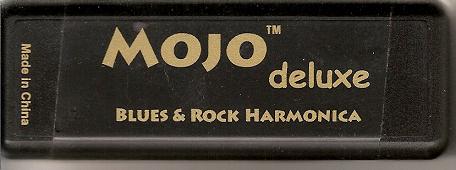
We both had a good laugh. Almost as good as the one reserved for the ludicrous nature of the old Mojo Deluxe Blues & Rock Harmonica. Which was probably made in the same plant and with the same machines as the ‘Piedmont Blues’ harmonicas.
Replaced by the Piedmont Blues.
Over the weekend, the absentee president hailed a trade deal with South Korea.
South Korea is where the American rock instrument industry took some manufacturing for items somewhat less pricey that its domestically made product. It filled the niche Japan used to about twenty years ago, before labor in that country made its rock instruments into premium buys.
It is where DD’s Epiphone Les Paul Ultra II was made, a mid-priced instrument which I would have been able to buy, at some point, in the US when I was in the Highway Kings. Now most Gibsons are prohibitively expensive artisan plutonomy pieces.
So jobs were outsourced to South Korea. Whose people, incidentally, now enjoy a better tech infrastructure than the United States.
One thing I’m hearing, now that all hope of useful fiscal policy is gone, is the idea that trade can be a driver of recovery — that stuff like the South Korea trade agreement can serve as a form of macro policy.
Um, no.
Our macro problem is insufficient spending on U.S.-produced goods and services; this spending is defined by
Y = C + I + G + X – M
where C is consumer spending, I investment spending, G government purchases of goods and services, X is exports, and M is imports. Trade agreements raise X — but they also lead to higher M. On average, they’re a wash.
“And there’s even an argument to the effect that increased trade reduces US employment in the current context; if the jobs we gain are higher value-added per worker, while those we lose are lower value-added, and spending stays the same, that means the same GDP but fewer jobs,” he adds.
South Korea, as it pertained to Epiphone, the low-price brand Gibson subsidiary, meant lost jobs in the US. For less value added jobs at places like Guitar Center here.
Since then, Gibson took a lot of Epiphone manufacturing to China downsizing South Korean labor for cheaper sources. Well, now some of them have probably been working at the national equivalent of Guitar Center, too.
A Washington State candy-maker ships lots of something most Americans don’t particularly care for — Almond Roca.
Great demand for it in China, where it’s packaged as a luxury good under the name “Happy Family” has created the need for twenty five additional workers at the American facility.
They are also now growing fond of American wine, mixed with soda, it is said. That must be worth something.
For American business, the United States currency dispute with China is a two-sided coin.
On the tails-we-lose side are companies like New York-based PS Brands, one of the biggest American importers of socks. With the Obama administration pressing China to raise the value of its currency, the cost of Chinese-made socks is likely to rise. So PS Brands’ main supplier here is demanding shorter contracts at higher prices.
“Before, I could price six months out,??? Elie Levy, chief executive of PS Brands, said during a recent factory visit here. “Now they only want to price 30 or 40 days out because the dollar could lose value.???
Meanwhile, the American companies most likely to oppose Washington’s currency fight with Beijing are businesses like PS Brands — Wal-Mart would be another good example — that get their goods from China
and sell them in the United States. Those companies’ balance sheets are likely to suffer, and American consumers more likely to feel the effect …
Which is entirely true. The middle class gets a great coin toss coming and going. It’s always heads China and corporate America win, tails it loses.
It got pole-axed when all the manufacturing moved from here to China and we lost the ability to make socks to a country that sells them back with holes ready to appear after one wash.
Jobs went to China for the sake of cheap shoddy goods bought by people who still had jobs or who could put more and more on credit. And now that the economy is shot, the same among us have a hard time even affording the cheap stuff. Wal-Mart is beset by more and more of its customers only spending their food stamp budget.
What a moral business model. The national economic policy that caused it could not have been spun from finer cloth.
Then there’s those who benefit from the currency war. The few in the new “artisan” economy. Businesses that hardly employ anyone in the US and make high end goods the Chinese state buys.
For American exporters like Staco Systems, above, a weak dollar makes its products more attractive abroad … an American company 9,000 miles away, in Irvine, Calif., where the prospect of a weaker dollar is actually good news. There, Staco Systems, a maker of aerospace electronics, has a growth business selling parts to state-owned aviation companies in China. If anything, a stronger Chinese renminbi would make Staco’s products even more attractive to buyers in China.
Got rid of mass middle class work for the sake of penny-ante Swiss watch-type businesses. That’s progress.
As usual, I have a song for that. And I had it yesterday.
The China Shuffle — about socks with ready-made holes and other stuff — here.
This was written for La Puta, slated for later in the week. But I’ve moved the tune up as a teaser. It fits the leaden Made In China green reusable grocery bags story perfectly.
Go to neighbor store
Buy stuff for the poor
Socks, socks, socks with holes
Crap that’s full of mold
Go to Acme store
Buy stuff that falls apart
Toothpaste made of dirt
Pills to make your head hurt
Pills to make your head hurt
For the ladies, a cheap skirt
Now stores all full of shit
All made with plastic bits
Wigs all full of lead
Things to make you piss red
Socks, socks, socks with holes
Socks, socks full of holes
All things now with mold
Socks, socks, socks with holes
All things now full of mold
Toothpaste made of dirt
They also make black T-shirts
Toothpaste full of dirt
Pills to make your head hurt