05.12.14
Posted in Culture of Lickspittle, Rock 'n' Roll, Shoeshine at 12:00 pm by George Smith
At RockNYCLiveandRecorded, a music website edited by Iman Lababedi, an old regular at the long defunct Creem magazine:
Stenography, that is to say, the passing on of favorable publicity and hagiography, is the major business practice of the mainstream media. Having the temerity of daring opinion in relationship to power, or money or whatever the majority feels is great consumer stuff, went badly out of fashion in the last few decades. So Lorde can be forgiven for believing something stupid, but which sounds superficially fair on first hearing, about the original nature of entertainment writing.
Stenography, or the rote passing on of free publicity, is a decades old problem, spread across many genres of journalism.
When I started writing for the Morning Call newspaper of Allentown in the late Eighties it came at a time when the entertainment section’s function was to be exactly that — providing of stenographers for the local arts people and those coming through town.
When that changed to sending in reports that frequently afflicted those deserving of it, it created a substantial short term fit. The assistant managing editor did not at all like getting angry phone calls on Monday morning, the first time he could be reached after the weekend bits had run. There was no e-mail you could just delete. You had to listen to grumpy people on the phone. In his estimation, the job of features section journalists was to make their subjects happy …
Read all of it.
Permalink
08.12.13
Posted in Culture of Lickspittle, Cyberterrorism, Shoeshine at 12:16 pm by George Smith
Excerpts from a talk by Pulitzer-winner Chris Hedges at Chautauqua:
Through a “bombardment of cultural lies and manipulations,??? it has erased every progressive movement from the face of the country.
The system has also created a “psychosis of permanent war,??? Hedges said.
To maintain control over the population, Hedges argued, the U.S. government has done what all empires have done: brought harsh forms of control from the outside to the inside.
“A night raid by a militarized police force in Oakland — command helicopters, searchlights, command vehicles, police in black, Kevlar vests … automatic weapons — looks no different from a night raid in Fallujah [Iraq],??? he said.
Becoming a part of a social movement is the only way to respond to these issues, he said. There is no time to play the game of politics.
And, there is this…
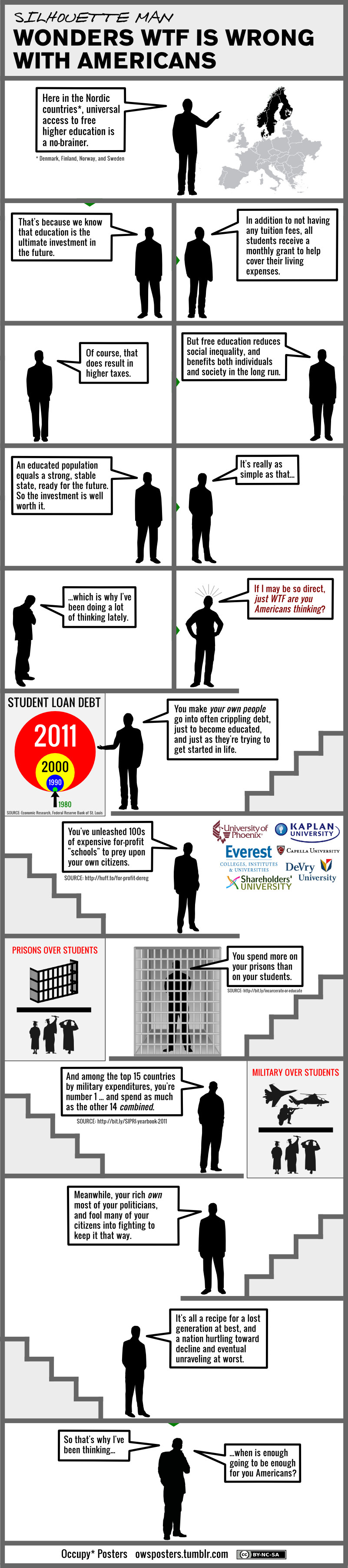 Originally.
None of the points are new. I’ve made them here in comment, music and art for the past decade. The serious security threats are not external.
Most now seem to innately grasp this with the exceptions of complete morons. And the villains in the matter, who know exactly how things stand.
Al Qaeda whoopie cushions get little traction outside of the mainstream press these days. There’s a reason for it. There’s a silent disbelief and cognitive disconnect.
And Keith Alexander of the National Security Agency has gone from someone parading around with a story about how the US was being pillaged by Chinese cyberespionage to just another apparatchik in a uniform whose job it is to defend the assertions of government and make claims about the foiling of terror plots, claims no one supports who isn’t paid to.
Think about it, again. Two months ago you couldn’t get away from the news about Chinese cyber-spying allegedly stealing the intellectual treasure, military secrets and future of America.
Uploaded August 2011. Two years old now.
Permalink
07.29.13
Posted in Culture of Lickspittle, Cyberterrorism, Shoeshine at 12:55 pm by George Smith
A couple select quotes from national security megaplex 1-percenters at the Aspen Security Forum:
NSA director Keith Alexander: “Make no mistake about it: These are great people who we’re slamming and tarnishing and it’s wrong. They’re the heroes, not this other and these leakers!???
“The bad guys…hide amongst us to kill our people. Our job is to stop them without impacting your civil liberties and privacy and these programs are set up to do that … The reason we use secrecy is not to hide it from the American people, but to hide it from the people who walk among you and are trying to kill you …”
Mike Leiter, former director of the National Counterterrorism Center (NCC) and lawyer for Palantir, tech spying software contractor for the NSA: “Just seeing us here …that inspires confidence, because we’re not a bunch of ogres.???
When you’re protesting you’re “not a bunch of ogres,” it’s a tacit admission of self-consciousness over moral standing in the national security megaplex.
Army general and NSA director Keith Alexander is a special case. As someone who publicly tries to pass off the fiction that Chinese cyber-espionage is the “greatest transfer of wealth in history” at a time of great personal hardship for millions of Americans he is easy to portray as socially tone deaf on a grand scale, someone at the top of the national security pyramid pursuing and building things which are only of importance to the mandarins, corporate and government.
Alexander cannot even capitalize on the normal faux reverence Americans show for all things military. Despite the chest of decorations, he is colorless even in a corps of military men characterized by their appearance as government technocrats serving time until their tickets are punched in the private sector.
And he’s going to rightly have the “greatest transfer of wealth in history” quote hung on him until he’s retired.
As a refresher, from just this morning on the salient problems facing this country in 2013:
46.2 million people in poverty
“Four out of 5 U.S. adults struggle with joblessness, near-poverty or reliance on welfare for at least parts of their lives, a sign of deteriorating economic security and an elusive American dream.”
“Marriage rates are in decline across all races, and the number of white mother-headed households living in poverty has risen to the level of black ones.”
From the census: “[People] ages 35-45 had a 17 percent risk of encountering poverty during the 1969-1989 time period; that risk increased to 23 percent during the 1989-2009 period. For those ages 45-55, the risk of poverty jumped from 11.8 percent to 17.7 percent.”
Comparative statistics, Keith Alexander’s salary: somewhere between 230,000 and 290,000/year.
Amount spent on the military and homeland security during the war on terror: $8 trillion.
The annual Aspen Security Forum, make no mistake, is for the privileged in American society, those who work as the peddlers and crafters of the national security megaplex. It has more in common with a summer festival for wealth in Monaco than anything the American citizenry might experience.
And therein lies a central dilemma in any attempt to restore prosperity, genuine security and fairness in the country. They’re a big part of the problem.
The A-list at the Aspen Security Rent-Seeker Forum — from Cryptome.
Permalink
07.11.13
Posted in Culture of Lickspittle, Cyberterrorism, Shoeshine at 10:58 am by George Smith

NSA director, Mr. Keith Alexander, encouraging young hackers to save the US from economic crippling and mass loss of life in the immediate future at the 2012 DefCon meeting in Las Vegas.
From Reuters:
The annual Defcon hacking convention has asked the federal government to stay away this year for the first time in its 21-year history, saying Edward Snowden’s revelations have made some in the community uncomfortable about having feds there.
“It would be best for everyone involved if the feds call a ‘time-out’ and not attend Defcon this year,” Defcon founder Jeff Moss said in an announcement posted Wednesday night on the convention’s website …
Moss, who is an advisor on cyber security to the Department of Homeland Security, told Reuters that it was “a tough call,” but that he believed the Defcon community needs time to make sense of the recent revelations about U.S. surveillance programs.
They need time to make sense of the recent revelation about US surveillance programs. Adorable.
It’s all eyewash and balderdash, anyway.
The NSA and Keith Alexander, of course, will be there. Everyone will. And that’s because everyone knows guvmint security agencies have money, lots of money.
The real affair is the $2000/ticket Black Hat conference, on July 31, a two day affair just before DefCon. The latter, on August 2 is $180 to get in.

Jeff Moss, DefCon founder, maintaining good public relations.
Keith Alexander — from the archives.
Permalink
07.07.13
Posted in Culture of Lickspittle, Shoeshine at 3:12 pm by George Smith
Nick Bilton, the New York Times tech journalist who gave the country Cody Wilson and the 3D-manufactured plastic gun fills up space today with the future urban paradise created by the self-driving car. It’s something only one of the privileged shoeshine boys of American tech plutocracy could write.
Self-driving cars will always be for the topmost in US society. As inequality continues to surge, unless they’re giving them away, they’ll never make a dent in southern California in what’s left of my lifetime. Indeed it’s laughable to posit that southern California’s great servant underclass would ever benefit from self-driving cars.
Do they even know about Google’s many vanity projects?
Bilton’s fantasy, excerpted:
As scientists and car companies forge ahead — many expect self-driving cars to become commonplace in the next decade — researchers, city planners and engineers are contemplating how city spaces could change if our cars start doing the driving for us. There are risks, of course: People might be more open to a longer daily commute, leading to even more urban sprawl.
That city of the future could have narrower streets because parking spots would no longer be necessary. And the air would be cleaner because people would drive less. According to the National Highway Traffic Safety Administration, 30 percent of driving in business districts is spent in a hunt for a parking spot, and the agency estimates that almost one billion miles of driving is wasted that way every year.
“What automation is going to allow is repurposing, both of spaces in cities, and of the car itself,??? said Ryan Calo, an assistant professor at the University of Washington School of Law, who specializes in robotics and drones.
Harvard University researchers note that as much as one-third of the land in some cities is devoted to parking spots. Some city planners expect that the cost of homes will fall as more space will become available in cities. If parking on city streets is reduced and other vehicles on roadways become smaller, homes and offices will take up that space. Today’s big-box stores and shopping malls require immense areas for parking, but without those needs, they could move further into cities.
“People might be more open to a longer daily commute, leading to even more urban sprawl.”
It’s worth repeating, enough to make you fall from the chair in laughter if you’ve ever spent time in Los Angeles County and the Inland Empire.
Who, exactly, is on our soCal roads who doesn’t already do an excessive commute in a region that defines urban sprawl in the continental United States?
And Google and expensive self-driving cars for the upper class and their servants will fix it. Sure. Google will fix everything, just as it does now, only better.
Here’s what might fix it.
Mass unemployment, underemployment and inequality climbing inexorably higher. Potentially, there could be less cars on the roads because people won’t be able to afford to drive.
That will alleviate congestion and make inner-city parking easier for the haves.
One professor of “the Internet and society” at Stanford, Bryant Walker Smith, imagines his driver-less car becoming an extension of his home.
This next bit, on the other hand, is perfectly great. Escape from WhiteManistan can definitely see the overlords and minders this way in a decade or so:
“I could sleep in my driverless car, or have an exercise bike in the back of the car to work out on the way to work,??? he said. “My time spent in my car will essentially be very different.???
Your Personal Fitness Gym car, streaming smoothly along amidst the the hundreds of thousands of late models and junkers that must be kept going by the slave labor class.
Here’s a thought question.
What’s the future potential for class resentment in the servant class to boil over into vandalism and sabotage of self-driving cars? You still have to rub elbows, or bumpers, on those big freeways and cities, wizards of tomorrow.
Oh, the future’s brimming with promise
And the promise is heading our way
So keep your eyes on that shining horizon
Make way for tomorrow today!
Daring new devices will help us to succeed
Better tools for living will meet our every need
Incredible inventions through new technology
Extending life’s dimensions for all humanity!
Permalink
06.24.13
Posted in Culture of Lickspittle, Cyberterrorism, Shoeshine at 12:27 pm by George Smith
I’d skipped this last week because it was a particularly exceptional example of pathetic American journalism, a feature at high button Vanity Fair, on the “terrifying” nature of cyberwar.
It was made for the print edition, so it was completed before the Edward Snowden affair blew the rubbish of it into the trash. It’s standard script-writing, take the pants-wetting stories from anonymous government security sources, embellish with purple prose, and let a couple hackers of either stock smarm or villainy be presented as potentially able to take down portions of the the US with just a few keystrokes because they are so smart.
The latter was old stew over a decade ago.
Anyway, some of the worst of it (no link, Vanity Fair being another website of the infinite download):
On the hidden battlefields of history’s first known cyber-war, the casualties are piling up. In the U.S., many banks have been hit, and the telecommunications industry seriously damaged, likely in retaliation for several major attacks on Iran.
(Did you notice the telecommunications industry was seriously damaged by Iran? Somehow Escape from WhiteManistan missed it.)
Even so, many current and former government officials took account of the brute force on display and shuddered to think what might have happened if the target had been different: the Port of Los Angeles, say, or the Social Security Administration, or O’Hare International Airport. Holy shit, one former national-security official recalls thinking—pick any network you want, and they could do this to it. Just wipe it clean.
(Yes, terrible. Iran could take down the US through cyberspace. Never mind restore from backup. Repeat terrifying script of puny country making entire US infrastructure collapse.)
Asymmetric warfare — unconventional, guerrilla-style attacks on more powerful adversaries, such as the U.S.— is a cornerstone of Iranian military doctrine.
Repeat script third time. Puny country, master of guerrilla cyber-warfare, threatens US infrastructure.
During the second week of September 2012, a new spate of cyber-attacks against American interests began. This time, the targets were on American soil: U.S. banks. A previously unknown group calling itself the Izz ad-Din al-Qassam Cyber Fighters and presenting itself as an organization of Sunni jihadists made an online posting written in broken English, referring to an anti-Islamic video on YouTube called “Innocence of Muslims??? that had sparked riots in the Muslim world the week before. The posting stated that “Muslims must do whatever is necessary to stop spreading this movie All the Muslim youths who are active in the Cyber world will attack to American and Zionist Web bases as much as needed such that they say that they are sorry about that insult.???
Next script: They attacked the financial system. Yes, nothing gets up the sympathy of the man in the street against the outside enemy by telling him someone attacked the websites of giant American banks.
To absorb the gargantuan volume of traffic coming their way, banks had to buy more bandwidth, which telecommunication companies had to create and provide. Telecoms have borne the brunt of these battles, just as the banks have, spending large sums to expand their networks, and to strengthen or replace hardware associated with their “scrubber??? services, which absorb DDoS traffic. Qassam’s first wave of attacks was so intense that it reportedly broke the scrubbers of one of this country’s largest and best-known telecom companies. In December, AT&T executive director of technology security Michael Singer reportedly stated that the attacks posed a growing threat to the telecommunications infrastructure …
Be afraid, very afraid. Because, like … the banks (!) and … AT&T!
A hacker in Iran who appeared to be the prime mover in this group goes by the name of Mormoroth. Some of the information concerning these attack tools was posted to his blog; the blog has since disappeared. His Facebook page includes pictures of himself and his hacker friends in swaggering poses reminiscent of Reservoir Dogs. Also on Facebook, his hacking group’s page bears the slogan “Security is like sex, once you’re penetrated, you’re fucked.???
Another hack, which occurred even as the bank attacks continued through the spring, delivered a still more dramatic financial threat, although its ultimate source was difficult to discern. On April 23, the Twitter account of the Associated Press sent this message: “Breaking: Two Explosions in the White House and Barack Obama Is Injured.??? Faced with this news, the Dow Jones Industrial Average dropped 150 points—the equivalent of $136 billion in value—within a matter of minutes. Upon learning that the information was false—and that the A.P.’s Twitter account had simply been hacked—the markets rebounded. A group calling itself the Syrian Electronic Army (S.E.A.) claimed credit for the disruption.
Enough, really enough. Perfect Culture of Lickspittle material.
Permalink
06.17.13
Posted in Cyberterrorism, Shoeshine at 8:14 am by George Smith
The Edward Snowden affair has done many things. One of the most signal is its (at least momentary) destruction of the US government/national security megaplex’s campaign of cyberwar shoeshine.
In the weeks preceeding the emergence of Edward Snowden’s information on cyber-spying in the US government had conducted a carefully staged p.r. operation to paint China as the primary sinner in cyberspace — a country that was not playing fair, one mercilessly targeting our networks and “intellectual property” in the cyber equivalent of a clandestine war.
This was said, most notoriously by NSA director Keith Alexander, to constitute “the greatest transfer of wealth in history.” The economic future of the United States was imperiled by Chinese espionage.
The Snowden affair has silenced Alexander on this matter. If only for the time being. And the crisis has forced him to explain, very poorly, what US cyber-spying and cyberwar operations are really up to.
That’s easy to summarize. It was so before Edward Snowden spilled the beans to the Guardian.
The US has been quietly building the biggest cyberwar machine in history.
This should not be a surprise. It’s been fairly obvious to people on the outside who follow the matter, even looking at the black box.
The US outspends every other nation, in every facet, of military development and deployment.
Why should cyber-operations be any different?
The hypocrisy on the subject, practiced by the majority of the US mainstream media is overwhelming.
A couple months back, while running the fund-raising pitch for DD blog, I noted the mainstream media had simply gone absent. It stopped serious reporting on many national security issues and almost completely took up the government line that many enemies were preparing to cut the country down through remote manipulation.
The United States was being surveyed and probed, its networks penetrated in advance of a time when the financial system would be attacked, nationwide power blackouts caused, the water poisoned, almost all facets of modern life disrupted.
And the media accepted all of it, passing on what’s called the “chumpbait” unhindered, no skepticism allowed. Critical response, I remarked — half jokingly, had been banished to, at best, 140-character tweets on Twitter.
The week leading up Snowden’s expose delivered a perfect example of US cyberwar chumpbait.
The Washington Post had been leaked a “confidential” portion of a Pentagon report on China. The “confidential” part was said to reveal massive Chinese infiltration of US networks and the making off with unspecified details on expensive and very important US weapons systems.
An analysis of it is here.
Excerpted:
If you’ve been following along it’s no secret the US government and the national security industry have been waging an increasingly concerted campaign to increase cyber-defense spending. The linchpin of the strategy is the relentless argument that Chinese hackers, under the guidance of its government and military, are into all American corporate business, military networks and the nation’s infrastructure. Because of this catastrophe looms.
Another ploy in this orchestrated theatrical production arrived today in the guise of the Defense Science Board report, Resilient Military Systems and the Advanced Cyber Threat …
However, it is not the same report the Washington Post’s Ellen Nakashima publicized in a big story on alleged deep Chinese cyberespionage directed against the US military and its arms manufacturers.
“Designs for many of the nation’s most sensitive advanced weapons systems have been compromised by Chinese hackers, according to a report prepared for the Pentagon and to officials from government and the defense industry,??? writes Nakashima for the Post.
The public version of the DSB report contains only three instances of the word “China??? and only one of “Chinese.??? “Espionage??? appears only four times in report’s 146 .pdf pages.
What does this mean?
It means one of the Defense Science Board’s members or minions — which can be any number of a pool of representatives from arms manufacturers like Boeing and Northrop Grumman, to consultants to these same businesses or small national security “think tanks??? or lawyers in legal firms providing consultation on cybersecurity issues under contract to the Department of Defense — leaked the real report, the “confidential??? part, to the Washington Post.
These are never selfless acts to get word out about an emerging national threat. That’s not how things work.
What it is is another report, among an increasing number, aimed at growing the national security industry’s cyberwar and cyber-defense programs, in which many of the Defense Science Board’s members are employed.
The secret report, the one the Washington Post tells us about, is to redirect attention toward a new threat. It is part of a national argument that generally lumps all cyber-crime , cyber-spying and claimed cyberwar into one big threat aimed at the United States, over everyone else.
Leaks aimed at fostering government and industry agendas on national security are always applauded. They’re perfectly acceptable shoeshine for national security aims.
On the other hand, Edward Snowden-style leaking, material that shows what the national security complex is really doing, stuff that immediately starts up an acrimonious global stink is abhorrent, even treasonous.
From the wire, today, China delivers a formal response to the Snowden reveal:
China made its first substantive comments on Monday to reports of U.S. surveillance of the Internet, demanding that Washington explain its monitoring programs to the international community.
Several nations, including U.S. allies, have reacted angrily to revelations by an ex-CIA employee over a week ago that U.S. authorities had tapped the servers of internet companies for personal data.
“We believe the United States should pay attention to the international community’s concerns and demands and give the international community the necessary explanation,” Chinese Foreign Ministry spokeswoman Hua Chunying said at a daily briefing.
The Chinese government has previously not commented directly on the case, simply repeating the government’s standard line that China is one of the world’s biggest victims of hacking attacks.
A senior source with ties to the Communist Party leadership said Beijing was reluctant to jeopardize recently improved ties with Washington …
Snowden told the South China Morning Post, Hong Kong’s main English language newspaper, last week that Americans had spied extensively on targets in China and Hong Kong.
He said these included the Chinese University of Hong Kong, the site of an exchange which handles nearly all the city’s domestic web traffic. Other alleged targets included government officials, businesses and students.
At the briefing, Hua rejected a suggestion that Snowden was a spy for China. [This claim has been delivered by Dick Cheney, among others.]
“This is sheer nonsense,” she said, without elaborating.
Just ended at the Guardian, an on-line interview with Edward Snowden. Snowden gave answers showing completeness and sophistication.
The last question he answered was germane to an alleged “free press” operating in a country that isn’t really a true democracy anymore:
So far are things going the way you thought they would regarding a public debate? – tikkamasala
[Snowden]:
Initially I was very encouraged. Unfortunately, the mainstream media now seems far more interested in what I said when I was 17 or what my girlfriend looks like rather than, say, the largest program of suspicionless surveillance in human history.
The question and answer session, now over, is here.
Permalink
06.14.13
Posted in Culture of Lickspittle, Cyberterrorism, Shoeshine at 1:54 pm by George Smith
The plutocrats of Wall Street and their trade association band together to drill on defending themselves from cyberattack:
Quantum Dawn 2 is coming to Wall Street.
No, it’s not a video game or a bad zombie movie; it’s a simulated cyber attack to prepare banks, brokerages and exchanges for what has become an ever-bigger risk to their earnings and operations.
Organized by the trade group SIFMA, Quantum Dawn 2 will take place on June 28 – a summer Friday that, with any luck, will be a relatively quiet day in the real markets.The drill involves not just big Wall Street firms like Citigroup and Bank of America, but the Department of Homeland Security, the Treasury Department, the Federal Reserve, the Securities and Exchange Commission, according to SIFMA officials.
The drill, run by an ex-Marine who went to work for Goldman Sachs, aims to simulate attacks on the “equity markets.”
Failure of which, everyone knows, would bring the US to a screeching halt.
Naturally, it’s also a way to raise money on a service of no social good to anyone except the people collecting the price of the tickets.
“About 40 firms will participate in the operation, having paid fees of $1,000, $5,000 or $10,000 depending on the size of their revenue … Each firm must send three executives: one from business continuity, one from information security, another from operations whose job is to keep trading, settlement and clearance running during market crises,” informs Reuters.
“A firm called Cyber Strategies, which works with the Department of Homeland Security on cyber threats, will receive the fees for overseeing the exercise.”
Here you have it, folks. The ultimate in cyberwar shoeshine, the servant class of the one percent, in collaboration with the Department of Homeland Security, for an inside circle jerk that asks you to swallow the idea that the most important thing now is protecting “equity markets” on Wall Street. From the hordes of cyber-enemies who have figured out all that’s needed to kneecap America is to cause “unusual slowness, in trading, or [have] viruses trying to invade the systems.”
“The [market players] will also have to call one another to figure out what’s going on.”
On the other side of the coin, the majority of Americans would still like protection from Wall Street.
“I don’t like you. Fat. Wealthy. Think you understand pain.” — Rorschach, Watchmen.

Permalink
06.13.13
Posted in Culture of Lickspittle, Cyberterrorism, Shoeshine at 11:19 am by George Smith

From the Guardian, yesterday:
Edward Snowden said he was releasing the information to demonstrate “the hypocrisy of the US government when it claims that it does not target civilian infrastructure, unlike its adversaries”.
Jen Psaki, a spokeswoman for the State Department in Washington, said it was not aware of the hacking claims and could not comment directly, but she rejected the idea that such an incident would represent double standards given recent US criticism of Chinese cyber attacks.
You would hate to be the officials having to respond to queries on US double-standards re the rules of proper cyberwar and cyber-spying. But it comes with the job now and they are all well compensated.
The US acts as if it is the exceptional nation in cyberspace. It reserves the right to criticize and lecture others on what constitutes proper conduct but reserves the right to do what it pleases because of its allegedly exceptional nature.
The US, you see, only wages cyberwar, or cyber-espionage, campaigns in defense of freedom and to keep Americans safe. No other nations do similar things. They only cyber-spy on us and probe the net infrastructure to cause damage and steal our wealth.
The country has been in a terrible position to talk terms in cyberspace ever since it started up a hot clandestine war on the Iranian nuclear program and subsequent related malware spilled over into other nations.
The Edward Snowden affair only underlines it.
Permalink
06.12.13
Posted in Cyberterrorism, Shoeshine at 3:15 pm by George Smith

One good thing about the Edward Snowden affair: It has quieted NSA director Keith Alexander on cyber-espionage against the US being the greatest transfer of wealth in history. At least for a moment.
In fact, it’s blown the Cult of Cyberwar and its army of shoeshine completely off the pages of the dailies.
In turnabout, we have Congressmen who just a couple weeks ago were warning about the perfidy of the Chinese, now trying to make themselves look good in grilling Keith Alexander.
Edward Snowden, make no mistake, was part of the big corporate shoeshine army of cybersecurity, the well-paid servants of the upper class, with the privilege of work in the national security megaplex.
That he left the fold is rather remarkable, considering the sheer size of the shoeshine army. Paid employment in the US does buy loyalty for most.
Anyway, today from the Guardian, what one would expect:
[NSA director Keith Alexander] said that “dozens” of terrorist attacks had been thwarted in part because of the domestic surveillance dragnet. But he did not give specific details …
Alexander said he struggled with how much detail to provide in public about the surveillance. “I would rather take a public beating, and let people think I’m hiding something, than jeopardize the security of this country,” Alexander testified. He said he would aim to declassify specific cases in which the two surveillance programs described by the Guardian had contributed to government efforts at thwarting terrorist attacks.
It’s reasonable to be a cynic, even healthy. Two months from now it will be business as usual. You wait and see.
The national security powers know it as does everyone else paying attention. One just has to be patient and the bad notices eventually blow away like dry dog excrement before the wind.
Too late now in the national security state. Always too late.
You do retain the freedom to shop, of course.
Keith Alexander and the Cult of Cyberwar — from the archives.
Permalink
« Previous Page — « Previous entries « Previous Page · Next Page » Next entries » — Next Page »