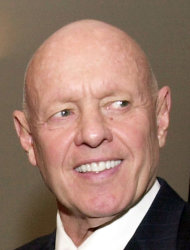
Stephen R. Covey, author of “The Seven Habits of Highly Effective People” as well as three other books that have all sold more than a million copies, has died. He was 79.
In a statement sent to employees of a Utah consulting firm Covey co-founded, his family said the writer and motivational speaker died at a hospital in Idaho Falls, Idaho, early Monday due to complications from a bicycle accident in April …
Covey was hospitalized after being knocked unconscious in the bicycle accident on a steep road in the foothills of Provo, Utah, about 45 miles south of Salt Lake City.
At the time, his publicist, Debra Lund, said doctors had not found any signs of long-term damage to his head.
Of minor interest to this blog because of his book’s alleged importance to the yearly thing called Keystone Boys State in Pennsy.
Keystone Boys State, one of the bane’s of DD’s existence long before he was DD, was originally dealt with here. (Click the link in graph before this one — ha-ha. Imagine how vexing it must be!)
In part, it reads:
Yes, one thinks learning to suck up, march in formation and follow pointless orders does teach something about life but one ought not to ask teenage kids to give up a week of summer to learn it. The current website seems to indicate Keystone Boys State is big with those junior ROTC operations which haven’t yet been run off public high school properties.
“The effort to get everyone involved at [KBS] manifests itself by having every ‘citizen’ elected, selected, assigned or appointed to leadership positions throughout the week. Each citizen also is provided with text materials based on organizational science and personal development exercises. Much of what we do is a spin-off of the Stephen Covey text, The 7 Habits of Highly Effective [People],” the boys camp proclaims.
“All citizens should become familiar with parliamentary procedures, ‘Robert’s Rules of Order’ and Covey’s The 7 Habits of Highly Effective People – NOW ! ! !”
“The 7 Habits of Highly Effective People” wasn’t required reading when DD attended Keystone Boys State, probably because it hadn’t yet been written.
It is another in a long line of publications from the self-help industry, filled with the kinds of slogans and advice people used to following orders and doing pointless institutional or corporate busy work for work’s sake think will help them improve their attitude so they can earn a quick million dollars, get promoted and exit the logjam of daily life.
“[Endless work] may be necessitated by constantly raising your sights,” writes Barbara Ehrenreich in “Bright-Sided: How Positive Thinking is Undermining America.” “If you are satisfied with your current condition, you need to ‘sharpen the saw,’ in self-help writer Stephen Covey’s words, and admit you could be doing better.”
In the election of ’64, Lyndon Johnson considered Barry Goldwater an easy mark. Goldwater, a John Bircher, jabbered about nuclear war so much the Johnson campaign made a famous commercial, the Daisy ad, that helped destroy the man.
Goldwater appeared so extreme and virulently anti-Communist he conveyed the message he was ready to take down the entire world, to turn it into a cinder with America’s nuclear arsenal, to stop it.
The power to hit the nail on the head is now in President Obama’s corner. Mitt Romney has a frightening message, too, just like Barry Goldwater. He is ready to turn the rest of the country into an economic cinder, with the spoil reserved for the fittest at the very top. And the President is right to show the truth of it, having a potential “Daisy ad” in this:
The alert may notice the producer’s of the video have added varying digital reverberations to Romney’s “sing.” Some making it sound as if from a distant claustrophobic lo-fi radio broadcast, some from a dim tunnel, like an empty bomb-shelter. It’s an artful and devastating touch. My hat is off.
Showing Mitt Romney as he is can scare people. He is as inhuman to the daily experience as he appears to be. He’s a person who has created the image that if you took a phone call from him you’d get an invoice, as a file attachment from Bain, to the amount of $10,000 for 60 seconds of consult. The ad, without much effort, is loathsome.
And it’s not like it’s the first. Mitt Romney is a stationary target, one furnishing an always bigger and more inviting bull’s-eye. Outside his class Mitt Romney is appalling. But this commercial has the President’s image and voice in it up front, setting it apart from all the rest. He’s telling us, “Take a look at this guy, can you believe it?”
Mitt Romney is the symbol of the high-button asshole, the antithesis to whatever delusions anyone may cling to about the America dream. The more he appears on screen, the more people must turn away knowing the only reason he’s succeeded in life is because he’s had a mountain of cash to start and that he was in a place where “I like being able to fire people” (1 billion hits on Google) was the Golden Rule.
A recent update to Symantec’s antivirus software rendered some Windows-based PCs inoperable, the security software maker disclosed Friday.
An update earlier this week to Symantec Endpoint Protection 12.1 antivirus software for businesses caused some Windows XP-based computers to crash repeatedly with a “blue screen of death,” the company revealed on its Web site …
The company said it learned of the issue Wednesday night from customers, who said they were forced to manually remove the software from disabled machines, a process they described as time consuming … “This whole episode is a joke, had the issue been a conflict with a random device driver then I could maybe slightly more sympathetic,” the customer said. “But for it to conflict with its own Symantec related drivers and cause this issue is a total farce …”
Anti-virus software can’t be dispensed with by most. On the other hand, I was able to rid myself of it a few years ago through the combination of running things in a sandbox and knowing how to manually pick unrecognized malware off a machine.
I realized the only malware that was getting into my stuff was undetected by signature scanning and, subsequently, always removed before a signature update and automated purge was available. Indeed, the signature update would occur because I eventually submitted a sample and was curious about response times which were generally very good.
However, there was little practical value in continuing the use of it.
But I don’t recommend this for most. Regulars of DD blog, exempted, of course.
“In my opinion, it’s the greatest transfer of wealth in history,” said general Keith Alexander, he of the National Security Agency, on cyberattacks launched at our great country. Not quite, and no one has to rely on opinion. The greatest transfer of wealth in history is the economic collapse of 2008, a disaster that shaved 40 percent off the worth of most Americans and which still has the nation in a deep slump.
“That’s our future disappearing in front of us,” Alexander added on the consequences of cyberattack.
It’s a claim that’s been made more than once, mostly because it gets your attention.
However, Monday was the latest example, in a talk on cybersecurity and American power given at the American Enterprise Institute.
Cybersecurity is a serious national issue. But the implication that it is the issue or that your future is disappearing in front you due to the lack of it should put a bug up your ass.
The preeminent national security challenge faced by this country is devolution into the equivalent of a banana republic with the largest military in world history and all the implications of that for stability and, ahem, the preservation of economic well-being. The future disappeared for millions, right in front of their eyes, between 2007 and 2008. What’s left is still dribbling away.
Moving on, in the introductory part of the talk Alexander reflected on the advances made in computing power, musing about what it would mean for gene sequencing — “think what we can do for gene research” (leave the predictions on molecular biology to the experts, is all I’ll say), invoking the number of apps for Crapple devices — 500,000, and that in a couple years there will be more mobile computers in circulation than people.
Which tells you that the world’s haves are accumulating multiple gadgets at a furious rate, not that conditions are wonderfully transformative.
The statistics are necessary to give an audience reference points to hang onto.
Americans love statistics and if furnished with enough they will often not notice when one is straying into quantifying the unquantifiable. Which is where you are when hearing about the greatest transfer of wealth, ever.
But all of this was just a preamble to the center of Alexander’s talk on cybersecurity, the meat of which started with the problem posed by companies that did not know they had been hacked. They outnumber those that do, 100 to 1, he said. This is very bad and requires an evolution to information sharing at “network speed.”
This, according to the discussion, hinges on applying a “thin layer” of security on top of the “cloud,” with the patches, updates and anti-malware signatures pumped out automatically. In addition, information sharing equals the rapid dispensation of data on threats occurring in real time.
Alexander assured the crowd this was all to be done with care for civil liberties. It’s not the e-mail they’re interested in so much as what’s coming with it, and the signatures of attackers.
Information sharing between government and industry has been an issue for almost twenty years. No one who has argued for more of it has ever believed there is enough. It’s always been that way, along with the promises that no one will be reading the mail. That’s the standard line. Nothing new here.
Paradoxically, the people making the arguments for more information sharing now know that the conditions they want are virtually impossible. It’s always unfinished business with many private sector institutions not interested in that level of two way flow on computer attacks. However they cannot bring themselves to say it. Thinking in the United States has always been crippled by a beamish adherence to a “can do” ethic. A realistic admission that some things just can’t be done is heresy.
One suspects the battle is also lost to get the “American people” to trust anyone from the government on the issue. This is not any fault of Keith Alexander but a national condition that can’t be remedied by good words, or even law.
Many already believe their mail is being read, anyway. It’s a perception that’s fatalistic and entrenched. Does it matter? The way things have gone, it would seem not. Public debate has made very little difference on what the national security side of the US government wants to do, or does, in the last decade. No heads have rolled because the security men have gone too far.
In Tim Weiner’s “Enemies,” a history of the FBI, the author asserts the FBI was reading national e-mail for most of the war on terror, anyway, part of this under the name of what has been called Stellar Wind. But then it stopped.
By the record of who the FBI was arresting in this country and the charges brought, particularly through the middle years of the last decade, there appears to be a great deal of truth to such assertions.
However, the new requests for information sharing are for different reasons than digging up terrorists in the country’s backyard. Now it’s for the timely and rapid application of technical solutions.
Alexander also spoke to the audience about not wanting to wait for something bad to happen and then jumping to “where we don’t want to be” in the world of monitoring and collection.
Well, that would seem to have already happened and cyberattack was not the precipitating cause — it was that Osama bin Laden fellow.
Alexander told his audience he would be where he didn’t want to be the day after “there went the electrical grid, there went the financial sector.” Testifying before Congress about how it all could have been avoided, as with 9/11.
That’s what everyone says and Alexander is sincere. He does sound like he means it. But you’re always gonna have those kinds of days, one or two of them, in a lifetime. That’s the vagary of history and no one can get around it.
On the other hand, if you conduct a meaningful public poll on how much average Americans really care about “the financial sector” being protected against cyberattacks, you might get an earful on how they’d like to be protected from the financial sector. Bank of America and Wall Street aren’t going to be popular again for a good long time. This is called ignoring the big picture, or historical context, and it has always had meaning for issues in national security. You cannot defend something or win the war when the little people, the locals, have little or no interest or incentive in rallying to your side.
Alexander took questions for about fifteen minutes. To his credit he dismissed one reporter’s query on whether or not al Qaeda had a serious cyberattack capability. No, he answered but if someone with the right training were able to take advantage of knowledge and tools available on the Internet …
I’d have answered, “Look, buddy, al Qaeda’s virtually operationally dead. They have a hard time making underwear bombs, finding people to run them and even getting out .pdf files of their company organ. What makes you think they’re great cyber-warriors?”
It’s sort of like asking if one thinks the Cleveland Browns might win the Super Bowl in 2013. Y’know, the name was good once. A real long time ago. And, theoretically, they could get better.
But government men have to be cautious about what they’ll admit.
For the sake of a discussion that emphasizes the gravity of dealing with cybersecurity it’s just easier to quote someone higher up, like Leon Panetta: “Technologically, the capability to paralyze this country is there now.”
It works in a talks even though the people who’ve been around since the beginning quietly hoot and roll their eyes.
Extreme heat, power blackouts and wildfires are no reason to mull over the consequences of global warming. Keep your eyes on the ball, folks! Instead they illustrate how frail US civilization is. And they let us have just a little taste of what life might be like after electromagnetic pulse doom.
If you thought embarrassing failure in the Republican presidential primary was any reason to keep Cult of Electromagnetic Pulse Crazy chief Newt Gingrich off the pages of the Washington Post, you were mistaken.
Without power, the comforts of home become worthless. You sit in the sweltering heat, realizing you are living in a box that, without electricity, is a trap. You pray for the “juice??? to return before your groceries go bad. You either make do in the heat or find refuge with friends who have electricity …
I write this now because of my concern for national security and our power grid, which are susceptible to doomsday-level damage if hit by an electromagnetic pulse (EMP) strike …
In 2009, my friend — and sometimes co-author — William R. Forstchen published a truly frightening book, “One Second After.??? (I wrote the foreword.) The story is fiction but based on hard facts. It is a cautionary tale about the threat of EMP strikes and major solar storms, known as coronal mass ejections.
William turned to bipartisan congressional studies published in 2004 and 2008 and interviewed many experts. His book made the New York Times bestseller list and helped to trigger what some call the “prepper??? movement …
It’s a play on the old pejorative “Vietnamization,” the word for the failed strategy of propping up the old Army of the Republic of Vietnam with US air power while transferring the job of fighting the war to it.
Without US air, the Afghan toady army, like the ARVN, gets beat up.
US bombing always suppresses or removes the enemy, like removing a boulder blocking a road to nowhere.
“Asked how Afghan soldiers or police officers might manage a similar tactical problem in the same canyon, Commander Burks gave a knowing frown,” reads the Times. “I don’t know, but they’re not going to do this.???
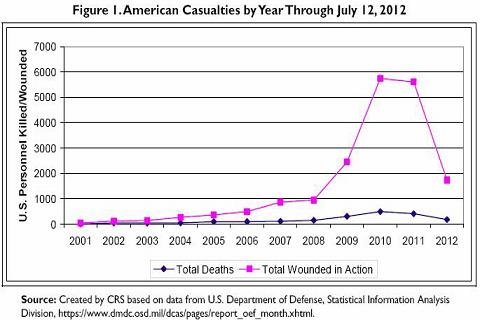
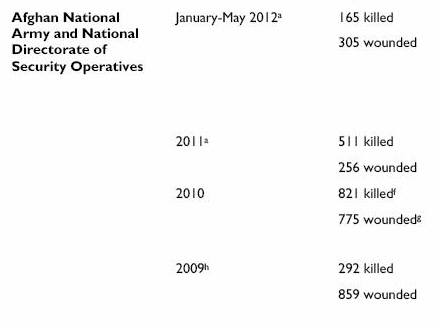
And the Steve Aftergood’s Secrecy blog has recently posted a Congressional Research Report on Afghan Army casualties. It is here.
There are two important figures.
And the numbers, if reliable, on Afghan National military casualties.
One can only tell the national toady army and police force don’t bear the brunt of any fighting. When they do fight, they are more likely to die than US forces.
This may also indicate other problems.
The Afghan National army may, like the ARVN, be casualty and risk averse, reluctant to fight. And that when it fights, it loses.
It may also often be ambushed, in its barracks, at home or in the field. And that the handling of those blown up or shot is much less effective than US retrieval of combat casualties, meaning you are more likely to not survive if hit in the war.
Over ten years in Afghanistan and the US military cannot make a decent fighting force out of the locals dragooned to finish the war for an unpopular central government.
Recall all the guff Democrats take for being snobs, for not embracing stock car racking with enough fervor, for being prissy and fussy, like the hated French or all those fags in England. It’s a class thing, showing a lack of authenticity. They, we, are not salt of the earth.
And Mitt Romney’s family ‘sport’ is something the average Tea Party voter could easily watch on the giant flatscreen while crushing an emptied Budweiser can in his right hand.
GLADSTONE, N.J. — Mitt Romney and his wife, Ann, who plan to attend the opening of the Olympic Games in London this summer, now have a personal rooting interest in the event.
Jan Ebeling, Mrs. Romney’s longtime riding tutor, and his horse Rafalca, co-owned by Mrs. Romney, earned a berth on the United States Olympic dressage team on Saturday.
Mr. Ebeling, 53, who has spent a decade knocking on the door of top international competition, made his first Olympic team with a third-place finish here at the United States Equestrian Team Foundation headquarters, a century-old stable built by the financier James Cox Brady to adjoin his 64-room mansion.
While Mr. Romney was barnstorming on a bus tour of swing states, Mrs. Romney watched from a V.I.P. tent as Mr. Ebeling executed a smooth “test??? of flying changes, in which Rafalca seemed to skip down the arena, and piaffes, an in-place trot …
As millions tune in to the Olympics in prime time this summer, just before Mr. Romney will be reintroducing himself to the nation at the Republican convention, viewers are likely to see “up close and personal??? segments on NBC about the Romneys and dressage, a sport of six-figure horses and $1,000 saddles. The Romneys declared a loss of $77,000 on their 2010 tax returns for the share in the care and feeding of Rafalca, which Mrs. Romney owns with Mr. Ebeling’s wife, Amy, and a family friend, Beth Meyers.
Remember, ithe horse does not share the nature of its owners. A horse does not choose for whom he trots. I like horses.
Yes, yes, you’re right. A lot of this is about class warfare and hating on the wealthy. Gotta problem with it? What’re you, some kinda commie-loving Euro-homo? I bet you don’t like pig’s feet or blind robbins.
Romney can’t even be mean with any honesty. Even when he’s pandering to viciousness, ignorance and racism, it comes across like a scaly calculation. A guy who feels like he has to take a dump on the N.A.A.C.P. in Houston in order to connect with frustrated white yahoos everywhere else is a guy who has absolutely no social instincts at all. Someone like Jesse Helms at least had a genuine emotional connection with his crazy-mean-stupid audiences …
[Mitt Romney] doesn’t buzz with anything. His vision of humanity is just a million tons of meat floating around in a sea of base calculations. He’s like a teenager who stays up all night thinking of a way to impress the prom queen, and what he comes up with is kicking a kid in a wheelchair. Instincts like those are probably what made him a great leveraged buyout specialist, but in a public figure? Man, is he a disaster. It’s really incredible theater, watching the Republicans talk themselves into this guy.
We got outraised last month, and not by a little bit.
Part Two of getting outraised is getting outspent. That translates into a potentially devastating sweep of negative, misleading messaging that’s going to flood the airwaves in swing states — over and over and over — until November 6th. It’s already started, and it’s only July.
Will you make a donation of $4 or more to help close this gap?
How this election plays out will define our democracy: Can super PACs and hundreds of millions of dollars from Republicans and the Romney campaign — through the brute force of negative advertising alone — drown out millions of voices?
Or can the politics of inclusivity [sic] — asking supporters to chip in $5, $10, $25 at a time — keep the margin close enough to win?
Please donate $4 or more today to close the gap:
https://donate.barackobama.com/Outraised
Thanks,
Julianna Smoot
Deputy Campaign Manager
Obama for America
Julianna Skinner Smoot and Lon Barton Johnson were married Saturday in Northport, Mich. The Rev. Thomas H. John Sr. performed the ceremony at the Northport Indian Mission United Methodist Church, where he is pastor.
The bride, 44, is keeping her name. She works in Chicago as a deputy manager for President Obama’s re-election campaign. Until March, she was the White House social secretary. She graduated from Smith. She is a daughter of Edward B. Smoot and Julia L. Smoot of Willow Springs, N.C.
The bridegroom, 40, is a partner in TVV Capital, a private fund in Nashville that invests in small and midsize manufacturers and other companies, chiefly in the Southeast …
The canvas e-mails from the swells shown in the pages of the New York Times’ wedding section is so not cool.
The husband of the fund-raiser is a partner in a junior league Bain.
Could the machine choose people who aren’t just more shoeshiners for the 0.1 percent and the forces of national entropy?
From images of corporate raiding, to luxury speedboats, to offshore accounts in the Cayman Islands, to mega-mansions in the Hamptons, this week’s stories suggest that the candidacy of Mitt Romney – poster-boy for the symbiotic relationship between big money and the modern Republican party – is in serious trouble …
Last weekend’s photos of the Romney clan on a luxury speedboat cruising around a lake in New Hampshire, where their multimillion-dollar compound sits, were startling in their tone-deafness.
What is so very puzzling about the whole episode is the sheer in-your-face-ness of it.
Yet, perhaps that is the point. As a very perceptive article in the New York Magazine, Lisa Miller describes how new psychological research indicates that wealth erodes empathy with others. In the “Money-Empathy Gap”, Miller cites one researcher who says that:
“The rich are way more likely to prioritize their own self-interests above the interests of other people. It makes them more likely to exhibit characteristics that we would stereotypically associate with, say, assholes.”
I changed the thumbnail photo on Mean Future, canceling out the “I Love Capitalism” Tea Party man. It’s too disturbed, like watching someone you’re sure has slipped from their prescription drug straight jacket.
I was on Lake Winnipesaukee once, as a child. I accidentally threw a neighbor’s fishing rod overboard with a bungled cast. It was never recovered.