The mainstreaming of Ted Nugent as a pundit and personality demonstrates a deep flaw in American character — the real enjoyment and approval of those who are defined by their malice toward others.
Ted Nugent is now much of the GOP electorate. He is one of the most recognizable faces of the Psychopath Vote. And it’s why the party is essentially dead except in gerrymandered WhiteManistan.
There is no question that wishing ill on others is just about all that motivates Nugent. It’s his money-maker. One only has to read a year of his columns at the Washington Times and tabulate the various curses and slurs he brings down on others weekly.
Today is no exception. At the heart of his column is the assertion that the poor, those receiving benefits as part of the in-tatters social safety net, should have their right to vote rescinded. While it may seem shocking and reflexively nasty it’s not an uncommon sentiment in 2012 USA.
On election night Nugent publicly choked on his own bile. And he quickly adopted the odious bigot’s theory of everyone else in the the Republican Party’s top rung — the only reason Barack Obama won was because he gave stuff to lots of people, like the Obamaphone. And those people are all leeches, bringing the country down.
The three sacred entitlement cows in the room that no politician wants to poke are Social Security, Medicare and Medicaid. A blinding statement of the obvious is that we are never going to get our financial house in order until these sacred entitlement cows are not only poked, but slaughtered …
In addition to slaughtering the three sacred entitlement cows that consume a vast majority of the federal budget (and I use the term budget generously), let’s truly spread the pain around and raise taxes on everyone, including the nearly 50 percent of Americans who pay zero federal income taxes. Those Americans need to have some skin in the game, too. I recommend at least a 5 percent federal income tax bracket for them.
Let’s also stop the insanity by suspending the right to vote of any American who is on welfare. Once they get off welfare and are self-sustaining, they get their right to vote restored. No American on welfare should have the right to vote for tax increases on those Americans who are working and paying taxes to support them.
Ted Nugent is a raging public bigot, full time. It’s his career. He appears regularly on television and lousy cable tv specials made especially for him.
In a civil society Nugent would have no place. But that’s not us. His presence is a symptom of underlying sepsis in the soul, the yen to see others, always the weaker, publicly hurt or destroyed.
Mitt Romney was all right with Ted Nugent, even seeking his approval. So if there is good news in any of this, it is that Nugent is so public and so very obviously a good example of the Republican Party.
The former [Richard Feynman] student who stands out to me the most was a friend of mine and fellow homesteader in the jungle here in Belize who, sadly, died of cancer about two years ago at age 51. Mark Ludwig had a doctorate in particle physics. For his PhD thesis, he had worked out by a different means one of the classic math derivations of modern physics. I marveled that it had not been worked out as he did it long before, but it was not a simple feat.
True? Probably.
It has the ring of it. Unlike John McAfee, Mark Ludwig was rock solid truth. However, there was always an element of mystery to him and it got stronger when he left the country for Belize and other parts in Central America many years ago. It lives on in his old books, by far the strangest and most idiosyncratic things on my bookshelf.
I knew Ludwig was a student of Richard Feynman’s at CalTech and the reference contains additional information congruent with what he’d told me over a few years back in the Nineties.
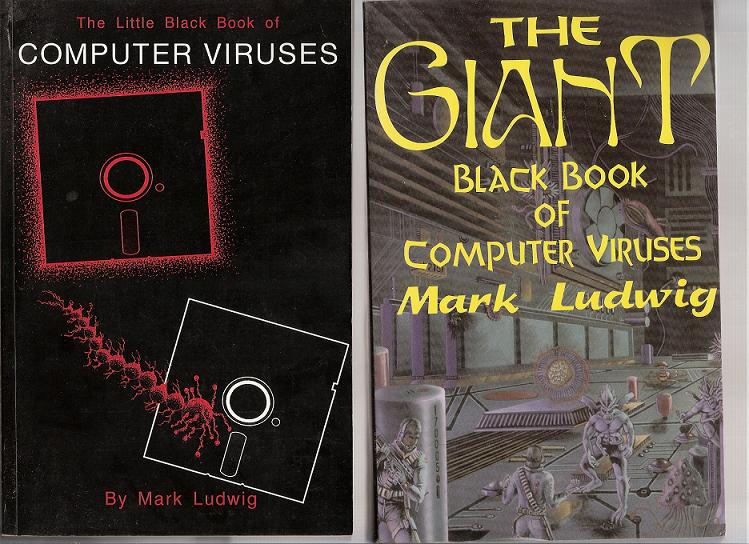
I first came to know the man in 1992, around the time of John McAfee’s hyping of the Michelangelo virus. I was interested in these contagious programs and found there was little information on their innards, their exact programming. Ludwig had written The Little Black Book of Computer Viruses, pictured, and it came with compilable source codes for a few simple viruses. (Two were basic DOS viruses. Two others, more accurately, worked at the level of the BIOS — since they operated from the boot sector of hard disks and floppies. This was the most effective method of virus spreading prior to common use global networked communication. There was a slang term to describe it — via sneaker net — or the running of disks and diskettes between machines.)
Ludwig sent me a copy of the book. This was forbidden stuff in 1992, you didn’t get malware every other day as an attachment in your spam folder, and it set me on a path into the virus underground, the results of which were published in my old virus-code Crypt Newsletter and, later, The Virus Creation Labs, which Ludwig published.
Although I have no figures, the original The Little Black Book (first edition is pictures, later editions revised the cover art) sold enough to launch Ludwig’s publishing company and make him infamous. For a time, he was successful at riling the anti-virus industry whose members were often compelled to purchase his CD-ROM virus collections so their programs didn’t miss anything.
The computer viruses in The Little Black Book were fairly simple by today’s standard. All written in assembly language, two file infectors didn’t do much of anything except slowly infect other small programs. One simple boot sector infector, called Kilroy, never spread. It had a habit of landing in a place on the hard disk the PC used as book-keeping for your files. And that immediately killed everything, requiring a clean-up.
However, the last virus in the book traveled around the world on floppy disks and diskettes. Dubbed Stealth.Boot.C, it was successful in the wild. A couple years after The Little Black Book was published I found from a colleague that it had infected quite a few PCs at the Washington Post. The friend remarked it was discovered because it often corrupted diskettes which were full of data.
The virus hid itself by copying part of its code to the data sectors on these diskettes. And if the diskette was full or near full when the virus tried to infect it, data was overwritten and lost.
From 1990 to 2002 Ludwig wrote virus black books, including even a dense, tangled volume on them as artificial life interleaved with a discussion on intelligent design/creationism. (It was uncharacteristically unpopular with the usual hacker crowd that bought his paperbacks.)
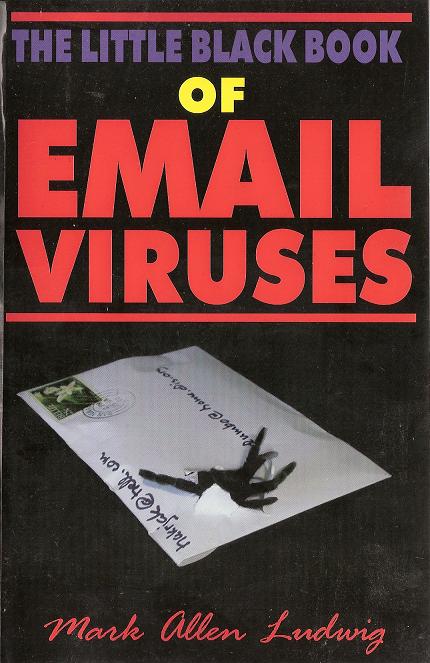
The last Ludwig volume was The Black Book of E-mail Viruses (also pictured).
By the time it was printed Ludwig had moved to Belize. Prior to 2000, he told me he thought the US was either going to fall or descend into total chaos and tyranny during a Millenium Bug crisis and occasional self-published pamphlets reflected this belief. Whatever the case, he wanted out of the country.
And so Ludwig left with his family to make a home in Belize where he pursued a hard fundamentalist Christianity, a life of faith (writing a couple more extreme books on this subject) and the building of geodesic domes.
Ludwig’s American Eagle, which an interesting publisher, was not the best place for my kind of book. The audience was all wrong, terribly so, now a matter of bemusement more than regret. You need a sense of humor to get what I did. Publishing black books on computer viruses was mostly for a totally humorless audience.
Indeed, a few years after the publication of VCL the company’s bestseller was a deplorable thing called Civil War II, a “think piece” on an alleged coming race war in America brought on by Hispanic gang revolt in southern California.
It was big with neo-Nazis.
I have a complete set of the black books of computer viruses and they indeed remain unique things. (Interested? They’re all mint to new. Plus you get an official GS “I was there” provenance. I might let go of them for a handsome figure.)
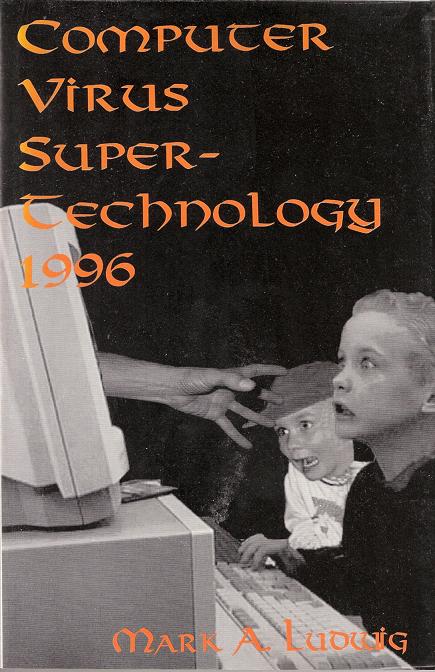
A new copy of Computer Virus Super Technology — 1996 reads “It is being published in a strictly limited edition of 500 copies and sold by invitation only to qualified people.” My copy is marked “review” in Ludwig’s handwriting. A collectible edition is billed as selling for 780-some bucks on Amazon.
Computer Virus Super Technology sold for $395 (see the back cover snap) which came to about two dollars/page although it was advertised, pre-publication, at a discounted $99.
In The Little Black Book of E-Mail Viruses, Ludwig’s last in 2002 — published from Panama, the author writes about progress and his philosophy:
[The Internet] has greatly increased the speed at which information flows and is generated. So one the one hand, a fairly simple virus can infect a million computers in a week, whereas that might have taken a year in the past. On the other hand, if a virus exploits a certain security weakness today, that weakness can be patched up by a software vendor this week and made widely available by automatic internet update next week …
These facts demand a different approach to learning about viruses. Frankly, I could write a book that contained examples of viruses that could be typed into your computer and let loose which would be fully capable of destroying the data on 100 million computers in one week. The problem is, first, that I don’t want to be responsible for doing that, and I know some idiot out there somewhere would actually sit down and type in anything I printed and send it on its merry way without having a clue to what he was doing. So it would be irresponsible to print such code. But secondly, this book would become obsolete after the idiot did that because it would force vendors to change programs so these viruses no longer worked.
So Ludwig asked readers to think of viruses more “conceptually,” to do a little of the mental work themselves. For this purpose, he included exercises.
“Get on the Internet and sleuth around with a search engine to see if you can locate a copy of the source code for the first generation file infecting virus called Jerusalem-B,” Ludwig wrote, for the first such exercise.
Now it’s an elementary task.
Time blows away everything. The physical reality of these books and what they contained are difficult to describe to people who are now growing up on smartphones and iJunk. Will apps for doing stupid, non-essential and unproductive things outnumber trivial PC viruses? Yep, and soon.
Long time readers will be familiar with the code “decoration” found at the footer of the main page and individual posts. It was the result of an error in the page designer’s template files, one of the WordPress default choices for style and look. And the only one I could stand.
After two years, I finally took the time to correct the error, which was trivial, yesterday. And now the virtual lint and dust bunnies are gone. Thanks to Frank at Pine View Farm for taking note and just putting enough of a bug into me to get to it.
John McAfee’s goose is now well and truly cooked with the media. Few trust what he writes or says and the consensus opinion, although not always flatly stated, is he’s a drug addict despite regular denials. The media in the US realizes the truth is impossible to get from him since so much of his life has been devoted to unusual media deceptions.
In this, McAfee resembles one part of very old hacker culture typified by those who got some of their kicks through a kind of malicious and reflexive horse-shitting and ranking on acquaintances.
Eventually, it always backfired. And so it has for the ex-anti-virus tycoon.
Before he went underground, Mr. McAfee led a noisy, opulent and increasingly stressful life here [in Belize]. He was known for the retinue of prostitutes who he says moved in and out of his house …
Some McAfee watchers have a different theory — namely, that he grew paranoid and perhaps psychotic after months of experimenting with and consuming MDPV, a psychoactive drug. These experiments were described in detail by Mr. McAfee himself, under the pseudonym “Stuffmonger??? in a forum on Bluelight, a Web site popular with drug hobbyists.
So, here’s one hypothesis: Rich man doses himself to madness while seeking sexual bliss through pharmacology. Then shoots neighbor in a rage. Case closed, right? Ah, but those Bluelight posts were a ruse, Mr. McAfee would later blog …
Throughout his varied, occasionally confounding and hoax-filled career, the one constant has been a genius for self-promotion.
Mr. McAfee bought this [Belize] property four years ago and, like much else about him, the reasons for his relocation, and what he was doing here, are a bit murky.
What is certain is that he bought a water taxi service and started a couple of small local businesses. The most ambitious was QuorumEx, a biotech start-up that aspired to develop natural antibiotics with plants in the Belizean rain forest …
The idea for the company made a certain sense: a guy who had spent years fighting computer viruses turns his attention and talents to combating bacteria. [Actually, it makes no sense. The two have nothing in common. I learned bacteriology as an avocation, about computer viruses as coincidental accident. And there’s no connection in which knowledge about one leads to knowledge about the other.]
Whether these Bluelight posts [by the anti-virus tycoon on ‘bath salts’ use] were just a charade, as Mr. McAfee contends, is impossible to say. But Dr. Paul Earley, an addiction specialist in Atlanta, said that MDPV users commonly rhapsodize about their early experiences, claiming the drug makes them alert, activated and in some cases fantastically randy.
“That’s part of the danger,??? Dr. Earley said. “The absence of any apparent side effects lures users into heavier and heavier doses and at some point, for reasons we don’t fully understand, MDPV becomes extremely toxic. Users become psychotic and paranoid. They hallucinate monsters. Often they think the police are after them. That is the classic MDPV profile.???
In 1992, the same year [McAfee Associates] had gone public, he began hyping the threat of a virus called Michelangelo, contending in television and newspaper interviews that it would waylay millions of computers.
The scare came and went with little notable impact, other than the one it had on the balance sheet of the company (very positive) and the reputation of Mr. McAfee (very negative).
Read all of it. If there’s a way to write something more damning and which, essentially, has the ring of truth, I don’t know it. By the end of the piece it’s clear David Segal, the Times reporter, has had all he can stand of the legend.
Again, McAfee is tied to drug runners, addiction, seedy bribery and a taste for young prostitutes. His blog, although occasionally amusing, instead of revealing any compelling counter-story has been a public relations disaster.
There may be a book in the shabby crack-up of John McAfee’s life but it won’t be successfully done by an amateur and peddled as an R. Crumb-like graphic novel. There’s no new Hemingway or Hunter Thompson in the pipeline, no Fear and Loathing in Ambergris Caye.
McAfee explained that infectious bacteria become dangerous only when they multiply to a certain concentration, at which point, thanks to a process called “quorum sensing,” they collectively shift to a pathogenic mode. The signal that modulates this response is a certain chemical pheromone — if a drug can block its action, the bacteria will never become dangerous. And because no bacteria are killed, the accelerated evolution that results in antibiotic resistance never occurs.
Yes, all bacteria are good little pups until they agree, in a big group, not to be. Quite.
While the reporter isn’t quite up enough on science to immediately call bullshit, he does get at it another way in looking at the man’s history and ways prior to his arrival in Belize.