05.10.13
Posted in Bioterrorism, Ricin Kooks at 11:16 am by George Smith
During the height of the war on terror you hardly ever saw anyone in the professional ranks with the nerve to say that grubbing for more defense research funding on the back of fear was inadvisable.
For the Courier-Journal newspaper of Indiana, a scientist speaks of the recent ricin scare in a most surprising way:
I am a scientist. I am not opposed to research. It is essential for the similar preparation required for either a bioweapons assault or a naturally emerging disease. Nevertheless, a fear-based crisis response, because public officials happened to be among the targets, is self-defeating.
Academics should resist the temptation to exploit the ricin letters to obtain more resources for their research. There are already ongoing scientific studies of ricin, including some that employ the toxin to kill cancer cells. We don’t need an infusion of money into ricin research. I don’t claim to know the motives of the ricin letter mailer or whether he got the idea from a television show. I do know that overreaction encourages future terrorists.
The author, David Sanders, is “an associate professor of biological sciences at Purdue, is working on a Howard Hughes Medical Institute-sponsored curriculum-development project,” reads the newspaper.
“[Environmental] sensors for true biological agents are and will be for the foreseeable future wastes of money,” he adds.
Sanders also writes that the over-reaction to things like the Dutschke ricin-mailings inspires other terrorists.
He is echoing what I have written for years. The ocean of print, television and Internet news on the subject, during the war on terror years, established the received wisdom in the minds of would-be terrorists that biological and chemical warfare are easy to do.
As one consequence, many bad people have maintained an interest in fiddling with castor seeds.
It is fortunate that reality does not match the national belief that a ricin weapon is easy to make, simply by pounding castor seeds, and J. Everett Dutschke’s tainted letters were, in the final measure, just a damn nuisance.
After the ricin letters arrived and made news, a scientist and one company did immediately go rent-seeking.
And I wrote about it, pointing to a piece from Nature:
The US Army Medical Research Institute of Infectious Diseases in Fort Detrick, Maryland, has developed a vaccine called RVEc, which protected mice that were exposed to inhaled ricin.2 The vaccine has also been tested in human volunteers, who subsequently developed antibodies to the toxin. But further human testing is needed, and it is not clear whether the Department of Defense will continue to fund the vaccine’s development.
The other leading vaccine candidate, RiVax, is made by a company called Soligenix, based in Princeton, New Jersey. The vaccine was initially developed by Ellen Vitetta, an immunologist at the University of Texas Southwestern Medical Center in Dallas, and batches made by her group have been tested in animals. Those batches have also been found to be safe in healthy human volunteers, in whom they stimulated the production of antibodies.
But Soligenix has not yet tested the safety and effectiveness of its own batches of RiVax. The company’s development efforts have slowed as a result of budget constraints at its funding agency, the NIAID, says Vitetta.
“It basically is not going anywhere,??? she says. “It’s disappointing and upsetting.??? After an event such as the latest ricin mailings, “everyone wants to know where the vaccines are. Somebody has to think this work is important enough to fund us and let us finish it.???
Soligenix’s work on the vaccine is currently funded by a US$9.4-million NIAID grant, but further testing in animals to prove the treatment’s effectiveness would cost between $20 million and $40 million, says Chris Schaber, the company’s president.
And another from a New Jersey business journal:
Soligenix is actively working to develop vaccines for bioterrorism agents such as ricin, but funding the research remains a challenge, according to company president and CEO, Christopher J. Schaber.
“Every biodefense program needs to be sponsored by the government,??? said Schaber. “We don’t spend our own money on biodefense. The company could not take off with biodefense unless we secure a large procurement contract from the government, which are typically in the hundreds of millions of dollars …
Soligenix’s share price rose 20 percent this week after the ricin-laced letters to government officials were publicized.
Soligenix would make money if the government stockpiles the vaccine, but the research has to be funded and it has to get FDA approval before the company can procure a government contract.
“We’ve taken this very far with the support of the NIH (National Institutes of Health), but we really need to get a larger contract with more funding to allow us to move forward,??? Schaber said. “The government many times doesn’t move that quickly on these things, especially because a lot of people haven’t died.
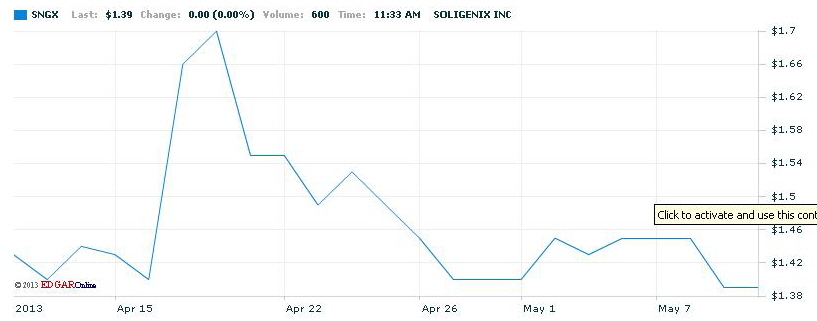
Bigger.
Soligenix’s stock, which isn’t worth a great deal, shot up on the 16th and 17th, the day ricin letters to Roger Wicker and the President were discovered, boosted by speculators. A letter had been sent to a judge in Tupelo, MS, on the 10th but did not make the news until after the letters had been discovered in the nation’s capital.
J. Everett Dutsche was arrested on April 27 by the FBI.
Soligenix, a company that exists only because of taxpayer spending during the war on terror — from the archives.
Permalink
05.09.13
Posted in Ted Nugent, WhiteManistan at 3:20 pm by George Smith

From the South Bend newspaper, Ted Nugent tortures the journalist:
Q: You say on your website “Styx and REO deserve me.??? What does that mean?
A: Make no mistake, those incredible virtuosos in both Styx and REO were and continue to be inspired by the same black American musical heroes that my band and I are inspired by. I guarantee you that each member of all three bands was lured into the world of music by Chuck Berry, Bo Diddly, Little Richard and of course the Stones and Beatles who were inspired by Howling Wolf, Muddy Waters, Lightning Hopkins and all the original black soul music masters. Even the sweetest music moments by those bands are delivered with real all-American gung-ho soulfulness and we couldn’t be more proud to bring our Ted Nugent Black Power Tour 2013 to the same music-loving fun gluttons that love all three bands. We deserve each other!
Q: About a year ago, you said “If Barack Obama becomes the president in November, again, I will be either dead or in jail by this time next year.??? Neither has happened. Please explain.
A: This president and his administration are so out of control that they are creating an America that does not resemble the America of our founders, and good people like me are their enemy.
Q: Because of some of your comments, you were visited by the Secret Service and were disinvited from performing at Fort Knox. Can you comment on this?
A: We indeed had a wonderful, professional meeting of mutual respect, and they left knowing what they arrived knowing: that I did nothing wrong and that they wasted their time responding to dishonest liberal Democrats who lied through their teeth.
Q: America is, I think, at its most divisive. What is the solution to bringing the country back together and can you find any common ground with the other side?
A: We the people are fighting back stronger than ever and I still believe that the U.S. Constitution and Bill of Rights, the American Way, will prevail and return soon. We need to show unity in we the people having a dream of nonviolence upgrade for our beloved America …
The reporter asked good questions. But this doesn’t work with Ted Nugent as he responds only through e-mail.
You’ll have to admit “nonviolence upgrade,” coming from Nugent, adds to the already long list of howlers.
Permalink
Posted in Culture of Lickspittle, Decline and Fall at 4:34 pm by George Smith

Mark Zuckerberg has publicly yearned for more immigrant visas. But only a certain kind of worker need apply. He wants cheaper revolving door programming and development labor in the Silicon Valley. Let’s dispense with the tech propaganda and have a quick look at how his desired knowledge workers compare with other necessary workers in the great state of California.
Zuckerberg, in the pages of the Washington Post, a few weeks ago:
Today’s economy is very different. It is based primarily on knowledge and ideas — resources that are renewable and available to everyone. Unlike oil fields, someone else knowing something doesn’t prevent you from knowing it, too. In fact, the more people who know something, the better educated and trained we all are, the more productive we become, and the better off everyone in our nation can be.
This can change everything. In a knowledge economy, the most important resources are the talented people we educate and attract to our country. A knowledge economy can scale further, create better jobs and provide a higher quality of living for everyone in our nation.
Many people can grasp why this isn’t really true anymore.
In a global knowledge economy everyone knowing the same thing around the world has and does disempower huge classes of people who helped pay for the invention, development and deployment of the network that distributes it worldwide.
And how this is done is easy to see.
Where the cost of living is high, as it is in the United States relative to China or India or somewhere else, the knowledge the American workers possess — even though it may be the same as those in other countries — is more costly to employ.
Therefore, the value of our knowledge in body has crashed, even though it is the same as elsewhere. It is uncompetitive not because of lack or inferiority, but because of where we live.
And this is really what Mark Zuckerberg and others like him are about. They want cheaper educated labor, always.
However, Mark Zuckerberg is not even particularly accurate in terms of the needs of the United States. He overlooks one of the giant engines of the California economy because it just doesn’t contain the kind of people who are of any consequence to his wealth or business.
Take this bit, written by ex-California Arnold Schwarzenegger, the same week:
The [state of California] produces more than half of the fruits, nuts and vegetables grown in the U.S., with an output of $43.5 billion last year. Californians don’t rely just on the food produced by the state’s farms; they rely on the revenue and the jobs too. Agriculture employs more than 1.5 million people in California.
And who are many of these people employed in the California field, many more than employed in the Silicon Valley?
Well, they’re the brown people without the legal smartypants visas meritocratic KnowledgeStan’s Mark Zuckerbergs want. And these agricultural knowledge workers do not earn top dollar. No one in powerful American giant business stands for them in the Washington Post although it is easy to find those who hate on them. But they cannot be dispensed with, like lots of other American workers with knowledge who are deemed too expensive to employ because you still need people to go into the fields and do s— while being sprayed by crop dusters.
Silicon Valley software, programming genius, social networking, the cloud, Big Data and my new favorite phrase — “the Internet of things” — can’t eliminate the need for their work in this country.
But did you know Mark Zuckerberg and his wife solved the world problem of organ donation, just over a couple glasses of posh wine?
Of course you did. Everyone knows that!
Oh, wait. Oops! Never mind.
Then there’s the fellow who almost was able to wipe out measles and mumps. Nobody remembers his name.
Permalink
Posted in Culture of Lickspittle, Cyberterrorism, Shoeshine at 9:13 am by George Smith
Formally, the Obama administration has chosen to allow the Pentagon to take the lead in describing the threat of Chinese cyberwarriors:
The Obama administration on Monday explicitly accused China’s military of mounting attacks on American government computer systems and defense contractors, saying one motive could be to map “military capabilities that could be exploited during a crisis.???
While some recent estimates have more than 90 percent of cyberespionage in the United States originating in China, the accusations relayed in the Pentagon’s annual report to Congress on Chinese military capabilities were remarkable in their directness. Until now the administration avoided directly accusing both the Chinese government and the People’s Liberation Army of using cyberweapons against the United States in a deliberate, government-developed strategy to steal intellectual property and gain strategic advantage.
“In 2012, numerous computer systems around the world, including those owned by the U.S. government, continued to be targeted for intrusions, some of which appear to be attributable directly to the Chinese government and military,??? the nearly 100-page report said.
The report, released Monday, described China’s primary goal as stealing industrial technology, but said many intrusions also seemed aimed at obtaining insights into American policy makers’ thinking. It warned that the same information-gathering could easily be used for “building a picture of U.S. network defense networks, logistics, and related military capabilities that could be exploited during a crisis.???
The Pentagon report is here.
Whether or not these Pentagon statements on Chinese cyberespionage are “remarkable in their directness,” as New York Times reporter David Sanger writes, is open to interpretation.
Chinese cyberwar/cyberespionage capabilities comprise somewhat less than two pages in the entire thing. More space is devoted to China’s conventional warfare capabilities and hardware, its ballistic missiles programs, it’s preliminary moves into aircraft carrier aviation through the refurbishment and equipping of the old Varyag — now renamed the Liaoning, its naval modernization and other subjects.
In fact, the Pentagon can say little about Chinese cyberespionage other than it exists and much material, from the US private sector devoted to supporting the US military, is being copied.
What benefit this has been the Pentagon does not know and cannot or will not say. No one knows. It’s impossible to put a finger on the value of it to China, or precisely what losses this country directly suffers. It is an argument that has no meaning for the majority of Americans, something only the top most cares about.
And that’s because they can only be made to care about things they suspect may make them slightly less wealthy.
In terms of what’s actually happening, for example, China has not made any obvious great leap in generating a carrier battlegroup-centered navy.
On the other hand, we certainly do know that the US private sector, our multi-national corporations, are intimately involved in business relations with China.
Indeed, it is safe to say that the strapped American middle class would have next to nothing if all its household consumer electronics and dry goods of Chinese origin were taken away.
If, for example, Chinese cyberwarriors are stealing Apple’s secrets, what does it matter? Is Apple stopping its majority manufacturing through China?
America’s electric guitar and rock amplifier companies make the majority of their mainstream goods in China. If Chinese cyberwarriors have stolen plans from Fender Musical Instruments or many other American companies, so?
The entire American industry of pop music instrumentation manufacturing, excepting custom shop artisan work, was sent to China to increase profit margins and decrease labor costs.
American business ceded its property to the Chinese industrial base for immediate profit in pursuit of the very cheapest unprotected manpower. This was long before Chinese espionage became an issue the national security megaplex decided to exploit for the purpose of parasitic rent-seeking.
Who are you going to find on the street who cares if Chinese cyberwarriors from a building in Shanghai are into American businesses? They’ve already lost their jobs or much of their earning power. And their access to the Internet is a smartphone made in China.
Take a day off from the memes. Corporate America isn’t hiring, haven’t you heard? It’s not because of mass Chinese cyber-spying.
One last figure, furnished to again put Chinese cyberespionage/cyberwar efforts in perspective, as they relate to the American experience …

You can really tell how Chinese cyberespionage/cyberwar is taking away our futures, right?
National cyberdisaster described in less than 120 words: We’ll lose power, then we’ll drown:
U.S. intelligence agencies traced a recent cyber intrusion into a sensitive infrastructure database to the Chinese government or military cyber warriors, according to U.S. officials.
The compromise of the U.S. Army Corps of Engineers’ National Inventory of Dams (NID) is raising new concerns that China is preparing to conduct a future cyber attack against the national electrical power grid, including the growing percentage of electricity produced by hydroelectric dams …
The database contains sensitive information on vulnerabilities of every major dam in the United States. There are around 8,100 major dams across waterways in the United States.
The cyberwar menace repeat staff, at Scientific American:
Since this incident there has been a growing realisation that various elements of a critical national infrastructure are similarly vulnerable. They use similar, if not identical, embedded computer systems as were used at Natanz. The initial thought was one of defending the realm against foreign aggressors. After all, it was an obvious way to cripple a country without firing a physical shot. Why launch missiles if you can switch out the lights and turn off the water. It’s cheaper too. So much so that this form of attack has become a great leveller, allowing small nations to potentially punch well above their weight.
The same guy, in the Irish Times:
The North Koreans have been blamed for interrupting websites run in South Korea by banks, newspapers and TV companies in “a show and tell??? warning about what they are capable of during a conflict, warns Sally Leivesley of Newrisk. The South Koreans have taken the warning seriously, upgrading security at their nuclear plants – including disabling every USB port in every computer at the plants lest they be used to breach defences.
States initially used internet hacking for espionage, or intellectual property thefts, but warns Prof Woodward, they are using it for “aggressive??? attacks: “This is the cool war, as some people have put it, not the cold war. Why invest in bombs and bullets when, potentially, in a shooting match you can turn out the lights, turn off the water. Some countries are really punching above their weight. They don’t need a huge nuclear weapons programme.???
Some yob nobody knows at the Huffington Post:
Cyber terrorism. Terrorist groups and states will make use of cyber-war tactics, though government will focus on information-gathering than outright destruction. Stealing trade secrets, accessing classified information, infiltrating government systems, disseminating misinformation — traditional intelligence agency ploys — will make up the bulk of cyber-attacks between states.
Virtual statecraft. States will be wistful for the simpler days of foreign and domestic policy. Power in the physical world is no assurance of power in the digital world. This disparity presents opportunities for small states looking to punch above their weight …
Cyberwar allows small nations to punch above weight — brainless new received wisdom.
Usage: North Korea was really punching above its weight when it quietly took its missile off the launch platform this week turned off all the electricity in Los Angeles County with a secret cyberattack.
From the New York Times, a few weeks ago, on the White House collecting the wealthiest and most infamous CEOs from the companies that have profited immensely in the last three years, to talk about cyberwar:
The difficulty of deterring such [Iranian cyber attacks] was also the focus of a White House meeting this month with Mr. Obama and business leaders, including the chief executives Jamie Dimon of JPMorgan Chase; Brian T. Moynihan of Bank of America; Rex W. Tillerson of Exxon Mobil; Randall L. Stephenson of AT&T and others.
Mr. Obama’s goal was to erode the business community’s intense opposition to federal legislation that would give the government oversight of how companies protect “critical infrastructure,??? like banking systems and energy and cellphone networks. That opposition killed a bill last year, prompting Mr. Obama to sign an executive order promoting increased information-sharing with businesses.
“But I think we heard a new tone at this latest meeting,??? an Obama aide said later. “Six months of unrelenting attacks have changed some views.???
Unrelenting attacks, in this case, meaning making banking websites occasionally run more slowly.
Permalink