Unsurprisingly, YouTube has a fair amount of home video devoted to Chinese manufactured Gibson guitars.
The devil’s bargain forged by American manufacturing offshored to that country has resulted in an obvious ambivalence in American guys.
The counterfeits sell to American guitarists who can’t resist what they believe are great bargains. They know the goods are shifty but they’ll do it for the price.
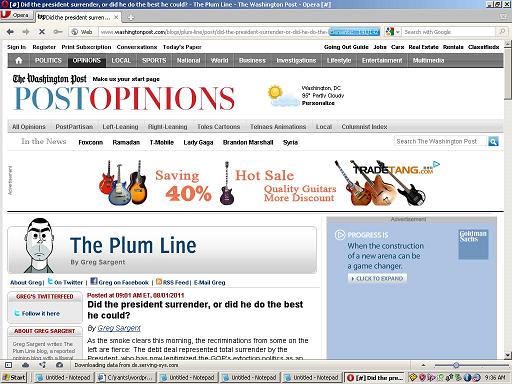
What’s different this week is the bald-faced advertising of Gibson guitar counterfeits all through the Washington Post’s website. I’ve been there a half dozen times and the banner ad comes up everywhere.
But first, two YouTube vids — from last year — on the counterfeits. In the first one, you see the problem Gibson faces: The guy who promotes them as a steal — which they are — only not in a good way. This is common.
The second is a dissection of the instrument which is obviously can be discerned as a fake by people familiar with the real thing.
The situation which exists now is that there are more counterfeits being made than Gibson, and one imagines other domestic guitar makers, can police.
If you waste any time at all on these videos, you come away with the impression that the counterfeiters are fairly good. For the price, they make a fair guitar and the finishes are generally judged to be fine and professional.
You can theorize that American training and outfitting of a Chinese labor force has had something to do with this. It is only logical that Chinese manufacturing would become adept, or adept enough, with elements of it seeing no need to retain licensing agreements from American multi-nationals.
Finally, as with the US government, the Washington Post is a dysfunctional agency. There simply is no one home when it’s time to legitimately complain and demand that they do the right thing.
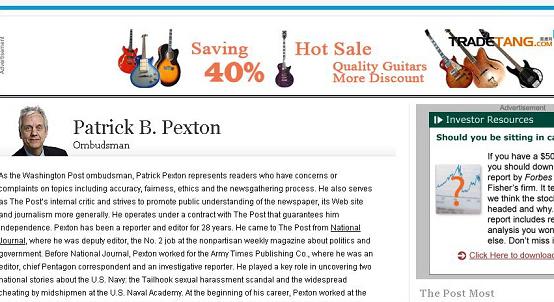
Here’s the page of the Post’s ombudsman, Patrick B. Pexton, with — ha-ha — the ad for counterfeit guitars right over his head. On the same page there’s no way to reach Patrick B. Pexton. One supposes you’re supposed to telepathically beam your messages to the newspaper.
The WaPo continues to refuse to do the right thing. Today, the newspaper still runs the ad selling made-in-China frauds and counterfeit electric guitars.
Here’s the small screen snapshot, larger one with date clearly visible in the link.
I can fill in alot of info about TT and Chinese guitars. I was curious as you and contacted TT and studied them from afar for many months to learn exactly what they were doing. Talked with their “sales staff??? , and I assure you, as you already know, they offer more than they deliver.
I study guitars, I have learned to build classical guitars, I know what’s right, and what to look for.
TT is just an outlet for many different Chinese dealers. When you sign in to their website, you can choose from many different American fakes.
What is really amazing to me, is that they advertise on sites that should know better.
Gibson customer service was informed. This reply came back on Sunday:
Thanks for the email, and for the information. We appreciate your interest in helping us maintain the Gibson name. This information will be forwarded to our Legal Department. Thank you!
It’s apparent that big American companies simply won’t do the right thing, even if it’s small.
Personally experiences, over the weekend, with the Washington Post and DD’s discovery of it running a banner ad for Chinese-made electric guitars specifically aimed at fraudulently trafficking on American products.
And it was still running the banner yesterday. Maybe today. I don’t check the place every day.
Do your part to destroy any American manufacturing, even if it’s only small. Every little bit helps.
The nut of is that the banner ad run by the Post was from some operation selling knock-offs of famous Gibson guitars. Gibson, an iconic guitar manufacturer, does have factories making electric guitars in China. But those guitars, sold in the American market as a cheaper alternative to domestically made instruments from Gibson’s Nashville facilities, are -specifically- recognizable as Epiphones.
Their headstocks, trademark names and various different choices in hardware mark them as such.
The instruments advertised through the banner running at the Washington Post do not fall into this category. They are either cheap knock-offs, counterfeits, advertised in some fraudulent way, or a combination of these.
The Washington Post does not need to help in the job of undercutting US business for the sake a few Internet advertising dollars. In this, it is on the side of the bad guys.
DD knows the line about capitalists willing to sell one the rope you’ll hang them with. But really now …
Some readers may recall my continued posts about American classic rock electric guitar making being offshored to China. This was part of a decade long migration aimed at taking advantage of cheap overseas labor while trying to preserve a high end customer base for much more expensive custom-shop guitars made domestically.
Fender and Gibson, the two most iconic American guitar companies, moved manufacturing to China. Indeed, the Gibson website brags, if you dig deep enough, about how it trained Chinese laborers to make cheaper Gibson models under the brand name Epiphone. One company employee indicated that there was just about no difference between its manufacturing facilities in China and its domestic manufacturing in Nashville.
Counterfeiting has been an obvious problem for the US guitar industry. The pictures here show the result of the outsourcing devil’s bargain. An inability to control abuse, flagrantly shown through advertising on prime Internet real estate provided in the US — the Washington Post.
Idly browsing the Washington Post today, DD was reading an opinion piece on Obama being no FDR when a big ad at the top of the page caught my eye. It was for cheap guitars sold off TradeTang. And they all looked like Gibsons. The pictures in the ad were cleverly cropped, however, to avoid … discerning eyes. (Most specifically, the sales pages stay away from presenting clear and complete front photos of the headstocks. There is simply no legitimate reason for that.)
And here’s an image of a “Les Paul” for sale. Note that it is clearly marked “Made in USA” and has, although laymen might not recognize it, the iconic Gibson headstock.
Licensed Chinese made Gibson Les Pauls are branded Epiphones and do not have the same headstock as those made in Nashville.
They also don’t say “Made in USA” or have a serial numbering scheme seemingly aimed at making them look like American-made Gibsons.
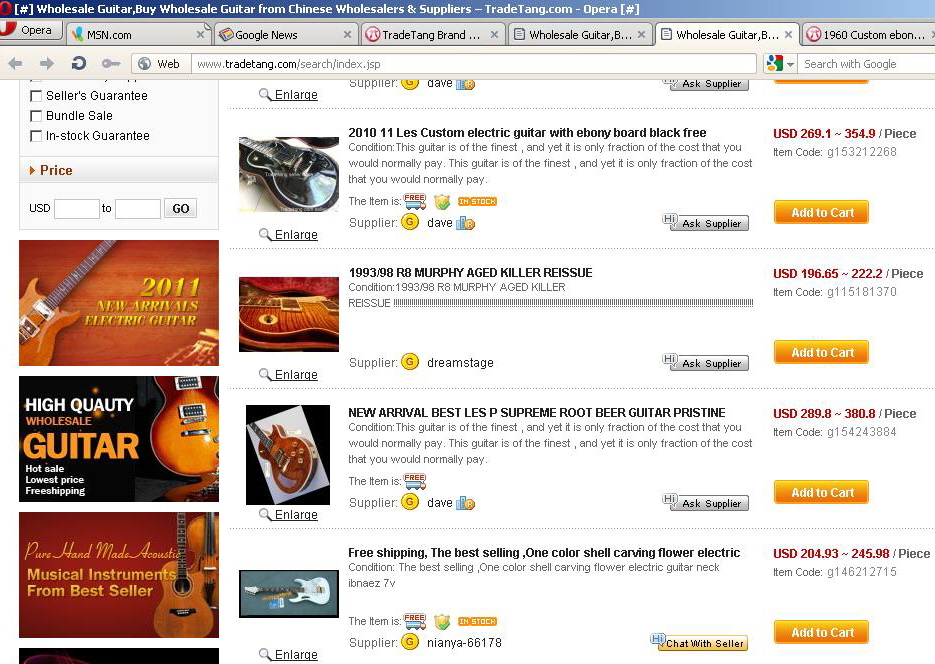
The link for the larger shot shows prices for Les Pauls that are complete frauds unless you know you’re purchasing knock-offs. You can’t buy these instruments new for $280 – $300 plus dollars in the States. Many of them sell for ten times those amounts although some rock bottom end models go for around one thousand.
Here’s another example of some kind of fraud using the Gibson brand, either in the photograph, what’s being presented, or what’s being sold:
Larger shot, again, here. Whatever it is, it looks like a mess to me. It’s a Les Paul headstock but with tuners I see more commonly on offshored Epiphones and the front view is not presented. Which is a bit of a giveaway.
Here’s the pricing for the same advertised instrument, again indicating a misuse of the Gibson brand of some kind:
Ralph Nader stating the baldly obvious (although it’s nice he said it):
Corporations say they love their country, especially when it comes to manufacturing modern weapons systems for the Pentagon.So let’s extend this love and see how they measure up patriotically.
Is it patriotic for drug companies to leave our country without any production facilities for ingredients used in penicillin and other key drugs because they have shipped production rapidly in the past decade to China and India which lack the inspection standards we have here? Leaving America defenseless and so dependent in this critical area is especially galling. Remember Big Pharma accepts billions in tax credits and valuable free research, development and clinical testing by the National Institutes of Health for many important pharmaceuticals.
Is it patriotic for CEOs to demand and use taxpayer dollars to facilitate moving abroad with their industries? The latest version of this lack of fealty is taking large federal subsidies for solar energy research and development and then moving the production facilities to China.
It’s good to keep in mind that the big filch Nader mentions re Big Pharm also applies to our arms manufacturers. They get all their R&D money from Uncle Sam for making our marvelous killing technologies, stuff the Lockheed Martins and Raytheons then peddle to various pantywaist militaries around the world.
The signs look real, the products look real and the staff all think they work for Steve Jobs – but this Apple store in China is a complete fake.
It was spotted in Kunming in the south-west of the country by U.S blogger … who was convinced at first that it was a real store.
But then she noticed that the signage said ‘Apple Store’ – and Steve Jobs’ electronics giant never writes that on its signs.
Since Apple makes all its iKit in China it only stands to reason, that like many many US companies, it has trained a legion of laborers to make its stuff very well. And it will have occurred to some of them that perhaps they don’t really need Apple and iSteve’s leash to make it.
This is a problem that has affected US guitar manufacturers. Having offshored most of their production to China, and supervised the upgrade of manufacturing there, they have seen counterfeiting operations. And it is difficult to know how widespread it is since Americans generally do not report on what they find in Chinese music stores — which could easily imitate Guitar Center.
At this point, about all I have to say is “they had it coming.”
What’s iSteve gonna do? Complain to the WTO? The US government?
It doesn’t matter, anyway. Apple’s quarterly statements show it’s the premier company in the US, one perfectly positioned to dominate the future of trivial gadget and status symbol manufacturing for the plutocracy.
Now if only penguins had hands. American multi-nationals could move production to Antarctica, maybe.
Which also gets me wondering, how good are mountain gorillas at shop labor?
GE’s Greenville plant, where all 22 gas power-plant turbines will be exported this year, is hiring 125 people in 2011. — SF Chronicle
Yesterday, arch rent-seeker Jeffrey Immelt, General Electric CEO and Obama’s job czar, headlined the “Campaign for Free Enterprise??? job summit. In typical fashion, Immelt had little concern for free enterprise or job creation. Since the beginning of the Obama administration, GE has realized that lobbying for big government, subsidies, and tax credits is far more profitable than competing and profiting from merit.
GE has chosen to specialize in rent-seeking behavior and has directly receiving millions of dollars from Obama’s stimulus and much more cash indirectly. GE notoriously paid zero taxes in 2010. — OpenMarket
The charge from labor-friendly liberals and free-market conservatives has been the same: the appointment [of Jeff Immelt as jobs adviser] represents pure crony capitalism. The leaders of the largest U.S. multinationals are hardly the best suited to give advice on domestic job creation, the line goes, when they spent the last decade eliminating 2.9 million jobs at home and adding 2.4 million overseas. And in particular, the chief of GE, No. 6 on the Fortune 500, shouldn’t be charged with heading that effort, considering the company’s sprawling lobbying agenda in Washington. — Fortune
The chairman of President Barack Obama’s jobs and competitiveness council said Wednesday there is no magic potion to jobs creation. — Newsday
Then the Obama administration sends Jeffrey Immelt, CEO of General Electric, which paid no federal income taxes last year, to lecture U.S. business firms to “stop complaining about government.” –letter to the Allentown Morning Call newspaper
Cisco Systems plans to cut 15 percent of its staff and sell a set-top box factory as part of a plan to cut annual expenses by $1 billion as the network equipment maker tries to revive its fortunes.
The company said on Monday that it will cut 11,500 jobs, compared with the several thousand that analysts had predicted. The cuts come after Cisco’s chief executive John Chambers said in April that the company had “lost its way.”
Cisco will notify U.S. and Canada-based employees who are losing their jobs in the first week of August. The layoffs in other countries will take place later in compliance with local laws and regulations, Cisco said.
Cisco outsources about 90 percent of its manufacturing to contract manufacturers … [to the same factories in Asia that produce all of Apple’s iKit.].
Portraits of sociopathic minds in action. Two guys, one who is part of a “jobs council” but whose most notable achievements are off-shoring and tax evasion, the other one who maintains on the premier news program in the US that tax relief will create jobs while making plans to reduce his labor force by fifteen percent.
Yesterday I foolishly decided to take an old Gibson SG to Pasadena’s Guitar Center.
The idea, since I don’t use it very much anymore and it’s an old American-made piece when Gibson was still in Michigan, was to trade it in for something new.
Big mistake. GC Pasadena spent an hour and half photographing it digitally, then sending them off to the Hollywood store for consultation. All for the sake of an offer that wasn’t worth making.
It’s a Gibson SG, stamped as a Les Paul Custom on its truss rod cover plate, with all original hardware. And it plays wonderfully.
It is obviously from 1979 — that is, it looks great but it also appears well played. And as fairly common for thin neck SGs of this age it has a minor, almost imperceptible, neck repair near the tuning peg head.
Whatever that damage was it had happened to the guitar before I bought it in 1986. And the instrument performed perfectly at all dive bars it was asked to in the Lehigh Valley in subsequent years.
What I hadn’t taken into account, and what I’d forgotten I’d written about on this blog, was that instrument valuation, like everything else in the US, has turned into a racket. One in which only certain pieces, never or almost never played — hidden away in closets, are coveted appreciating assets for various among the plutocracy and those serving it.
You know, the annoying guys — lawyers, semi-high end people in Internet businesses, early retirees, assorted shoeshine boys to the heads of investment firms, the types you sometimes meet at a show in a high-rent place where they serve expensive drinks.
“I used to play guitar a lot and I have …” they always say, wanting to get into a penis-measuring contest before you turn to the amp and make like you’re checking connections until they go away.
Tied with this was the always-on observation that the American made guitars are now all for the plutocracy. You go into the store and the US pieces worth having are all hung up on the wall out of reach without help, or behind the counter, or in the special glass-walled room where you can be kept under observation.
The off-shored stuff, however, is for you.
So, too, you see the big Fender amps — like some Frontman model kind of dressed up to look sort of like a Fender Twin — out for the peons.
In the back among the used gear is a ’74 Fender Twin, really beat-up looking from the time when CBS owned the company, priced among the pearls, almost three times the amount of the new foreign-made stuff.
There are, unfortunately, no pictures of the old Fender manufacturing facility after it was expanded by CBS in California during the early Seventies. And that’s a shame because it actually employed a lot of people. As opposed to employing a lot of people in China and Mexico.
An aerial view of it in “The Soul of Tone,” a coffee table book on Fender, shows old pre-CBS Fender filling nine medium-sized warehouse-type buildings. CBS then immediately doubled the company’s manufacturing floor space.
Imagine that!
With a little stroll across the floor we come to the rack of Fender Telecasters. Hidden among them is one US-made model distinguished immediately by its price above 1k.
Everything else is distributed between Chinese and Mexican origin, the latter being the new middle-market price point.
My friend asks me where they’re all made. I tell him to look at the headstock or the serial number.
Earlier this year Cisco put its CEO, John Chambers, on 60 Minutes to attest how US corporate tax rates were preventing it from bringing profits and jobs home.
“Trending now: the dark side,” announced the ad. Which could just as well be applied to Cisco itself, now one of the standard corporate cheats/predators on the national landscape.
Cisco’s international earnings have been taxed at about 5 percent since 2008, records show.
Cisco Systems Inc. (CSCO), the largest networking-equipment company, may cut as many as 10,000 jobs, or about 14 percent of its workforce, to revive profit growth, according to two people familiar with the plans.
The cuts include as many as 7,000 jobs that would be eliminated by the end of August, said the people, who asked not to be identified because the plans aren’t final. Cisco is also providing early-retirement packages to about 3,000 workers who accepted buyouts …
Moving along, the Financial Times ran a special on outsourcing IT to overseas data centers, again “moving it to the cloud,” so to speak.
The remaining countries in the top ten are Mexico, Thailand, Vietnam, the Philippines and Chile.
There’s some discussion on using outsourced data centers as replacement for various corporate enterprise security functions.
DD found this hysterical. The last three years saw the US press and government alive with stories about Chinese infiltration of American networks — business, military and otherwise.
As karmic justice, the US government ought to mandate search for lowest bids providers — in this time of austerity, you know.
If this were to happen, Chinese service centers could replace Booz Allen, Lockheed Martin and Northrop Grumman contracting services in this area. At substantial savings I would imagine.
At a recent outsourcing industry meet-and-greet in China, [an American outsourcer] was surprised to discover that other US attendees were public-sector workers, representing a number of cities and states. They wanted to understand how subsidies were being packaged in China, so that they could do something similar back home.
If you read the subtest of these stories, it’s clear China, India and other countries subsidize their service center IT shops for the express purpose of getting American (and other western) contracts.
It’s kind of an anti-labor national protection racket and it has nothing to do with the free market and everything to do with capitalizing on the US ecology of multi-national corporate vultures.
Now, the US government could easily do the same kinds of things and protect US labor. But the only place this happens is in the defense industry. The domestic non-military side is left to be picked clean. As a look at the Cisco story makes clear.
It’s not only IT that is outsourced. Anything that doesn’t require being tied to a particular geographic location in the continental US is fair game.
People in the sciences of the pharmaceutical and molecular biology industries already know this as the last few years have seen more and more their jobs just outsourced to R&D labs in Asia.
Like most other big pharmaceutical companies, AstraZeneca has also outsourced much of its IT.
“We have also signed a contract to outsource some of or human resources work, and we’ve already done some selective outsourcing of some of our R&D work,??? explains Mr Glynn.
Mr Dalal points out that the pharmaceutical industry is full of examples of companies that outsource their R&D activity for drug development.
In small part, this explains one of the reason why the war on infectious microbial disease is being lost to increasing antibiotic resistance and the lack of new compounds.
Do you really believe US pharmaceuticals are interested in the hard work and often initially unprofitable nature of this kind of work if the corporate heads are mostly focused on how fast they can send their labs to India and China?
Rhetorical, obviously.
For the future the obvious growth positions are then in jobs, services actually, which cannot be moved.
Janitors, sanitation workers, bedpan technicians, staffers of mini-marts at local gas stations, prison guards, car wash employees, waiters, bartenders, re-training camp community college instructors for 18-month certifications and bondings for these types of jobs.
Bl-a-a-a-t! I bought some new IT! It was made in China!
Unemployment soared during the financial crisis and its aftermath. So it seems bizarre to argue that the real problem lies with the workers — that the millions of Americans who were working four years ago but aren’t working now somehow lack the skills the economy needs.
Yet that’s what you hear from many pundits these days: high unemployment is “structural,??? they say, and requires long-term solutions (which means, in practice, doing nothing).
Well, if there really was a mismatch between the workers we have and the workers we need, workers who do have the right skills, and are therefore able to find jobs, should be getting big wage increases. They aren’t. In fact, average wages actually fell last month.
The only thing missing is the obsession with re-training camp community college. Because, like in China — dude, they got all those workers going to community college to learn how to make the stuff we used to make and still need but don’t make but buy at Wal-Mart and Target and everywhere else you can shop.
My US-branded made-in-China socks, bought new three weeks ago, sprouted holes on the third wash. And those jobs went over there because of the fault of American workers, yep.