In 2011, free trade to most Americans — anyone in my demographic — means you’re going to be taking it in the slats.
The chemistry, physics and energy of making a Les Paul guitar in China, as opposed to Nashville, has not changed. The skills and talents of Chinese or other foreign workers are not better than average Americans for the 21st century, as some free-traders argue. The difference with regards to the Les Paul is that Chinese labor is much cheaper, the cost of living is much less there, and the Chinese government — in effect — subsidizes lots of overhead and energy costs because there is no regulation.
Two economic adviser functionaries, formerly for the GWB and Clinton administrations, proffer an opinion piece in today’s New York Times.
It’s purpose is to aid in breaking an impasse on pending free trade agreements with Colombia, Panama and South Korea.
Matthew J. Slaughter and Robert Z. Lawrence write that free trade must be increased along with a social safety net for American workers fucked over by it. It’s easy to see the first happening. But not the latter because it needs to be packaged as unemployment insurance expansion. And there’s no societal generosity at all in the US now.
Three principles guide our proposal. First, trade is indeed worth it for America … [Wow. Followed by dollar amount originally American but now multinational outsourced companies have apparently brought in.]
Second, trade is not worth it for every individual American. Trade creates unemployment for some and wage losses for others; its gains do not directly accrue to every worker and community. Indeed, there has been a steep drop in public support for trade; a recent Wall Street Journal/NBC poll found that only 17 percent of respondents said free-trade deals have helped America.
Third, Trade Adjustment Assistance, created in 1962 to supplement unemployment insurance, cannot adequately help displaced workers.
Our proposal to resolve the trade impasse: more trade and more aid.
Voter support for engagement with the world economy is strongly linked to labor-market performance. If American workers continue to fear change, their support for free trade will not return.
More trade and more aid. A pretty wan exhortation.
I can’t see any return to support for free trade in my lifetime. Note — having to buy the products brought in by free trade because there are no other options or choices is not the same as enthusiasm for it. (All readers who use iKit and mobile gadgets are excused from reading this.)
While it holds no appeal for teenagers and lovers of pop music, China Toilet Blooz continues to get a steady trickle of new listeners every month.
Foreign made fractured toilet seat as metaphor for US economy.
Google’s Les Paul tribute doodle looks good and sounds little.
A nice idea for a global birthday anniversary that doesn’t capture any of a real guitar’s magic, much less anything made by Les Paul.
I tried it late last night and the problem, as with lots of virtual instruments played with the pointer, is the virtually total lack of expression. You can’t do anything with it that’s remotely like a real guitar. The tonal richness isn’t present. And, of course, there’s no physical contact between the player and the instrument which is what defines the nuance, color and unlimited style of the electric guitar.
That’s all obvious. But still you can’t make it boogie even a little.
You can hear a really lousy stab at — uck — Stairway to Heaven on this thing, here.
You can hear a real Les Paul here in the vid of Cursing the Oilmen (the tone is early Cream although Clapton was more closely associated with the Gibson SG at that point) and here in Hey Cutie.
The other point worth making over Google’s delivery of Les Paul tribute was that electric guitars and, subsequently, rock and roll were an export to the world. Things that made life better; something that made others think highly of us.
It’s a complete reversal, the triumph of evil over good in the national identity.
For more on the phenomenon of antique guitar acquisition as the hobby of poxy wealth speculators, see here.
Teaser lines:
Weekly, features writers find the most annoying examples of Grotesquus Americanus. Then [the newspaper] proceeds to portray whatever herd of manipulators it has found as something swell. The point of it is to make you feel stupid …
Update: Rachel Maddow thinks the Google guitar app is really cool. Empirical proof it has no connection with rock ‘n’ roll or actual guitar music played by human beings.
Every Memorial Day features sales. Locally, this weekend Guitar Center ran television ads for theirs, all the bargains made in China.
Get your rock on, they beckoned. Courtesy of all the offshored rock and roll gear manufacturing in the last decade.
Ultra low low prices to compensate for the beggaring of the US middle class, the abandonment of domestic non-military manufacturing except for arms and that thing called private sector debt overhang.
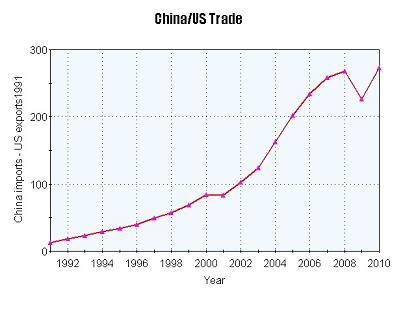
So for the sake of Guitar Center’s Memorial Day Sale, the graph that shows the increasing slope of trade imbalance, a picture of US offshoring during the decade when permanent war arrived.
And a measure of the social cost in the state of war which, on Memorial Day, is unstoppable:
Buried in the numbers in the area under the curves, all the rock and roll equipment production, stuff once invented and made here, sacrificed to China.
[The American people] accept it. Since 9/11, war has become normalcy. Peace has become an entirely theoretical construct. A report of G.I.s getting shot at, maimed, or killed is no longer something the average American gets exercised about.
He continues on a theme I’ve had for awhile. It doesn’t matter what anyone says because nothing can be done about the state of affairs.
Not to put to fine a point on it, the national security apparatus successfully removed the democracy organ.
The story so far: In the 1990s, U.S. manufacturing employment was more or less steady. After 2000, however, it entered a steep decline. The 2001 recession hit industry hard, while the bubble-fueled expansion of the decade’s middle years — an expansion marked by a huge rise in the trade deficit — left manufacturing behind. By December 2007, there were 3.5 million fewer U.S. manufacturing workers than there had been in 2000; millions more jobs disappeared in the slump that followed.
Crucially, the manufacturing trade deficit seems to be coming down. At this point, it’s only about half as large as a share of G.D.P. as it was at the peak of the housing bubble, and further improvements are in the pipeline. The Boston Consulting Group, which is now predicting a U.S. “manufacturing renaissance,??? points to major U.S. firms like Caterpillar that once shifted production abroad but are now moving it back. At the same time, companies from other countries, especially European firms, are moving production to America.
I don’t want to suggest that everything is wonderful about U.S. manufacturing. So far, the job gains are modest, and many new manufacturing jobs don’t offer good pay or benefits.
Krugman credits this to current policy and the cheaper dollar. Which will surely drive the fiat money kooks wild.
However, it’s still not enough to offset this, not by orders of magnitude:
On the ground, almost everything the average American buys — other than automobiles — is made in China.
There is no other option.
As a side note, earlier in the week, along with millions, I was a recipient of the Obama machine’s clever idea to put his birth certificate on a T-shirt, along wiith “Made in USA” under his picture.
I haven’t been able to buy American-made T-shirts in years. For example, all the Pasadena-themed garments in, uh, Pasadena, are made in China.
And while I’m not going to buy one of these things to check, unless the operation got off a special dispensation to an American made factory, I’m betting these aren’t, either.
But verification or proof of American origin is left to the future research of others.
Reader C sends in an item, another Associated Press piece concerning the popular meme of Chinese military modernization. AND WHAT WE MUST/WILL DO TO COUNTER IT.
The US already spends more than ten times what the Chinese do in this area. And China’s military, partly as a result, is anywhere from ten to twenty years behind us in capability.
While we have forfeited all domestic non-military manufacturing to that country — with Wall Street and big American multi-national business leading the push, such is not the case with protected arms manufacturing.
The U.S. is developing aircraft carrier-based drones that could provide a crucial edge as it tries to counter China’s military rise.
American officials have been tightlipped about where the unmanned armed planes might be used, but a top Navy officer has told The Associated Press that some would likely be deployed in Asia …
“Chinese military modernization is the major long-term threat that the U.S. must prepare for in the Asia-Pacific region, and robotic vehicles — aerial and subsurface — are increasingly critical to countering that potential threat,” said Patrick Cronin, a senior analyst with the Washington-based Center for New American Security …
The DF 21D “carrier killer” missile is designed for launch from land with enough accuracy to hit a moving aircraft carrier at a distance of more than 900 miles (1,500 kilometers). Though still unproven — and some analysts say overrated — no other country has such a weapon…
Northrop Grumman has a six-year, $635.8 million contract to develop two of the planes, with more acquisitions expected if they work. A prototype of its X-47B took a maiden 29-minute flight in February at Edwards Air Force Base in California. Initial testing on carriers is planned for 2013.
Other makers including Boeing and Lockheed are also in the game. General Atomics Aeronautical Systems, Inc. — the maker of the Predator drones used in the Afghan war — carried out wind tunnel tests in February. Spokeswoman Kimberly Kasitz said it was too early to divulge further details.
The news agency produced one, that’s one, China expert to be the skeptic. The man mentioned he doubted China would attack a US aircraft carrier and start a war, for very obvious reasons.
It would screw-up trade and lose their biggest buyer. The trade imbalance would drop to zero and economic calamity would envelop the working class in both countries.
I’ve written about this off and on — mostly the absurdity of it.
There is no serious argument other than cosmetic nibbling around the edges on whether or not military contractors and the Pentagon need
to be reigned in. The total absence of reasonable thinking, replaced by just more sales pitches, fearmongering and arms development, has become so overwhelming that such discussions have been effectively outlawed.
It’s laughable.
Here’s part of what I wrote:
[After the war starts the] middle class sees all US stores run out of stock of sundries. Wal-Mart, Target (and every giant box store like them), BestBiuy, all hardware stores, all consumer electronic stores, Bed/Bath & Beyond, sporting goods shops — all crash and go bankrupt. Salvation Army outlets become the sole garment distribution centers for the entire country …
Unemployment becomes massive and all-encompassing; a new recession to make the Great Recession look small ensues. People watch video of our bombers methodically destroying China’s military for a month. In fact, the military is the only place where employment is stable. After two months, television watching stops too as cable is disconnected for non-payment.
In the next election, every incumbent — from top to bottom — is voted out of office.
[Of course, faced with loss of its major buyer massive unemployment spreads to China, destabilizing that country. Just while the muscle-bound US military destroys every scrap of that nation’s hardware. A new world Dark Age is ushered in.]
In e-mail, reader C commented acerbically:
It seems that the shiny heads at the Pentagon have figured out a way to keep military spending going–by re-inventing the Cold War …
An unmanned fleet of stealth bombers? I shudder to think of the ramifications. Besides, China probably has the technology already, but not the will.
I can see a future with these weapons-by-proxy where *all* casualties of war are civilian.
This item was to laugh yesterday — a Wal-mart CEO bemoaning the fact that the customers of the sundry goods megastore chain weren’t spending.
Having led the charge to Chinese-made goods and subsequent forfeiture of American jobs and wage compression, there’s a lethal irony in a US multinational company unselfconsciously expressing regret over diminished profits because its US middle class customer has been beggared.
Wal-Mart reported better-than-expected quarterly profit and revenue Tuesday, although its U.S. store sales continued to decline as higher gas, energy and food prices ate away at its customers’ paychecks.
“Our core U.S. customers are stretched. They are concerned about rising gas, food prices and employment issues,” Wal-Mart CEO Mike Duke said …
Last month, Duke told an industry gathering that Wal-Mart’s core shoppers are running out of money much faster than a year ago due to rising gasoline prices, and that the retailer is worried.
Wal-Mart shoppers, many of whom live paycheck to paycheck, typically shop in bulk at the beginning of the month when their paychecks come in.
Lately, they’re “running out of money” at a faster clip, he said.
As their budgets get more stretched, Wal-Mart shoppers are also changing their buying habits, picking up more groceries and household goods — such as detergent and paper towels — while cutting back on non-essential items such as clothing and home furnishings.
Which are all made in China although they may be US company branded.
Like its competitor Target, Wal-mart has greatly expanded its role as a supermarket, both companies realizing people must eat. And that the government foodstamp subsidy is a revenue stream to be mined more thoroughly.
If you had a button to push that would silently annihilate these people you’d use it.
A lot of people aren’t aware of the role Wall Street investment banks had in moving American jobs overseas. Most of the major bailout recipients, in fact, helped finance the wholesale export of the American manufacturing sector by lending money to the Chinese to build the sophisticated industrial infrastructure it needed to take full advantage of its inexhaustible supply of cheap pseudo-slave labor. This has been one of Bernie Sanders’s pet peeves for years, that we not only provide financial assistance to companies who lay off American workers, we even spend taxpayer money to help finance the disappearance of American jobs.
The Rolling Stone jourmalist quotes a Forbes article in which the writer asks, “What’s the next Goldman lemon trade?”
China is the answer. Goldman pumped up dodgy Chinese manufacturing assets and now it may be getting ready to dump them.
Maybe. Won’t help make things any better here. It would, however, maim big American companies that outsourced industrialization to those assets.
A reader sends in a piece collecting recent espionage convictions. All of them collaborations between Chinese handlers and American sell-outs.
It is not particularly surprising given our national character and the sheer size of military development and manufacturing. It stands to reason that a certain percentage can always be turned with money as a lure.
An excerpt:
Today’s “agents” are professors and engineers, businessmen exporting legitimate products while also shipping restricted technology and munitions, criminal capitalists who see only dollar signs. While some may be acting at the direction of a government handler, others supply information to firms for either private enterprise or state-sponsored research — or both.
I’ve never thought much of Chinese efforts to steal everything. From movies and music to military gear, whatever it is, they’re copyists — sometimes good, often very bad.
And it’s not like we haven’t fostered it. It’s has been to corporate America’s advantage to sell off the nation’s treasure to China for the sake of cheap labor. You get back what you’ve asked for, apparently.
It is much like the occasional story in which Fender or Gibson’s businesses in the US complain about Chinese counterfeits being sold on eBay, all probably made in the factories both companies commissioned to outsource labor.
In other words, karmically, they have it coming.
In terms of military hardware or dual use things, just because that labor is protected in the US for national security reasons really makes no difference in the great fire sale.
As a last note, these types of stories — always mentioning how China is modernizing its military — do show that country’s far from infallible.
Refurbishing things that are already obsolete should be encouraged. It’s like finding people who believe polishing turds is a great idea. Since we have some of them here, why shouldn’t the Chinese have some of the fun, too?
“Increasing exports, as the administration aims to do, is a promising strategy.”
Can someone get these people an intro econ textbook? Increasing exports is not what creates jobs, it is increasing net exports (exports minus imports) that creates jobs.
If GM shuts an assembly plant in Ohio and instead ships its car parts to Mexico to be assembled there, are these parts exports creating jobs? In Washington Post land the answer is apparently “yes.” Unfortunately in the real world the answer is no. Since we have been increasing our imports more rapidly than we have increased our exports, the United States has been running a big trade deficit, leading to a large loss of jobs. (The trade deficit also implies negative national savings — and therefore either large budget deficits or negative private savings or some combination, but we’ll leave this issue for another day.)
Finally, the Post conclues by urging patience:
“The costs, human and economic, of high unemployment are heartbreaking. But it will take a measure of patience as well as a sense of urgency to prevent it from becoming a permanent feature of the U.S. economic landscape.”
Yes, all the buffoons running economic policy who could not see the largest asset bubble in the history of the world are still there running economic policy. All the Wall Street clowns who made a fortune pushing junk mortgages and packaging them into complex financial instruments are still rich. That’s just the way it is. The rest of us just need to be patient.
It’s worth adding that “increasing exports” the administration’s way usually just means either mostly arms deals or insignificant bumps in opening foreign markets to SUVs, and plutocracy artisanal economy products from small companies that very rarely expand their workforces in southern California.
Here today, a story from the Wall Street Journal on US manufacturing work.
Baby-boomer retirement, a minor fall in the dollar and slight upticks in demand after the bottom year of the Great Recession have caused slight growth in manufacturing hiring. What the article also does not say is that many of the jobs are also dependent on arms manufacturing spending.
These jobs pay well, as readers of this blog know, but they’re still not anywhere near significant in terms of the entire US employment picture.
In fact, they’re a constant reminder of the two-tiered rigged nature of the US economic system, one in which manufacturing jobs for non-military production were all thrown away while weapons-making was preserved.
Manufacturers say the U.S. education system doesn’t produce enough students strong in math, science and engineering. About 5% of bachelor’s degrees awarded in the U.S. are in engineering, compared with an average of about 20% in Asia, according to the U.S. National Science Foundation. In the most recent comparison of math and science test scores of 15-year-old students by the Organization for Economic Cooperation and Development, American students trailed far behind those from China, Japan, South Korea, Canada and Germany.
While community colleges and technical schools struggle to keep up with demand for skilled workers, some prisons are trying to help. At California’s San Quentin prison, the machine shop offers training to prepare prisoners to pass exams demonstrating skills in such areas as operating computer-controlled lathes and mills. Some inmates get classes in calculus and trigonometry to help them work with machinery.
Swift-Cor Aerospace, a maker of airplane parts, has hired several former prisoners for its plants near Los Angeles and Wichita, Kan., and is happy with their work, says Cecilia Mauricio, human-resources manager.
As a graduate of Lehigh University when its sports teams were still called “The Engineers,” as opposed to the more modern, “Mountain Hawks,” I always look askance at claims that the US doesn’t produce enough people adept in science, math and engineering.
My experience was the opposite. During my years in advanced education this country produced more than enough. And they didn’t go away.
It was US business that just wasn’t particularly interested in hiring them.
Everyone wanted experience. And very few wanted young people who didn’t already have an in through acquaintance hiring, much less spending time — like a mere couple months — training people for the jobs.
What makes this story even more odious is the insinuation that prison is a good place to learn such skills, or that training programs there somehow produce workers who might be better than those you might deign to try out and train from high school.
What you’re probably not being told is there is some manner of systemic bribe in action here — a kickback from state or federal government given to firms that hire cons.
The other pernicious thing floated in this story, and others like it, is that it’s hard to train people to do the kind of work described.
It’s not.
It just takes will, some patience and the desire to remove the usual human resource impediments to hiring that dismiss everyone who doesn’t look like a pure tabula rasa lily-white gift to American business.
And it’s worth saying again: Prison-training for employment in some minor area like specialty aerospace manufacturing is more of an indicator of the odious quality of American business and hiring practices rather than of some place where precious skills are nurtured and maintained.
The common element is prison labor as a potential cheap exploitable resource for arms-manufacturing firms. You see, they don’t have to train the people. It’s done on the taxpayer’s dime while enjoying the hospitality of the authorities (or her majesty, as the usage was coined in England).
When DD has seen stories in the alleged loss of math, science and engineering skill in this country, they have almost never been linked to concerns over loss of general innovation or a true middle class national edge.