Reader Chuck points to an article on the Apple needing three things China offers that the US does not — much cheaper labor, escape from environmental regulations and … rare earths as necessary materials in iPad manufacturing.
Even the latter is no particular surprise. Months ago DD blog went into a bit of detail over the abandonment of rare earth mining in the US.
Rare earth elements aren’t particularly rare. And they are strategic minerals. However, mining is labor intensive and messy, and it doesn’t fit short term American corporate business interests.
Not enough profit could be made instantly. So it was abandoned.
But there’s another important reason why Apple and other manufacturers have their heels stuck in Chinese mud. iPad manufacturing, like the manufacturing of other electronics, requires a significant amount of rare earth elements, the 17 difficult-to-mine elements used in all kinds of green technology …
Why is all this rare earth consumption a problem? China currently controls 95-97% of the world’s supply of rare earths and has repeatedly cut export quotas, sending already-high prices skyrocketing. Fearing dependence on China for rare earths, two companies—Molycorp in California and Lynas Corp in Australia—plan to begin mining rare earths this year …
None of this is new. Although iKit was mentioned specifically, the present and future uses of rare earth elements were discussed in the original series of posts. And the government report on rare earths as strategic materials specifically addressed the fact that abandonment of mining has contributed to the creation of a significant national handicap.
Once the US actually led the world in rare earth mining. But that was like, so boring.
This graph, from a National Science Foundation report, shows how the US totally abandoned rare earth mining just as its value and digging skyrocketed everywhere else it was done.
It was, what they call in the economic parlance, an abandonment of a value chain.
For what?
U S A! U S A! We’re number 15. We’re number 15. Or maybe lower.
“If we stopped it all right now we’d get rich a whole lot quicker.”
To preserve the gigantic Pentagon budget, House Republicans want to cut, cut, cut — anything that has to do with keeping the working poor afloat. This as part of the fight for the most important cause — easing the rich man’s burden.
From food stamps to child tax credits and Social Service block grants, House Republicans began rolling out a new wave of domestic budget cuts Monday but less for debt reduction — and more to sustain future Pentagon spending without relying on new taxes …
Nothing better illustrates this perhaps than the renewed focus on food stamps — now titled SNAP (Supplemental Nutrition Assistance Program). And the estimated $33.2 billion in 10-year savings there could have an immediate impact on the farm bill debate and come November, the 2012 elections.
An average family of four would face an 11 percent cut in monthly benefits after Sept. 1 and, even more important, tighter enforcement of rules would require that households exhaust most of their liquid assets before qualifying for help. This hits hardest among the long-term unemployed, who would be forced off the rolls until they have spent down their savings to less than $2,000 in many cases.
Indeed, food stamp enrollment and costs have exploded since the financial collapse four years ago, making SNAP a target for the right — but also a far bigger political issue in swing states like Florida, Nevada and Ohio.
National enrollment reached 46.4 million people in January 2012, a nearly two-thirds increase from the average monthly participation in fiscal 2008. The annual costs — now running in excess of $80 billion — have more than doubled in the same period. And even the most ardent food stamp proponents will sometimes say SNAP is a program “asked to do too much.???
The White House deliberately increased monthly benefits in 2009 by about $20 per person as a way to pump stimulus dollars into the economy. And in this post welfare-reform crisis, strapped governors have sought to maximize food stamp dollars as a cheap way to help families without tapping state funds.
No surprise. Republicans have always hated food stamps and fighting hunger.
A week ago or so ago, the New York Times ran a front page story on how food stamp usage had surged in the response to the poor being tossed out of social welfare programs during the economic collapse.
Sadly, yes, poor people must eat. It’s a damn nuisance. We need to pay for more Predator drones and things.
The US national security machine and its army of private sector warning robots disguised as human beings whirs and buzzes, scanning the world for menaces as the country rots from the inside out. Triumphant that it’s greased some fleabags in Yemen or added another one hundred unmanned flying or crawling machines to its mighty arsenal, it’s missed all the serious indicators of danger, those nasty internal signs, like the 44-45 million people on food stamps …
Food stamp usage in the US is a symbol of national economic failure so systemic it takes your breath away. It is rock solid proof the US economy does not provide jobs which earn a fair living for a polyglot cohort that dwarfs entire western nations.
And the great and powerful Oz’s of our national defense structure are really on the stick, aren’t they? While they were getting the lion’s share of national swag during the last decade, a Biblical mass of their countrymen were applying for food assistance.
If you add up the populations of the 50 states, starting with the least, the number of people on food stamps in the US is a number that roughly includes the summed populations of:
Wyoming, Vermont, Alaska, North Dakota, South Dakota, Delaware, Montana, Rhode Island, Hawaii, New Hampshire, Maine, Idaho, Nebraska, West Virginia, New Mexico, Nevada, Utah, Arkansas, Kansas, Mississippi, Iowa, Connecticut, Oregon, Oklahoma, South Carolina and Kentucky.
This shows a country where the economy and business have so depressed wages the US government must take up the slack so hunger doesn’t stalk the land.
The proposed House Republican budget cuts, which probably have no hope of passing (although one cannot always be certain) seek to preserve defense spending.
But that means mostly money for arms manufacturing.
Lately a lot of complaints have been made about the food stamp program. Let’s take a look a one group that gets food stamps — 14,000 military families were on food stamps in 2000.
The Pentagon does not keep track of any military families that are on food stamps. President Bush in 2001 decided to authorize a $500 subsistence pay increase that was taxable in order to help military families get off food stamps. It did not work. Military families increased on food stamps because food stamps are non-taxable.
From 2008 to 2009 military families were using food stamps at twice the rate as civilians, 25 percent to 13 percent. About $31 million of food stamps were used in nationwide commissaries.
From July 2009 to March 2011 in Oklahoma, where there are four military bases — Fort Sill, Tinker AFB, Vance AFB, Altus AFB — $1.8 million in food stamps was spent.
There’s a deep national immorality entrenched here. And you’re not a decent human being if you can’t see it. What does that make those who would slash money for food so the Pentagon gets to keep everything it’s grown comfortable with in the last decade?
The first, an everyman’s adventure. The second about rent-seeking and corporate tax cheats/parasites. A year after Occupy Wall Street and growing knowledge of great inequality and national erosion due to 1 percent tax evasion, all still true.
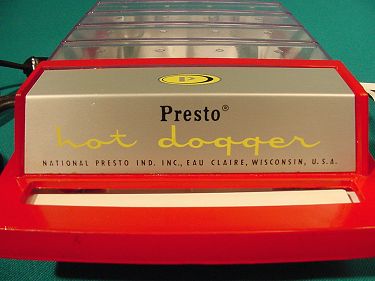
The last post on ‘Old pink meat product‘ produced a comments section identifying the electrocuting hot dog cooker as the Presto Hot Dogger. YouTube had a few home videos devoted to the Presto as retro cooking equipment. Unbreakable and manufactured, originally, as early as the Fifties in Eau Claire, WI, here’s one amusing video.
With a touch of extra amusement provided by the Carolina Chocolate Drops singing “Short Life of Trouble.”
I used the Hot Dogger in the late Eighties and early Nineties. It was a thing that, fundamentally, always worked. Unlike the current service-centered economy, as you know if you have standard Internet connectivity through AT&T, or have recently dumped cable because having no tv other than DVD replay is actually better.
Presto made home appliances. And you know what happened. It was all moved to China.
Here’s a piece from the BBC on US manufacturing, from 2002:
Maryjo Cohen is shutting two factories.
Cheap, high quality goods from China have eaten away profit margins at National Presto industries, a Wisconsin-based firm which makes pressure cookers and electric frying pans.
“That’s going on all over the US, our entire industry has moved to China,” says Ms Cohen, National Presto’s president.
She is reluctant to say how many jobs will go at National Presto’s plants in New Mexico and Mississippi but it will be a “substantial number for a company our size” – at least half the workforce.
National Presto has an agent in Hong Kong who subcontracts work to plants in China’s neighbouring Guangdong province.
How did National Presto diversify and expand after outsourcing its small cooking appliance manufacturing? You read this blog, you already have a hunch.
Once again, a perfect example of national decline.
National Presto went into arms manufacturing, the only protected business and preserved-at-all-costs labor in the United States.
The company makes over 600 million a year in ammo and ordnance production through a subsidiary.
National Presto Industries Inc. said Monday its ammunition products unit has received an $81 million defense contract option from the U.S. Army.
The Eau Claire-based company said AMTEC Corp., a wholly owned subsidiary, received the option award under AMTEC’s five-year contract to produce 40 mm systems for the Army. It is the first award AMTEC has received during the government’s 2012 fiscal year, which ends in September, and additional awards are anticipated, the company said.
The option award brings the cumulative amount awarded under an ongoing 40 mm contract to $364.7 million, the company said.
A business profile at Seeking Alpha comments, “National Presto Industries (NPK) is an oddly diversified producer of military arms, adult diapers, and small cooking appliances with a market capitalization of well under $1 billion.”
Up until a few years ago the received wisdom, also delivered by economists, was that it was fine to deindustrialize and ship most domestic non-military manufacturing to China and other periperal nations with cheap labor markets.
You didn’t have to make things in America anymore. You could be good at other stuff — like financial products and software programming.
Add arms manufacturing.
Life ain’t fair. But even the bromide, the preservation of arms manufacturing and the consequent decade of continuous war has been profoundly unfair to the 99 percent in this country.
If arms manufacturing had been exposed to the same pressure as all other forms of domestic manufacturing, we wouldn’t have war.
A black comedy could be written around a script in which a national leader decides to enact policies that would mandate absolute lowest bid contracts on arms manufacturing to a global marketplace. Yes, I know it could never happen.
But a story revolving around the fear, loathing and comeuppance in the military defense industry complex upon dislocation into the Chinese manufacturing sector is enjoyable to consider. I’d buy that novel. I’d anticipate it being optioned to Hollywood. I’d be first in line for the the movie adaptation, too.
I’d love the parts where the dispirited newly fired workers of Northrop Grumman and Lockheed Martin were taught how to apply for food stamps at severance meetings. And, how, with a lot of extra free time on their hands they fruitlessly strived to make a go of things by fashioning their own personal brands, uploading homemade white rap and comedy videos to YouTube. Or making small business website pages advertising new artisan coffee or dog walking businesses. Logging on to Zaarly everyday to find new opportunities as personal assistants or gofers for the more fortunate, locally.
Going back to school to learn how to be a chef at the Cordon Bleu school; taking two or three janitorial positions, any job that couldn’t be sent to hired hands overseas. Wait staff, not so favorable an outlook, because of something else, made by another in the army of pitiless trivial douchebags from the creative economic destruction industry, coincidentally called the Presto.
There would be growth in the cyberdefense subsidiary businesses of the big arms companies because, paradoxically, while all the manufacturing had been shipped to China, Chinese state-supported hackers were still penetrating US networks. However, growth would slow as even the Chinese began to realize there was little left to steal in the way of so-called intellectual property. And getting into the power grid just wasn’t important when you had that country’s
production completely by the balls.
Yes, there should be equalization and fair dinkum payback! And no, it won’t happen but that doesn’t mean you can’t savor the idea. China is getting into the aircraft carrier business, I hear. And certainly it has a military space program.
Think of all the money that could be saved on ammo and bombs.
If the Chinese can make electric guitars for Fender and Gibson, and all the digital underpinnings that go into the modern consumer electronics music industry, surely it can produce Joint Direct Attack Munitions and Predator drones through licensing agreements.
Shock! Horror!
It’s nice to dream about it all being gone. Like the Presto Hot Dogger.
Everyday, someone somewhere spreads rubbish in an effort to get you to think the reality in the robot novels and short stories of Isaac Asimov are just years away.
Often they come from the military. Along with the military robot research stories come emphases that projects are all for good Samaritan work — like wanting fire-fighters, this rather odd at a time when state governments have fired workers that do these essential jobs. Due to economic collapse.
From MSNBC:
Uncle Sam wants you to make a military robot capable of walking on two legs, handling power tools and even driving vehicles. Luckily, the U.S. military’s new robotics challenge aims to save lives rather than hunt down human warriors …
[Yeah, luckily.]
The $2 million challenge by the U.S. Defense Advanced Research Projects Agency appeared in an official online solicitation Tuesday. DARPA wants a humanoid robot to replace humans doing dangerous work in the aftermath of terrorist attacks, industrial accidents or natural disasters … the U.S. Navy already has plans to build its own robotic firefighter capable of doing humanoid tasks such as climbing ladders and throwing extinguisher grenades.
The Government anticipated receiving approximately $11.5M of FY04-07 funds for this program. The Government expected TO 1 costs would not exceed $500K, TO 2 costs would not exceed $3M, and TO 3 would not exceed $8M. It was anticipated that an IDIQ contract would be awarded with a maximum ceiling of $20M since it was impossible to accurately estimate all requirements during the five year period of performance. This funding profile was an estimate only and is not a promise of funding, as all funding is subject to changes/availability and Government discretion. It was desired that contract expenditures be managed and billed so as to maximize FY05 expenditure of FY04 and FY05 funding.
It weighs as much as the bell in Big Ben; it’s capable of plunging through 60 feet of reinforced concrete and has the most ridiculously sexual name imaginable for a deadly weapon – but the Massive Ordnance Penetrator is THE bomb, says the Pentagon.
Talk of beefing the bomb up with a hardened case and further advancements has been ongoing since the Air Force took delivery of it in September 2011. But Bloomberg reported that, in response to “an urgent request??? from the Pentagon, immediate approval was given to shift $81.6 million to the so-called MOP program.
The urgency is not explained – but it can be speculated that the Pentagon does not want to mop up a potential mess if (or when) it goes to war with Iran. So they’re putting a rush on something that can easily destroy things like underground labs, or secret nuclear facilities.
Two million puts life-saving clean-up after terrorist attack robots as posh hobby/corporate welfare money for relatively small business and/or vanity projects.
So far this week Kroger and SafeWay, two of the nation’s biggest supermarket chains (I shop at Ralphs in Pasadena, a Kroger property), have forsworn Beef Products, Inc’s pink slime.
Supermarket chains Kroger Co. and Stop & Shop said Thursday they will join the growing list of store chains that will no longer sell beef that includes an additive with the unappetizing moniker “pink slime.”
The chains joined Safeway, Supervalu and Food Lion, among others, who have said they won’t sell beef with the filler.
“Our customers have expressed their concerns that the use of lean finely textured beef — while fully approved by the USDA for safety and quality — is something they do not want in their ground beef,” Kroger said in a statement. “As a result, Kroger will no longer purchase ground beef containing lean finely textured beef.”
As a result one would expect the company of Eldon Roth to shortly be in ruins. Unless it can maintain a niche selling pink slime into prison cafeterias, to pet manufacturers, or to the base kitchens serving US military men overseas.
There are others, like Wal-Mart, which have still not eschewed the purchase of pink slime. Corporate America, however, is not particularly ballsy when it comes to going against widespread consumer revulsion.
And the image of finely textured beef — pink slime — is now forever repugnant.
A longer story, from 2009, in the New York Times on the material shows what corporate American businesses believe to be innovative: making money from garbage.
From time to time DD blog has covered how this blows up in the faces of businesses, semi-regularly making for great outrage in the nation’s newspapers when people are sickened or killed.
Paradoxically, pink slime was “invented” as a cure-all for tainted beef after virulently toxic E. coli in Jack In the Box hamburgers slaughtered about ten people a decade or so ago.
The New York Times story on the nature of pink slime shows its inventor, Eldon Roth of a company named Beef Products, engaged in magical thinking, believing at one point that mixing his ammonia-treated product with any ground meat cleansed the entire batch, perhaps like a disinfectant. (Ammonia gas, NH3, is added to the meat slurry in pipes. I presume that when it hits the moisture in the product, it is solubilized to ammonium hydroxide, a base. This raises the alkalinity of the material, killing bacteria. The problem posed is that to get the alkalinity high enough to absolutely kill everything, the material begins to reek — ammonia having an odor that is generally recognized as repugnant to everyone.)
“This was based on Mr. Roth’s initial prediction that his treated beef could kill E. coli in any meat it was mixed with,” wrote the Times in 2009. “The company acknowledges that its subsequent study found no evidence to back that up …”
An excerpt:
As suppliers of national restaurant chains and government-financed programs were buying Beef Product meat to use in ground beef, complaints about its pungent odor began to emerge.
In early 2003, officials in Georgia returned nearly 7,000 pounds to Beef Products after cooks who were making meatloaf for state prisoners detected a “very strong odor of ammonia??? in 60-pound blocks of the trimmings, state records show.
“It was frozen, but you could still smell ammonia,??? said Dr. Charles Tant, a Georgia agriculture department official. “I’ve never seen anything like it.???
Unaware that the meat was treated with ammonia — since it was not on the label — Georgia officials assumed it was accidentally contaminated and alerted the agriculture department. In their complaint, the officials noted that the level of ammonia in the beef was similar to levels found in contamination incidents involving chicken and milk that had sickened schoolchildren.
The material seems to be marketed primarily to places serving institutional populations — prisons and schools. McDonald’s, noticeably, has dropped use of it.
The New York Times 2009 piece says use of it as a ground meat extender shaves 3 cents off the price of a pound of hamburger in school lunch programs.
The economic crash and reduced state government spending presumably extends to school lunch programs.
Vulture capitalism until so much bad publicity accrues the company causing it is forced into collapse.
Will pink slime’s growing reputation as, well, pink slime, ever finish Beef Products in the US? Hard to say.
A more pro-active consumer protection stance by the government would be needed.
Unless you’re working for an arms manufacturer, some disruptive digital revolution company stuffed with annoying tech nerds working to destroy the livelihoods of others, or in financial services, you’re permanently on the downward slope of employability.
DD’s going out on a pretty strong limb here to assert the US economy will never revive substantial employment for the middle class. Retail, food service and jobs as hospitality workers for the tourism business won’t refloat the American dream.
So the country will continue its slide into not making anything anyone really wants in the wider physical world except weapons and some cars.
How do I know?
An incessant barrage of news articles on how to make money on the side.
There is an unintentional black humor to these pieces since they literally involve squeezing blood from stones.
What’s the number one way to quick money in this story?
Sell blood! Maybe you’ll make an extra $25 to $35 a month!
The next recommendation? Be a guinea pig. Sign up for clinical trials of unapproved drugs.
This is like being a prostitute, only it pays less, is somewhat more hazardous and lacks the small satisfactions that might come from knowing you’re attractive and effective enough to be a streetwalker and can kick the john out when you’ve collected the cash money and done the service. In fact, it’s a good argument for the legalization of the world’s oldest profession.
As a boost to employment opportunities, of course.
Also on the list — liquidation. After being put out of work by corporate America, you can sell of all your things at next to nothing prices on two of the boom-boom revolutionary companies in US net tech, eBay or Amazon, and make a few extra bob.
And remember the bit at the top of the piece on disruptive technology service firms and how good it is to work for them? Building their business models on technology that enables the haves to use the network to wipe their feet on the have-nots, you can join the global slave labor pool through them, doing anything someone can think of for a few pebbles and a handful of dirt:
“Still, you can use the Internet to make extra cash. You can provide product research on sites like SurveySavvy.com for anywhere from $1 to $15 per survey, or perform quick menial tasks like tagging images for a few cents each on Mechanical Turk. You can also use the Internet to find offline jobs in your area (like bartending or short-term work as a personal assistant) at Zaarly, where some gigs are worth $100 or more.”
EBay transformed the way people sold vintage trinkets online. Craigslist changed the way people bought new sofas and hunted for apartments in their towns. A new start-up called Zaarly hopes to alter the way people outsource simple errands and tasks …
Bo Fishback, the chief executive and founder of the company, said the most exciting piece of the news was that the company was also gaining Meg Whitman, the chief executive of Hewlett-Packard and the former chief executive of eBay, as a board member …
The site works by letting people post requests for an item or service, and then lets other people, businesses and companies bid to fulfill those needs. Once an agreement is met, Zaarly connects the two parties so they can complete the deal. People can either pay in cash, or through Zaarly’s payment system.
Krugman took up the business media’s yen for comparing how things work in some part of Paphlagonia, and then loudly proclaiming that the place with the insignificant population means something as compared to where large majorities of Americans live.
So Krugman takes on a piece in the Wall Street Journal, one claiming North Dakota could be a lesson for California because of an alleged soaring economy.
This is all about the minor oil boom in the Bakken Shale, one which continually spawns stories about how that’s where all Americans can go to get high-paying jobs. These stories always center around Williston, which because of the oil boom, has expanded from 15,000 to 30,000.
Williston, even expanded, is still only a fifth the size of Pasadena.
“Workers are making $120,000 a year in Williston,” reads this representative piece. This is made to seem remarkable. For a small town, it is. But in comparison with a place like Pasadena, there are more people here earning more that what is earned in Williston, no boom, and it has been so for a very a long time.
Nevertheless, insists one of the new denizens of Williston: “The world has changed, you just can’t make it with a normal job anymore.”
The subtext, of course, is if we all migrate to Paphlagonia to mine oil shale, our problems are solved.
“Williston sits atop the Bakken Shale, which will later this year be producing more oil than any other site in the country, surpassing even Alaska’s Prudhoe Bay, the longtime leader in domestic output,” reads the Wall Street Journal piece ridiculed by Krugman. “This once-sleepy town is what the Gold Rush might have looked like had it happened in the time of McDonald’s …”
Krugman notes North Dakota is, essentially, a speck of fly shit compared to California.
[Following] a link to Allan Meltzer led to to a report that’s bad even by current WSJ standards: Stephen Moore telling us to compare California with North Dakota to see what works economically. Because a resource boom in a state whose total population is basically that of one neighborhood in LA, as compared with a slump caused by the mother of all housing bubbles and its aftermath, totally shows that free markets rool.
Incidentally, California’s job gain since the bottom in 2009 is, if I’m not mistaken, bigger than the entire adult population of North Dakota.
The Congressional Research Service recently published a report entitled “Financial Performance of the Five Major Oil Companies, 2007-2011.”
Such reports are requested by Congress, usually as ammo for hearings or background for some other type of activity in which various members of Congress pontificate and, perhaps, even legislate. However, CRS reports do not tell which members ordered them. And Congress does not make them available to the public.
The incentive of higher and rising oil prices in 2007-2008 and 2010-2011 did not result in observably higher production of the five oil companies. Similarly, the disincentive of lower or falling oil prices did not result in observably lower production by the companies … The five major oil companies seemingly have not behaved in accord with market economic theory with respect to output adjustments in relation to changing prices. That theory depends on the responsiveness of firms to price signals to expand output in times of higher and or rising prices and to provide reductions to output during lower and or falling prices. In this way price volatility in the market is reduced while keeping supply matched to demand.
The report observes that oil companies do not obey market economics and that the “oil market … is difficult to fit into the model of free market adjustments.”
Perhaps the five largest oil companies could be viewed as a power unto themselves. Like a cartel.
The CRS report does not furnish material useful in blaming the president for precipitously rising gas prices. It gives no obvious opening to those who might think of appealing to oil companies for help in the matter, like increasing production. And, in view of its statistics, it furnishes no obvious information elucidating why oil companies receive tax breaks and constant government energy policy subsidies.
“Bringing new oil supplies on the market can be a double-edged sword for oil producers,” continues the report.
“While the oil companies need to expand their reserve bases to replace losses due to production they … may find it not in their best interest to expand available supply too much, too quickly. When oil supplies flood the market and excess capacity rises to excessive levels, the price of crude oil can tumble. A sharp decline is not in the interest of oil company profits … ”
The illogic, then, of allowing “excess capacity rising to excessive levels”
seems indisputable. If somewhat vexing and evil.
“The capital expenditures of the [oil companies] have not succeeded in increasing their production of oil and natural gas,” concludes “Financial Performance of the Five Major Oil Companies, 2007-2011.”
“They have been successful in providing returns to their shareholders.”