This was the question that someone asked me last week.
While I was in the cancer ward helping someone through a hard bout of chemotherapy.
We had been sitting there and if you know anything about people, you know you can help alleviate exhaustion or general feelings of great illness with mild conversation. It helps to have a friend there to take the mind off things, to feel the warmth of it.
And we had been discussing the week’s news in passing including the protests and the police firing of teargas rounds.
Another patient — chemotherapy is an automated group out-patient experience these days — overheard and asked me “But what do they want?”
It was a much older individual. And I just said OWS was protesting economic inequality, the economic collapse and Wall Street greed and massive unemployment.
Which brought the response that yes, greed was a problem in the US. But it was the greed on the part of people who all got home loans they did not deserve and could not afford. And that this, in turn, had caused the economic collapse. And, finally, it was Bill Clinton’s fault.
I said little. One doesn’t argue with cancer patients. It’s not graceful or human. It would have been excruciatingly bad to not be on their side right then.
There was a brief pause and then another person joined in. The mass joblessness was caused because people had no skills.
Eventually the talk petered out. Even in the cancer hospital, the walls are high and people can’t let the class differences and embedded animosity for the young or different appearing slide for a minute.
Anyone who has tracked this issue over time knows what I mean. Whenever growing income disparities threaten to come into focus, a reliable set of defenders tries to bring back the blur. Think tanks put out reports claiming that inequality isn’t really rising, or that it doesn’t matter. Pundits try to put a more benign face on the phenomenon, claiming that it’s not really the wealthy few versus the rest, it’s the educated versus the less educated …
The most popular argument right now seems, however, to be the claim that we may not be a middle-class society, but we’re still an upper-middle-class society, in which a broad class of highly educated workers, who have the skills to compete in the modern world, is doing very well.
It’s a nice story, and a lot less disturbing than the picture of a nation in which a much smaller group of rich people is becoming increasingly dominant. But it’s not true.
Workers with college degrees have indeed, on average, done better than workers without, and the gap has generally widened over time. But highly educated Americans have by no means been immune to income stagnation and growing economic insecurity …
That is, the protesters who portray themselves as representing the interests of the 99 percent have it basically right, and the pundits solemnly assuring them that it’s really about education, not the gains of a small elite, have it completely wrong …
His argument is that this disparity threatens the nature of our democracy, making it one “in name only.”
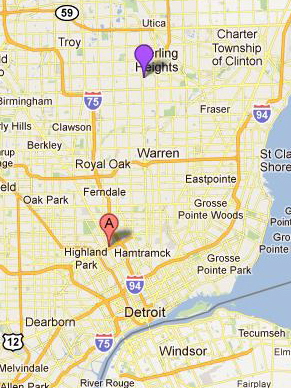
General Dynamics Land Systems, makers of the M1 Abrams tank, in purple.
Highland Park, where they’re being forced to hock street lights, in red.
Two big parts of the American economy flourished during the last decade: financialization on Wall Street. And national security/arms manufacturing.
General Dynamics Land Systems, corporate HQ in Sterling Heights, Michigan, was one of the manufacturing companies that suffered not at all during the economic collapse. Armored fighting vehicle sales went through the roof due to the war on terror and the desire of toady nations in the Middle East to own American-made weapons.
As for the rest of Michigan, things haven’t been so good. We do recall the automotive industry needed saving.
As the sun dips below the rooftops each evening, parts of this Detroit enclave turn to pitch black, the only illumination coming from a few streetlights at the end of the block or from glowing yellow yard globes.
It wasn’t always this way. But when the debt-ridden community could no longer afford its monthly electric bill, elected officials not only turned off 1,000 streetlights. They had them ripped out — bulbs, poles and all. Now nightfall cloaks most neighborhoods in inky darkness.
“How can you darken any city?” asked Victoria Dowdell, standing in the halo of a light in her front yard. “I think that was a disgrace. She said the decision endangers everyone, especially people who have to walk around at night or catch the bus …
Highland Park’s decision is one of the nation’s most extreme austerity measures, even among the scores of communities that can no longer afford to provide basic services.
Other towns have postponed roadwork, cut back on trash collection and closed libraries, for example. But to people left in the dark night after night, removing streetlights seems more drastic. And unlike many other cutbacks that can easily be reversed, this one appears to be permanent.
The decline, states the story, has been relentless, slow and long.
Once a hub of auto-manufacturing, the city took a severe hit when Chrysler moved its headquarters north to Oakland County in the Nineties.
After that, small businesses and the tax base began to collapse, a disaster that was never reversed.
YouTube gee-whiz, complete with bad but wishful computer animation, for man groupies who get erections over technical applications
for making slipping it to others far poorer more tactically efficient.
Consider for a moment the wonderland on display here, completely isolated and out of touch with the rest of the country.
(“Nearly 15% of the U.S. population relied on food stamps in August, as the number of recipients hit 45.8 million,” read the WSJ on Tuesday. “Food stamp rolls have risen 8.1% in the past year, the Department of Agriculture reported, though the pace of growth has slowed from the depths of the recession.”)
You may have seen things tank in the last decade but the contractors and boffins in the business of research and development of flying war robots are in the same general vicinity as the 1 percent.
No better than Wall Street when you get right down to it.
An investigation by Channel 2’s Jim Strickland revealed fake chips have been discovered at a Georgia military base and at a Roswell military supplier.
Technicians repairing an F-15 flight computer at Robins Air Force Base in 2008 said they discovered that four replacement microchips were fake just in time.
“Our job is to ensure that those who want to counterfeit parts, that we don’t allow them into the supply chain. It’s a battle every day,” said base commander Maj. Gen. Robert McMahon.
McMahon is battling back-alley operations like ones in Shenzhen, China. Video of laborers there revealed an operation in which workers peel chips off old circuit boards, Strickland reported. Some are reconditioned and relabeled as military grade …
“Anyone who has legacy-type products is forced to go into the independent world of electronics distribution, and that world can be a scary place,” said Dan Ellsworth, CEO of World Micro in Roswell. His company is a global components dealer. Ellsworth infiltrated the Shenzhen facility himself.
The Oakland Chamber of Commerce raised alarms about the continued economic impact. “There are a number of negative ramifications from these protests,” said Paul Junge, director of public policy with the chamber. “A number of local businesses are seeing sales drop off dramatically.”
The Fountain Cafe, in the Oakland City Center complex downtown, is among those that have already felt the bite of Occupy Oakland.
“The protests have hurt our business,” said Elias Salameh, owner of Fountain Cafe. “If it goes on any longer, I’m sure it will hurt more.”
Protests, by people demonstrating against mass unemployment (theirs) and economic inequality brought on by plutocracy, criticized for being bad for business.
A strike will hurt shopping and eating!
Missing from the news piece is that for strikes to be effective wounding business is often quite necessary. Or else authorities who believe protesters can be waited out or dispersed by police forces won’t change or be removed.
In this country it’s why private sector collective actions have essentially been squashed up until now. And, one is paying attention, why the GOP has gone after private sector unionization all over the country.
According to the newspaper, not all business is opposed to OWS:
Some businesses intend to close in solidarity with the general strike attempt. Berkeley-based Biofuel Oasis, a worker-owned collective that sells fuel and farming supplies, will shut its doors for the day.
“It’s all about local businesses keeping money in the community and supporting the local economy,” said Ace Anderson, one of the members of the cooperative. “We hope we won’t lose too much business by being closed. But it’s for a good cause.”
Some labor leaders called on their members to take time of work to support the Occupy event.
By contrast, in 2010 a general strike put a dent in business interests in France. It was countrywide and was enabled by unionized workers whose rights and powers were largely protected in ways that were erased in the US in the past decades.
From the New York Times:
The political scientist Jacques Capdevielle noted with surprise that while only 4 percent of French workers were unionized, credible polls showed that a majority of the French supported the [national] strike.
Jean-François Copé, parliamentary leader of Mr. Sarkozy’s party, said Wednesday that this was “the week of truth??? on the pension overhaul and emphasized “the cohesion of the majority and the government??? on the change, saying, “There is no other solution to save our pension system.???
He then criticized the opposition Socialist Party for promoting the demonstrations without a viable legislative alternative and for calling students, whose weeklong school holiday starts on Friday, into the streets. He said he was appalled that “a handful of people have taken the economy of our country hostage by blocking the fuel depots.???
While it did not bring about significant chance, it demonstrated that the French — or at least a good number of them — were willing to go into the street and oppose government austerity plans in a way that did achieve a slow down.
However, it is fairly inconceivable that American citizens and workers could strike and block fuel distribution in this country. But this is more of a reflection on how effective the corporatocracy has been at squashing the willingness to embark on such such things rather than on logistical problems with doing so.
Truckers, for example, could refuse to move fuel. And that would really hurt fast.
Damaging national interests and business through general strikes is a way to get around having to hope for political change through the ballot box. Corporate America destroyed private sector collective action first. And then it destroyed the power of the ballot by buying all candidates and gaining permission to anonymously give unlimited amounts of money to cut-out political agencies opposed to change. (In a manner of speaking, corporate America was given permission to do the kinds of things the CIA does to destabilize and undermine foreign governments and leaders — with the exception of supplying arms.)
Between elections this leaves only general strikes brought about by groups with substantial popular support, like OWS. Or, eventually, a rebellion.
If you take the long view, from the standpoint of security for everyone and stable government, it is better to enact positive change before the natives are so provoked they begin looting and burning.
It’s fairly lame, although not entirely so, in light of how bad things are.
And it’s reminiscent of Bill Maher’s idiotic call, one nobody really remembers, to divest from big banks about a year ago.
Paradoxically, one of the banks in Maher’s list of suitable new banks for holding your money was OneWest, an institution a few OWS members in Pasadena targeted a couple weeks ago.
On the other hand, OWS drawing attention to Bank of America as a very bad institution in the hopes that larger agencies and groups involved in doing business with will divest is an entirely … capital … idea.
Noted this summer: Installation of bullet-proof see-through polymer between tellers and clientele at the Bank of America at the corner of Colorado and Lake in Pasadena.
Today’s top news item, a whoopie cushion expose in which the lousiest national leadership in national history, the GWB administration, believed it was exposed to botulinum toxin.
Why is it so bad? Well, our leaders — so benighted and fixated on the war on terror — were obviously too stupid to pick up the phone and get someone who would have told them right away that a detection was a false positive with absolute certainty.
Why with absolute certainty?
First — because bioterrorism detectors really don’t work very well. And they didn’t work at all reliably when this actually happened.
Second — there was no intelligence or evidence anywhere in the world that indicated al Qaeda or anyone, besides the United States biodefense industry, could make botulinum toxin into the potential weapon which the alleged attack would have represented. (In fact, there was only one company that leaked botulinum toxin during the height of the war on terror and it was here and on the inside of the homeland security industry. But the details aren’t important to get into for this post.)
The story reveals the absolute meretriciousness of so much American threat assessment. Identification of threats, not by way of any evidence, but by errant and lousy technology and potentials dreamed up by “advisors” and “experts” on what they think WE could do with all our resources.
It was just a few weeks after September 11, 2001 when Condoleezza Rice accompanied the president on a trip to China for the APEC summit. In Shanghai Vice President Cheney appeared on a secure video conference line and delivered President George W. Bush this message:
“The Vice President came on the screen and said that the White House detectors have detected botulinum toxin, and we were all– those of who exposed were going to die,??? Rice told me.
He said that?
“Yes, he said that. And I remember everybody just sort of freezing, and the President saying, ‘What was that? What was that, Dick?’??? Rice, who was the National Security Advisor at the time, said.
Botulinum toxin is, according to the Center for Biosecurity, the “most poisonous substance known??? and “extremely potent and lethal.???
The exposure time meant that she and those on the trip — Bush, Secretary of State Colin Powell and Chief of Staff Andy Card — were all at risk, Rice told me.
The next day, the poisoning was confirmed as a false alarm by whatever great national lab had been employed to find out. No test mice breathing cups of White House air had died.
Folks, this is nothing but pure proof of epic fail in leadership, a tale of our self-absorbed leaders who believed in nothing but their own idiotic ghost stories and the machine that supported them in that.
These were the kind of people you’d laugh at on the SyFy Channel if they were the poorly dressed moron freak show reality actors on Ghost Hunters, stumbling through old houses with their Radio Shack cameras and night vision goggles, wondering if the cold draft just felt or creak heard from a dark corner was evidence of something from beyond.
What’s the big difference between the Ghost Hunters crew and our old national leaders? Not a trick question. Answer: The Ghost Hunters didn’t have the power to wreck the country.
This story, if you’re asking, is apparently courtesy of Condoleeza Rice’s new book, something called “No Higher Honor.” No higher joke.
If you had a class at Stanford with this person you’d be moved to throw things.
Another sad part is that most journalists simply don’t know enough about such details from the war on terror to get they’ve been fed still another worthless but demoralizing turd wrapped in the shiny paper of a new book announcement.
Chinese-manufactured Stratocaster electric guitar, famous around the world. Invented here in California, promoted worldwide by rock ‘n’ roll, now made in much greater number there than here. Those we still make are for the wealthy and major label musicians. Everyone else, including me, gets the China-made copy. The parent company, Fender, keeps a domestic business that’s mostly a custom shop, goods designed by people with good opinions of self-worth but who are not so strong in the way of improvement or innovation.
Same as above. In the Seventies there was a real big Fender factory in
soCal. Now they’re all in China. The blue box, an Adrenalinn III, is not made in China, although its computer chips are. Shot at Studio Dick D.
The real China toilet that inspired “China Toilet Blooz.” The seat blistered as above one week out of its box. It was the third we bought in Pasadena So we left it.
Truly, corporate America has been so very bad for most Americans in the last decade, all brand loyalty should be well and truly dead.
The human thing to do is not even buy Fender-branded guitars made in China, but to get another less famous brand doing the same pieces. In the pic above, it’s a Jay Turser.
In fact, one might encourage Chinese business to simply dispense with their American partners and replace them with new names including the multi-nationals out. If possible.
I’d support that.
Weapons, of course, are mostly all still made here.
Wood ducks and one Canada goose who blutzed into the photo looking for a handout, at the Arboretum in Arcadia. Not made in China.
A few years back Representative Barney Frank coined an apt phrase for many of his colleagues: weaponized Keynesians, defined as those who believe “that the government does not create jobs when it funds the building of bridges or important research or retrains workers, but when it builds airplanes that are never going to be used in combat, that is of course economic salvation???…
Faced with this prospect, Republicans — who normally insist that the government can’t create jobs, and who have argued that lower, not higher, federal spending is the key to recovery — have rushed to oppose any cuts in military spending. Why? Because, they say, such cuts would destroy jobs …
Appeals to confidence have always been a key debating point for opponents of taxes and regulation; Wall Street’s whining about President Obama is part of a long tradition in which wealthy businessmen and their flacks argue that any hint of populism on the part of politicians will upset people like them, and that this is bad for the economy. Once you concede that the government can act directly to create jobs, however, that whining loses much of its persuasive power — so Keynesian economics must be rejected, except in those cases where it’s being used to defend lucrative contracts.
So I welcome the sudden upsurge in weaponized Keynesianism, which is revealing the reality behind our political debates. At a fundamental level, the opponents of any serious job-creation program know perfectly well that such a program would probably work, for the same reason that defense cuts would raise unemployment. But they don’t want voters to know what they know, because that would hurt their larger agenda — keeping regulation and taxes on the wealthy at bay.
And it’s worth adding that arms manufacturing jobs have been the only ones that are protected.
You can throw away all manufacturing to China. You can throw teachers and other government workers to the wolves.
But you can never go after the laborers in the weapons shops.
I’ve long referred to much arms contracting in the US as Keynsian jobs programs. All labor in them is protected, everyone else can go to hell.
The Republican Party, and a surprising number of Democrats, don’t care if jobs for making all sundries in US stores are all from China, domestic non-military production gutted.
On the other hand, all jobs in defense manufacturing are sacrosanct. Cut defense spending and immediately the cry is heard, “But that will cost jobs!”
Ah, so now we have a new principle of economics: government spending can’t create jobs, but cuts in government spending can destroy jobs — as long as the jobs are in the defense sector …
One thought here is that a Keynesian is an Austrian whose campaign contributors are about to lose a lucrative contract. But it also harks back to Keynes’s point, when he suggested burying bottles full of cash in disused coalmines, so that private enterprise could dig them back up and create jobs in the process …