Plate 1, The Botox Shoe of Death, un-reduced scan of the original from the summer, seven years ago. Made by your host at height of war on terror. The Washington Post newspaper ran a story on how al Qaeda was planning to strike with biological weapons, including botulism, citing one then newly discovered enemy web memo on the matter. They did not inform readers of the fine print which imagined putting botox on the shoes, a gaily laughable proposition.
Plate 2, The Mubtakkar of Death. About the same time as the al Qaeda Botox Shoe of Death Plan, journalist Ron Suskind revealed an al Qaeda plot in TIME, the Mubtakkar of Death, which was allegedly a cyanide bomb for use on the NY subway. But Ayman Zawahiri spared NYC, it was said.
I had to analyze whether the Mubtakkar was real. There was no evidence that it was although an al Qaeda drawing of a theoretical poison gas bomb that was not like the described Mubtakkar was found in the hands of DHS and distributed around the country as something to look out for. As GlobalSecurity.Org Senior Fellow I was asked to go on NPR to discuss the alleged weapon. The segment was cancelled because I would not tell the host a scary story.
While there is a famous distasteful video of al Qaeda putting a puppy to death with poison gas, there is no public record of the terror organization ever deploying a cyanide bomb although an apocryphal tale, known only to a few, says an attempt was made at one in Afghanistan and that it did not work.
Scan with an aged paper, almost like papyrus, look. Both prints suitable for framing or silk-screening onto T-shirts as educational slices of real American history.
Proof that truth is stranger than fiction. Suitable for any modern iteration of Ripley’s Believe It or Not!
The trial of accused ricin mailer Matthew Buquet has been pushed off until next year. The reason? Because there is only one lab in the country that does the forensic ricin determinations needed in the case, according to the judge.
But is this really true? It’s an interesting story.
The federal trial of a Spokane man charged with sending a poison letter to President Barack Obama has been delayed until next year because of the complexity of the case, U.S. District Court Judge Lonny Suko ruled on Tuesday.
Suko pushed back the trial of Matthew Ryan Buquet, 37, until May 5. It was supposed to begin later this month.
Suko agreed with lawyers on both sides that the complexity of the case, including dealing with a deadly poison called ricin, made a speedy trial impossible.
“There is only one lab that can process this evidence because of the nature of the toxin involved,” assistant U.S. Attorney Stephanie Van Marter told the judge.
Prosecutors hoped to have most of their evidence turned over to defense lawyers within the next month, she said.
Defense attorney Matthew Campbell, of the Federal Defenders of Eastern Washington, said that his office would then have to undertake complex analysis of that evidence.
“There can be no trial in a speedy time,” Campbell said.
The lab being referred to is the National Biodefense Analysis and Countermeasures Center and, more specifically, its National Bioforensic Analysis Center, or NBFAC.
The NBACC homepage does not list the cost of construction but material from the web pegged its estimated price from 120-150 million dollars. It is run by Battelle under a contract for 500 million.
“NBACC’s National Bioforensic Analysis Center (NBFAC) conducts bioforensic analysis of evidence from a bio-crime or terrorist attack to attain a ‘biological fingerprint’ to identify perpetrators and determine the origin and method of attack,” reads its homepage.
“NBFAC is designated by Presidential Directive to be the lead federal facility to conduct and facilitate the technical forensic analysis and interpretation of materials recovered following a biological attack in support of the appropriate lead federal agency. On January 12, 2007, NBFAC achieved ISO 17025 accreditation, the most rigorous international standard of testing and calibration by which a laboratory can be assessed. Through this achievement, NBFAC has established itself as a model for bioforensic laboratory practices.”
It certainly sounds like the expensive NBACC has all the tools necessary to process ricin samples.
But does it?
In a recent domestic ricin case dating from last year, I was consulted as Senior Fellow at Globalsecurity.Org for my expertise in ricin terrorism.
This was a startling thing. Why did the country’s premier bioterrorism research facility outsource its lab work to another firm? The NBACC was built, and — indeed — its homepage explicitly states that its mission was to have its highly accredited facilities be a model for bioforensic laboratory practice.
A colleague, Milton Leitenberg, when hearing of the NBACC procedure, asked sources in the US biodefense community why this was done. No answers were provided.
So, yes — indeed, with all the shuffling of samples and evidence through offices and labs, it is easy to understand why a ricin trial would be put off.
But, strictly speaking, it’s not because only one lab can (or does) the work.
And it shows that, as in many things, the taxpayer does not get good value for dollar, or even cheaper work, when everything is outsourced as knee-jerk procedure. In fact, the opposite.
Today’s Washington Post featured a news piece on Booz Allen Hamilton and the outsourcing of work in the national security megaplex.
Near the end, there was this:
But the growth in contracting in defense and homeland security work continues. That has been fueled by several factors — ongoing public worry about terrorism, antipathy toward big government and an evolution in Washington’s revolving-door culture that provides extraordinary rewards to top government officials who go private, experts say.
Yet even outsourcing’s most vocal skeptics agree contractors are here to stay, despite what they contend are illusory savings.
“Curbing the use of contractors would be difficult or impossible,??? said Chuck Alsup, a retired Army intelligence officer and vice president of the Intelligence and National Security Alliance, an Arlington County-based association of private companies and individual experts. “It would be, frankly, unwise.???
BioWatch is a now infamous and expensive government program, put together in the aftermath of the anthrax mailer, to detect aerial release of pathogens in major American cities.
After ten years, it does not work.
In 2012, the Los Angeles Times ran a series of news stories on it that tore apart the program’s reputation.
Last year, David Willman of the Los Angeles Times wrote:
President George W. Bush announced the system’s deployment in his 2003 State of the Union address, saying it would “protect our people and our homeland.” Since then, BioWatch air samplers have been installed inconspicuously at street level and atop buildings in cities across the country — ready, in theory, to detect pathogens that cause anthrax, tularemia, smallpox, plague and other deadly diseases.
But the system has not lived up to its billing. It has repeatedly cried wolf, producing dozens of false alarms in Los Angeles, Detroit, St. Louis, Phoenix, San Diego, the San Francisco Bay Area and elsewhere, a Los Angeles Times investigation found.
Worse, BioWatch cannot be counted on to detect a real attack, according to confidential government test results and computer modeling.
The false alarms have threatened to disrupt not only the 2008 Democratic convention, but also the 2004 and 2008 Super Bowls and the 2006 National League baseball playoffs. In 2005, a false alarm in Washington prompted officials to consider closing the National Mall.
Federal agencies documented 56 BioWatch false alarms — most of them never disclosed to the public — through 2008. More followed.
The ultimate verdict on BioWatch is that state and local health officials have shown no confidence in it. Not once have they ordered evacuations or distributed emergency medicines in response to a positive reading.
“I just think it’s a colossal waste of money … It’s a stupid program,” one scientist for the Colorado Department of Health and the Environment told the newspaper.
Even my hometown has been affected by BioWatch’s failures.
Wrote the Times:
Dr. Takashi Wada, health officer for Pasadena from 2003 to 2010, was guarded in discussing the BioWatch false positive that occurred on his watch. Wada confirmed that the detection was made, in February 2007, but would not say where in the 23-square-mile city.
“We’ve been told not to discuss it,” he said in an interview.
Despite its failures and increasing news of such, no one can halt the BioWatch program. Put together by the federal government and under the control of the Department of Homeland Security, BioWatch is also run by private sector national security contractors.
One such contractor is a business virtually no Americans have heard of called the Tauri Group.
It’s website is bland, revealing little except that it’s a great company to work for and that one of its specialties is combating weapons of mass destruction. A page mentioning its involvement in BioWatch is
here.
In e-mail discussions between your GlobalSecurity.Org Senior Fellow earlier this year on the money spent battling the threat of bioterrorism (not counting the recent goofball ricin mailers, there have been no deadly bioterror attacks since Bruce Ivins) an insider with knowledge of the BioWatch program had this to say:
“Some of the Tauri Group contractors running BioWatch were making $350K on top of their military pensions.”
BioWatch has cost one billion dollars to date. The sum indicates why there is intense effort to sustain it.
Outsourcing, from the NBACC and trivial ricin mail cases, to BioWatch, does not necessarily save taxpayer dollars.
The look of national bioterrorism defense entitlement spending in Omaha, Nebraska. The flush days may be ending.
“Federal funding for the Special Pathogens and Biosecurity Laboratory at University of Nebraska’s Medical Center peaked at $1.2 million, has been sliced in half in recent years, and could get whacked again,” reads the Omaha World Herald caption on the picture.
It’s the type of article that shows up about once a month now, bioterrorism defense scientists at obscurely named labs built in the great counter-bioterror boom after anthrax, exuding woe that their work is being, or could be, slashed.
The country way over-invested in bioterror defense in the wake of 9/11. Free money went out for almost a decade. No results were required and none were furnished. During the time the public was bombarded with assertions that catastrophic bioterror attacks were easy to mount and likely.
None of the claims of the threat-mongers materialized. That’s zero.
Many of our most famous bioterror defense researchers grew wealthy during a period when millions of other Americans saw their economic futures languish or go up in smoke. Infrastructure repair and spending for the public good shriveled but national security spending ballooned.
Now, in some places, it is getting a much needed haircut. But still not enough.
It’s a hard fact the poor in America have no political voice. But those in national security work always do.
The Omaha World news piece tries to paint a picture of a high tech lab engaged in secret and sensitive work, vital to the safety of citizens.
It does not help the case, however, to mention ricin as a big thing.
From the Herald:
The three-ring binders, each one containing its own nightmare, line one shelf in the lab.
“Bacillus anthracis,??? one binder is labeled …
“Ricin,??? another binder is labeled. That would be the powdery poison that a Mississippi man allegedly mailed to President Barack Obama this spring in the upside-down days after the Boston Marathon bombing.
There are other binders, many others, but as I write down their names, the Omaha scientists who run Nebraska’s Special Pathogens and Biosecurity Preparedness Laboratory politely ask me to stop …
This bookshelf of horrors needs to stay secret, they say.
“We’d let you read this, but then we’d have to lock you up for 10 years,??? says Dr. Steven Hinrichs, director of the Nebraska Public Health Laboratory, which oversees the biosecurity lab.
He points to the ricin binder. He is joking. At least I think he is.
However, the public knows there’s not much book in ricin terrorism having experienced a uniquely remarkable period of it this year.
Ricin, or more descriptively — castor powder, in mail is hardly a hazard. This despite the national line, now twelve years old, that it is profoundly deadly and easy to make.
In the long period between now and the beginning of the bioterror defense boom there’s been essentially no change in the science used to examine ricin or samples suspected to be contaminated with it. In fact, the science is the almost the same as when I was in grad school working protein biochemistry in the mid-Eighties.
I know. I’ve seen the work from ricin cases, been asked about it from a professional’s standpoint.
There’s nothing new needed for ricin. The FBI gathers its evidence and does preliminary testing. Then it sends its sample to the mega-bioterror defense lab built in the response to Bruce Ivins, the National Biodefense Analysis and Countermeasures Center (NBACC) in Maryland.
Then the NBACC, despite its vast resources and its ability to do the work in house, outsources the determinative work to yet another lab. And it’s all part of the chain of over-spending established during the war on terror.
Think of it as nationally hiring crews of hundreds to screw in a couple light bulbs.
Why?
Perhaps because they were given way too much money.
Because the national leadership over-reacted over a long period of time. Because no very-important-person can suggest the bioterrorism threat has been hyped and inflated and that the response to it is now glaringly inappropriate without losing their career.
The Omaha scientists find their lab “increasingly starved for once-plentiful federal cash,” writes Matthew Hansen for the newspaper.
What if everyone decides the [bioterror threat] is no big deal?
An amount of ricin roughly equivalent to three grains of salt can kill a human. A Mississippi man tried to send ricin to the president of the United States in April. A Texas woman — a small-time actress in the TV series “The Walking Dead??? — tried to send President Obama ricin in May.
And yet you would’ve barely known that if you looked at the front page of a newspaper. The first ricin story got crowded out by the Boston bombing, and the second barely made a blip in the 24-hour news cycle.
It’s laughable.
You couldn’t get away from Shannon Richardson during the days leading up to her arrest and after. Her husband made celebrity morning television to speak tearfully of his scheming wife. Thousands of pictures of castor seeds and Shannon in various fetching outfits overflowed Internet gossip sites.
James Everett Dutschke became ubiquitous on the evening news. His
coincidentally bad timing with respect to his ricin mail scheme, coming as it did during the week of the Boston bombing, gave the incident even more publicity.
No, the public got a very good look at ricin terrorism. And there was a cognitive disconnect between what it saw and what it had been told about the allegedly deadly horror of it over the last twelve years.
The [scientists of the Special Pathogens and Biosecurity Laboratory at UNMC] bring up the fact that you can find recipes on the Internet to cook up any number of biological horrors,” adds the reporter.
Something that’s been said thousands of times in the last dozen years. Repeated ad nauseum in the news, worked into television shows, dramatic series and movie plots.
Mostly it’s been convenient bullshit. That it has lost a lot of its power to frighten and persuade is not really a case of public apathy.
But it has always had a lot to do with those defending their career turf.
A secret three-ring binder for lil’ ol’ me? Tee-hee.
Earlier this year, [Ross Miller of Elma, NY], [a] 44-year-old artist and small-businessman assisted the FBI as a witness in a case involving letters that were poisoned with a deadly substance called ricin and mailed to President Obama, a judge and a Republican senator, Roger F. Wicker of Mississippi.
Miller, who has been visiting loved ones in East Aurora and Elma this week, said he was shocked and upset to learn that someone may have used beans he sold to make a substance intended to hurt or kill public officials.
“We were very upset. It was irritating and nerve-racking. I found it offensive that somebody would use a bean product that we sold them to try to kill someone,??? Miller told The Buffalo News.
The Millers, meanwhile, had been following news reports in the case. They realized that ricin could be made from ground-up castor bean shells …
“We’d been … hoping that nobody used any beans that were bought from us to make ricin,??? Miller said.
“We checked our records to see if we’d ever sold any beans to anyone in that part of Mississippi. My wife keeps extensive records, and she found out that we had sold some beans to??? Dutschke last year.
He was a faceless Internet customer who spent about $20 on about 100 castor beans the Millers sent to him.
The realization that they may have sold beans used to make ricin that was sprinkled on a letter to the world’s most powerful leader scared and deeply concerned the Millers …
[The Millers, after making inquiries, were put in touch with] W. Chad Lamar, the federal prosecutor in Mississippi who was handling the ricin case …
“The Millers’ information was very helpful, especially after Dutschke had denied ever buying castor beans,??? [a lawyer friend of the Millers] said.
The Millers told the newspaper their craft business will no longer sell castor beans. They were not very profitable, anyway, Ross Miller informed.
Matthew Buquet, 37, entered not-guilty pleas during an appearance before U.S. Magistrate Cynthia Imbrogno.
He is charged with producing and transferring a biological toxin called ricin; mailing a threatening communication to the president of the United States; and mailing a threatening communication to a federal judge. He faces up to life in prison if convicted.
No motive has been offered for the mailings, and the federal government has sealed most of the court documents in the case.
Last week, a case of rent-seeking behavior on the hazard of ricin from a laboratory funded by Homeland Security, by reporter Tom Sowa of the Spokesman Review newspaper:
As federal prosecutors build a case against a Spokane man charged with sending ricin-laced letters to the president, the CIA, a federal judge and Fairchild Air Force Base, one of the legal challenges they’ll face is proving that the substance is indeed ricin, a lethal poison derived from ground seeds of the castor plant.
[Note: This is untrue. There straightforward lab procedures used to test for active ricin. Typically, the FBI sends suspect samples, be they castor seeds, castor powder, or both, to the National Biodefense Analysis and Countermeasures Center (NBACC). NBACC, which was built for the war on terror, then outsources the lab work to a firm like American International Biotechnology Services (AIBiotech) in Richmond, VA. Why does the NBACC, one of the most well-funded science installations in the country, outsource this work? Interesting question, one perhaps to be answered in the future.]
[Investigators] also can use tests to figure out how the ricin was made, which can help link a suspect with the chemicals used in the process or determine how much advance planning took place. New versions of those analytic tests are being developed at the Pacific Northwest National Laboratory in Richland, at the Chemical and Biological Signature Sciences Laboratory.
[Although the documents in the Buquet case are sealed, the FBI reporting agent will already have a very good idea of how the tainted letters were made. This is again not really accurate news, shaped to make the work at the Pacific Northwest National Laboratory appear more valuable.]
Among the lab’s goals is developing better tools to identify the exact methods used to make ricin or other toxic substances, said David Wunschel, a biochemical researcher at PNNL.
There is an urgency to the lab’s work, because for many would-be terrorists, the ease of access and relatively simple production method has made ricin the “weapon of choice,??? Wunschel said.
[But ricin is not a weapon of choice of terrorists. This is, again, untrue and the researcher must know it. The alleged perpetrators in the cluster of three ricin cases — J. Everett Dutschke, Matthew Buquet, and Shannon Richardson — are not “terrorists” in the sense of the war on terror. A look at their pictures and what is known of their lives shows everyone that this is the case.
The choice to make ricin mail, in these cases, appears to be trivial. One case, that of Shannon Richardson, looks like it could have been a partial copy-cat of the J. Everett Dutschke incident, one where the primary aim is to draw attention and frame another person.
It is not difficult to understand this. However, rent-seeking behavior, that is the justification of continued work, or research on a matter that is of little value to average Americans, requires that a different story be told — that ricin is a “weapon of choice” of terrorists.
During the war on terror, zero people have been killed by ricin.]
Ricin is a “one-to-one??? attack that relies on getting a potential victim to breathe or swallow the toxin. Unlike poisonous gases or viruses, ricin isn’t absorbed easily through the skin.
Even so, the bioterror scenarios include the possible distribution of dozens of ricin-laced packages to a government office, causing a lot of disruption and requiring extensive cleanup, Wunschel said
Wunschel joined the PNNL staff in 2000. Following 9/11, the new Department of Homeland Security started funding projects to give law enforcement better tools in dealing with bioterrorism. The ricin study has been underway in Richland since 2005.
Scientists say extracting ricin from castor seeds may be relatively simple if someone follows a series of steps deliberately and carefully. But if someone uses a less-complex method with fewer steps, the result is a less pure and less lethal product, Wunschel said.
Ricin accounts for roughly 1 percent of the weight of the dry castor seed.
Ricin isn’t a contact poison. It’s not absorbed through skin anymore than a piece of lunch meat is, period.
But there you have it, once again. Ricin is simple to make. The purification of ricin is beyond the people being arrested in the US on ricin-making charges.
Ricin just does not make a very good weapon. One of the reasons is that there isn’t much of it in a castor bean. A bean is generally mostly oil and 1 percent as ricin is only a start point. Any protein purification must, by definition, result in less because that is the nature of the work.
Currently, war on terror rent-seeking in the national security complex has funded the development of two research ricin vaccines.
One is being pursued by a company mentioned infrequently here — Soligenix. The other is in development at USAMRIID, once known as Fort Detrick in Frederick, MD., that national lab facility on bioterror defense that, in turn, spawned the idea for the NBACC.
Two other ricin-making machines, one human and the other a seed grinder that spews castor hulls and powder into the air.
The rest of the world does not care about the bullshit on castor beans, terrorism and ricin peddled by the American national security complex.
Posted in Bioterrorism at 12:52 pm by George Smith
An installation of a substitute for Akismet crashed the blog for about an hour in a php incompatibility. Turning off all plugins through the database restored access.
And, upon reactivating Akismet for one last try, I found it working again. Coincidence, maybe, maybe not.
Whatever.
Thanks for the help and suggestions, anyway, folks.
If you’ve kept up with the story of J. Everett Dutschke, his music and ricin letters here, you’ve had a full measure of the twisted idiosyncrasy and unusual crime he delivered to his neighborhood in Tupelo.
However, these three grafs leap of a Washington Post feature on him:
In the summer of 2012, as Dutschke prepared to enter his band RoboDrum in the annual Bud Lite Battle of the Bands contest, he started coming to the attention of law enforcement.
In June, he was charged with indecent exposure by the city attorney’s office after several neighborhood children came forward.
“He would get the attention of the girls with a green laser. He would hit the laser and click it around until they started to look into his house. Then he would expose himself,??? said Dennis Carlock, whose 13-year-old granddaughter was one of the victims and testified to the incidents.
He was convicted on exposure and later charged with three counts of fondling minors.
As mentioned earlier, there has to be a book in it: Bean Pounding, with only slight apologies to Faulkner.
The American bioterror defense effort is riddled with rent-seekers, individuals and businesses who spent the better part of the war on terror years inflating threats to increase spending in the field.
Most recently DD blog covered the company Soligenix which promptly used the recent ricin case to go looking for funding in the mainstream press.
Indeed, anthrax mailer Bruce Ivins can be thought of as the most successful bioterrorism research rent-seeker. Part of his motivation in mailing anthrax, according to FBI reasoning, was to save interest in research and development on the anthrax vaccine, of which he was a major part.
Ivins was spectacularly successful. The national panic over the anthrax mailings virtually created the modern bioterror defense industry in the United States.
Over the weekend, Los Angeles Times reporter David Willman, who was the first to publish news on Ivins and his suicide in 2008, went public with a story that fingered another big name from bioterrorism defense, former secretary of the navy and pre-presidential Obama security advisor, Richard Danzig. (His biography at the University of Pittsburgh’s Center for Biosecurity is here.)
“Anthrax drug brings $334 million to Pentagon advisor’s biotech firm,” reads the headline in the newspaper.
Danzig, a lawyer, made himself into an expert on bioterrorism — the kind of expert who always insists a catastrophic attack was perhaps imminent and certainly probable, that such attacks were easy to mount.
From the LAT:
Over the last decade, former Navy Secretary Richard J. Danzig, a prominent lawyer, presidential advisor and biowarfare consultant to the Pentagon and the Department of Homeland Security, has urged the government to counter what he called a major threat to national security.
Terrorists, he warned, could easily engineer a devastating killer germ: a form of anthrax resistant to common antibiotics.
U.S. intelligence agencies have never established that any nation or terrorist group has made such a weapon, and biodefense scientists say doing so would be very difficult. Nevertheless, Danzig has energetically promoted the threat — and prodded the government to stockpile a new type of drug to defend against it …
Danzig did this while serving as a director of a biotech startup that won $334 million in federal contracts to supply just such a drug, a Los Angeles Times investigation found.
By his own account, Danzig encouraged Human Genome Sciences Inc. to develop the compound, and from 2001 through 2012 he collected more than $1 million in director’s fees and other compensation from the company, records show.
The LATimes account is damning. By all accounts, Richard Danzig’s career as a bioterror defense advisor should be over. But nothing will happen. A quick read of Danzig’s biography would convince most that he is too important in the national security megaplex. Of course, he has already made his pile.
“Dr. Philip K. Russell, a biodefense official in the George W. Bush administration who attended invitation-only seminars on bioterrorism led by Danzig, said he did not know about Danzig’s tie to the biotech company until The Times asked him about it,” continued Willlman.
“Holy smoke—that was a horrible conflict of interest,” the scientist told the newspaper.
During the salad years of the war on terror Danzig peddled a talk and paper entitled “Catastrophic Bioterrorism — What is to be done?”
In the paper Danzig recommended a counter-measure drug to anti-biotic resistant anthrax be developed as soon as possible. He added that making antibiotic resistant anthrax was an elementary process, one that could be performed by a high school student.
In all this time, Danzig did not inform many, if any people, that he was on the board of directors of Human Genome.
“A Times search found seven papers Danzig had written on bioterrorism since 2001, reported Willman for the Times. “In only one of those did he disclose his tie to Human Genome.”
Danzig told the Times he had noted his position with the firm in confidential forms required annually by the government.
During the war on terror years Danzig made the rounds in the press and consultations to the government and industry, inflating the threat with claims that anthrax posed a greater potential threat than 9/11 and that bioterrorists could attack again and again with it, a process called “reloading.”
Bioterrorism “reloading” was also a potential scenario fast peddled by Tara O’Toole, a research scientist who made the University of Pittsburgh’s Center for Biosecurity famous during the Bush administration. O’Toole is now a director at the Department of Homeland Security, a position that has required she keep her opinions on catastrophic bioterrorism out of the press.
Wrote Willman for the Times:
The anthrax letter attacks, Danzig wrote in his “Catastrophic Bioterrorism” paper, exposed national security vulnerabilities “greater than those associated with 9/11.” He argued that the country’s defenses were inadequate.
Doses of anthrax vaccine would have to be given weeks or months in advance of an attack. As for antibiotics, Danzig suggested that even a novice terrorist could “readily” make a resistant strain.
“Development of an antibiotic-resistant strain … is quite easy,” Danzig wrote. “Even at the high school level, biology students understand that an antibiotic-resistant strain can be developed.”
This is something beyond the capability of a high school student or even someone with graduate training.”
“It’s not a trivial endeavor,” Paul Keim, a Northern Arizona University geneticist and anthrax expert, told Willman.
“This is something beyond the capability of a high school student or even someone with graduate training.”
Unfortunately, readers know from experience what always happens in cases such as this.
Nothing. Conflicts of interest are like bread on the table — the staff of life in the national security megaplex.
It doesn’t matter if important people in unique positions to make policy are involved in businesses that profit directly from their policy advice and lobbying. That is just the way things work in the United States.
During the height of the war on terror you hardly ever saw anyone in the professional ranks with the nerve to say that grubbing for more defense research funding on the back of fear was inadvisable.
I am a scientist. I am not opposed to research. It is essential for the similar preparation required for either a bioweapons assault or a naturally emerging disease. Nevertheless, a fear-based crisis response, because public officials happened to be among the targets, is self-defeating.
Academics should resist the temptation to exploit the ricin letters to obtain more resources for their research. There are already ongoing scientific studies of ricin, including some that employ the toxin to kill cancer cells. We don’t need an infusion of money into ricin research. I don’t claim to know the motives of the ricin letter mailer or whether he got the idea from a television show. I do know that overreaction encourages future terrorists.
The author, David Sanders, is “an associate professor of biological sciences at Purdue, is working on a Howard Hughes Medical Institute-sponsored curriculum-development project,” reads the newspaper.
“[Environmental] sensors for true biological agents are and will be for the foreseeable future wastes of money,” he adds.
Sanders also writes that the over-reaction to things like the Dutschke ricin-mailings inspires other terrorists.
He is echoing what I have written for years. The ocean of print, television and Internet news on the subject, during the war on terror years, established the received wisdom in the minds of would-be terrorists that biological and chemical warfare are easy to do.
As one consequence, many bad people have maintained an interest in fiddling with castor seeds.
It is fortunate that reality does not match the national belief that a ricin weapon is easy to make, simply by pounding castor seeds, and J. Everett Dutschke’s tainted letters were, in the final measure, just a damn nuisance.
After the ricin letters arrived and made news, a scientist and one company did immediately go rent-seeking.
The US Army Medical Research Institute of Infectious Diseases in Fort Detrick, Maryland, has developed a vaccine called RVEc, which protected mice that were exposed to inhaled ricin.2 The vaccine has also been tested in human volunteers, who subsequently developed antibodies to the toxin. But further human testing is needed, and it is not clear whether the Department of Defense will continue to fund the vaccine’s development.
The other leading vaccine candidate, RiVax, is made by a company called Soligenix, based in Princeton, New Jersey. The vaccine was initially developed by Ellen Vitetta, an immunologist at the University of Texas Southwestern Medical Center in Dallas, and batches made by her group have been tested in animals. Those batches have also been found to be safe in healthy human volunteers, in whom they stimulated the production of antibodies.
But Soligenix has not yet tested the safety and effectiveness of its own batches of RiVax. The company’s development efforts have slowed as a result of budget constraints at its funding agency, the NIAID, says Vitetta.
“It basically is not going anywhere,??? she says. “It’s disappointing and upsetting.??? After an event such as the latest ricin mailings, “everyone wants to know where the vaccines are. Somebody has to think this work is important enough to fund us and let us finish it.???
Soligenix’s work on the vaccine is currently funded by a US$9.4-million NIAID grant, but further testing in animals to prove the treatment’s effectiveness would cost between $20 million and $40 million, says Chris Schaber, the company’s president.
Soligenix is actively working to develop vaccines for bioterrorism agents such as ricin, but funding the research remains a challenge, according to company president and CEO, Christopher J. Schaber.
“Every biodefense program needs to be sponsored by the government,??? said Schaber. “We don’t spend our own money on biodefense. The company could not take off with biodefense unless we secure a large procurement contract from the government, which are typically in the hundreds of millions of dollars …
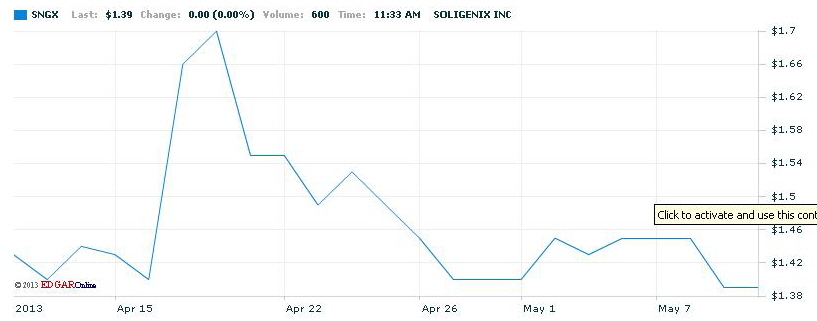
Soligenix’s share price rose 20 percent this week after the ricin-laced letters to government officials were publicized.
Soligenix would make money if the government stockpiles the vaccine, but the research has to be funded and it has to get FDA approval before the company can procure a government contract.
“We’ve taken this very far with the support of the NIH (National Institutes of Health), but we really need to get a larger contract with more funding to allow us to move forward,??? Schaber said. “The government many times doesn’t move that quickly on these things, especially because a lot of people haven’t died.
Soligenix’s stock, which isn’t worth a great deal, shot up on the 16th and 17th, the day ricin letters to Roger Wicker and the President were discovered, boosted by speculators. A letter had been sent to a judge in Tupelo, MS, on the 10th but did not make the news until after the letters had been discovered in the nation’s capital.
J. Everett Dutsche was arrested on April 27 by the FBI.
Soligenix, a company that exists only because of taxpayer spending during the war on terror — from the archives.
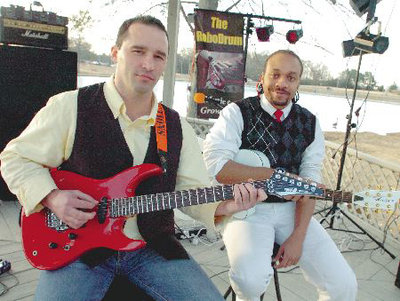
Accused ricin mailer J. Everett Dutschke and his group, RoboDrum, of Tupelo, MS, in a contest video shot by Budweiser in St. Louis for a Bud Light beer Battle of the Bands competition.