The Cult of EMP Crazy is ridiculous for many reasons.
One of the more noticeable of these is the practice of spitting out the exact same scripts and stories, sometimes more than a couple times every month. EMP Crazies are such crappy opinion writers they pretend to not notice that every single one of them always emits the exact same lines, like a chorus of trained parrots.
“Ever heard of Electromagnetic pulse, or EMP? Probably not, unless you’re a nuclear weapons expert.”
No, wrong. Ding! Ding! For the love of Pete, have mercy! Only for the second or third time this week.
“What if the electricity suddenly went out?” asks KT McFarland.
Who is KT McFarland? Someone who tried to run against Hillary Clinton. Oh, this really does not look good.
“Kathleen Troia ‘K.T.’ McFarland served in national security posts in the Nixon, Ford and Reagan administrations,” it reads. “She wrote Secretary of Defense Weinberger’s November 1984 ‘Principles of War Speech’ which laid out the Weinberger Doctrine. She is a senior adviser to the Foundation for the Defense of Democracies and a frequent contributor to the Fox Forum.”
“What if the electricity suddenly went out?” KT writes, a second time. In case you, like, didn’t see it in the lede.
“Nothing would work – not the phone system, or water pumping stations, or planes, trains or automobiles. Your toilet wouldn’t flush and the TV wouldn’t turn on. Planes would stop in mid-air. (That’s a helluva trick of physics, aerodynamics and internal combustion! — DD) The only way to communicate would be face to face. Credit cards would be useless.
“Tens of millions would die of disease and starvation.”
So club the Obama administration over the head again for not doing anything to stop it — like bombing Iran.
KT McFarland, Tea Partier: ‘Throw the bums out!’ and Yellow Peril shtick.
Less clownish rock band with pretty girl making Faustian deals. Way less Iggy Pop.
Now, Iron Man 2 is more like it, making better use of heavy metal and rock star metaphors.
Iron Man set to AC/DC.
Mickey Rourke as The Wrestler as the Bounty Hunter as Whiplash, originally one of the “ten crappiest Iron Man villains” ever. Well-explained here.
And Don Cheadle as War Machine. Doesn’t he seem a little small for the part to you? War Machine was big and mighty, like the young Jim Brown. Ah, Robert Downey’s wee, too, and he works splendidly as Tony Stark.
Tipped by Armchair Generalist, someone with a good eye. The second trailer is cooler than the first.
Guaranteed to spawn too many US military officers and analysts telling magazines and newspapers America needs its defense contractors to make something like that. To limit collateral damage in the war on terror, of course.
Good news, lads! Good news! Between Wall Street and the way things are done here, the US is getting set to march proudly into the future. Home-schooling for everyone! Fire more of those slackers with three months off in the summertime.
“The urban core has suffered white flight post-the 1954 U.S. Supreme Court decision Brown v. the Board of Education, blockbusting by the real estate industry, redlining by banks and other financial institutions, retail and grocery store abandonment,” Brooks said to applause from the standing-room-only crowd.
“And now the public education system is aiding and abetting in the economic demise of our school district,” she said. “It is shameful and sinful.”
Under the approved plan, teachers at six other low-performing schools will be required to reapply for their jobs, and the district will try to sell its downtown central office. It also is expected to cut about 700 of the district’s 3,000 jobs, including about 285 teachers.
“The Kansas City school board voted … to close” fifty percent of its schools to avert bankruptcy it sez.
More than a year ago I coined a phrase that seems to have made its way into the econolexicon; writing about how cutbacks at the state and local level would tend to undermine fiscal stimulus at the federal level, I said that we had fifty Herbert Hoovers.
“It is always easy to find people who will pontificate about these matters and blow smoke in everyone’s ears … It’s a fancy idea lab, but the ideas are not that good.” — Me
“Electromagnetic pulse guns, genetically designed killer diseases and swarms of miniature self-guided missiles — if these sound like the products of a mad scientist, they should,” reports the Washington Times here. “They are among the threats predicted during the U.S. Army’s 11th annual Mad Scientist Future Technology Seminar (no, really) in Newport News, Va.”
“It is only a matter of time before there is a significant high-tech surprise awaiting U.S. military forces” … is this bullshitters paradise’s motto, reads the newspaper.
Refreshingly, DD was asked to deliver a dash of ice-water to the face.
“The summary lists five ‘significant findings’ of the seminar, concluding that ’emerging biological technology … especially in the hands of non-state actors, has the greatest potential to catch the Army unprepared in the short term’ by allowing the creation and delivery of new diseases for which there is no cure,” continues the Times. “The summary states that this capability likely will be available to U.S. adversaries ‘as early as 2015.'”
“The seminar concluded that ‘EMP weapons will become available to potential adversaries in mortar and artillery rounds soon … blending technologies necessary to generate an EMP with advances in miniaturization could produce a hand-held EMP gun before 2020.”
EMP guns lagging behind custom-made plagues? You don’t say, Misters Science Fiction Men! How about turning people into living shrapnel bombs, like they did in an episode of Fringe last year?
George Smith, a defense technology analyst and a senior fellow at GlobalSecurity.org, said in an interview that he was skeptical about the value of such exercises … They have been predicting some of these things for 20 years,” Mr. Smith said about some of the advanced threats discussed in the summary.
That’s just a fact. Electromagnetic ray guns have been promised for as long as DD has been in cyberspace. It’s the weapon that’s always coming but never quite arriving, despite much hoping and wishing.
And a few times a month DD gets querulous mail from people wishing to show me their EMP guns or impugn my character for writing stuff like this here.
What’s changed most, however, is the need for the Army’s ‘mad scientist’ picnic.
There isn’t any.
Anyone who follows national security affairs knows there’s no shortage of predictive analysis rank bullshitting about the many enemies the US is likely to face. Potential foes and their fancy weapons and plans lurk everywhere! MacGyver-like terrorists will make Facebook and bags of high-tech dirt into existential threats.
“[Adversaries] are likely to try to bypass the military, shifting ‘toward a focus on disrupting transportation, banking, and government infrastructure within the United States’ by exploiting malicious use of the Internet and other computer networks, ‘generating greater stress in an increasingly vulnerable U.S. homeland,” says some alleged director of Army intelligence analysis named Tom Pappas.
In today’s New York Times Sunday magazine, from an article on what makes good teachers, a remarkable technique is cited:
In Cold Call, No. 22, stolen from Harvard Business School, which Lemov attended, the students don’t raise their hands — the teacher picks the one who will answer the question. Lemov’s favorite variety has the teacher ask the question first, and then say the student’s name, forcing every single student to do the work of figuring out an answer.
All the techniques are meant to be adaptable by anyone. To illustrate cold-calling in Boston, he showed clips of four very different teachers: Mr. Rector, whose seventh graders stand up next to their chairs as he paces among them, lobbing increasingly difficult geometry problems; Ms. Lofthus, who leans back in a chair, supercasual, and smiles warmly when she surprises one second grader by calling on him twice in a row …
Taken from the Harvard Business School, huh?
DD can’t recall being in public school in Pine Grove, PA, in the Sixties and Seventies where teachers didn’t randomly call on kids.
The New York Times Magazine is for upper middle class snobs.
From my perspective it publishes a certain flavor of pap.
And one can always count on a reinvention of the obvious.
For example, I grew up surrounded by teachers, like many Americans. My mother was a teacher at Pine Grove Area Middle School. It was the only job she ever held.
She was a reading instructor. And she hated reading.
I never saw her read a book in her free time at home, ever. She never read for pleasure. Not once — in my memory.
If you read this blog for even 20 seconds, you know DD is a reader.
When I went off to grad school in the late Seventies, my mother took books I’d accumulated over the years but could not take with me, purloining them for her class at Pine Grove Area High School.
Not liking reading, she had no books of her own. To make herself look real, she had to take my clothes.
Was my mother a reading teacher? I have no idea. I had her as my fifth grade teacher for almost a full year in Pine Grove Elementary. It’s a given that a kid ought not to have one of his parents as teacher considering the temptation to always embarrass the child as some manner of good, bad or indifferent example. I can’t recall a single uplifting thing about the experience. However, it was only fifth grade and I knew how to read.
My mom is used here, not only out of spite, but as fairly average proof of the obvious — that teaching schools often turn out those who may not be the best or who frequently don’t even particularly care about the subject they’ve chosen to be certified in. And I am certain a good portion of people my age could still point out public school teachers –ticket-punchers — who mystified because of the obvious dislike or disinterest which they held for the subjects they were earning their money on.
My mother was certified to teach reading by Millersville State Teachers College.
MSTC was a school that required liberal arts and ed students to take three units of music composition.
You’ll recall DD is a rocker and a guitar player, forced to hear his mom’s feeble efforts at composing some fragment of a tune for the course, after being told numerous times that playing the electric guitar or Iggy & the Stooges’ Raw Power too loud was Satan’s work. The class’s instructor issued a pitch pipe to every student.
If you need a pitch pipe, you’re beyond help, tone deaf.
Learning this rubbish had nothing to do with being a teacher. It was just someone’s idea on how education majors needed to be made to jump through various hoops to get their licenses validated.
When I eventually came back from Lehigh University with a Ph.D. in chemistry and before going off to do postdoctoral work at the PSU School of Medicine, I subbed at Pine Grove Area to earn money. This was a mistake.
I started as a chemistry instructor in the high school from which I graduated. This worked under the assumption, now shown to be stupid by US life, that people trained to be expert in something for over half a decade are actually well-trained experts:
I was the most highly qualified instructor Pine Grove ever had. I was quickly pulled off this, the rationale being that I was likely to destroy the reputation and credibility of the high school chem teacher who I was standing in for in front of his students.
The man had been one of Pine Grove Area’s shop teachers.
That made sense.
Don’t overexpose the kids to the Ph.D. in chemistry because it would make the shop teacher’s work harder. Y’know, just in case the young people might harbor an interest in science or something.
So I was then set to teaching algebra at the middle school.
Pine Grove’s schools did have many good teachers. Many of those I could mention are now dead. They ran the gamut from those who had tyrannical discipline — good “classroom management skills” — to those who had no discipline at all.
There was not a common set of features as to what determined a ‘good teacher’ among them. It was governed by circumstance and serendipity, plus a pool that generally was of much higher quality, in terms of raw education, than what is ‘average’ in the country now. Odds were good then that you’d get regularly better than an average cut of person.
And, of course, every classroom wasn’t a pail full of fail, needing daily heroic interventions to be rescued, coming in.
I give “Doug Lemov” — the person who’s techniques and methods are featured in the New York Times magazine — five years or less before he’s thrown to the devil and the merciless statistics of the FUBAR American system.
DD was directed into science by Pine Grove Area High School teachers from wide curricula. This must still happen but one only sees it as a sort of man-bites-dog story in today’s news. It is a great disservice to a US system of education less and less can remember.
Between then and now the country changed radically for the worse.
Among the many unintended consequences: The destruction of public schooling, to be replaced by a never-ending string of ‘problem-solvers’ haplessly trying to regain what never needed losing.
God bless my old teachers at PGAHS. I was rather lucky, it seems. Spanning hard science to athletics to high math, they were teachers I didn’t always like but who I always believed in, people who inspired the young through collegial wisdom and basic human decency.
The SPIN magazine backpages are in Google Books as noted here mid-point through last month.
If you’ve delved the sidebar links you’ll know that at one time DD wrote rock criticism. And I did it on and off for a long time until it became nothing but 50-word advertising blipverts with everyone who could be appropriately supercilious about the release schedule for the week banned in favor of industry tail-chasers.
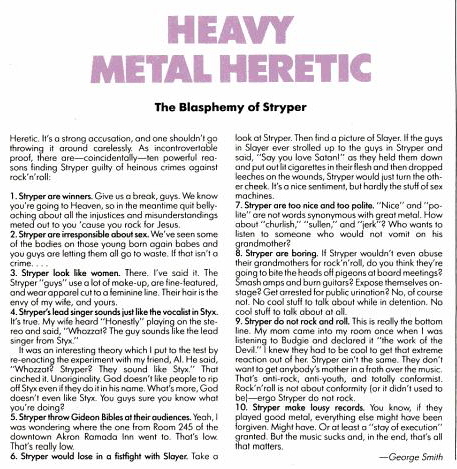
I wrote about Stryper back in 1988. They wore stage wear with the color scheme of bumblebees. Perhaps it was to get across the message they were as the industrious pure-hearted worker insect, toiling without complaint — for Jesus. One of their records was called The Yellow and Black Attack.
They were made for me to insult.
Brian Carson, drummer for the Highway Kings, really loved Stryper. Paradoxically, it never impeded his playing rock ‘n’ roll for bikers, power drunks and miscellaneous scum in dive bars.
This week the Cult of Cyberwar was out in force at the RSA convention. At such a security con one expects a good deal of hot air meant to serve the corporate and government cybersecurity business infrastructure.
But even by the really lax Americans standard for cyberwar/cyberterror hype, this was an excessive exhibition.
“Every major company in the US and Europe has been penetrated — it’s industrial warfare … All the little cyber devices that the companies here sell have been unable to stop them. China and Russia are stealing petabytes of information … Nation states have created cyber-warfare units. They are preparing the battlefield … We have the governments of China and Russia engaging in daily activities successfully that the US government and private industry are not stopping and they are stealing anything worth stealing.” — Richard Clarke
Clarke was mentioned earlier in the week, here coincidentally, in a flog for his April-skedded book on the menace of cyberwar.
In that piece, it was said our most backward enemy, North Korea, is a deadly menace because the very nature of their backwardness renders them immune from our cyber-retaliations.
“White House Internet security coordinator Howard Schmidt on Tuesday at RSA released a declassified version of a Comprehensive National Cybersecurity Initiative,” informed AP.
The Federation of American Scientists posted a copy of that here.
To call that an underwhelming contribution to public knowledge on the government’s cybersecurity strategy is to do a disservice to the definition of underwhelming. By reasonable standards, Schmidt and the White House could have done nothing at all and the end result would be indistinguishable.
DD blog posted on Howard Schmidt being dubbed a ‘rock star’ of cybersecurity on Monday here.
It was a ludicrous statement then. Now it’s even more so, if such a thing is possible.
More quote, from FBI head Robert Mueller:
“As you well know, a cyber-attack could have the same impact as a well-placed bomb … In the past 10 years, Al-Qaeda’s online presence has become as potent as its in-world presence … Al-Qaeda uses for the Internet range from recruiting members and inciting violence to posting ways to make bio-weapons and forming social-networks for aspiring terrorists, according to Mueller,” informed the AP.
This material has been debunked so often it’s not worth going into detail over why it’s so pandering. Suffice to say, DD has looked at virtually all al Qaeda recipes for bioweapons.
They can’t make them from their Internet-distributed recipes. Period.
Mueller knows this, or some certainly do at the FBI, very probably those who just closed the case on a real bioterrorist, Bruce Ivins, the anthraxer.
Bruce Ivins did not use Internet recipes to make anthrax mail that killed five and terrorized the country. He used a gold standard flask of anthrax spores accumulated in his laboratory at Fort Detrick. Plus his lab skills as one of the foremost experts on anthrax in the country.
All this does is point out the obvious: That you can say anything you want in the US, no matter how devoid of content, substance or full of stuff handcrafted for an audience of unquestioning fools and get away with it all the time. As long as you’re vetted as an allegedly sane authority figure.
And that goes double and triple for the Cult of Cyberwar.
There is one thing the Cult of Cyberwar and its fuglemen never allow in stories.
That would be comparisons from the real world. That’s because incoveniently bringing up Bruce Ivins when someone is babbling about al Qaeda passing around bioweapon recipes on the Internet is a real show-stopper.
Another such show-stopper was posted by Paul Krugman earlier this week. Krugman is a Nobel laureate. Richard Clarke, Howard Schmidt and Robert Mueller are not Nobel laureates.
Krugman knows how to use data and statistics graphically to make a point.
In his “Great Failure” blog post, Krugman put up a plot showing a projected one trillion dollar loss in real goods and services in the US as the a result of the economic collapse brought about by Wall Street.
Not hackers and nation-states prepping the battlefield against us for cyberwar.
“It’s crucial to realize that the trillion dollars’ worth of goods and services we could have produced this year, but won’t, is a loss we’ll never make up,” wrote Krugman on Monday. “And that doesn’t count the suffering and damage to our future inflicted by the non-monetary costs of mass long-term unemployment.”
It certainly puts the Cult of Cyberwar in perspective.
Alert readers will have noticed that recently DD began throwing Cult of Cyberwar stories into the ‘extremism’ category. That’s because that’s what the public message on the subject now amounts to.
If someone had asked me in 1985, the year I earned my Ph.D. in chemistry, if I thought the US would be a profoundly more backward country in 2010 I’d have likely thought they were nuts.
The linkage of evolution and global warming is partly a legal strategy: courts have found that singling out evolution for criticism in public schools is a violation of the separation of church and state. By insisting that global warming also be debated, deniers of evolution can argue that they are simply championing academic freedom in general.
A better editor or journalist might have written the second sentence this way:
By insisting that global warming also be debated, deniers of evolution absurdly argue they are championing academic freedom in general.
Another way to put it is that they are ‘bundling their flat-earther disbeliefs.’ And as usual, it’s solely the property of the current Republican party and Evangelical Christian religion, the American Taliban.
The Discovery Institute makes an appearance in the Times story, a fringe agency that has continuously fought to have creationism taught in biology class. Quite naturally, it has also latched onto global warming denial as a convenience.
It again reminds me of Lehigh University’s predicament: Professor Michael Behe, advertised as a senior fellow at Discovery.
Behe arrived at Lehigh through vetting by its Department of Chemistry as I was leaving. The search committee, of which my advisor was a member, thought he was grand.
At the time, Behe was either keeping his opinions about evolution to himself or perhaps no one was really paying attention.
In the mide-Nineties, DD even recalls a hastily put together alumni letter issued by the same department lauding Behe’s book, Darwin’s Black Box, for landing on bestseller lists. This only demonstrated that someone rather benighted in the place had not actually read it.
By the time Lehigh — a school that prided itself on its science and engineering curricula — got its act together with regards to Behe, he’d done all the damage he could.
Writing editorial features for the New York Times and other places on intelligent design — evolution deniers code for creationism — he had generally contributed to the casting of the impression in the lay public that there was significant scientific doubt about evolution.
Behe also had tenure at Lehigh.
And the only thing the school’s biology department could do was post a really late-to-the-party disclaimer on him.
I was traveling via Los Angeles International Airport — LAX — last week. Walking through its faded, cramped domestic terminal, I got the feeling of a place that once thought of itself as modern but has had one too many face-lifts and simply can’t hide the wrinkles anymore. In some ways, LAX is us. We are the United States of Deferred Maintenance. China is the People’s Republic of Deferred Gratification. They save, invest and build. We spend, borrow and patch.
Whenever looking up at the intellectual giants in the sky I never have to strain to see little Tommy jetting about the country (or world) to interview some really big corporate swell. Some person whose boots are always to be licked, be they a wizard sipping strawberry lemonade with Friedman on a patio at Caltech or a king of the corporate world, for it is these people who are packed with wisdoms the rest of us shits cannot fathom or appreciate.
I had a chance last week to listen to Paul Otellini, the chief executive of Intel, the microchip maker and one of America’s crown jewel companies. Otellini was in Washington to talk about competitiveness at Brookings and the Aspen Institute. At a time when so much of our public policy discussion is dominated by health care and bailouts, my public service for the week is to share Mr. Otellini’s views on start-ups.
Yes, I think we can all agree, Intel is quite the start-up. And who better to hear such a man leader than more wonderful and smart people at Brookings or the Aspen Institute, places where the rest of us are properly forbidden to go.
You can guess what comes next.
The same old story: America costs too much compared to China, a real laugher if you’ve been reading any stories about the many medium-sized towns in America emptying out and collapsing as a result of our current national sickness.
What Americans aren’t is too expensive. It’s just damn inconvenient to use them after their wages have been compressed for two decades, because the Chinese are still cheaper and one doesn’t have to worry about pollution, really squandering energy, the occasional pesky union, or dumping hydrofluoric acid into the back lot in plain sight until the silica in the earth catches on fire.
Give us more R&D tax credit, from one of the most successful companies in the world, says the guy who runs it.
Would someone tamp a cigarette out in his eye?
If the government just boosted the research and development tax credit by 5 percent and lowered corporate taxes, argued Otellini, and we “started one or two more projects in companies around the country that made them more productive and more competitive, the government’s tax revenues are going to grow.??? With the generous research and development tax credits and lower corporate taxes they receive, Intel’s chief competitors in South Korea basically have “zero cost of money,??? said Otellini. Intel can compete against that with superior technology, but many other U.S. firms can’t.
We must eat our moldy peas “because smart, skilled labor is everywhere now. Intel can thrive today — not just survive, but thrive — and never hire another American.”
To change this, of course, wealthy corporations must receive more tax credits, government incentives and rewards. So while you are eating your crappy-tasting peas this year and the next, implies little Tommy, you must hope our government smartens up enough to realize it must give much more to those who have everything before it trickles down to those of us grubbing around in the dirt.