In any case, the Cult of Electromagnetic Pulse Crazy has been getting caught in the DD blog spam filter this week, first for its Internet radio show.
And now for a techno-thriller posted on-line, written by someone who cleaves to the “Ludwig Van Mises Institute,” an eye-rolling place dedicated to promoting goldbuggism and persuading assorted nuts plutocrats to hide their money in tax-dodge banking nations like Switzerland and Lichtenstein.
Here’s the spam synopsis:
“A short story showing how powerful elite Washington & London interests and central bankers could manipulate American foreign policy using a black flag event in order to guarantee the American dollar remains the world’s reserve currency. Follow what could be the next Middle East conflict in the Persian Gulf region involving the US, UK & Iran over the dollar and oil reserves and the resulting [electromagnetic pulse attack] attack and world financial crisis starting in the Middle East.”
Yeah, I know, I can’t follow the logic, either.
Be that as it may, there are threads connecting the Cult of EMP Crazy and the fiat money kooks. They mostly have to do with extreme right philosophies about imminent catastrophe linked to conspiracy from the Middle East and the collapse of American civilization. And, of course, the dollar.
DD spent a couple minutes reading the story, or what there is of it.
A poor man’s piece of Tom Clancy fan fiction, it’s a tale of a provoked war with Iran. Iran retaliates by launching an electromagnetic pulse attack on the oil fields, rather than the usual target — the United States.
The price of gold soars, the dollar “dies” and that’s the end of the installment.
There’s a stalwart old general, set up to be the hero, who doesn’t do anything in the first chapter but worry about US currency and sovereign debt.
A sample. so you get the drift (no link — Google it if you must):
Later following the 2008 financial crash [the general] delved even into finance and politics with Wood’s Meltdown book and then Ron Paul’s End the Fed. Although he didn’t vote for Ron Paul in 2008 because he thought it improper to mix politics with military service, he had begun to get a thorough education in what had happened to the Constitution and his country he had sworn an allegiance to defend.
He privately attended several Mises Institute events and when at home logged on to read The Mises Blog, LewRockwell.com and The Daily Bell almost every day. He read Hayek and Ludwig von Mises including even Human Action.
That’s draw-you-in stuff.
I also leaned William Forstchen’s One Second After is Mahmoud Ahmedinejad’s favorite English-language book. Presumably because it’s about the end of American civilization after an electromagnetic pulse attack.
If you dig around enough in this type of material, eventually you find the Ludwig Van Mises fiat money kooks are, like the Cult of EMP Crazy, very fond of videos with high production values.
Mississippi, where 34.4 percent of the people are obese, has the highest obesity rate. Other states with obesity rates above 30 percent include: Alabama, Arkansas, Kentucky, Louisiana, Michigan, Missouri, Oklahoma, South Carolina, Tennessee, Texas and West Virginia …
Correlate with percentages who hold disbelief in the President being an American, global warming as hoax, etc …
Yep, it’s a stereotype. And sometimes the stereotypes have some accuracy going for them.
Life expectancy decline in the southern red and backward part of the country. “I guess the geography of the decline speaks for itself,” says the blogger.
There’s the exception to the national fatness demography in New Jersey. Where a lot of people now have buyer’s remorse.
[A] form … made by combining together phrases from random web searches … Flarf started off as a joke but then these joke poems that people were coming up with “evolved from ‘bad’ to ‘sort of great'”.
“Sort of great” being a description with great elasticity.
Confirming years of warnings from government and private security experts, a top Homeland Security official has acknowledged that computer hardware and software is already being imported to the United States preloaded with spyware and security-sabotaging components …
[Congressional question to functionary from DHS]: “Are you aware of any component software (or) hardware coming to the United States of America that already have security risks embedded into those components?”
[Answer: Hesitant, stumbling “yes”.]
Pre-loaded junkware and smart devices manufactured overseas have been obvious sitting duck targets for computer criminals for years.
And how does one absolutely distinguish the threat of suspiciously malicious junkware from stuff so full of holes and bugs it’s not fit for any purpose?
Its just deserts when the corporate bottom line, outsourcing and anything that detracts from instantaneous easy do-nothing profits on services and digital goods trumps everything else.
A TIME blog, called TechLand, muses on a scripted routine now fifteen years old.
And that’s because you can walk right in off the street at such places and be uninformed and incurious. Today this is an asset because a grasp of history and the vast sprawl of the issue gets in the way.
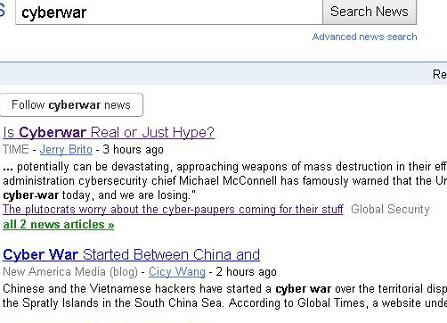
Online security risks have become increasingly prevalent with the likes of Anonymous and LulzSec continuing to expose the sorry state of corporate network security, and policymakers are clamoring to “do something??? to address the threat. Unfortunately, there is a tendency in Washington to employ the rhetoric of war when talking about cybersecurity, which is a very dangerous tendency.
For example, in a Washington Post op-ed today, Senators Lieberman, Collins and Carper argue for cybersecurity legislation, saying, “The alternative could be a digital Pearl Harbor — and another day of infamy.???
“Electronic Pearl Harbor, electronic Pearl Harbor, electronic Pearl Harbor, ad nauseum.
“I certainly agree that the notion of an electronic Pearl Harbor specifically, and more generally of information warfare, has been hyped to the point of nausea,” said the vice president of one intelligence contractor that has multi- billion dollar annual revenues from its work in information technology. “This is but the latest of many fads in ‘the Community’,” he told S&GB, “and like most of its predecessors, [it] has just enough substance to require that serious attention be paid, but not nearly as much substance as the Cassandras of the Community would have us believe.”
Quite a bit has changed in the intervening period. It’s not a fad anymore, it’s a way of life.
And billions on-line are now confronted daily with malicious software and criminal activity. In 1998, the average citizen’s exposure to such things was orders of magnitude less.
Another big change has been the total decoupling of national security interests, including computer security, from virtually anything have to do with the great mean — the middle class — in this country.
Now, the entire public debate is basically high-button threatre designed to convince everyone of the need to protect the plutocrats from the paupers in cyberspace.
A cursory reading of [the historical record] of beware-of-electronic-Pearl-Harbor notices since the late Nineties reveals their sameness. All of them are ultimately based on the simplistic idea that unknown enemies on the other side of the world can overturn substantial portions of the US by flicking a few software switches.
This is essentially the result of two things: Now way-old American national security infrastructure near psychotic paranoia over magical technological surprise that never occurs and now way-old methodology on massaging the national treasury for funding.
The other bits in the current arguments about cybersecurity and cyberwar are the warnings that the financial system could be hit …
The argument that the US financial system ought to be protected from electronic Pearl Harbor would, if all Americans actually knew of it, strike them as ridiculous.
It’s easily observable that people are much more interested in protection from the racket that’s the American financial system. Cyberwar and hack attacks on it, when compared to the damage inflicted by Wall Street misbehavior, are absurdly small things.
“The average American does not view the economy through the prism of GDP or unemployment rates or even monthly jobs numbers,” David Plouffe said at a Bloomberg breakfast event Wednesday. “People won’t vote based on the unemployment rate, they’re going to vote based on: ‘How do I feel about my own situation? Do I believe the president makes decisions based on me and my family?’ “
He’ll trade the Democratic Party for a race in which you hold your nose and vote for the President because the alternative is quick brimstone and ruin. Rather than slow death in pieces.
And, yeah, he’s right. People don’t vote statistics. They vote on the impression they have because either they’re out of work, family members are out of work, friends are out of work, or some combination thereof. Too much time spent rubbing the hands together over the wonder of a Twitter press conference.
Life as a statistic, lads! I was in the space between the dotted red line and the solid red line in 2010. Now I’m just back to the regular line.
Americans who illegally download music, movies and games may soon find their internet access grinding to a halt. The nation’s top internet providers – including Verizon, Time Warner Cable, AT&T, Cablevision and Comcast – have agreed to a new system in which users suspected of digital copyright infringement will be given a series of six warnings by email or other means. Repeat offenders would be threatened with progressively severe punishments, culminating in reduced connection speed or having service cut off entirely. Customers will be allowed to contest each warning.
The internet carriers hope to deter piracy through annoyance …
Of course, no one will be punished for downloading pirated material from a Google property … like YouTube, one assumes. Lest the entire business model collapse.
The only working rule in effect here is if the group or individual is a current big seller, their legal fixers and YouTube will work to keep their albums from being uploaded. So that the videos can be monetized through Vevo.
What would happen if ISP’s blocked YouTube, for the annoyance of users into stopping their downloading/streaming of pirated content?
Nugent, a supporter of GOP candidates and critic of Obama, told The Arizona Republic recently that “politics are extremely personal” as he defended [Tom Petty’s] right to ask Bachmann to stop playing American Girl.
Nugent happens to think Bachmann is a “great American,” and told The Republic she can use one of his songs. But Nugent is waiting for Texas Gov. Rick Perry to jump into the race and says Stranglehold would be appropriate for Perry because it’s “the ultimate soundtrack of defiance.”
In the mind of Americans, “Born to be Wild” probably rates higher on the defiance song list.
Anyway, it’s selective news. Nugent is presented as reasonable.
And he never is, this just another example where some noxious tar baby is repackaged as a voice of experience and reason.
YOU REMEMBER THE NIGHT THAT YOU LEFT ME
YOU PUT ME IN MY PLACE
GOT YOU IN A STRANGLEHOLD NOW BABY
GONNA CRUSH YOUR FACE
The last two lines are a pretty accurate representation of what national GOP policy is. But since they’re blunt and frightening to old white people when they come blaring out of the loudspeakers at somewhere over 90 db, the song’s unusable.
But none of this is important in a national newspaper for a story that gets reprinted in lots of little and medium-sized ‘burg rags.
The title — Stranglehold — is a bit of a tip-off. But things have gotten so dense nationwide, the soft touch doesn’t work. Only spelling it out in detail does.
This is still a fine campaign song. Would look and sound great on television news or a comedy show.
From the wire, things a computer program or tape-recorder could furnish:
“The economy as a whole just isn’t producing nearly enough jobs for everybody who’s looking,” Obama said in prepared comments in the White House Rose Garden. He cited “tough headwinds” that are exerting a drag on the economy …
He also cited the need to “rein in the deficit” and come to an agreement to raise the debt ceiling, in order to give businesses the confidence they need to start hiring.
Most economists believe that cutting spending will reduce growth …
When the Associated Press note-taking piece immediately tacks on the “most economists believe” bit, it’s done for.
Whatever is driving the President now, no one with any sense can fathom it other than to state he’s bought into the right wing delusion on government spending and deficits causing the country’s failure. And that it’s linked to a groupthink of the worst kind.
In 2012 it won’t matter if the parts of the Democratic base simply don’t vote for the man. The state is a lock. But it’s astoundingly demoralizing to know the President has calculated he can install horrendous policy because we’ll hold our noses and vote for him since the alternative is so much worse.
From the Dept. of Very Small Laughs, EMPAct America, the umbrella organization also referred to as the Cult of Electromagnetic Pulse Crazy has hired a spammer to advertise their latest venture, I guess because it is under-appreciated at this time of national travail.
It’s an Internet radio iPod broadcast called, obviously enough, EMPAct Radio.
This week one of the spam filters on my domain picked up a couple of attempt to upload a canned advertisement for it into comments.
No link, it’s easy enough to Google. The lead-in, to urgent blip-blipping music:
“You’re listening to EMPAct Radio, the only radio network dedicated to addressing electromagnetic pulse and other threats that could end American civilization as we know it … For you nation, for your family, and for your way of life … it’s EMPAct Radio!”
“This should be a great show!” adds the host before I move on. Sales pitches for Electronic Armageddon and America in the Dark DVDs included.