09.10.12
‘What is that yellow box?!’
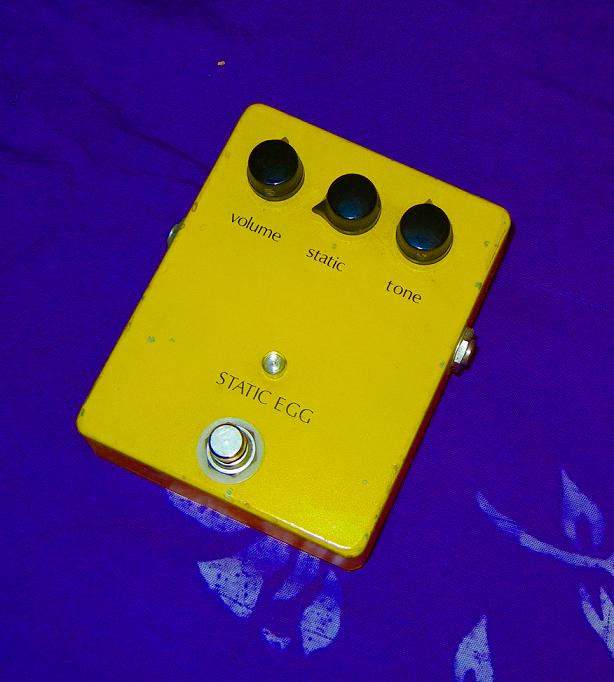
From Mark Smollin, DD band drummer at Saturday rehearsal, after a few rounds of it on early-Seventies style hard rock. It’s a Holowon Static Egg, now ten years old, I think, dating back to when a niche US industry for handmade guitar effects, usually copies of old classic circuits, emerged. Think — not made in China — where the major manufacturers shipped all their production and tooling.
The Static Egg is a fuzz tone and they’re basic equipment for copping the feel of Sixties and early Seventies blues rock. A good one, and this is, enables a great woolly distortion, static-y shrill squealing noise, horn-like bleats, and just about everything in between.
When it’s on, it sounds righteous, from slightly compressed and clean to heavy and crushing with a twist of the guitar’s volume knob. And it tears its own hole in any mix. (It’s not necessary to explain the knob functions. You just twiddle until it sounds right. There’s nothing to it.)
For example, if you have a Stratocaster and you want to do something ala Jimi Hendrix, a certain kind of fuzz tone — called a Fuzz Face, helps a lot. The Static Egg isn’t a Fuzz Face but it will still do the job.
This tune shows it off well. It gives a bit of sustain to the clean guitar parts, makes the jangly and twangy stuff more penetrating, furnishes the crunch on power chords, and does the bleats and stereotypical Sixties fuzz sounds, too
Strat and Static Egg fuzz (plus an octave-up fuzz on the outro.)
C’mon, this is a great spoof with a nice grifted image of LiLo, too.
After I bought mine, the production of Static Eggs seemed to stop for many years. More recently, a newer model has been spotted, one with four knobs and a bit more of a conventional look. But I’ll always have mine, it looks fine now with ten years of wear and the Letraset transfer lettering still very legible. Fuzz tones are close to being bulletproof.
The Static Egg also is the primary sound for Carla Sandwich, which accentuates what you can do for the sake of trash rock.
YouTube rewards users who upload demos of equipment. like fuzz tones, where the player sits around, plays a few riffs from favorite songs and twists knobs by himself. A more valid demonstration is to show it in a recording. But that’s harder, YouTube doesn’t reward the practice, and it makes tyros and amateurs whine they can’t hear the guitar and box by themselves.
In the real word, not Google/YouTube’s universe of dull copycats, guitar players use effects and tone in the context of tunes.
Fuzz tone effects didn’t capture the imagination because they were popularized by random nerds humorlessly copying fragments of someone else’s famous riffs. They were in radio cuts by the Rolling Stones, Jimi Hendrix, Iron Butterfly and Led Zeppelin.
onthewaterfront said,
September 10, 2012 at 2:39 pm
Remember the old wa peddles nearly indestructible
George Smith said,
September 11, 2012 at 8:47 am
Yeah, they go together, almost inseparable.