08.24.11
WaTimes and counterfeiting funnies
Today, at the Washington Times — the de facto right wing newspaper of the capitol, this unintentionally hilarious tableau:
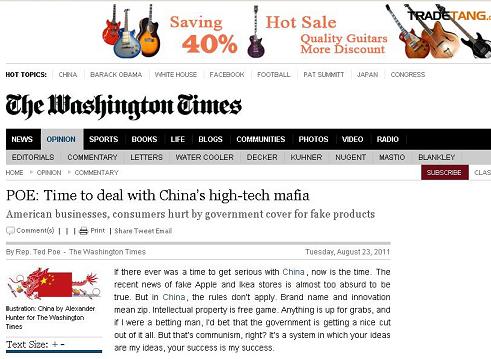

In case you’re late in on this series, the banner ad above the opinion piece is for a Chinese internet trading site selling counterfeit American electric guitars. The opinion is a Congressional politician’s complaint about Chinese counterfeiting.
The guitars are sold out of Beijing with many of the ads spun out on Google’s AdWords/AdSense business.
Clicking through the WaTimes ad takes you to a page selling fake Paul Reed Smith guitars. Paul Reed Smith’s are made in Maryland and are the very high end of domestic electric guitar manufacturing.
When DD blog first noticed the made-in-China counterfeiting business, its ads were on the Washington Post and pointed to sales for faked Gibson guitars. I notified Gibson and the Post and the ad was changed to specifically advertise “Made in China.” And the Post ad also switched clickthrough to fakes of the product of the much smaller company, Paul Reed Smith, the company victimized today.
It’s explained in greater detail in this series of posts.
The funny part comes in the WaTimes opinion piece, written by a politician, underneath the TradeTang ad.
Excerpted:
If there ever was a time to get serious with China, now is the time. The recent news of fake Apple and Ikea stores is almost too absurd to be true. But in China, the rules don’t apply. Brand name and innovation mean zip. Intellectual property is free game. Anything is up for grabs, and if I were a betting man, I’d bet that the government is getting a nice cut out of it all. But that’s communism, right? It’s a system in which your ideas are my ideas, your success is my success …
I also met Jim D’Addario, CEO of D’Addario Guitar Strings, an instrument strings manufacturer based in New York. This business, family-owned since the 1600s, has spent millions to stop the manufacture of counterfeit guitar strings in China. Mr. D’Addario has watched several coordinated raids on manufacturing facilities in China that exist solely to make counterfeit copies of D’Addario, Fender, Martin and other American companies’ guitar strings. On a website, it’s hard to tell the difference between a counterfeit and a legitimate D’Addario guitar-string set. As with the Chi flatirons, the packaging looks identical, but the fake package of guitar strings contains a hologram sticker – just to trick you – and the product inside is horrendous. It is that unbelievable.
“So what do we do?” asks the politician, “Rep. Ted Poe, a Texas Republican, was a prosecutor and judge in Houston [and] serves on the House Judiciary and Foreign Affairs committees.”
Nothing. “Get tough on China.”
Big horselaugh.
American businesses, including guitar manufacturers, downsized and outsourced their manufacturing to Asian labor, effectively turning their US facilities into artisan custom shops for the plutocracy. In this bargain, repeated all across US non-military domestic production, the American companies gave up intellectual property and trained the Chinese to make their goods for the sake of the short term bottom line.
The Chinese are not better workers for the modern and future world economy and they do not have schools where people were trained to make electric guitars. This, lack of training and education, being the argument/excuse/insult so often used to explain why Americans are laid off and obsolete.
The problem is bilateral in its perfidy. China’s leaders are afraid of mass unemployment. They must keep people working and the way to do that is to sell all dry goods to the US middle and lower class. And US corporations have no interest in American labor because, being more expensive, it impinges on profits to the shareholders. They’re content with the US government ignoring mass unemployment.
So now it is only logical that some Chinese, maybe many, would see no point in maintaining licensing agreements with American multi-nationals once they were capable of copying the goods, or making cosmetically adequate facsimiles, on their own.
Comments left on the Chinese sales site, and many YouTube vidoes, show young American men who have no problem buying fakes of US premium goods. Since middle class wages have been destroyed this is a logical development, too.
And American companies, individually and collectively, whether they have engaged in short-sighted predatory behavior or forced into it by the competition, do not have the resources needed to combat the problems brought upon us by the great trade imbalance.
This post has been updated for clarity.
Google is not your friend
Google is responsible for distributing many, if not all, the ads mentioned in this series. In so doing it makes easy money from the benefit of selling counterfeit American products. But there is little any individual company can do by itself to rectify the matter. Google is so powerful it can simply ignore you.
In a related matter, from the wire today:
Google Inc, which has agreed to pay $500 million for accepting ads from Canadian pharmacies to sell in the United States, said in a statement that it should not have allowed the ads in the first place.
The U.S. Justice Department, which announced the settlement on Wednesday said that it represented all of Google’s revenues from Canadian pharmacy advertisements and was one of the largest ever in the United States.
Google said in a brief comment that it had banned advertising of prescription drugs in the United States. The announcement was made in a February 2010 blog post.
“However, it’s obvious with hindsight that we shouldn’t have allowed these ads on Google in the first place,” the statement said.
amanfromMars said,
August 24, 2011 at 9:47 am
Hi, George,
Regarding the Google slap on the wrist ……..