A Federal Grand Jury indicted a Browne’s Addition man Wednesday for allegedly mailing five letters laced with ricin. Matthew Ryan Buquet faces life in prison if a jury finds him guilty.
Buquet sent ricin-tainted mail to the White House, Fairchild AFB, a judge in Spokane and the “downtown Spokane post office.” A letter sent to the CIA was not delivered and returned to a postal facility.
All letters were said to include the statement:
“We have a bomb placed. We are going to Kill you. Hezbollah.”
Buquet had a page on Facebook. On it he liked his smartphone, “Hannibal,??? the tv show, PSY’s new single, Led Zeppelin’s “Stairway to Heaven,??? Cody Wilson’s 3D printed plastic gun and the right wing crank newsite, Newsmax.
This, in my mail, from Daniel Ellsberg on another petition making the rounds, an ACLU-sponsored plea to undo NSA spying:
There has not been in American history a more important leak than Edward Snowden’s release of NSA material …
The technical capabilities are in place. With the flip of the switch or another major attack, we may find ourselves in a dangerous situation in which average citizens, along with Congresspersons, journalists and their sources, even judges, are watched around the clock and are afraid to dissent. The core fixtures of our democracy—the right to protest, the right to live freely in the pursuit of life, liberty, and happiness without government intrusion—could be weakened beyond repair.
I remain afraid of this reality, but we cannot hesitate to address it. I believe we now have the information and inspiration we need to stand up before it’s too late to turn back …
I remain both pessimistic and skeptical. It’s already too late for many things.
Do Internet petitions work? Do you think the national security megaplex will be wilted by tens of thousands of people using their smartphones to digitally sign an on-line petition?
Go ahead, stab that app with your righteous digit of anger! Take that, nosy surveillance state!
Consider the changing identity of the most valuable company in America. For a long time, it was GM, then Exxon, then IBM. These were companies with huge visible production activities …
But now it’s Apple, which has hardly any employees and does hardly any manufacturing. The company tries, through fairly desperate PR efforts, to claim that it is indirectly responsible for lots of US jobs, but never mind. The reality is that the company is basically built around technology, design, and a brand identity.
There was an old Dilbert in which the pointy-haired boss explained that the company had discovered that despite its slogan, people weren’t its most important asset — money was, and people only came in at #8 or something. Actually, in Apple’s case market position is its most important asset.
There are a couple of obvious implications from this change in the nature of corporate success. One is that profits are no longer anything remotely resembling a “natural??? aspect of the economy; they’re very much an artifact of antitrust policy or the lack thereof, intellectual property policy, etc. Another is that a lot of what we consider output is “produced??? at low or zero marginal cost.
Smartphones and mobile computing haven’t been transformative for the American populace, at least from what I can see at Baja Ranch everyday. Everyone has an iPhone with apps for every social networking site and more processing power than many older PCs. But they still can’t earn enough to get out of the WIC, SNAP and EBT programs.
Every day it becomes easier to detest Apple and the rest of America’s “tech” industry.
Pictures showing why WhiteManistan is slowly biting the dust and how the Republican Party will not be able to win a presidential election even after Barack Obama is gone.
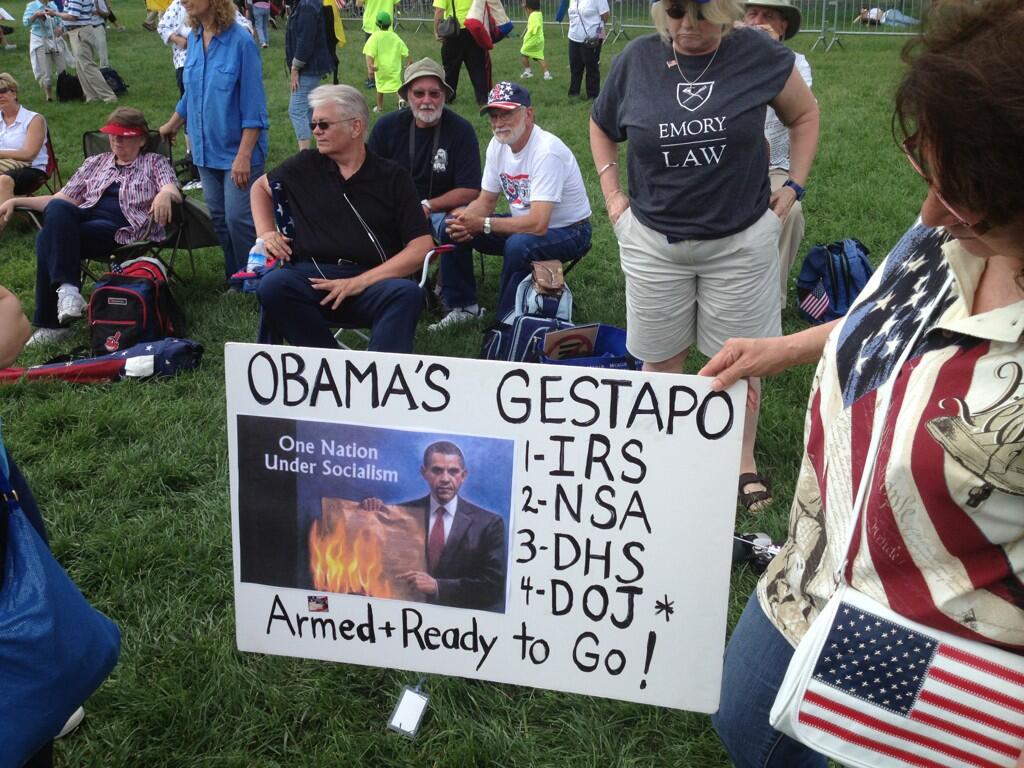
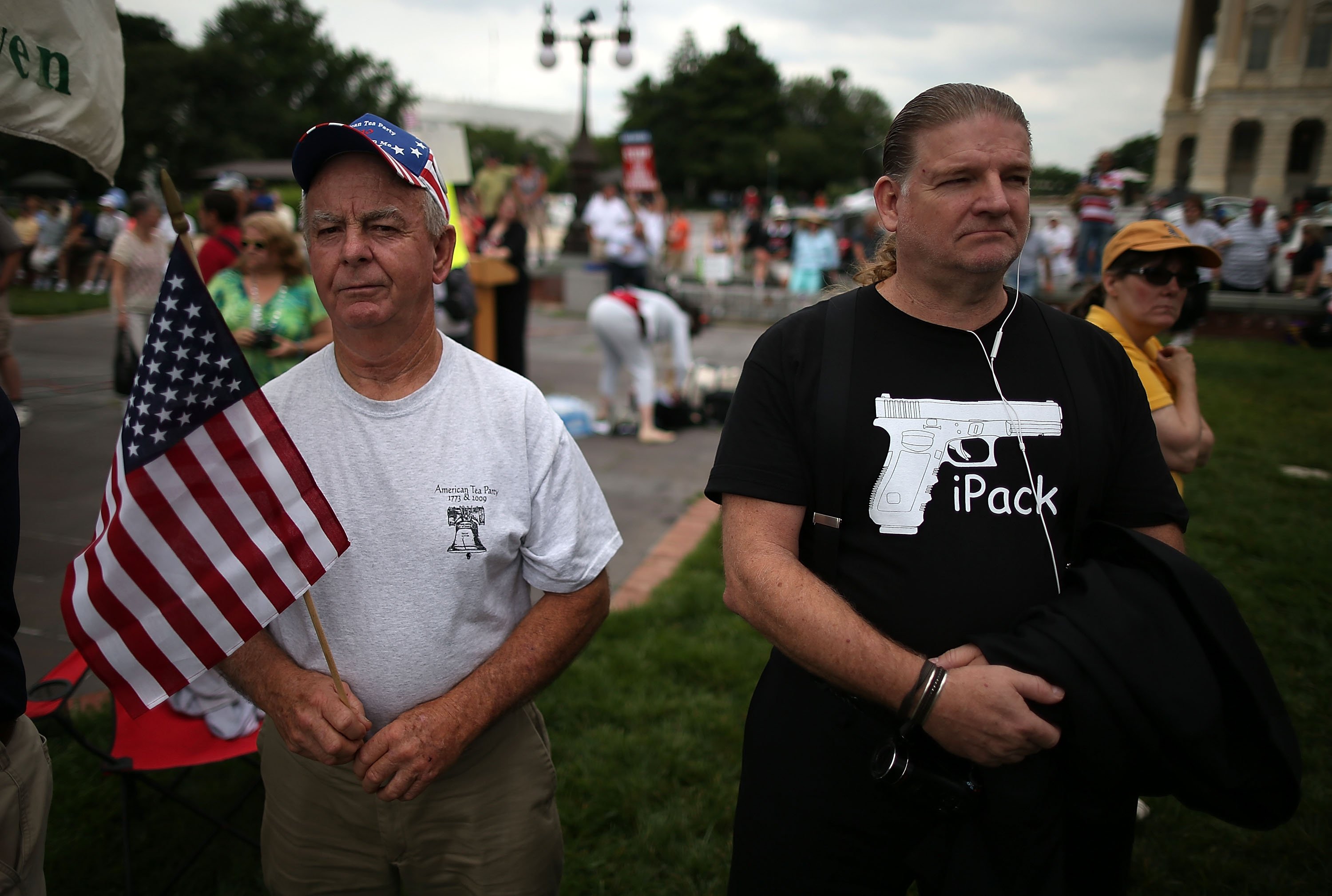
Tea Party people at an anti-IRS/anti-immigration legislation/anti-everything rally in DC. You’d either take laughable pictures, too, or leave for a few hot dogs.
Major fun just waiting to happen. Were thinking about ricin mail until others made it a summer fad.
THe NSA’s Keith Alexander has pointed to the case of Najibullah Zazi, a foiled improvised bomber (peroxide explosives, specifically) who was seized by the FBI in 2009, as evidence its PRISM surveillance program is critical for the safety of Americans. In the case, Zazi quickly reached a plea agreement with the government and was assumed to be cooperating with authorities. Many details in the plot against the NYC subway remain cloudy.
Nevertheless, it was big news at the time. Peroxide bombs were supposedly easy to make, great anxiety over them arising from failed shoe bomber Richard Reid and the infamous “liquid bombs” plot that got so many carry-on containers banned from flying in 2006.
The idea from the latter was that it was easy to mix a bomb in an airplane toilet.
The Guardian investigated the case and came more strongly down on the side of an assertion that the clue that led to Zazi had been found in a British counter-terror operation called Pathway.
In the case of Zazi, an Afghan American who planned to attack the New York subway, the breakthrough appears to have come from Operation Pathway, a British investigation into a suspected terrorism cell in the north-west of England in 2009. That investigation discovered that one of the members of the cell had been in contact with an al-Qaida associate in Pakistan via the email address sana_pakhtana@yahoo.com.
British newspaper reports at the time of Zazi’s arrest said that UK intelligence passed on the email address to the US. The same email address … was cited in Zazi’s 2011 trial as a crucial piece of evidence. Zazi, the court heard, wrote to sana_pakhtana@yahoo.com asking in coded language for the precise quantities to use to make up a bomb.
Eric Jurgenson, an FBI agent involved in investigating Zazi once the link to the Pakistani email address was made, told the court: “My office was in receipt – I was notified, I should say. My office was in receipt of several email messages, email communications. Those email communications, several of them resolved to an individual living in Colorado.”
Zazi, living in Aurora with his father, made attempts to purchase an inordinate amount of hydrogen peroxide at beauty parlor supply stores in a plan to concentrate the oxidizer, a necessary step in making a peroxide bomb. Later he holed up at a hotel in Aurora where he attempted to concentrate the material by heating on a stove. An FBI detention memorandum from 2009, here, traces his actions — he was under surveillance — and delivers an analysis of their meaning.
It mentions Zazi was observed and his communications with a confidant monitored by the FBI, exchanges in which he continued to ask for better instructions on making peroxide bombs. None of the notes indicate he was successful. Indeed, he may not have solved the problem of making bombs when he set out for New York City. There he had intended to visit a swimming pool supply store to buy hydrocloric acid, another ingredient used to catalyze the production of the final explosive peroxide-derived compound.
Zazi was subsequently arrested.
Another complaint, this against an FBI informant who was charged with making false statements in a terror investigation, shows that Border Patrol and Customs had been aware of Najibullah Zazi when he traveled to Pakistan, ostensibly for terrorism training in August of 2008, returning to NYC in January of 2009.
The complaint against Ahmad Afzali, lodged at Cryptome, is here. In it Najibullah Zazi is represented as “Individual A.”
Taken together, most of this points to the old-fashioned assembly of clues, along with a bit of good fortune, in the tip-off to the Zazi plot. There’s no conclusive indication that NSA findings were the Holy Grail on the case.
Coincidentally, old DD blog wrote a great deal about Zazi’s apprehension because of the hysterical statements that tended to accompany the discovery of peroxide bomb plots. In the US, there have been none successful during the war on terror.
Yesterday, DD commented that whenever would-be peroxide bombing terrorists are in the news, web hits go up. Way up. (This because of an old post that attracted people doing Google search on peroxide bombs entitled, Peroxide Bombs — Easy to Make.)
Everyone (well not everyone …) is looking for ‘how to make a peroxide bomb. Naturally, after reading about it in the news.
However, in retrospect, DD blog had an unusual spike of searches on how to make peroxide bombs from at least mid-August until yesterday. Some of it was attributed to continued news coverage and fallout from the Airplane Liquid Bomber Plot convictions in early September.
So I decided to drill down a bit and Colorado jumped out and bit me. DD blog almost never has any readers from Colorado. California, New York, northern Virginia, Texas, Pennsylvania and the UK are where most of the regulars phone in from.
Using screen snaps of Google Analytics returns, unusual search results line up from Aurora. Why is Aurora interesting?
Because, according to the US government — Najibullah Zazi and the Beauty Parlor Supply Store Bomb Gang were there shopping around for ingredients.
For example, from today’s Los Angeles Times:
“During July and August 2009 Zazi and others … purchased unusually large quantities of hydrogen peroxide from beauty supply stores in the Denver area … Zazi [made purchases] from a supply store in Aurora … In July, August and September 2009 [individuals associated with Zazi made purchases] from three different beauty supply stores around Aurora.”
Colorado logons for peroxide bombs, many in the last few days. (September/Fall 2009) Big circle is Denver. Aurora sticks out on drill down.
The significant number of logons for information on peroxide bombs occurs prior to the permanent detention of Zazi.
Zazi and unknown collaborators were in Aurora from September 6 – 10, at which point he flew to Queens on the 10th, and was back in Denver by the 12th. Are one, two or three hits here from Zazi and/or accomplices surveying the net? Maybe, maybe not. The information does not resolve it.
Continued from the old DD blog post:
At SITREP yesterday, I commented that the government’s indictment of Zazi showed the frequently seen al Qaeda poor man’s approach — to ineptly surf the Internet for bomb-making recipes, hoping something will fall into one’s lap that makes it as easy as baking a cake.
Despite a lot of media coverage on peroxide bombing being easy in 2006, this is not really the case. If it was, peroxide bombs would have been exploding quite frequently over the past few years.
Nevertheless, it led to a survey using Google Analytics and data-mining on DD blog statistics for search on peroxide bomb instructions, linked to times and countries of origin.
That piece, entitled Trends in Terror Prep Net Surfing from 2009, at GlobalSecurity.Org is here.
The original coverage of Najibullah Zazi was overwhelmingly focused on the peroxide bomb angle. This was because peroxide bomb-making, despite its total lack of success in the US, had become one of the hobby horses of US counter-terrorism and the media, starting in 2006. The script was that peroxide bombs were simple and could be brewed up on the spot.
History has shown this to be untrue, certainly in this country. Peroxide bombs can be made but they’re no easier to make than any other kind of improvised explosive. Instructions can be printed on the net, or in an issue of al Qaeda’s Inspire magazine, and still they do not spring up like daisies.
It requires an experienced bomb-maker, someone who knows the art and has done it many times, to make peroxide bomb-making, or any other kind of bomb-making, successful.
Zazi traveled to Pakistan for training, of some type, it is assumed. Was the training effective? Evidence in the FBI complaints against him does not paint the picture of an accomplished bomb-maker but rather someone who, up to the last minute, was still seeking advice on it.
Zazi was one of the clear first examples of a growing problem in al Qaeda — its inability, under US attack, to put dangerous and extremely competent agents into the field. As the war on terror continued it became more obvious. Quality of the personnel means a lot and al Qaeda men, increasingly, did not have it.
The American public has a short attention span. When Keith Alexander went before Congress and mentioned the Zazi bomb plot against the NYC subway hardly anyone would have been expected to remember the details.
On the other hand, it also hurt his testimony. Alexander is not a generalist expert on the war on terror. Up until last week he was a specialist who runs cyberwar and cyber-spying operations at the NSA for the Obama administration. He has been most famously in the press for saying Chinese cyber-espionage is causing “the greatest transfer of wealth in history,” congressional testimony on expanding American cyberwar operations and being the first NSA director to go to the DefCon hacker convention to hobnob and pat young people on the back.
So any testimony about the NSA’s alleged contribution to uncovering the Zazi plot, back in 2008-2009, was never going to be compelling or persuasive.
It is just an argument from authority. And do you believe such an argument? The Edward Snowden affair is all about not believing arguments from authority.
For about a year I’ve been saying the US has touched off cyberwar on the Internet. When it deployed Stuxnet into the Iranian nuclear program and continued to write and deploy malware for that purpose it ignited a clandestine battle.
Stuxnet could not be restricted or contained, as has always been the case with computer viruses. And that secret war has spread and resulted in retaliations.
It set up a growing black market for the hoarding and misuse of security vulnerability information by national cyberwar programs. And it triggered a digital arms and acquisition race among nations with the resources to dig deeply into the mechanics of cyberwar.
The US demonstrated it had an active and busy offensive cyberwar program and that it was expanding its size and capabilities. This has gradually come out in thinly veiled government and military position papers, security contractor news and hiring trends and in speeches delivered by US military men.
In effect, the US has made cyberwar a growing national security business, one that is global, one that a lot of big arms manufacturing and defense service corporations want in on. And there’s no putting the stops to it now. It will continue to roll, gaining momentum as more and more money is spent. More simply, there’s a lot of moolah to be had in screwing with people and other countries through digital arms. Organized crime has proven very little can be truly made secure and now professionally staffed and trained corporate military and intelligence agencies have great incentive to increase their action and leverage.
America has efficiently put itself in a terrible position to complain about the bad doings of others. We have always reserved the right to overdo stuff and this has backfired. Again. It’s a national trait.
Cynically, this may have been impossible to avoid. Having looked in on matters of national security for two decades, the corporate arms and government/military interests, purely on a profit-seeking basis, grew way too large and powerful for it to be otherwise. Lacking any oversight or serious attempt to rein things in, and there were none, the umbilically connected national security powers, mega-businesses and policy-makers were always going to go ahead with lobbying for and building a structure that was for cyberwar.
However, by ingenuously continuing to deliver the script that other bad actors, China, Iran, North Korea, etc., were behind much of the alleged badness on world networks, we set the stage for ruining our reputation.
These countries were at it, probing American business, infrastructure and military sites, putting in place mechanisms and practicing techniques that would allow them to strike in America at later notice. The mainstream media was complicit in delivering this baleful warning without daring to look in the mirror or inspect the other side of the coin.
And up until the Snowden affair, all you could read was the government and national security industry line, that digital Pearl Harbor was coming to the United States, courtesy of many bad guys aimed at … the financial system, the power, the water and on and on.
There was literally no end to it.
This was easily recognized at GlobalSecurity.Org and the other one or two respectable mainstream outlets I normally correspond with.
NSA director Keith Alexander, in the same speech last year where he claimed Chinese cyber-spying was bringing out the “greatest transfer of wealth in history,” added he was trying to ready the nation so that he would not have to go to Congress and explain things the day after a catastrophe.
Well, today General Alexander was in front of Congress, again after last week, for explaining things. But it wasn’t because this country had been subjected to “electronic Pearl Harbor.”
It needs repeating: The reveals by Edward Snowden have derailed Alexander’s (and the government’s) complicated script on digital doom and the accompanying mythology, delivering fundaments and information easier to grasp. The news is not as nebulous, the narrative more compelling.
As the owner of the most powerful military in world history, the US has been consequently also engaged in building the largest cyberwar machine.
From Schneier, at CNN (no link):
Today, the United States is conducting offensive cyberwar actions around the world.
More than passively eavesdropping, we’re penetrating and damaging foreign networks for both espionage and to ready them for attack. We’re creating custom-designed Internet weapons, pre-targeted and ready to be “fired” against some piece of another country’s electronic infrastructure on a moment’s notice.
This is much worse than what we’re accusing China of doing to us. We’re pursuing policies that are both expensive and destabilizing and aren’t making the Internet any safer.
The latest extremist tactic in legislatures of red states is to practice nullifications, tactics to supersede settled federal law. It’s white Confederacy strategy without firing on Ft. Sumter.
It’s been nearly 10 years since Thomas Frank wrote about the conservative takeover of his home state in What’s the Matter With Kansas? Back then, Kansas still had a Democratic governor in Kathleen Sebelius. But after last fall’s civil war, Kansas has emerged a more intense shade of red than even Frank imagined. The state legislature is the most conservative in the United States, and now there is absolutely nothing stopping the Brownback revolution – one which happens to be entirely at odds with any notion of the GOP adapting to the broader social and demographic changes in the country. If anything, these purists argue, Republicans lost in 2012 because the party wasn’t conservative enough.
No one can say that about Sam Brownback, who is rumored to be mulling his own presidential run in 2016 – and using Kansas as a sort of laboratory, in which ideas cooked up by Koch-funded libertarian think tanks can be released like viruses on live subjects. At a national level, the GOP remains stuck in a reactive position, pursuing executive branch “scandals” and blocking Obama’s policies with no real power to effect changes of their own, and so states like Kansas have become very important to the future of the party’s far-right wing. Consider it a test, a case study – proof, finally, that an unfettered hybrid of Randian free-market dogma and theocratic intolerance can create, in the bitter words of outgoing Senate President Steve Morris, one of the ousted moderates, an “ultraconservative utopia.”
The RS piece charts the evolution of it up to and including Sam Brownback’s tenure as governor. The end result is a state that will eliminate taxation for the sake of Koch industries and destroy its educational system. Other matters include declaring an embryo feel pain at 21 days and adjusting state abortion law accordingly while simultaneously creating an environment which encourages violence toward people who work in an abortion clinic. (There is only one in the entire state, George Tiller’s, who you will recall was assassinated.)
In addition, the Kansas legislature has passed an unconstitutional gun law that maintains arms manufactured and sold within the state are not subject to federal laws. It’s a nullification act and a sovereign citizen type of extremism. Indeed, Brownback even uses the word sovereign in a letter warning Attorney General Eric Holder not to mess with Kansas.
All this only underlines the Republican Party’s problem with young people, Rolling Stone’s core audience. Those who read the article would view Kansas as full of bad — old, angry white guys fulminating against the US government and everyone else not exactly like them.
Yet they still lack the nerve to seize a federal facility or jail those passing through from those places in the country they view as un-American.
“[Brownback’s Kansas budget bill] was designed, frankly, to take care of Koch Industries,” one conservative but not crazy politician tells the magazine. “I could see that it took money from very poor people and benefitted me, personally, too significantly. And I’m not poor.”
They subsequently ran him out of office.
Rolling Stone calls Kansas a “rogue state.” A better description is “pariah state.” And the United States has a number of them, all engaged in what people see but awkwardly refuse to acknowledge as a Cold Civil War.
What’s the answer? What was the answer to apartheid South Africa? Putting the squeeze on economically and socially.
What does Kansas export? Aircraft engines, wheat and meat, primarily. But it’s a puny exporter compared to a state like California. Kansas exports grossed 12 billion in 2012, California — 162 billion.
Canada is Kansas’ primary buyer, taking 22 percent of the trade.
Encouraging a major trading partner not to do business with a state with discriminatory law and a government inimical to social welfare and science would be a start. Kansas is a poor state and its current trajectory will make it more so. Even a small number of percentage points shaved off business would hurt under such conditions.
Certainly not easy but conceptually easy to grasp.
“Pariah state” might not even be strong enough.
Sample this, also excerpted from the Rolling Stone piece:
In the current legislative session, the House and Senate voted to rescind a 25-year-old ban on quarantining people with AIDS, and Rep. Steve Brunk of Wichita introduced a bill that would require cities that put fluoride in their water to inform customers that fluoridation lowers the I.Q. of children. The latter claim, of course, is patently false, but somehow fluoride has become a source of paranoia out in the chemtrail/Alex Jones corner of the wackosphere. A group with anti-abortion ties called Wichitans Opposed to Fluoridation actually managed to pass a ballot initiative last fall that would remove fluoride from Wichita’s drinking water.
People ought to be protected from government predation. In this case, the benighted people of Kansas are the ones who need protection — from their state.
Naturally, there is no way a law that enables the quarantining of people with HIV is constitutional or enforceable in the 2013 US.
Nevertheless, its passage illustrates what the red state GOP crazies grasp instinctively once they are in control: They can pass bad or predatory law no civilized society would tolerate faster than it can be brought before the courts to be struck down.
A new term is needed for it, in addition to nullification. How about vexatious legislating?