02.28.11
Posted in Made in China, Permanent Fail, Predator State at 6:05 pm by George Smith
The Great Recession caused by Wall Street whacked almost all of the middle class in the United States. Newspaper articles and the opinions of economists discuss the the mass unemployment and hardship caused by it daily. However, there are some industries which escaped the Great Recession, one because of massive government bailout, another because it is also protected by the taxpayer and the US government.
The first, and most obvious, is Wall Street; the latter is arms manufacturing. The arms manufacturing industry in the US enjoys protections afforded no other industry except for Wall Street. It is an exercise in socialism for the private sector, rigged to be underwritten and guaranteed by labor and taxes of the US middle class. It is not subject to pressure from global labor markets, pressures which have been used by American big business and government policy to tear apart and destroy all other domestic manufacturing in this country.
Previously, a graph from the New York Times makes a bad picture very clear.

The Great Recession cratered demand and US non-military production. But arms manufacturing, paid for by the middle-class taxpayer, soared.
At a time when the GOP and Fox News portray middle class union workers — teachers — as pampered parasites, there are two American industries totally immune to any notions of austerity and shared sacrifice. Obviously, one is Wall Street. The other is made up of weapons makers.
While they don’t enjoy quite the same very top fruits of greed and avarice like Wall Street CEO’s, the bossmen of US weapons-makers also make out really really well. While everyone else was getting fired or seeing their incomes shrink, for instance, General Dynamics — one of the top five US arms developers — was richly rewarding its CEO.
“The chief executive of General Dynamics Corp. received pay and compensation the company valued at $17.96 million during 2008, a 15 percent annual increase that came as the defense contractor posted a big profit on the sale of equipment such as armored vehicles, private jets and submarines,” reads a news article from The Street.
“General Dynamics gave Nicholas Chabraja $1.38 million in salary and a bonus of $4.5 million, according an Associated Press analysis of the Falls Church, Va.-company’s proxy filing with the Securities and Exchange Commission Friday. Chabraja’s salary was up slightly from 2007, while his bonus was $1 million richer than the year earlier.”
In 2008, when millions of Americans were being laid off, the SIPRI database on worldwide arms sales showed the US industry ascendant. While everyone else in the heartland was being hammered, seven of the top ten arms sales companies in the world were American.
In the previous installment of the Economic Treason series, I discussed the itty-bitty arms maker, Combined Systems.
Combined Systems, a manufacturer of tear gas, high explosive rounds and handcuffs, is the primary employer in Jamestown, PA. Its entire business is arms manufacturing. It ships worldwide and is not subject to the pressures which have destroyed US non-military production. Famously, its products were seen being used against the now victorious Egyptian revolution.
Located in Mercer County, Pennsylvania, it has flourished while all other
industries making things in the county and its environs have suffered.
But that’s only one small company.
This year, SIPRI described its database on very big worldwide arms merchants in this manner:
With e total arms sales of the SIPRI Top 100 maintained the upward trend in their arms sales, an increase of a total of 59 per cent in real terms since 2002 … 45 of the SIPRI Top 100 are based in the USA. These companies generated just under $247 billion in total arms sales, which is 61.5 per cent of the SIPRI Top 100 arms sales.
While American big business has shipped all the jobs it can to China, US arms manufacturing labor is sacrosanct. It is protected, essentially underwritten by the mass of taxpayers who have been treated so shabbily in the last decade. While we were getting poor, arms manufacturing, like Wall Street, was getting rich through its status as a profoundly unfair industry underwritten and guaranteed by the state.
The Economic Treason series focuses on arms manufacturing businesses, comparing them to the fortunes of everyone else in the communities in which they are located. Because the effects of the economic collapse are so widespread, as a general rule it appears that while weapons production facilities have done well in the last ten years, everyone not in weapons production in the same or surrounding communities has done abominably.
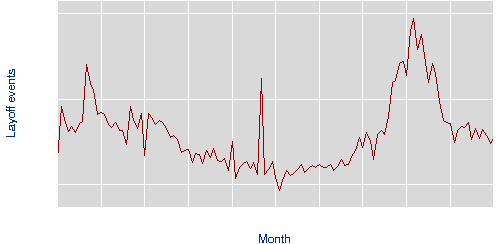
Mass layoffs, which ticked up at the Bureau of Labor Statistics here, are for everyone. Except Wall Street and arms makers.
Mass layoffs occur for everyone else but not at weapons plants. And mass layoffs are now always threatened for public sector union workers, something prescribed as belt tightening as well as shared sacrifice and pain. This is fork-tongued speak. Like Wall Street, no sharing of pain ever comes to weapons makers. They are exempt.
Take General Dynamics Land Systems in Sterling Heights, Michigan.
Unemployment is abominable in Michigan. And it is also very bad in Macomb County, part of the Detroit metro-area, where General Dynamics Land Systems design bureau and corporate headquarters is located.
Michigan’s unemployment rate is 11.7 percent, as noted by the US Bureau of Labor Statistics here. Statistically, it stood out in this report because of the rate of change, which has been greater than most of the rest of the country. While the rate has decreased faster, it is not because Michigan has a good jobs creation program. The rate of change downward is due to a decline in the population of the state.

Unemployment is terrible in Macomb County, Michigan. Unless you work for General Dynamics designing armored fighting vehicles. (Data from the St. Louis Fed here.)
The M1 Abrams tank manufactured by General Dynamics Land Systems is not particularly useful in the war on terror. We were attacked by suicide commandos using boxcutters on 9/11. al Qaeda has no armored fighting vehicles. The M1 tank went into action when we attacked a country that didn’t attack us in a war sold on a variety of now very famous frauds.
The M1 tank also had a visible role in the Egyptian revolution. But while it did no harm it was not really on the side of the people who brought down Hosni Mubarak.
In Macomb County, threatening public workers with layoffs is noticeable in the news. Articles oncoming layoffs at municipalities hurt by the economic collapse is also a common feature in Michigan newspapers in nearby Oakland and Wayne counties.
This recent news item from a place called Clinton Township says:
Clinton Township Supervisor Bob Cannon recommended that three police officers and 12 firefighters be laid off in the 2011-2012 fiscal year budget to help the two departments’ struggling bottom lines.
The board is expected to vote on the budget and possible cuts on March 21, and will make another decision that night on a federal grant that could re-hire seven firefighters already laid off last year.
Cannon made the recommendation at a Feb. 22 public hearing on the budget.
From the city of Troy, in neighboring Oakland County, we read this:
The city projects a $6.2 million budget deficit in 2010-2011, $6 million in 2011-2012 and $3.2 million in 2012-2013.
Under Option One of the restructuring plan, there would be no police layoffs until 2011-2012, when four police officers would be laid off. In 2012-2013, 29 police officers are slated for layoff, 14 in 2013-2014, for a total of 47 police layoffs.
The plan calls for reducing library staff by 39 people in 2010-2011 and 69 in 2011-2012.
The Parks and Recreation Department would also be eliminated in phases …
Armored fighting vehicles — special! Libraries, parks and recreation for children and civilians, not so much.

Unemployment has been craptastic in Allen County, Ohio! Except for the General Dynamics tank-making facility in Lima, the county seat.
“Ohio Fraternal Order of Police (FOP) President Jay McDonald hosted a press conference in Lima to highlight how Congressman John Kasich’s tax plan for Ohio would force local tax increases or lead to layoffs in public safety departments, according to a media release Thursday,” reads this bit of news from the web.
“Congressman [John Kasich’s] tax plan for Ohio would continue the damage he wreaked on the state during his time in Washington and on Wall Street … Similar to how Kasich’s support of outsourcing through unfair trade deals like NAFTA led to hundreds of thousands of layoffs in Ohio, his tax plan would force layoffs in our schools, and just as alarmingly, our police and fire departments.”
M1 Abrams tanks — huzzah! Police, public safety, teachers — eh.

Unemployment bloomed in Lackawanna County when the economy went ka-boom in 2008. Except, you guessed it, if you worked for General Dynamics Land Systems in Eynon, PA.
This item from Lackawanna County, describes public worker lay-offs in 2010 due to fiscal distress:
Majority commissioners have pledged to not raise taxes in 2011. They have cut the county budget by about 5 percent since taking office in 2008 without increasing taxes, but to keep that promise have laid off 109 employees and eliminated many others, including more than 320 positions through the sale the Lackawanna County Health Care Center earlier this year.
It is a drearily familiar thing. Public and private sector workers getting the chop everywhere. But not arms manufacturing. Firemen, hospital workers, policemen, receptionists, teachers — everyone threatened or downsized outright. The economy stumbles along, lives are reduced to splinters, people are tossed away in the wind.
But the factories that produce armored fighting vehicles are sure doing well.
General Dynamics Land Systems corporate headquarters emits a steady stream of truly wonderful press releases — these from 2009 — on tanks and armored fighting vehicle production. Tanks for the Iraqi army. And still more tanks and upgrades for our great pals in Saudi Arabia.
And while 2008 was really bad for almost everybody, it was swimming for General Dynamics Land Systems.
Record numbers of Americans apply for food stamps and unemployment. Every job not in finance or arms manufacturing gets beggared or threatened with shipment to China. Saudi Arabia and Iraq get tanks. More and more tanks. There are never enough.
As a thought experiment, I am going to propose a war-profiteering dividend/tax on US arms sales. Since the core markets for all these businesses are essentially guaranteed by the US taxpayer and government, it seems only fair Americans ought to be regarded as shareholders. And as shareholders, they ought to be in for some rewards. It’s the American way.
Let’s make the war-profiteering tax significant because, although even though I haven’t researched it yet, the US arms industry is probably quite adept at tax avoidance already. So I make it twenty percent of all profits in overseas arms sales — weapons, tanks, aircraft, ships, guns, ammo, bombs, chemicals, computer systems, software, consulting services and support — everything.
Here’s the calculation, using SIPRI’s latest data:
20 percent of 247 billion = 49 400 000 000
Further, I will propose a yearly war-profiteering dividend check for everyone in the United States on food stamps.
According to Reuters: “For fiscal 2011, average enrollment is forecast for 43.3 million people.”
Here is the calculation:
49.4 billion divided by 43.3 million = 1 140.8776
Everyone on food stamps, no exceptions, gets a check from the protected US arms industry, for roughly $1,140.88. That would certainly be a help.
One could also extend the dividend to all tax-filers for a given fiscal year although it would probably cut the size of each check by at least two thirds. The only people who wouldn’t be entitled to checks would be employees of the US arms manufacturing base. They’re already getting dividends as well as security.
Of course, none of this has any chance of consideration. It’s just a thought exercise. The protected industry of American weapons production is a third rail. No one will seriously discuss taking any big whacks at it.
However, this article does illustrate that when politicians, both GOP and Dem, fight for pieces of defense budget funding because of the familiar cry that it preserves “jobs” in their community, what they really mean is this:
Weapons making jobs are good and need preserving. Everyone else can go to Hell because “we’re broke” or belts need tightening or public sector union workers are scum.
It is also fun to imagine that such a war-profiteering tax/dividend might cause American arms manufacturers to raise prices to various clients (often countries whose rulers do not share our now largely theoretical democratic ideals) to retain profit margin. Or they could always start outsourcing to China.
Is there an arms manufacturer in your county? One you’d like to see profiled in the Economic Treason series? Send me a note or leave a comment.
General Dynamics plutocrat compensation — 2010.
Permalink
02.24.11
Posted in Culture of Lickspittle, Made in China, Permanent Fail at 8:22 am by George Smith
Latest from the Yahoo news laugh-line, a sucker bait article on jobs to get you out of the office cubicle.
Numero uno is the somewhat less than overwhelmingly popular answer questions on-line for a penny gig invented by Amazon, Mechanical Turk.
At Yahoo it’s called “virtual question answerer.”
The Wiki entry on Mechanical Turk:
Because [these questions] are typically simple, repetitive tasks and users are paid often only a few cents to complete them, some have criticized Mechanical Turk as a “virtual sweatshop.”[11] Because workers are paid as contractors rather than employees, requesters do not have to file forms for, nor to pay, payroll taxes, and they avoid laws regarding minimum wage, overtime, and workers compensation. Workers, though, must report their income as self-employment income. In addition, some requesters have taken advantage of workers by having them do the tasks, then rejecting their submission in order to avoid paying. However, at least some workers on Mechanical Turk are people who are middle class and do the work for fun.
Other top jobs for the economy that makes nothing, preferring to buy all its goods from China:
Professional Twitter-er, cable box recovery man (because everyone’s now hip to the fact that cable companies suck with rip-off pricing), astro-turfer for products made in China (called a “brand ambassador”), traveling bedpan technician/physical therapist, suck-up for corporate America’s remaining products (called a ‘focus group participant’), video game tester and — wait for it — the ubiquitous cellphone app developer.
Also tutoring for very low wages. Because the economic crash has resulted in teacher lay-offs nationwide.
Unintended hilarity: Article running in section called “Financially Fit.”
Win The Future!
Permalink
02.22.11
Posted in Made in China at 6:46 pm by George Smith
Steve Jobs, the King of All Music and Phones, the man Barack Obama consulted on how to create more jobs, revealed n-hexane poisoning in its Chinese suppliers, according to the New York Times today.
The Chinese workers who were poisoned told the Times they’d never heard from Apple or the King of All Music.
“Instead, they said the contractor — a Taiwanese-owned company called Wintek — had pressed them and many other affected workers to resign and accept cash settlements that would absolve the factory of future liability, charges the company denied,” reported the Times.
“The Wintek injuries underscore the challenges Apple faces in trying to source goods from China, which dominates electronics manufacturing with low-cost labor and highly efficient factories that often operate around the clock,” continued the Times.
“But China is also known for factories that routinely flout labor and environmental laws.”
The NYT article contains various meaningless statements from Apple and descriptions of the symptoms of n-hexane poisoning in Chinese workers making the company’s kit.
It does not include any information on what Steve Jobs, the King of All Music and Phones, might have told the President about creating US jobs at the posh dinner held for that purpose.
Permalink
02.17.11
Posted in Culture of Lickspittle, Made in China at 12:37 pm by George Smith
Fresh off the news, President Obama is bowing before consulting the two smartest men in the world today, Nobel laureate/Pulitzer prize winner Mark Zuckerberg and King of All Music, Steve Jobs.
The goal: How to create more jobs.
Jobs, whose name is most appropriate because he has made many many jobs in China, will probably tell the President the problem is the large number of no-skill sitting around people in the US.
“Stop counting them, Mr. President!” he may advise. Future growth lies in more Harmonica or You’re Fired! apps and what not, particularly now that one of the rival cell phones brags it has 60,000 of them. Sixty thousand!
Nobel laureate/Pulitzer winner Mark Zuckerberg may tell the President that to create jobs … we must unleash the creative power of every American to make more social networking sites.
Neither of these guys are interested in making jobs for all these baggy and lumpy no-skill sitting around people. Which is only right.
Did you know Dick Destiny is on Facebook? I look just like Brett Favre.
Ha-ha! Those Facebook peeps are so clever.
Did you know that it’s easy to create a fake account of someone who’s not you on Facebook? And that if the person who is not you discovers it and complains by sending e-mail to Facebook they don’t even read it until the Attorney General of a state gets involved?
These are all just minor slip-ups, however. If they weren’t, Mark Zuckerberg would not be a Nobel laureate and Pulitzer winner.
Permalink
Posted in Made in China at 9:12 am by George Smith
Some US commentators, most notably Tom Friedman, are not infrequently fond of holding up Singapore as a model for the US.
Why can’t we be more like Singapore, it’s the model of the future, Friedman thinks. Their kids can do fractions and stuff. And everyone shits money, they are so great.
There are allegedly no useless no-skill sitting-around people in Singapore, like here and everywhere else.
However, Tom Friedman is always wrong.
Singapore is a small island. Think of it as a wart on Malaya, always held up as an alleged beacon of progress. With little to support any such annoying claims other than it’s a place, much smaller than soCal, where the kids do far better on tests and the beggars are a bit less obvious or something. In other words, progress that looks a lot like the progress that holds sway here, only in infinitely smaller and more confined geography.
Today, from AP, good ol’ Singapore, why can’t we be more like it:
Singaporean Ramzi Mohamed is tired of sleeping in the living room of the two-bedroom apartment he shares with his mother and older brother.
His problem is that housing prices in the city-state are up almost 70 percent since 2006 while the 29-year-old gym administrator’s monthly salary of 1,200 Singapore dollars ($938) hasn’t budged in five years.
“When I was 20, I thought I’d have my own place by 30,” Ramzi said. “Now that I’m almost 30, I wonder if that will ever happen.”
Like tens of thousands of others living in the tiny island nation that boasts one of the world’s highest levels of GDP per person, Ramzi’s failure to realize his modest ambitions is no accident.
A flood of cheap immigrant labor — and stiff competition for manufacturing jobs from Asian neighbors like China and Vietnam — has kept wages stagnant for many and widened the gulf between a very wealthy minority and the island’s poorest. Housing prices have skyrocketed as rapid population growth outstrips supply.
At the same time, ostentatious signs of the wealth enjoyed by the elite have multiplied. That has put the government under pressure to loosen its tightfisted stance on welfare in the next national budget Friday as it tries to defuse criticism its policies have worsened the plight of ordinary Singaporeans.
New motto: Visit Singapore! It eats it unless you’re rich there, too!
I was asked to give a talk at a tech university in Singapore once. They wanted it for free and the plane ride was way too long in coach.
Permalink
02.16.11
Posted in Made in China, Permanent Fail at 12:49 pm by George Smith
UPDATED
Now dumbly obvious, from CNN Money:
One major pull on the working man was the decline of unions and other labor protections, said Bill Rodgers, a former chief economist for the Labor Department, now a professor at Rutgers University.
Because of deals struck through collective bargaining, union workers have traditionally earned 15% to 20% more than their non-union counterparts, Rodgers said.
But union membership has declined rapidly over the past 30 years. In 1983, union workers made up about 20% of the workforce. In 2010, they represented less than 12%.
“The erosion of collective bargaining is a key factor to explain why low-wage workers and middle income workers have seen their wages not stay up with inflation,” Rodgers said.
Without collective bargaining pushing up wages, especially for blue-collar work — average incomes have stagnated.
International competition is another factor. While globalization has lifted millions out of poverty in developing nations, it hasn’t exactly been a win for middle class workers in the U.S.
Factory workers have seen many of their jobs shipped to other countries where labor is cheaper, putting more downward pressure on American wages.
“As we became more connected to China, that poses the question of whether our wages are being set in Beijing,” Rodgers said.
Finding it harder to compete with cheaper manufacturing costs abroad, the U.S. has emerged as primarily a services-producing economy. That trend has created a cultural shift in the job skills American employers are looking for.
Replace “services-producing economy” with “services and virtual goods of little to zero social value” — like Wall Street financial instruments.
Closer to home, the “services producing economy” includes the likes of HBGary Federal, Palantir Technologies, and Berico, spying firms whose products are pitched to attack private citizens critical of big money America.
A DD reader posted in comment, a link to this post at a blog written by a another journalist targeted by the US Chamber of Commerce and the three corporate spying/security firms.
That post is here and it mentions a subject I discussed last week. The use of software and methods developed for the war on terrorism against private citizens.
That’s part of the “services economy” as the employees blithely discussed payment splits — 2 million dollars and/or 200,000/month — in this post here yesterday.
At the bottom of the CNN story is a quote from a Wall Street analyst, and a most disingenuous one, at that:
“I think it’s a terrible dilemma, because what we’re obviously heading toward is some kind of class warfare,” Johnson said.
Wrong bucko. There has been class warfare and it’s been the uppers that have mercilessly waged it against the middle.
And the dirty-tricking unethical behavior as a “service” to be sold to law firms, Bank of America and the Chamber of Commerce is just one small direct example of it.
Another even larger example is the Republican attack on what remains of unionized labor — state and federal middle class workers who need to be either downsized or have their benefits hacked.
This brings up another issue that’s nagged your host.
If Mark Zuckerberg’s marvelous Facebook was allegedly what catalyzed volcanic systemic change in Egypt, why doesn’t it work here where the populace has much greater access to social networking tools?
Rhetorical, obviously.
Via Digby, quoting from ThinkProgress, coincidentally one of the organizations to be attacked through the machination services of HBGary Federal, Palantir and Berico:
ThinkProgress has been following both Gov. Scott Walker’s (R-WI) recent “budget repair bill,??? which would effectively eliminate state workers’ right to collectively bargain, and his coinciding threat to deploy the National Guard to stop a walkout. Yesterday, the Super Bowl champion Green Bay Packers criticized Walker, saying that collective bargaining is “fundamental??? to the middle class.
Approximately 13,000 peaceful protesters flooded the state Capitol yesterday, including nearly 800 Madison East High School students who left school to protest Walker’s bill. Democratic lawmakers listened to testimonies from citizens for more than 20 hours, stretching into the early morning. Many people who hadn’t yet gotten to speak pulled out sleeping bags.
Responding to his inappropriate threat to use the National Guard against resisting workers, Walker said last night on Greta Van Susteren’s On The Record that the National Guard has contingency plans for natural disasters, and a worker “walk-off is part of [the] contingency plan???:
Wednesday afternoon, momentary TV check, Fox News in high gear hysterically attacking the Wisconsin protesters, teachers, the IRS and assorted middle class federal workers.
Permalink
Posted in Made in China at 3:05 am by George Smith
One of the biggest jokes on DD blog is the US media’s fascination with the Chinese military.
The US spends more than the top ten countries in the world — combined — on its military.
And it has been in active combat for the last ten years.
Yet you still see stone idiot news, lately on Chinese inventions, said to put us behind the eight ball.
There are many things that have put the United States behind the eight ball. Most of our own invention. Chinese military might isn’t one of them.
So today, the continuing story of the Chinese super missile with the name that rhymes with “dung.” Similar to stories about Soviet super missiles decades ago. And we know how that turned out.
AP:
A new “carrier killer” missile that has become a symbol of China’s rising military might will not force the U.S. Navy to change the way it operates in the Pacific, a senior Navy commander told The Associated Press.
Defense analysts say the Dong Feng 21D missile could upend the balance of power in Asia, where U.S. aircraft carrier battle groups have ruled the waves since the end of World War II.
However, Vice Adm. Scott van Buskirk, commander of the U.S. 7th Fleet, told the AP in an interview that the Navy does not see the much-feared weapon as creating any insurmountable vulnerability for the U.S. carriers — the Navy’s crown jewels.
“It’s not the Achilles heel of our aircraft carriers or our Navy — it is one weapons system, one technology that is out there,” Van Buskirk said in an interview this week on the bridge of the USS George Washington, the only carrier that is home-based in the western Pacific.
The DF 21D is unique in that it is believed capable of hitting a powerfully defended moving target — like the USS George Washington — with pinpoint precision. That objective is so complex that the Soviets gave up on a similar project.
It’s material for a Tom Clancy thriller. Fuck that guy and his ilk.
In the real world, Chinese kit — all the stuff lining the shelves of American stores, from all garments to all electric guitars once invented here to all flatware — is either really substandard, slightly substandard, or necessarily acceptable because no other products are available. Because we gave up all manufacturing of the same things for the sake of Wall Street and the immediate bottom line. And even if you didn’t want to buy it you have no choice because it would mean going naked, shoe-less and with no furniture or appliances in your apartment.
The only thing you’d have left would be the dry and canned food on your cupboard shelves. Because your refrigerator would be taken away, too.
And suddenly the same country is said to have a missile that puts the supercarrier fleet at risk in the Pacific Ocean.
Here’s a thought exercise.
Assume it’s as perfectly omnipotent as claimed. The Chinese plink a US supercarrier in some imagined confrontation off North Korea or Taiwan.
We still manufacture weapons. In fact, that’s about all we manufacture, other than hookers and beer, the latter of which is all owned by Belgium.
How many weeks past two or four will the rubble stop bouncing at military bases in China?
Another example of news for the purpose of creating the impression the US military is behind in some way, immune from the painful sacrifice that’s going to be shoved down all our throats.
Permalink
02.14.11
Posted in Made in China, Permanent Fail at 10:08 am by George Smith
Continuing the subject that the US economic environment preserves arms manufacturing while allowing everything else to go to hell in a handcart, DD gives readers a small profile of Combined Systems, the Jamestown, PA, firm recently in the news as the manufacturer of the tear gas used on crowds in Egypt.
It’s already been noted that the other US product, the M1 tank, was used to lay smokescreens. And, in this, the Egyptian model, one which led to revolt, is similar to the US model.
Nothing for the people who went into the streets — which is why they pulled down the dictator. But no expense spared for arms acquisition.
Combined Systems is here and it is the primary employer in Jamestown, PA.
Its entire business is arms manufacturing with a subsidiary in handcuff production. As such, in the market it is not subject to the pressures which have destroyed US non-military production.
The federal governments, as well as those of states and municipalities — the taxpayer, underwrites it. And while there may even be layoffs of state workers, like policemen, in the time of austerity, usually hardware is not sacrificed in such budget cutting.
Obviously, Combined Systems has a significant business in the sale of tear gas worldwide, Egypt and Israel being two notable customers.
A brochure on high-explosive rounds, called FRAG-12, produced by the company is here.
“We believe FRAG-12 is a game-changing technology for the warfighter engaged in urban combat,” it reads.
A brochure post on the web describes the Combined Systems corporate setting:
The Combined System campus is comprised of 18 buildings on 160 acres in Western Pennsylvania. The workforce of 160 includes a full R&D department, electrical, mechanical and chemical engineers, a full quality assurance department, in house machining department, and in process quality department, and is fully ISO 9001:2000 certified and is DoD 4145.26-M compliant.
Founded in 1981, CSI by Michael Brunn and Jacob Kravel the company has grown to revenues of approximately $25 million, and has a very hands on corporate structure …
The US Bureau of Labor Statistics shows unemployment in Mercer County, where Combined Systems is located, to be among the worst rates in the state. It is, for example, tied with Schuylkill County, where DD was raised.
In December 2009, unemployment was at 11.7 percent in Mercer. One year later it had decreased to 9.6.
Mercer County did have domestic non-military production. You can guess how it has fared.
From a 2009 report in the county newspaper:
The local economy continues to bleed jobs as two leading industries on Tuesday announced layoffs totaling more than 70 workers.
The latest layoffs have led two local economic advisors to peg Mercer County’s manufacturing unemployment rate at 40 percent.
Cattron Group International Inc. said it was laying off 32 workers at its Sharpsville operation while Salem Tube Inc.’s Pymatuning Township plant said it laid off 41 workers since February and more will follow unless business improves.
These are the latest in a series of layoffs that have whipsawed the local economy. Large industrial employers such as Wheatland Tube Co. and Duferco Farrell have been forced to undergo rolling layoffs which have hit hundreds of its workers.
Other companies opted to shut their doors forever such as Signature Aluminum in Sugar Grove Township. When the company folded the local plant in March it employed 280.
Another story on lay-offs for state education workers — teachers — reads:
Hold-ups and haggling over the Pennsylvania state budget in Harrisburg, mean layoffs are coming to Mercer County Head Start. Right now, early childhood education staff for about 10 state-funded classrooms are being put on hold.
“The Senate Republican budget would cut “Pre-K Counts” by 46 percent, about $40 million. It would cut $20 million out of Head Start, which is a 50 percent cut,” says State Representative Mark Longietti, (D) 7th District.
“And the impact that that has is about 152 children will not be able to receive early childhood education as a direct result of this,” adds Larry Haynes, a consultant with Mercer County Head Start.
A collection of links on layoffs in Mercer County, at the county newspaper, is here.
Permalink
Posted in Made in China, Permanent Fail, Why the World Doesn't Need US at 8:22 am by George Smith
From the New York Times, Louis Uchitelle’s conclusion that losing the manufacturing base wasn’t such a good idea.
Quotes from various “experts,” easy observables by anyone on the street:
Losing an industry or ceasing to manufacture a particular product, in this case stainless steel flatware, has indeed become a fairly frequent event. Just in the last few years, the last sardine cannery, in Maine, closed its doors. Stainless steel rebars, the sturdy rods that reinforce concrete in all kinds of construction, are now no longer made in America. Neither are vending machines or incandescent light bulbs or cellphones or laptop computers.
======
Concern is increasing that this decline has gone too far. “I think there is a growing recognition that a diminished manufacturing sector will undermine our economy,??? says Mark Zandi, chief economist for Moody’s Analytics. (Unintentional knee slapper by ‘economic expert.’ Correction: “Has undermined the economy through mass unemployment and diminished buying power.”)
=======
How did the nation get into this situation? It gambled, in effect, that by importing more from foreign suppliers and from American companies that had set up shop abroad, consumer prices for manufactured products would fall, without any sacrifice in product quality. Low-wage workers abroad would make that happen.
American manufacturers, on the other hand, would be the world’s best innovators, developing sophisticated new products here at home and producing them, at least initially, in their domestic factories.
The first part of the arrangement worked very well. Consumer prices did fall as imports flooded in — from foreign manufacturers, of course, but also from factories newly opened abroad by American multinationals … The second part of the arrangement, however, has been more problematic. As it turns out, the United States is not the only path-breaker.
===
The loss of manufacturing capacity, measured in lost workers, is startling. From the high point in the summer of 1979, through last month, employment in manufacturing has fallen by 8.1 million, to
11.6 million, with most of the drop in just the last decade. While consumers have benefited from lower prices, made possible by unrestricted imports, on the other side of the ledger are tens of billion of dollars in lost manufacturing wages.
Something else is gone, too. “We had a storehouse of knowledge and skill built up in these workers and we can’t use it now,??? says James Jordan, president of the Interstate Maglev Project, promoting a high-speed rail technology that uses special magnets to levitate and propel trains. Maglev was invented in the United States … [but not used here].
Uchitelle’s piece, of course, forgets one big thing.
The US still manufactures weapons. Lots and lots of weapons. And that’s about all.
Furthermore, weapons manufacturing is not constrained by any of the things which have destroyed domestic product-making in the US.
It is not subject to death spiral pricing competition; its workers are not constantly downsized for cheap overseas slave labor. And it is underwritten entirely by the US taxpayers even if the taxpayers can afford it less and less.
There is no network of Walmart superstores pillaging the business, offering equivalent dirt cheap Chinese made kit for every missile, armored vehicle, landmine and drone manufactured in the States.
Diminished buying power and lost wages have no effect on US weapons manufacturing. Sacrifice is for everybody else.
Uchitelle’s story frets that the US will cede “innovation” due to loss of domestic manufacturing. Unless you count Mark Zuckerberg, future Nobel laureate, Pulitzer prize winner and global bringer of freedom to oppressed populations worldwide.
It has not lost “innovation,” if that’s what one calls it, in arms manufacturing.
There are General Atomics drones for every future possible application in global assassination, new varieties of cluster bombs, elaborate grenade launchers for blowing up people hiding behind rocks, and robots galore, to no discernible effect, for the forever war in Afghanistan.
It’s a great game for those on the winning side. For most of us, however, not so much.
The most highly read story on the blog early this year has been Not Made in China: US Bullshit Manufacturing. (Basically because of Internet random event. A high traffic sight, WhatReallyHappened, linked here after a few Twitters. Paradoxically, I don’t use Twitter anymore, being obsolete in my mental processes.)
From it:
[While] what production of durable goods in the US that remains is charted, it — along with the fortunes of the middle class and the new mass of unemployed — cratered in 2009. However, military production did not.
It went through a minor dip and then soared.
This is immoral. It destroys any argument on fairness and shared burden and consequences being a part of US society.
It is also economic treason.
The related series: US Bullshit Manufacturing.
Permalink
02.12.11
Posted in Made in China, Permanent Fail at 9:10 am by George Smith

Stagnant US labor market encounters rising number who “leave” unemployment rolls because they are permanently or semi-permanently severed from workforce.
Mike Konczal has started to answer the question from a Reuters news item today:
Since 2008, the American labor force — that is, the number of people either working or actively working for work — hasn’t grown at all, The Economist reports, looking at Labor Department numbers.
That’s not unusual during a recession, which typically leads some of the unemployed to become discouraged and give up looking for work, or to retire early. At the other demographic end of the labor market, recessions can also prompt some young people to go to school instead of entering the workforce, The Economist explains.
But things usually turn around during the recovery. This time, however, that’s not happening: Since the Great Recession officially ended in mid 2009, the “participation rate” — the share of the population in the labor force — has continued to decline, especially among the young.
But the problem appears to have deeper roots. In the 1990s, the labor force grew by 1.3 percent a year. Last decade, that figure dropped to 1 percent. And the Congressional Budget Office predicts that over the next decade, it will grow by only 0.7 percent.
Taken together, the slow growth of the labor force and the low participation rate mean that the offiical [sic] unemployment rate, now at an already high 9 percent, underplays the actual rate of joblessness even more than such official figures usually do. That’s because the official rate doesn’t include workers who have grown discouraged and stopped looking for work–and that number appears to be unusually high.
The obvious irony here is the case of Egypt, illustrating what happens on the extreme end of the curve, with its decades-long entrenched system of throwing away its human capital for the sake of a looter upper-class holding the reins of power.
Question: What happens when all manufacturing and jobs have gone overseas and there are less and less who can even raise a demand for the cheap stuff?
Answer: Like Walmart, you build overseas or diversify into things like drug sales to the elderly, which the US government underwrites, or white-knuckle banking and financial services for the poverty-stricken who still need to buy a few sticks of clothing. Or like Target, you turn half the store into a supermarket because people still must buy food, which the government can help pay for with food stamp programs.
Permalink
« Previous Page — « Previous entries « Previous Page · Next Page » Next entries » — Next Page »