“While Chinese labour costs are rising, US competitiveness has been improving,??? says Mei Xu, the Chinese-born co-owner of Chesapeake Bay Candle, which makes candles and other home fragrance products. “We can invest in automation to make our candles in a factory near Baltimore for a similar cost to doing the same job in China.???
Chesapeake Bay Candle has created 50 jobs, with another 50 likely next year, since it invested in US production. Half of the company’s production is now US-based. Last year all of its products were made in China.
While some will say “it’s jobs,” they’re only dribs and drabs, by magnitude unless multiplied by tens to hundreds of thousands of instances, not statistically significant enough to make a difference in the country’s mass unemployment debacle.
Lacking from the two stories this week — wage level and benefits — which, if they’re typical of US 2011, do nothing to address inequality and inability to provide a living.
Bringing jobs back at a level where people still are eligible for food stamps isn’t a thing to crow about. It’s just chasing pseudo-slave labor around the globe once US levels of labor compensation have stabilized at such a low level the government must subsidize families lest people starve.
Unlike the ABC News story, the Financial Times piece puts a skeptic into the piece.
“What’s going to stop the current trickle of extra employment from becoming a real trend is the behaviour by the Chinese government in persistently finding ways to help its domestic manufacturers,??? said a lobbyist for American manufacturers to the publication.
The Whirlpool jobs are a drop in the bucket of the unemployed. A third instance is for unskilled factory work making hair dryers in Texas. One assumes it pays barely above minimum wage.
All of the factories are based in the south, all in Right to Work states, indicating one of the drivers is to simply take a vulture’s advantage of lack of labor collective bargaining rights and depressed wages.
ABC News wraps this up in an ongoing series emblazoned with an American flag, desperate for any news it can package as good.
When you get right down to it, if there is any job return it’s about exploiting the desperation of a labor market willing to do things ever more cheaply, even if it’s personally ruinous.
We analyze the effect of rising Chinese import competition between 1990 and 2007 on local labor markets, exploiting cross market variation in import exposure stemming from initial differences in industry specialization while instrumenting for imports using changes in Chinese imports by industry to other high-income countries. Rising exposure increases unemployment, lowers labor force participation, and reduces wages in local labor markets. Conservatively, it explains one-quarter of the contemporaneous aggregate decline in US manufacturing employment. Transfer benefits payments for unemployment, disability, retirement, and healthcare also rise sharply in explosed labor markets. The deadweight loss of financing these transfers is one to two thirds as large as US gains from trade with China.
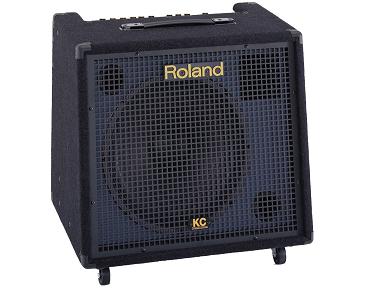
Back on Made-In-China Day at Guitar Center, DD’s colleague — a drummer who does not play guitar dropped an eye-popping 900 bucks for a Roland KC-550 keyboard amp and a Chinese-manufactured Classic Vibe Fender Telecaster.
He’d been sold on the guitar by a friend, and despite my advice, bought the Roland as an all-purpose amp. Not understanding guitars, the salesperson didn’t correct him, he bought an amp unsuitable for rock guitar.
However, the KC-550 is a powerful amp with absolutely no tonal opinion, much like having a small PA system run off a mixing desk.
So I told him I’d fix the mistake by bringing in some outboard gear I no longer use, namely an old Line6 PodXT, a digital guitar computer/simulator that mimics famous brand name analog amplifiers for studio work.
In a pinch, the desk model will work fine for live performance.
Plugged into one of the KC-550’s channels, one sets the POD exactly as you would for the studio.
I picked a couple of its amp sims, an old Marshall JTM-45 and a Hiwatt 100, for a test run.
Plugged in the Telecaster and did a quick 30 minute rehearsal of DD tunes with him at the drums.
The combination was loud, had good rock and roll dynamic explosion, and, courtesy of the Roland’s huge bass speaker, great low end.
I know loud.
My rig is the same as it was in 1985. A Hiwatt Custom 50 and some pedals on the front end for delay, chorus, rotary speaker effects and so on.
The Telecaster/Line6 POD XT/Roland KC-550 isn’t the same as my stuff into the old Hiwatt. But it would be close enough for quite a few people at small to medium gigs.
Limitations? Not a lot. The high end coming out of the Roland sounds good. But I could tell it would wear out the ears in a way the Hiwatt with its analog tube tone doesn’t.
And the Roland, which is simply amplifying the computer simulation of a Hiwatt or a Marshall from the Line6, isn’t as molten, as everywhere in the room, or as late-Seventies hammer down vintage hard rock.
These are relatively picky issues from my perspective, often not worth worrying about if what have in your hands translates to noise coming out the a big speaker in a way that makes the air move rock and rollingly.
In its favor, it’s a rig that theoretically will sound the same whenever you turn it on. That’s unlike my Hiwatt and things, which always requires a daily set-up, sometimes brief, sometimes maddeningly longer.
Then there’s the entire made-in-China thing. There I was, playing a Chinese made Fender, the kind they made in a huge factory that no longer exists here, when I was a kid.
I could get started. The USA-made Fender, four to five times the cost
of the “Classic Vibe” from China. The former instruments, of course, sold at prices the young adult employees peddling them cannot really afford on a weekly wage unless still living with mom and dad.
Over the Labor Day weekend, Guitar Centers nationwide had a sale.
Naturally, DD went to the store in Pasadena.
What was being sold, tried out and handled — I was there on Saturday and Monday — were guitars, all made in China.
They were the only ones the customers, middle class youngsters, could afford.
The Second Great Depression Great Recession destroyed the buying power at the heart of the company’s customer base. The result has been a struggle to squeeze even lower prices from American-branded Chinese manufacturing.
On Saturday and Monday the store featured 99 dollar (99!) Epiphone SG Juniors, the lowest price possible Gibson-brand guitar made in China Indonesia. (Same difference. — ed)
I played one. It was solid, looked very nice, and it was so light it almost wasn’t there. Compared to my old ’79 made-in-Michigan Gibson SG, it seemed to weigh about as much as a paper plate holding a big cheeseburger. (I went back a week later. The tone knob was broken on it. The pseudo-slave labor instruments get played a lot by the daily store riffraff, but still …)
About five yards away was a $79 (!) Fender Squier (made in China) Stratocaster.
The depression in prices to match smashed and amputated incomes was eye-opening. Most used made in China guitars sold two years ago, now in pawn shops in Pasadena, actually cost more.
While business seemed to be fair — squeezing ever more out of the charge card and hoping things will turn better in a few months — the sale and the instrumentation were a good metaphor for the ruins of the US economy. The profit margins must now be terrible.
Gibson and Fender employ more people in China than they do in the US. And this surely seemed like a great idea during the last decade.
Now it looks like a growing pile of ashes. Unless, of course, you work in the Gibson and Fender custom shops making guitars for the wealthy end.
The Reich column described what looked to me like an insoluble problem for the US. It de-industrialized and destroyed the idea that American workers deserve reasonable wages and that such things are good And it did it relentlessly over the course of decades.
Coming back from Guitar Center on the Saturday trip afforded an opportunity to chat even more about the vast amount of Chinese made merchandise.
My colleague, another musician, blurted out something I occasionally read and hear from those who run small businesses that have failed, or those who believe crap they’ve read from Tom Friedman, or those idiot libertarians stuffed full of Ayn Rand.
America, he said, should “only make the best things in the world!”
That was how we might fix things.
I immediately replied that this was Gibson and Fender’s philosophy — that they would only make premium goods for the wealthy. And that it had resulted in a relentless net loss of jobs, as it has throughout the economy with every other company that has practiced it.
I said that it was delusional to think a country of over 312 million people could get away with being the Swiss chocolatiers to the world.
For example, the Chinese multitudes do not have to make things better than everyone else. Far from it. They don’t need special education, or pricey degrees, or even know how to figure out enzyme kinetics or do linear algebra. They just do it cheaper because the rent’s so low.
And looking at the vast sea of US countrymen, it’s uncool, mean and exceedingly stupid to believe that they should only be allowed to succeed if they make “the very best things in the world.”
Americans used to make lots of things. And they weren’t always the best made. The Sherman tank, for example, was far from the best armored fighting vehicle in the world in WW II.
The Germans made the best armored fighting vehicles. That went well.
Making things is a living. It ought to be a good living for many and not tied to only those who can be artisans.
Coincidentally, last week news broke that the federal government had raided Gibson’s manufacturing facilities in Nashville and Memphis.
The company has been in trouble with the Feds since 2009 when it imported ebony from a corrupt regime in Madagascar.
Andrea Johnson, director of forest programs for the Environmental Investigation Agency in Washington, says the Lacey Act requires end users of endangered wood to certify the legality of their supply chain all the way to the trees. EIA’s independent investigations have concluded that Gibson knowingly imported tainted wood.
“Gibson clearly understood the risks involved,” says Johnson. “Was on the ground in Madagascar getting a tour to understand whether they could possibly source [legally] from that country. And made a decision in the end that they were going to source despite knowing that there was a ban on exports of ebony and rosewood.”
Gibson uses ebony fingerboards on their premium Les Pauls, among other guitars.
Other guitar manufacturers stayed away from Madagascar.
One, the Martin Guitar Company of Nazareth, PA, in the Lehigh Valley, had its chairman put it this way:
“There was a coup … What we heard was the international community has come to the conclusion that the coup created an illegitimate government. That’s when we said, ‘Okay, we can not buy any more of this wood.'”
The company supports the ban on Malagasy ebony.
The most recent raid on Gibson concerned rosewood from India. And it now seems certain the US government will eventually file criminal charges against Gibson.
“We believe the arrogance of federal power is impacting me personally, our company personally and the employees here in Tennessee, and it’s just plain wrong.???
It was said Gibson was using social media to tap into “right wing anger with the federal government.”
Which is a fairly idiotic statement. Guitarists don’t have a lobby, let alone a right-wing Tea Party-like one ready to take the issue and run with it as another example of why we ought to hate that socialist from Kenya, Barack Obama.
Yeah, complain on Twitter the government is abusing your business after getting on the radar for importing banned precious wood from a Madagascar black market. Tweeting Twitterers to the rescue.
Keep in mind your host plays Gibson guitars.
Through the previous week a couple news stories tried to play up fear that the Feds might come for your old instruments if you didn’t have the paperwork in order, paperwork showing time of purchase prior to when things got sticky with bans on protected special woods.
DD wasn’t feeling the fear. And as far as I could tell, none were in GC on Saturday and Monday.
However, there is one small demographic that stands to lose money in the matter when and if the federal government occasionally seizes instruments with protected wood when they come through customs.
It’s those who trade in vintage instruments, selling very high priced pieces to the mega-rich around the globe.
Nashville’s George Gruhn is one of the world’s top dealers of old guitars, banjos and other rare stringed instruments. “It’s a nightmare,” he says. “I can’t help it if they used Brazilian rosewood on almost every guitar made prior to 1970. I’m not contributing to cutting down Brazilian rosewood today.”
Gruhn acknowledges that the government has tried to create exemptions to cover vintage instruments. But he says they are rife with delays and to play it safe he’s nearly eliminated the 40% of his business that used to deal with overseas buyers.
Today’s example … men who hoard late-Fifties/early Sixties Gibson Les Paul Standard guitars painted in sunburst finishes.
An example of the ridiculous prices the instrument fetches is here at Gruhn Guitars, run by reseller/guitar collector/speculator, George Gruhn. If you read guitar magazines regularly you know Gruhn owns 98 or maybe even 110 percent of all the guitars worth having in the world. No one is allowed to say anything about the worth of electric guitars without first checking if it’s all right to do so with Gruhn …
In case you didn’t click through the link, the guitar on display at George Gruhn’s costs a good deal more than your house.
For you to accept the idea of used guitars which sell for a quarter-of-a-million dollars, you have to buy into all the conceits trotted out about them for the last thirty years. As conceits handed down for decades and pounded into the bedrock of electric guitar lore, they’ve created a warped reality.
In other words, “We said nonsense, but it was important nonsense.”
Now, if you’re a foreign buyer of a quarter million dollar Les Paul, you might be concerned if there was even a remote chance of it being seized by customs. Particularly since no insurer will cover the loss if the trafficking is a potential criminal matter.
Just off the cuff I’d imagine there’s little sympathy or much of a political lobby for the dealers in vintage guitars industry.
So they may be stuck by this attention to proscribed woods. But it’s no big loss to the middle class economy.
But it’s another example why the idea of rewarding only those businesses which can be the American chocolatiers to the world basically blows.
What will happen to Gibson? I don’t know. But I doubt it will put them out of business.
A criminal prosecution might cause the firm to purge some top management. Which probably wouldn’t hurt because it’s not that innovative or spectacularly run (traits it shares with the other American guitar manufacturers.)
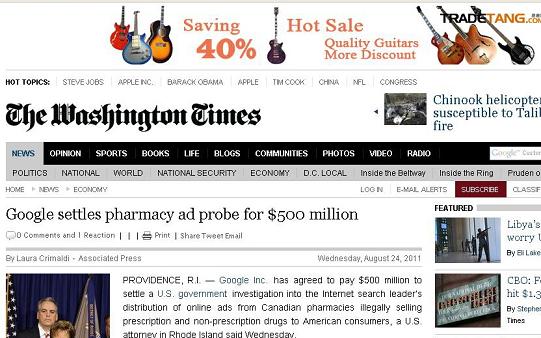
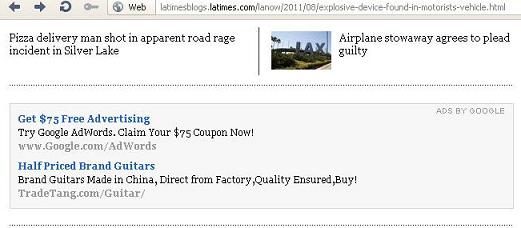
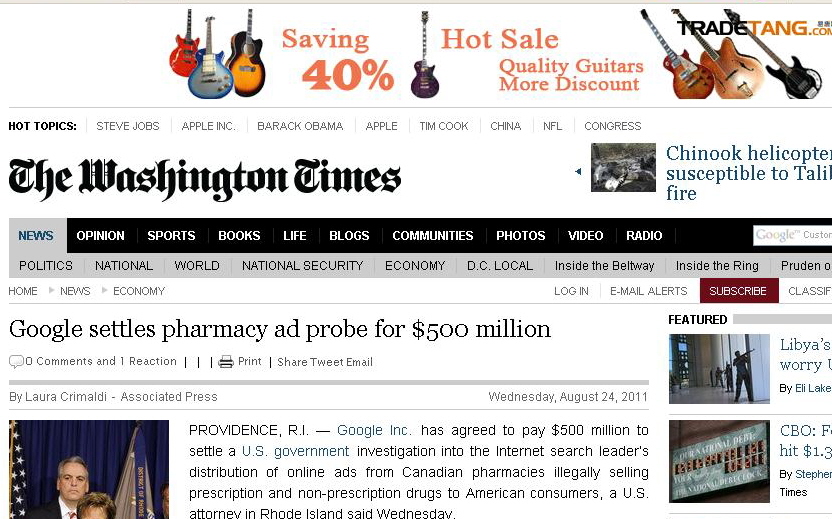
The second — the ad for Chinese counterfeit guitars spun out over a piece on Google being penalized by the Justice Dept. for selling ads for illegal Canadian pills …
“Google Inc has agreed to pay 5 million to settle a US government investigation into the Internet search leader’s distribution of online ads for Canadian pharmacies illegally selling prescription and non-prescription drugs to American consumers,” it reads.
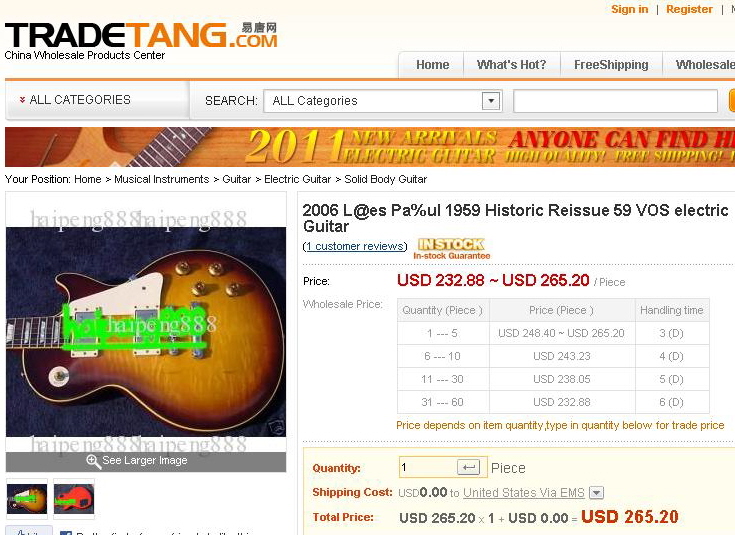
Click through the TradeTang ads leads to sales carts for a host of fake American guitars including Gibson and Paul Reed Smiths.
DD has observed that many of the ads for these counterfeit goods are distributed through Google’s AdSense/AdWords/AdChoices services.
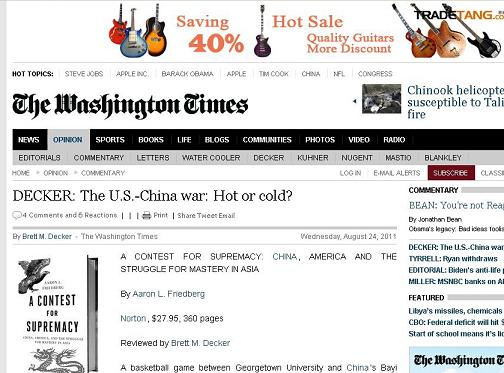
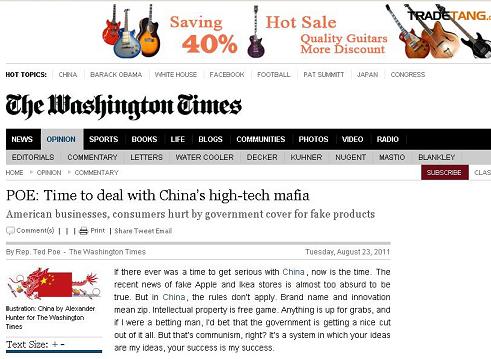
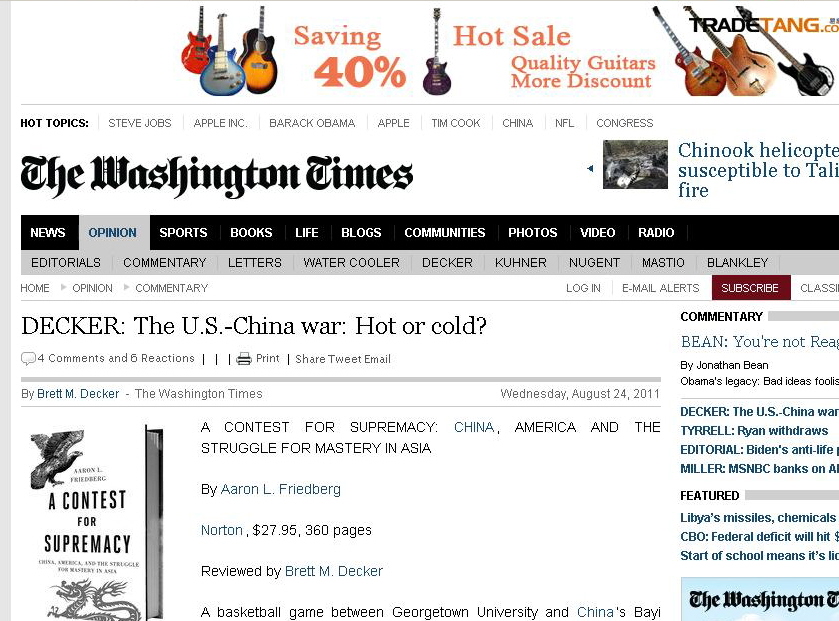
In case you’re late in on this series, the banner ad above the opinion piece is for a Chinese internet trading site selling counterfeit American electric guitars. The opinion is a Congressional politician’s complaint about Chinese counterfeiting.
The guitars are sold out of Beijing with many of the ads spun out on Google’s AdWords/AdSense business.
Clicking through the WaTimes ad takes you to a page selling fake Paul Reed Smith guitars. Paul Reed Smith’s are made in Maryland and are the very high end of domestic electric guitar manufacturing.
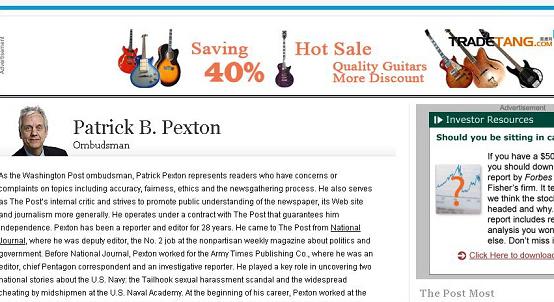
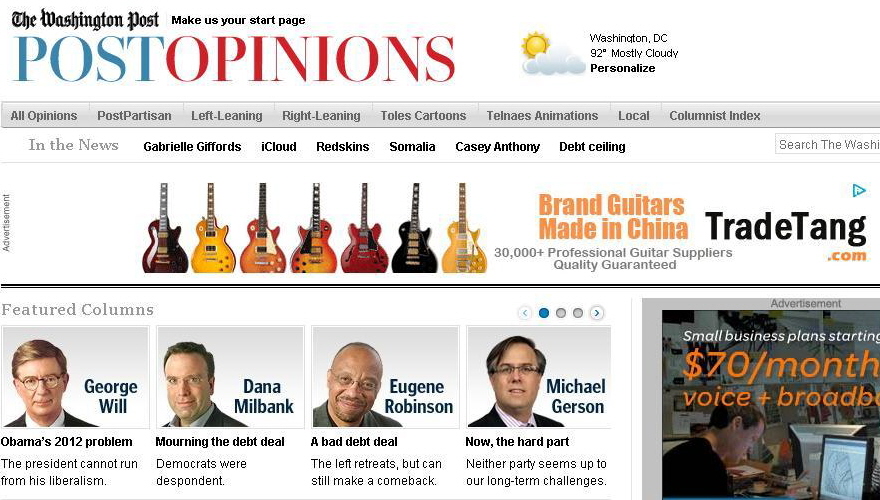
When DD blog first noticed the made-in-China counterfeiting business, its ads were on the Washington Post and pointed to sales for faked Gibson guitars. I notified Gibson and the Post and the ad was changed to specifically advertise “Made in China.” And the Post ad also switched clickthrough to fakes of the product of the much smaller company, Paul Reed Smith, the company victimized today.
If there ever was a time to get serious with China, now is the time. The recent news of fake Apple and Ikea stores is almost too absurd to be true. But in China, the rules don’t apply. Brand name and innovation mean zip. Intellectual property is free game. Anything is up for grabs, and if I were a betting man, I’d bet that the government is getting a nice cut out of it all. But that’s communism, right? It’s a system in which your ideas are my ideas, your success is my success …
I also met Jim D’Addario, CEO of D’Addario Guitar Strings, an instrument strings manufacturer based in New York. This business, family-owned since the 1600s, has spent millions to stop the manufacture of counterfeit guitar strings in China. Mr. D’Addario has watched several coordinated raids on manufacturing facilities in China that exist solely to make counterfeit copies of D’Addario, Fender, Martin and other American companies’ guitar strings. On a website, it’s hard to tell the difference between a counterfeit and a legitimate D’Addario guitar-string set. As with the Chi flatirons, the packaging looks identical, but the fake package of guitar strings contains a hologram sticker – just to trick you – and the product inside is horrendous. It is that unbelievable.
“So what do we do?” asks the politician, “Rep. Ted Poe, a Texas Republican, was a prosecutor and judge in Houston [and] serves on the House Judiciary and Foreign Affairs committees.”
Nothing. “Get tough on China.”
Big horselaugh.
American businesses, including guitar manufacturers, downsized and outsourced their manufacturing to Asian labor, effectively turning their US facilities into artisan custom shops for the plutocracy. In this bargain, repeated all across US non-military domestic production, the American companies gave up intellectual property and trained the Chinese to make their goods for the sake of the short term bottom line.
The Chinese are not better workers for the modern and future world economy and they do not have schools where people were trained to make electric guitars. This, lack of training and education, being the argument/excuse/insult so often used to explain why Americans are laid off and obsolete.
The problem is bilateral in its perfidy. China’s leaders are afraid of mass unemployment. They must keep people working and the way to do that is to sell all dry goods to the US middle and lower class. And US corporations have no interest in American labor because, being more expensive, it impinges on profits to the shareholders. They’re content with the US government ignoring mass unemployment.
So now it is only logical that some Chinese, maybe many, would see no point in maintaining licensing agreements with American multi-nationals once they were capable of copying the goods, or making cosmetically adequate facsimiles, on their own.
Comments left on the Chinese sales site, and many YouTube vidoes, show young American men who have no problem buying fakes of US premium goods. Since middle class wages have been destroyed this is a logical development, too.
And American companies, individually and collectively, whether they have engaged in short-sighted predatory behavior or forced into it by the competition, do not have the resources needed to combat the problems brought upon us by the great trade imbalance.
This post has been updated for clarity.
Google is not your friend
Google is responsible for distributing many, if not all, the ads mentioned in this series. In so doing it makes easy money from the benefit of selling counterfeit American products. But there is little any individual company can do by itself to rectify the matter. Google is so powerful it can simply ignore you.
Google Inc, which has agreed to pay $500 million for accepting ads from Canadian pharmacies to sell in the United States, said in a statement that it should not have allowed the ads in the first place.
The U.S. Justice Department, which announced the settlement on Wednesday said that it represented all of Google’s revenues from Canadian pharmacy advertisements and was one of the largest ever in the United States.
Google said in a brief comment that it had banned advertising of prescription drugs in the United States. The announcement was made in a February 2010 blog post.
“However, it’s obvious with hindsight that we shouldn’t have allowed these ads on Google in the first place,” the statement said.
Yesterday I wrote about Chinese ads selling counterfeit American electric guitars to YouTube. From the the frontpage of the Washington Post website the previous week, to a smaller picture ad spun out by Google Adsense/AdWwords and tied to guitar star demonstration videos.
In yesterday’s case it was sales pitching for fake Paul Reed Smiths.
Google AdSense is the vehicle of choice for Internet bottom feeders. Using Google “products” it’s probably fair to say you could set up AdSense ads for working hand grenades, hit squad services or sales of stolen goods, advertised with just the same words and get away with it for a few days. (In fairness, I haven’t tried. But judging by the reprehensible rubbish I routinely see peddled, it’s not a bridge too far.)
Today, the AdSense ads for fakes of domestic guitars were spied at the Los Angeles Times, sans immediate giveaway pictures.
Here’s the ad from this morning:
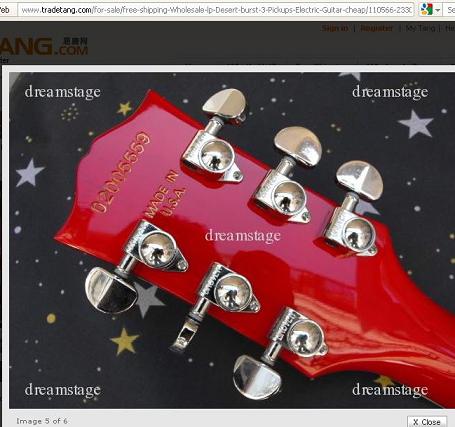
Clicking through to the site one gets a standard assortment of rock-bottom priced fakes of domestic Gibson gear.
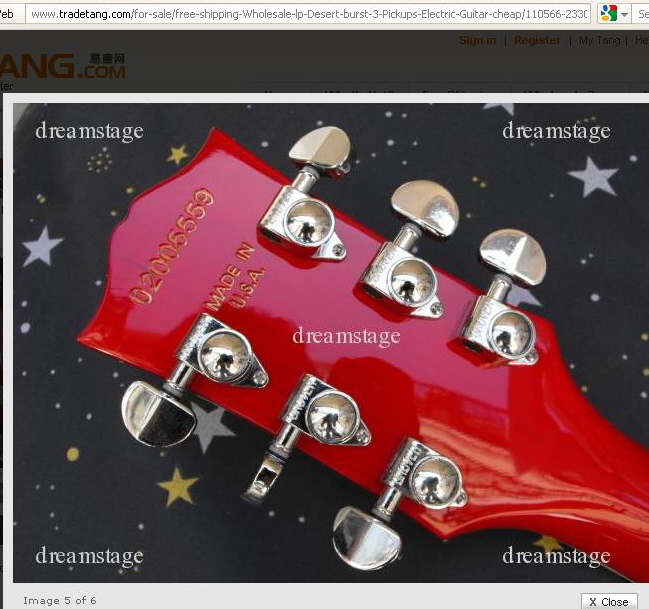
Again, here are two fresh examples, one labeled with a clear “Made In USA” marking on the headstock:
The technology of ad streaming makes it easy for these types of things to be everywhere. And it underlines the magnitude and the gravity of the problem faced by US guitar manufacturers.
Chasing this stuff around is whack-a-mole work and the resources simply don’t exist to combat it.
Futher, there’s no obvious control or correction mechanism in domestic net advertising to fight it.
My experience has shown US companies running this type of thing really don’t like hearing the news. They’d rather have the advertising dollars — even when the amount may be trivial — and for others to just shut up and not bother them over it.
After DD screwed up the plan for selling counterfeit guitars through the Washington Post ad feed last week — and I did screw it up a bit — Google property has now been enlisted.
The same Chinese-made “brand” guitar selling site now hitches to Google AdSense on YouTube, where they’re attached to guitar store demos.
I tipped Gibson’s legal department to the Post ads last week. But I’m done with the good Samaritan pro bono work.
Paul Reed Smith is never mentioned in the advertising. But all the models the ad links to are Paul Reed Smith steals.
The routine is identical. The guitars are photographed with obscured headstocks.
PRS guitars are top of the line, domestically. A number of years ago the company offshored some manufacturing to Korea and those models are called Paul Reed Smith SEs. They’re in the medium price range.
The Chinese-made counterfeits all sell in the same slots occupied in the Gibson funny business at the Post last week — the high 200 buck range.
Which is an entire order of magnitude cheaper than domestically made Paul Reed Smiths and about half the price of Korean-manufactured models.
And I’m done chasing this stuff around — for the time being. If the Post had to be hectored into doing the right thing. And then Google took up the slack, American guitar manufacturers are on their own.
Good luck stemming the tide when your countrymen work for the enemy.
Perhaps unsurprisingly to readers, the Washington Post (as of now) did not respond to a DD query on the banner ad it ran which pointed to sales for counterfeit US guitars made in China, trafficked on the Gibson brand name.
It’s the same thing you could access when you clicked through the Post ad last week. No American made Les Paul sells for the price advertised. Zero. Zip. Nada.
And, again, here is a video — one of many on YouTube — discussing Chinese made counterfeits. This is a significant problem for Gibson as well as other American manufacturers. And it is safe to say that it has grown beyond policing at the company level.
Postscript: You float on the Washington Post’s website enough and you’ll still catch the old ad sans the “Made in China” change. The Post simply won’t or can’t get rid of all of it although it’s become obvious a change someone had no original intention of making was made.